
Thailand Customs Digital Reform Spurs RFID Equipment Demand


Thailand Customs Department has launched a multi-year digital transformation initiative, driving new demand for compliant electronic labeling and RFID verification equipment among importers and logistics service providers. Though the exact start date of the reform rollout remains unspecified, its operational impact is already visible in recent platform-level adjustments—such as Lazada’s updated tariff handling—and in tightening regulatory expectations for low-value parcel traceability, e-labeling, and automated customs interfaces. The shift affects cross-border trade stakeholders across Southeast Asia, particularly those engaged in e-commerce fulfillment, electronics distribution, and consumer goods importation into Thailand.
Event Overview
The Royal Thai Customs Department is implementing its 2024–2027 Digital Transformation Strategy. As part of this plan, the annual Harmonized System (HS) code review has been integrated with platform-based tax collection mechanisms—exemplified by Lazada’s recent adjustment to its import duty calculation and withholding process. Concurrently, requirements for electronic labels (e-labels), real-time low-value parcel tracking, and standardized API-based customs declaration have been reinforced. This has accelerated procurement interest in smart label readers, RFID calibration and validation instruments, and barcode consistency testing devices that meet Thai regulatory specifications.
Industries Affected
Direct Trading Enterprises
Importers and cross-border e-commerce sellers operating in or targeting Thailand face increased compliance overhead. They must now ensure product labels—especially on electronics, cosmetics, and health products—carry machine-readable, Thai-language-compliant e-labels verified via certified RFID readers. Non-compliance risks delays at customs clearance or rejection of entire shipments, directly impacting order fulfillment timelines and customer satisfaction.
Raw Material Procurement Enterprises
Suppliers sourcing components or packaging materials for export to Thailand—including label film manufacturers, RFID inlay producers, and smart packaging integrators—must align their output with newly emphasized technical criteria: read range stability under Thai port environmental conditions, Thai-language metadata encoding standards, and interoperability with local customs APIs. Failure to pre-validate against these parameters may lead to downstream rejection by Thai importers.
Manufacturing Enterprises
Export-oriented manufacturers—particularly in consumer electronics, home appliances, and medical devices—now need to embed e-label capabilities earlier in production workflows. This includes firmware-level support for Thai customs data fields (e.g., importer ID, HS subheading, origin certification flags) and hardware-level compatibility with locally approved RFID readers. Retrofitting legacy lines incurs both capital and timeline costs, making early design-phase engagement with Thai compliance labs critical.
Supply Chain Service Providers
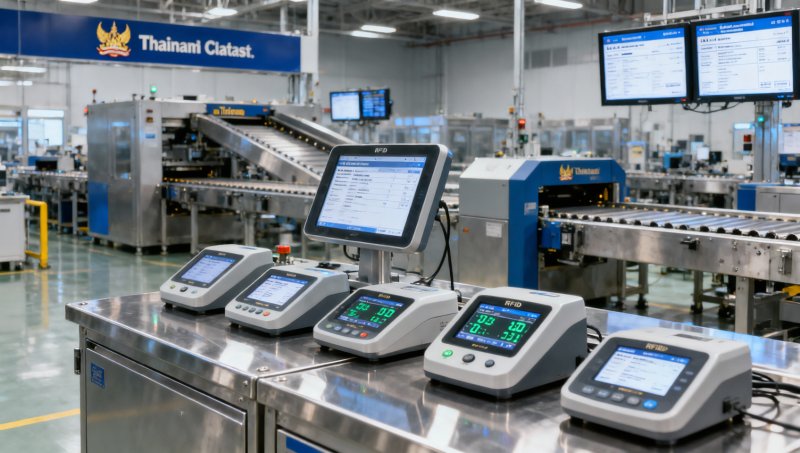
Third-party logistics (3PL) firms, customs brokers, and freight forwarders serving Thailand-bound cargo are upgrading infrastructure to support real-time e-label verification and API-driven declaration submission. Their investment focus has shifted toward integrating certified RFID test benches and automated barcode-e-label cross-check systems—not just for documentation but for pre-clearance quality assurance. Service differentiation now hinges on demonstrable local regulatory alignment, not just speed or cost.
Key Focus Areas & Recommended Actions
Validate Equipment Against Thai Customs Technical Specifications
Chinese manufacturers of RFID readers and label verification tools should prioritize obtaining TISI (Thai Industrial Standards Institute) pre-certification or partnering with accredited local labs. Testing must cover Thai-specific HS code mapping logic, Thai-language Unicode rendering in e-label payloads, and performance under high-humidity port conditions—factors not always addressed in CE or FCC testing scopes.
Localize Certification Support Services
Rather than shipping fully certified units from China, firms should establish on-the-ground technical liaison capacity in Bangkok or Chonburi. This enables faster response to Thai Customs’ ad hoc verification requests, supports importer training on device calibration, and facilitates joint audits with Thai importers—reducing time-to-market for new device models.
Align with Platform-Level Compliance Roadmaps
Since platforms like Lazada are now acting as tax withholding agents and enforcing e-label checks pre-shipment, equipment vendors should map their solutions to known platform API endpoints and data schema (e.g., required e-label XML/JSON fields, timestamping protocols). Co-developing integration modules with major Thai e-commerce enablers adds tangible value beyond hardware supply.
Editorial Insight / Industry Observation
Observably, Thailand’s move reflects a broader ASEAN trend—not toward harmonized regional standards, but toward nationally differentiated digital gatekeeping. Unlike Singapore’s unified TradeXchange platform or Vietnam’s single-window system, Thailand’s approach layers platform-specific obligations (e.g., Lazada’s rules) atop national infrastructure (e.g., Customs API). Analysis shows this creates higher fragmentation risk for multinationals: one device model may satisfy Lazada’s e-label reader spec but fail Shopee Thailand’s validation protocol. From an industry perspective, this makes modular, software-upgradable hardware more valuable than fixed-function devices—and favors vendors offering configurable firmware and localized API support over pure hardware exporters.
Conclusion
This digital reform is not merely a customs modernization effort—it signals Thailand’s strategic pivot toward controlling data sovereignty at the border. For global suppliers, it represents less a short-term compliance hurdle and more a structural recalibration: success will hinge on embedded local partnerships, adaptive hardware architecture, and continuous alignment with evolving platform-level enforcement—not just adherence to static technical standards.
Source Attribution
Official sources include the Royal Thai Customs Department’s 2024–2027 Digital Transformation Framework (published online, Thai language only); public notices issued by the Thai Revenue Department regarding e-commerce tax collection; and technical bulletins from the Thai Industrial Standards Institute (TISI) on RFID application standards for import documentation. Note: Specific e-label format guidelines and API authentication protocols remain under active revision—stakeholders should monitor TISI Circular No. TIS 1089/2567 (draft) and Customs Department Announcement No. 12/2567 for updates.
Recommended for You
 Brazil to Eliminate Import Duties on Cross-Border E-Commerce Orders Under USD 50Brazil to eliminate import duties on cross-border e-commerce orders under USD 50—key for portable testing instruments exporters targeting Mercado Livre & DIY buyers.
 New AI Agent Guidelines Impact Smart Inspection Device ExportsAI Agent Guidelines impact smart inspection device exports—learn how new China AI safety rules affect EU, US & Middle East market access.
 UPS Freight Rates Increase Effective May 17, 2026UPS freight rates increase effective May 17, 2026—impact FOB pricing for industrial monitoring equipment exporters. Act now to optimize packaging, revise quotes, and secure margins.
 新修订《海商法》施行:卸货港无人提货责任转向托运人,检测设备出口交期风控升级New Maritime Code shifts unclaimed cargo liability to shippers at discharge ports—critical for testing equipment exporters managing delivery timelines and compliance risk.
 China Imposes Zero Tariffs on Lab Analyzers for 20 African NationsChina's zero tariffs on lab analyzers for 20 African nations boost export competitiveness—pH meters, spectrophotometers & more now duty-free from May 2026.
 CA Toxic Chemical Tank Overheating Sparks Explosion Risk, Monitoring Equipment Orders SurgeGas leak detectors, remote temperature warning systems & explosion-proof thermal imagers surge in demand after CA toxic tank overheating incident.
 EU REACH Adds DBDPE to SVHC List, Impacting Brominated Flame Retardant Testing for Export EquipmentDBDPE added to EU REACH SVHC list—impact on brominated flame retardant testing for industrial instruments, sensors & export compliance. Act now.
 Thailand Customs Digital Reform Spurs RFID Equipment DemandRFID equipment demand surges in Thailand as Customs digital reform mandates e-labeling, real-time parcel tracking & API compliance—act now to meet TISI specs and platform rules.
 Lazada Thailand Cuts Import Duties on 528 CategoriesLazada Thailand cuts import duties on 528 categories — including wired headphones & notebooks — lowering costs for Chinese exporters and Thai SMEs via LGS.
 US Delays 400 Tomahawk Missiles to Japan Amid Iran Inventory ReplenishmentTomahawk missiles delay to Japan sparks urgent demand for alternative guidance, navigation & secure comms suppliers—key opportunity for export-ready defense electronics firms.
 What to Check Before Importing an F2 Concentration Analyzer in 2026F2 concentration analyzer import guide for 2026: learn what to check on compliance, performance, integration, lifecycle cost, and supplier support before you buy.
 SF6 Concentration Analyzer Market Trends for Power and Gas Applications in 2026SF6 concentration analyzer market trends for 2026: explore accuracy, digital integration, emissions control, and buying tips for power and gas applications.
 Common HCl Concentration Analyzer Mistakes That Lead to Unstable ReadingsHCl concentration analyzer unstable readings? Discover the most common installation, calibration, sampling, and maintenance mistakes—and the practical fixes that improve accuracy fast.
 H2S Concentration Analyzer Price Trends: What’s Driving Costs in 2026H2S concentration analyzer price trends in 2026: discover what drives costs, from sensor technology and compliance to materials and digital features, and make smarter buying decisions.
 How to Choose a Cl2 Concentration Analyzer for Process Safety in 2026Cl2 concentration analyzer selection in 2026 starts with process safety. Learn how to match scenarios, improve reliability, avoid costly mistakes, and choose with confidence.
 N2 Concentration Analyzer Cost Factors for Bulk Industrial ProcurementN2 concentration analyzer cost depends on more than unit price. Compare process, purity, and safety applications with total cost logic to source smarter and reduce lifecycle risk.
 Oxygen Concentration Analyzer vs Sensor Systems: Which Fits Continuous UseOxygen concentration analyzer or sensor system? Compare stability, drift, maintenance, and uptime for continuous use to choose the most reliable fit for your process.
 SO2 Concentration Analyzer News: Compliance Demands Reshaping Product SpecsSO2 concentration analyzer trends are shifting with stricter compliance rules. Learn how new specs, data integrity, and uptime demands are reshaping smarter buying decisions.
 He Concentration Analyzer Maintenance Tips for Stable Long-Term ReadingsHe concentration analyzer maintenance tips for stable long-term readings. Learn how to reduce drift, improve calibration accuracy, cut downtime, and keep industrial systems reliable.
 CH4 Concentration Analyzer Selection Mistakes That Raise Operating RiskCH4 concentration analyzer selection mistakes can raise safety, compliance, and maintenance risk. Learn how to choose the right analyzer for reliable performance and lower lifecycle cost.
 CO Concentration Analyzer Import Rules to Watch in 2026CO concentration analyzer import rules for 2026: learn the key customs, certification, labeling, and compliance checks to reduce risk, avoid delays, and source with confidence.
 NH3 Concentration Analyzer Market Trends for Industrial Process Control in 2026NH3 concentration analyzer market trends in 2026: explore technologies, industrial applications, selection tips, and how smarter monitoring improves compliance, safety, and process control.
 Ar Concentration Analyzer Accuracy Issues in High-Purity Gas ApplicationsAr concentration analyzer accuracy issues can compromise high-purity gas quality, safety, and compliance. Learn the key causes, practical fixes, and how to improve reliable measurement performance.
 CO2 Concentration Analyzer Price Trends in 2026: What Shapes Total CostCO2 concentration analyzer price trends in 2026 depend on technology, accuracy, calibration, compliance, and integration. Discover total cost drivers to compare quotes smarter and control lifecycle risk.
 How to Choose a NOX Concentration Analyzer for Low-Emission MonitoringNOX concentration analyzer selection for low-emission monitoring made easier. Learn how to compare accuracy, response time, compliance, and lifecycle cost before you buy.
 2026 Summit Highlights China's Smart Inspection Equipment as New Global Cooperation FocusSmart inspection equipment takes center stage at the 2026 Summit—unlocking new global cooperation, standards alignment, and market opportunities for exporters, OEMs, and tech suppliers.
 White House Warns Oil Shock May Fuel Core Inflation, Delaying Industrial Instrument ExportsWhite House warns oil shock may fuel core inflation—impacting industrial instrument exports. Discover how pressure, temperature & flow instrumentation exporters can mitigate delays and optimize trade finance workflows now.
 New AI Agent Guidelines Impact Export of AI-Powered Testing EquipmentAI agent guidelines impact export of AI-powered testing equipment—learn how new China security & controllability rules affect global compliance, supply chains, and market access.
 Canton Fair Phase III Boosts Sensor & Energy Testing ExportsSensor & energy testing exports surge at Canton Fair Phase III—driven by global demand for new energy home appliances and smart furniture compliance solutions.
 UAE Announces $150B Energy Infrastructure InvestmentUAE's $150B energy infrastructure push drives demand for IP68/IP69K, ATEX/IECEx, and LPWAN-enabled industrial sensors — act now to align with ADNOC tenders.
 WTI Net Longs Surge, Boosting Demand for Lubricant Monitoring SystemsLubricant monitoring systems surge in demand as WTI net longs rise—real-time viscosity, moisture & oxidation tracking now critical for global manufacturers.
 Shanghai Pudong Launches E-Label Pilot for Imported CosmeticsShanghai Pudong’s e-label pilot for imported cosmetics drives global demand for RFID/NFC readers, traceability solutions & certified testing equipment—act now to comply and lead.





















Search Categories
Search Categories
Latest Article
- Brazil to Eliminate Import Duties on Cross-Border E-Commerce Orders Under USD 50Brazil to eliminate import duties on cross-border e-commerce orders under USD 50—key for portable testing instruments exporters targeting Mercado Livre & DIY buyers.Posted by:
- New AI Agent Guidelines Impact Smart Inspection Device ExportsAI Agent Guidelines impact smart inspection device exports—learn how new China AI safety rules affect EU, US & Middle East market access.Posted by:
- UPS Freight Rates Increase Effective May 17, 2026UPS freight rates increase effective May 17, 2026—impact FOB pricing for industrial monitoring equipment exporters. Act now to optimize packaging, revise quotes, and secure margins.Posted by:
Please give us a message
