
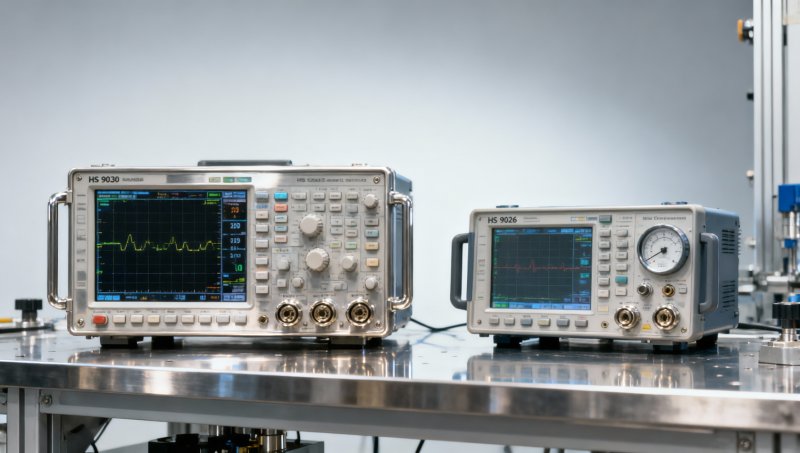
China Customs Launches Smart Classification Tool for HS 9026/9030 Instruments


On April 18, 2026, China Customs launched the ‘Instrument Export Smart Classification Assistant’, a new digital tool targeting exporters of measuring instruments (HS 9026) and detection/analysis equipment (HS 9030). The system directly affects manufacturers, exporters, and compliance teams in precision instrumentation, industrial automation, environmental monitoring, medical device testing, and laboratory equipment supply chains — where accurate HS coding is critical for customs clearance, tariff application, and preferential trade agreement utilization.
Event Overview
China Customs officially deployed the ‘Instrument Export Smart Classification Assistant’ on April 18, 2026. The system covers all subheadings under HS codes 9026 (measuring, checking, testing, navigating and control instruments) and 9030 (oscilloscopes, spectrum analyzers, and other instruments for measuring or detecting electrical quantities or for signal analysis). It supports automated HS code matching based on uploaded technical documentation, generates classification rationale reports, and provides RCEP and other FTA-origin recommendations. Following implementation, first-time submission pass rates for covered goods rose to 99.1%, and average reprocessing time for returned declarations fell to 1.2 working days.
Industries Affected by This Update
Direct Exporters (OEMs, Brand Holders, Trading Companies)
These entities file export declarations and bear primary responsibility for HS code accuracy. Misclassification historically triggered delays, penalties, or origin-related tariff disadvantages — especially under RCEP rules of origin requiring precise 6-digit or finer coding. The assistant reduces manual interpretation risk and improves consistency across filings, particularly for complex multi-function devices falling across overlapping subheadings.
Manufacturers & Assemblers (Including Contract Manufacturers)
Product design documentation now serves dual purposes: internal quality control and external classification input. With the system relying on technical specs (e.g., measurement range, principle of operation, intended use), manufacturers must ensure documentation clearly articulates functional distinctions that determine subheading placement — e.g., whether a sensor qualifies as a ‘measuring instrument’ (9026) or a ‘component’ (often 8543/8536).
Supply Chain & Compliance Service Providers (Customs Brokers, Trade Consultants)
Service providers face reduced demand for basic code verification but increased need for upstream engagement — helping clients prepare compliant technical dossiers and interpret system-generated rationale. Their role shifts toward advisory support on documentation standards and cross-border regulatory alignment, rather than post-hoc code correction.
What Enterprises and Practitioners Should Monitor and Do Now
Track official guidance on documentation requirements
While the system accepts technical documents, China Customs has not publicly specified minimum content or format standards. Exporters should monitor upcoming notices — particularly any requirement for standardized test reports, user manuals, or functional descriptions — to avoid auto-rejection due to incomplete uploads.
Validate coverage scope before scaling usage
The tool currently applies only to HS 9026 and 9030. Exporters handling related but excluded items — such as data loggers (8543), industrial controllers (9032), or calibration standards (9033) — must continue using traditional classification methods. Confirming product alignment with the defined scope prevents false assumptions about automation readiness.
Distinguish between system output and binding classification
The assistant’s generated code and rationale are advisory, not legally binding. Final determination remains subject to Customs review. Exporters should retain full documentation trails and treat system outputs as pre-submission checks — not substitutes for internal classification governance or audit readiness.
Update internal SOPs for technical document management
Teams responsible for export compliance should integrate technical documentation preparation into early-stage product development workflows. Standardizing naming conventions, version control, and metadata (e.g., intended use, measurement parameters) will improve upload reliability and reduce rework when submitting to the assistant.
Editorial Perspective / Industry Observation
From an industry perspective, this rollout signals a shift from reactive compliance to structured, documentation-driven classification — one aligned with global trends in automated trade facilitation (e.g., EU’s TARIC AI pilots, Singapore’s TradeXchange enhancements). However, it remains an operational aid, not a regulatory relaxation: accuracy still hinges on data quality and human oversight. Observation suggests its current value lies less in replacing expertise and more in standardizing inputs and surfacing ambiguities earlier — making it a process efficiency tool rather than a decision delegation mechanism. Continued monitoring is warranted for potential expansion to adjacent HS chapters or integration with electronic certificates of origin.
In summary, the launch reflects a concrete step toward digitized, evidence-based export classification for high-precision instruments — delivering measurable gains in filing efficiency but demanding greater discipline in technical documentation practices. It is best understood not as a policy change, but as a capability upgrade requiring alignment across engineering, compliance, and logistics functions.
Source: China Customs General Administration (official announcement, April 18, 2026).
Note: Expansion beyond HS 9026/9030, integration with other platforms (e.g., single window), and formal documentation guidelines remain pending official updates and are under ongoing observation.
Recommended for You
 How to choose the right detection range for a custom gas analyzerChoose the right custom gas analyzer detection range with practical guidance on accuracy, exposure limits, calibration, and supplier evaluation.
 How does multi component monitoring detect gases in stack emissions?Discover how multi component monitoring detects stack gases, manages interference and supports reliable emissions reporting. Explore key CEMS selection factors.
 How bright should an industrial monitor be for outdoor use?Choosing an outdoor industrial monitor? Learn why 1,000 nits is a starting point and how glare, contrast, and heat affect sunlight readability.
 How does water vapor affect infrared gas analyzers?Infrared gas analyzers can be affected by humidity, condensation and spectral interference. Learn how to protect sample integrity and achieve reliable results.
 How to reduce customer support response timesReduce Customer Support response times with actionable tips for reporting equipment faults, choosing the right channel, and getting expert help faster.
 How to choose a low range analyzer for trace-level measurementsChoose the right low range analyzer for trace-level measurements. Compare detection limits, sampling, calibration and support to make a confident decision.
 How to choose combustible gas detectors for a specific gasChoose combustible gas detectors with confidence. Compare sensor technologies, gas response, calibration, placement, and certification for your application.
 How to choose an air quality analyzer for the pollutants you need to measureChoose an air quality analyzer with confidence. Compare pollutant measurement methods, sampling, accuracy and calibration to find the right fit for your needs.
 How to choose industrial metrology tools for tight tolerancesChoose industrial metrology tools for tight tolerances with confidence. Compare uncertainty, calibration, tool types, and costs to reduce inspection risk.
 How moisture affects fixed analyzer accuracy in stack gas monitoringImprove fixed analyzer accuracy in stack gas monitoring. Discover how moisture causes dilution, interference, and sample loss—and learn practical ways to protect emissions data.
 How does production line speed affect in-line measurement accuracy?Discover how production line speed affects in-line measurement accuracy. Explore sensor response, sampling, and timing to boost throughput without compromising quality.
 How condensation affects HCl concentration analyzer accuracyHCl concentration analyzer accuracy can suffer when condensation traps HCl. Learn how to spot sampling losses, prevent low readings, and improve measurement reliability.
 How does cross-interference affect multi-component gas analyzers?How does cross-interference affect multi component gas analyzers? Explore measurement errors, compensation limits, and validation tips to choose the right system for your process.
 How does temperature affect high-accuracy sensor performance?Explore how temperature affects high accuracy sensor performance. Learn to reduce thermal drift, evaluate compensation, and select the right sensor for reliable measurements.
 Can a C4H8O concentration analyzer distinguish between isomers?Can a C4H8O concentration analyzer distinguish isomers? Compare GC, FTIR and MS methods, uncover selectivity limits, and learn what to validate before choosing your instrument.
 How to identify a reliable supplier using on-time delivery recordsIdentify a Reliable Supplier by verifying on-time delivery records, original commitments, and complete shipments. Learn practical checks to reduce purchasing risk and protect your project schedule.
 How sensitive should a portable hydrogen analyzer be for lab use?Choose a portable hydrogen analyzer for laboratory use with the right quantification limit, accuracy, and range. Learn how to verify performance and avoid costly buying mistakes.
 How to set industrial calibration intervals based on equipment riskSet industrial calibration intervals based on equipment risk, drift, and as-found data. Learn when to shorten or extend schedules to improve reliability and avoid unnecessary costs.
 How to choose electrochemical analyzers for low-current measurementsCompare electrochemical analyzers for precise low-current measurements. Learn how noise, leakage, bandwidth, and real-cell testing help you choose the right instrument.
 What tolerance does a custom gas mixture need for calibration?Choose the right custom gas tolerance for calibration. Learn how blending tolerance, certified uncertainty, and stability affect accuracy—and avoid paying for precision you don’t need.
 How condensation affects stack detector readings in wet flue gasStack detector readings can drift when wet flue gas condenses. Learn how to identify moisture interference, prevent sample losses, and improve emissions monitoring reliability.
 How to prevent condensation in a CO2 analyzer sampling systemPrevent condensation in your CO2 analyzer sampling system. Learn how to control dew point, eliminate cold spots, and manage moisture for reliable readings and fewer costly disruptions.
 How to verify accuracy claims for industrial quality analyzersVerify accuracy claims for industrial quality analyzers with calibration checks, independent testing, and clear acceptance criteria. Learn how to reduce risk and buy with confidence.
 How to calculate cooling loads for an industrial analyzer shelterSize industrial analyzer shelter cooling with confidence. Learn to calculate equipment heat, solar gains, and ventilation loads, then select HVAC capacity for reliable analyzer performance.
 Hydrogen Analyzers for Energy Storage: Purity Monitoring vs. Leak DetectionChoosing a hydrogen analyzer for energy storage systems? Compare purity monitoring and leak detection to select the right sensors, improve safety, and protect fuel cell performance.
 NH3 Monitoring in Fertilizer Plants: Where Should Leak Analyzers Be Installed?NH3 analyzer for fertilizer production: discover where to place leak detectors around storage, compressors, and loading areas to reduce blind spots and improve early warning.
 Diesel Engine NOx Analyzers: Response Time and NO2 Conversion ExplainedChoosing a NOX analyzer for diesel engines? Learn how response time, NO2 conversion, and sampling design affect accuracy—and make a smarter, evidence-based purchase.
 SO2 Analyzers for Smelter Emissions: Sampling Hot, Dust-Laden Flue GasSelect an SO2 analyzer for smelting industry applications. Discover how to handle hot, dust-laden flue gas, prevent sample losses, and achieve reliable emissions monitoring.
 Unstable CH4 Readings in Biogas Monitoring? Check Moisture and Sample FlowCH4 analyzer for biogas monitoring giving unstable readings? Discover how moisture, sample flow, and pressure checks help pinpoint faults and restore reliable methane measurements.
 Buying a CO2 Analyzer for Brewery Gas Recovery: Costs Beyond the Purchase PriceBuying a CO2 analyzer for brewery applications? Compare sampling, installation, calibration, and downtime costs to uncover hidden expenses and make a smarter gas recovery investment.
 Where to Place CO Analyzers for Effective Parking Garage VentilationOptimize your CO analyzer for parking garage ventilation with practical placement tips. Learn how sensor height, airflow, and zone coverage support timely detection and effective fan control.
 NDIR vs. FTIR Gas Analyzers: Which Fits Your Environmental Research?Find the right infrared gas analyzer for environmental research. Compare NDIR vs. FTIR on sensitivity, gas coverage, sampling needs, and cost to choose confidently for your study.




Search Categories
Search Categories
- Smart Meters & Power Quality
- Transformer Gas Analyzers
- BESS Thermal Runaway Detectors
- Energy, Power & Smart Grid Monitoring
- Optical Profilers & CMM
- Ultrasonic & X-Ray NDT
- Calibration Standards
- Precision Metrology & NDT
- Water Quality Analyzers
- CEMS & VOCs Monitors
- Price Trends
- Import & Export Updates
- Market Trends
- Industry News
- Industry Insights
Latest Article
- How to choose the right detection range for a custom gas analyzerChoose the right custom gas analyzer detection range with practical guidance on accuracy, exposure limits, calibration, and supplier evaluation.Posted by:
- How does multi component monitoring detect gases in stack emissions?Discover how multi component monitoring detects stack gases, manages interference and supports reliable emissions reporting. Explore key CEMS selection factors.Posted by:
- How bright should an industrial monitor be for outdoor use?Choosing an outdoor industrial monitor? Learn why 1,000 nits is a starting point and how glare, contrast, and heat affect sunlight readability.Posted by:
Please give us a message
