
How to identify a reliable supplier using on-time delivery records


A competitive quote means little if critical instruments arrive after your commissioning deadline. For procurement professionals, identifying a reliable supplier starts with examining on-time delivery records—not accepting headline percentages at face value. Were deliveries measured against original commitments or revised dates? Did complete, usable orders arrive, or only partial shipments?
These distinctions matter whether you are buying process transmitters, laboratory analyzers, or calibration equipment. A delivery report should reveal whether a supplier can protect your operating schedule, not simply whether its warehouse shipped something. The following checks turn delivery history into evidence you can use when shortlisting vendors, negotiating terms, and deciding how much business to award.
Before trusting the percentage, establish what “on time” means
Two suppliers can both report 96% on-time delivery while creating very different procurement risks. One measures arrival at your receiving dock against its original commitment. Another measures dispatch against a delivery date that its sales team can revise. Their figures are not directly comparable.
Ask each candidate to define these elements in writing:
- The delivery event: factory dispatch, carrier collection, arrival at the agreed destination, or another contractual milestone.
- The reference date: your requested date, the supplier’s original confirmed date, or its latest revised promise.
- The measurement unit: purchase order, order line, scheduled release, or individual unit.
- The permitted window: whether early deliveries qualify and whether any grace period applies.
- The exclusions: customer holds, cancellations, transport disruption, and other exceptions.
Use the agreed contractual milestone when assessing supplier execution. If the supplier’s responsibility ends at dispatch, do not quietly treat dispatch performance as evidence of arrival reliability. Evaluate the remaining transport stages separately, because your project still depends on the equipment reaching its destination.
Preserve both requested and originally confirmed dates
The requested date shows whether a supplier can meet your business need. The original confirmed date shows whether it keeps its own promise. Track both. A manufacturer that consistently delivers within its quoted twelve-week lead time may be dependable, but unsuitable for a project needing equipment in eight weeks.
Revised dates remain useful for operational planning, but they should not overwrite the historical baseline. Otherwise, repeatedly postponing commitments can make poor delivery performance look excellent.
Request records that can be checked, not just a dashboard
A presentation slide is a starting point, not proof. Request an anonymized transaction-level export covering a representative period—often twelve months, extended where order volumes are low or seasonality matters. Recent monthly results should remain visible so older performance does not hide deterioration.
The minimum useful dataset includes purchase order and line identifiers, product family, quantities, order acceptance date, requested date, original confirmed date, revised dates, actual milestone dates, and exception reasons. Where confidentiality prevents full disclosure, propose a redacted sample reviewed under a nondisclosure agreement.
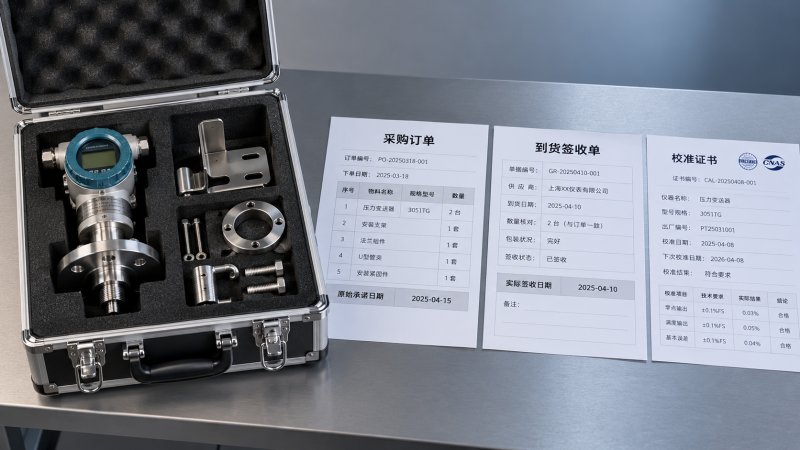
Trace selected entries through the underlying documents:
Select both random transactions and risk-based examples: late orders, partial shipments, month-end deliveries, and unusually short lead times. Ask for a reconciliation between the transaction sample and the headline report. A supplier need not disclose other customers’ identities to demonstrate that its calculation is reproducible.
Include orders due during the reporting period that remain open. A report covering only completed deliveries can omit the most overdue orders. Future-due orders should not enter the denominator prematurely, while cancellations and customer holds need transparent, consistent treatment.
Use three delivery measures instead of one flattering average
A useful assessment combines promise-keeping, completeness, and delay severity. No single percentage captures all three.
1. Original-commitment on-time delivery
OTD = obligations delivered by the original agreed deadline ÷ total obligations due in the period × 100.
Define “obligation” consistently: an order, line, or scheduled release. If measuring by line, establish how split quantities are handled. Counting a line as on time because its first unit arrived can conceal a substantial shortfall.
2. On-time, in-full delivery
OTIF = obligations delivered on time and in the full agreed quantity ÷ total obligations due in the period × 100.
For instrumentation, add a separate readiness check for required accessories, correct configurations, and agreed documentation. A pressure transmitter delivered without a specified mounting component or required calibration certificate may be physically present but unavailable for installation. Do not silently redefine a supplier’s standard OTIF figure; document your additional acceptance criteria explicitly.
3. Delay severity and overdue exposure
Ask for median lateness, a high-percentile delay such as the 90th percentile, and the longest delay. Specify whether these statistics cover late deliveries only. Also review the number and age of currently overdue obligations.
A supplier whose misses are usually one day late presents a different risk from one whose misses routinely extend several weeks. An average can hide that difference, especially when early deliveries offset late deliveries in a net calculation.
Consider this hypothetical comparison: Supplier A delivers 95 of 100 due orders on time, but its five misses are three weeks late. Supplier B delivers 94 on time, with six misses of one or two days. Neither is automatically better; the right choice depends on your schedule buffer and the consequences of interruption.
Compare the orders that resemble your purchase
Company-wide performance can be misleading when it combines stocked consumables with engineered systems. A strong overall record says little about a customized analyzer requiring application review, factory testing, and specialist components.
Segment the evidence by the factors that actually influence your order:
- Product and configuration: standard stocked instruments versus configured or engineered-to-order equipment.
- Order scale: individual replacements versus project packages with many interdependent lines.
- Production location: the factory or subcontractor responsible for your equipment.
- Delivery route: destination, shipping method, customs exposure, and agreed responsibilities.
- Demand conditions: routine replenishment versus shutdown seasons or demand spikes.
For an explosion-protected transmitter, look for comparable configurations and documentation requirements, not merely deliveries of the supplier’s general-purpose models. For laboratory systems, distinguish physical delivery from installation and qualification milestones where those services form part of the contract.
Always display the sample size beside the percentage. Ten successful orders provide less evidence of repeatability than hundreds of comparable deliveries across changing conditions. A small sample is not proof of unreliability, but it calls for a smaller initial award and closer monitoring.
Read the pattern behind each missed commitment
The explanation for lateness matters most when it reveals whether the next order is exposed to the same problem. “Material shortage” is not a complete root-cause analysis. Which component was unavailable? Was the shortage foreseeable? What changed in planning, sourcing, or inventory afterward?
Watch for recurring late deliveries linked to calibration capacity, electronic assemblies, specialist sensors, final testing, or export documentation. These patterns can reveal bottlenecks that a high-level capacity statement misses.
Several behaviors deserve particular attention:
- Delivery dates repeatedly move shortly before they are due.
- Partial shipments increase while reported OTD remains unchanged.
- Performance weakens during busy periods without a credible capacity response.
- Expedited freight is routinely needed to meet ordinary commitments.
- Exceptions are broadly labeled “customer delay” without supporting change records.
Evaluate communication alongside the outcome. A warning issued early enough to arrange an alternative is more useful than an apology after the deadline. Request examples showing when the supplier identified a risk, notified the buyer, and proposed a workable recovery plan.
Separate responsibility from exposure. A customer-approved specification change should not be treated as supplier failure. Conversely, an external transport disruption may fall outside the supplier’s direct control but still reveal weaknesses in contingency planning. Keep both the unadjusted operational result and any justified adjusted measure visible.
Turn delivery evidence into a supplier selection decision
There is no universal OTD threshold that makes every supplier acceptable. A routine maintenance item with local backup stock can tolerate different risk from a single-source analyzer needed for plant startup.
Set acceptance criteria before reviewing competing bids. This reduces the temptation to excuse weak records because a quotation is attractive. A practical assessment should answer five questions:
- Can the figures be reproduced? Definitions, source records, and exclusions must be clear.
- Does the history match our order? Relevant product, plant, and route data should support the decision.
- Are misses tolerable? Evaluate completeness and delay severity against your operating needs.
- Is performance stable? Review recent trends and unresolved bottlenecks.
- Does the supplier manage problems credibly? Look for early warnings and evidenced corrective action.
For a critical purchase, unverifiable records or unexplained date changes may justify withholding approval regardless of price. Where evidence is credible but limited, consider conditional approval: a trial order, staged allocation, additional buffer, or a qualified alternative source.
Delivery history should sit alongside technical suitability, quality performance, financial resilience, and applicable compliance evidence. ISO/IEC 17025 laboratory accreditation, for example, can be relevant to calibration competence within its accredited scope; it does not establish delivery reliability.
For instrumentation buyers using Global Instrument Hub’s supplier research, the same distinction is essential: technical capability and delivery dependability are separate questions. Strong sourcing decisions require evidence for both.
Make the next order part of the evidence
Before awarding business, translate the assessment into purchase-order requirements. Define the delivery milestone, agreed window, complete-delivery criteria, required documents, and escalation contacts. Record the original commitment separately from subsequent planning updates.
For long-lead equipment, agree meaningful progress checkpoints such as design approval, critical-component availability, factory testing, and readiness for dispatch. Avoid requesting frequent status reports that offer no evidence of actual progress.
Then compare actual results with the promises that won the order. A reliable supplier is not simply one with an impressive historical percentage. It is one whose records withstand scrutiny, whose performance fits your application, and whose response to emerging problems gives your team time to act.
The strongest purchasing question is therefore not “What is your on-time delivery rate?” It is: “Show us how comparable orders performed against their original commitments, including incomplete and overdue orders—and explain what that means for ours.”
Recommended for You
 How does multi component monitoring detect gases in stack emissions?Discover how multi component monitoring detects stack gases, manages interference and supports reliable emissions reporting. Explore key CEMS selection factors.
 How bright should an industrial monitor be for outdoor use?Choosing an outdoor industrial monitor? Learn why 1,000 nits is a starting point and how glare, contrast, and heat affect sunlight readability.
 How does water vapor affect infrared gas analyzers?Infrared gas analyzers can be affected by humidity, condensation and spectral interference. Learn how to protect sample integrity and achieve reliable results.
 How to reduce customer support response timesReduce Customer Support response times with actionable tips for reporting equipment faults, choosing the right channel, and getting expert help faster.
 How to choose a low range analyzer for trace-level measurementsChoose the right low range analyzer for trace-level measurements. Compare detection limits, sampling, calibration and support to make a confident decision.
 How to choose combustible gas detectors for a specific gasChoose combustible gas detectors with confidence. Compare sensor technologies, gas response, calibration, placement, and certification for your application.
 How to choose an air quality analyzer for the pollutants you need to measureChoose an air quality analyzer with confidence. Compare pollutant measurement methods, sampling, accuracy and calibration to find the right fit for your needs.
 How to choose industrial metrology tools for tight tolerancesChoose industrial metrology tools for tight tolerances with confidence. Compare uncertainty, calibration, tool types, and costs to reduce inspection risk.
 How moisture affects fixed analyzer accuracy in stack gas monitoringImprove fixed analyzer accuracy in stack gas monitoring. Discover how moisture causes dilution, interference, and sample loss—and learn practical ways to protect emissions data.
 How does production line speed affect in-line measurement accuracy?Discover how production line speed affects in-line measurement accuracy. Explore sensor response, sampling, and timing to boost throughput without compromising quality.
 How condensation affects HCl concentration analyzer accuracyHCl concentration analyzer accuracy can suffer when condensation traps HCl. Learn how to spot sampling losses, prevent low readings, and improve measurement reliability.
 How does cross-interference affect multi-component gas analyzers?How does cross-interference affect multi component gas analyzers? Explore measurement errors, compensation limits, and validation tips to choose the right system for your process.
 How does temperature affect high-accuracy sensor performance?Explore how temperature affects high accuracy sensor performance. Learn to reduce thermal drift, evaluate compensation, and select the right sensor for reliable measurements.
 Can a C4H8O concentration analyzer distinguish between isomers?Can a C4H8O concentration analyzer distinguish isomers? Compare GC, FTIR and MS methods, uncover selectivity limits, and learn what to validate before choosing your instrument.
 How to identify a reliable supplier using on-time delivery recordsIdentify a Reliable Supplier by verifying on-time delivery records, original commitments, and complete shipments. Learn practical checks to reduce purchasing risk and protect your project schedule.
 How sensitive should a portable hydrogen analyzer be for lab use?Choose a portable hydrogen analyzer for laboratory use with the right quantification limit, accuracy, and range. Learn how to verify performance and avoid costly buying mistakes.
 How to set industrial calibration intervals based on equipment riskSet industrial calibration intervals based on equipment risk, drift, and as-found data. Learn when to shorten or extend schedules to improve reliability and avoid unnecessary costs.
 How to choose electrochemical analyzers for low-current measurementsCompare electrochemical analyzers for precise low-current measurements. Learn how noise, leakage, bandwidth, and real-cell testing help you choose the right instrument.
 What tolerance does a custom gas mixture need for calibration?Choose the right custom gas tolerance for calibration. Learn how blending tolerance, certified uncertainty, and stability affect accuracy—and avoid paying for precision you don’t need.
 How condensation affects stack detector readings in wet flue gasStack detector readings can drift when wet flue gas condenses. Learn how to identify moisture interference, prevent sample losses, and improve emissions monitoring reliability.
 How to prevent condensation in a CO2 analyzer sampling systemPrevent condensation in your CO2 analyzer sampling system. Learn how to control dew point, eliminate cold spots, and manage moisture for reliable readings and fewer costly disruptions.
 How to verify accuracy claims for industrial quality analyzersVerify accuracy claims for industrial quality analyzers with calibration checks, independent testing, and clear acceptance criteria. Learn how to reduce risk and buy with confidence.
 How to calculate cooling loads for an industrial analyzer shelterSize industrial analyzer shelter cooling with confidence. Learn to calculate equipment heat, solar gains, and ventilation loads, then select HVAC capacity for reliable analyzer performance.
 Hydrogen Analyzers for Energy Storage: Purity Monitoring vs. Leak DetectionChoosing a hydrogen analyzer for energy storage systems? Compare purity monitoring and leak detection to select the right sensors, improve safety, and protect fuel cell performance.
 NH3 Monitoring in Fertilizer Plants: Where Should Leak Analyzers Be Installed?NH3 analyzer for fertilizer production: discover where to place leak detectors around storage, compressors, and loading areas to reduce blind spots and improve early warning.
 Diesel Engine NOx Analyzers: Response Time and NO2 Conversion ExplainedChoosing a NOX analyzer for diesel engines? Learn how response time, NO2 conversion, and sampling design affect accuracy—and make a smarter, evidence-based purchase.
 SO2 Analyzers for Smelter Emissions: Sampling Hot, Dust-Laden Flue GasSelect an SO2 analyzer for smelting industry applications. Discover how to handle hot, dust-laden flue gas, prevent sample losses, and achieve reliable emissions monitoring.
 Unstable CH4 Readings in Biogas Monitoring? Check Moisture and Sample FlowCH4 analyzer for biogas monitoring giving unstable readings? Discover how moisture, sample flow, and pressure checks help pinpoint faults and restore reliable methane measurements.
 Buying a CO2 Analyzer for Brewery Gas Recovery: Costs Beyond the Purchase PriceBuying a CO2 analyzer for brewery applications? Compare sampling, installation, calibration, and downtime costs to uncover hidden expenses and make a smarter gas recovery investment.
 Where to Place CO Analyzers for Effective Parking Garage VentilationOptimize your CO analyzer for parking garage ventilation with practical placement tips. Learn how sensor height, airflow, and zone coverage support timely detection and effective fan control.
 NDIR vs. FTIR Gas Analyzers: Which Fits Your Environmental Research?Find the right infrared gas analyzer for environmental research. Compare NDIR vs. FTIR on sensitivity, gas coverage, sampling needs, and cost to choose confidently for your study.
 Oxygen Analyzers for Diving: Calibration Checks Before Nitrox BlendingUsing an oxygen analyzer for diving applications? Discover essential calibration, sensor, and sampling checks before nitrox blending to support reliable readings.




Search Categories
Search Categories
- Smart Meters & Power Quality
- Transformer Gas Analyzers
- BESS Thermal Runaway Detectors
- Energy, Power & Smart Grid Monitoring
- Optical Profilers & CMM
- Ultrasonic & X-Ray NDT
- Calibration Standards
- Precision Metrology & NDT
- Water Quality Analyzers
- CEMS & VOCs Monitors
- Price Trends
- Import & Export Updates
- Market Trends
- Industry News
- Industry Insights
Latest Article
- How does multi component monitoring detect gases in stack emissions?Discover how multi component monitoring detects stack gases, manages interference and supports reliable emissions reporting. Explore key CEMS selection factors.Posted by:
- How bright should an industrial monitor be for outdoor use?Choosing an outdoor industrial monitor? Learn why 1,000 nits is a starting point and how glare, contrast, and heat affect sunlight readability.Posted by:
- How does water vapor affect infrared gas analyzers?Infrared gas analyzers can be affected by humidity, condensation and spectral interference. Learn how to protect sample integrity and achieve reliable results.Posted by:
Please give us a message
