
Germany Enforces New EMC Standard EN IEC 61000-6-4:2026


On 15 May 2026, Germany implemented the updated electromagnetic compatibility (EMC) harmonised standard EN IEC 61000-6-4:2026, introducing mandatory radiated emission limits for AI-powered industrial edge sensors, smart meters, and online monitoring terminals for the first time. This development directly affects manufacturers and exporters of instrumentation, industrial automation equipment, and related embedded systems from China seeking market access in the EU — non-compliant products may face customs delays or exclusion from the EU market.
Event Overview
Germany formally adopted EN IEC 61000-6-4:2026 as a harmonised standard under the EU EMC Directive on 15 May 2026. The standard specifies radiated emission limits for industrial, scientific, and medical (ISM) equipment, and for the first time explicitly includes AI-driven edge devices such as industrial edge sensors, intelligent utility meters, and real-time online monitoring terminals within its scope of mandatory compliance. No further official amendments or transitional provisions beyond this date have been publicly confirmed.
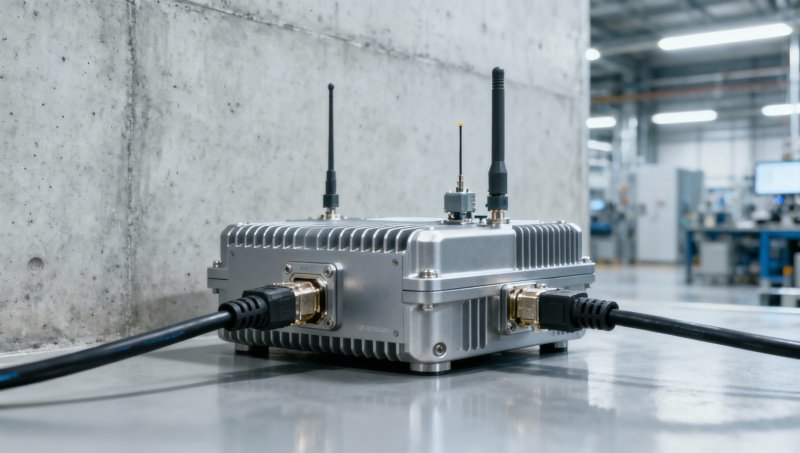
Industries Affected by Sector
Direct Exporters (Instrumentation & Industrial Automation Equipment)
These enterprises supply finished devices to EU importers or distributors. They are affected because EN IEC 61000-6-4:2026 is now a recognised basis for presumption of conformity under the EU EMC Directive. Products placed on the EU market after 15 May 2026 must demonstrate compliance with this version to obtain CE marking — legacy test reports based on earlier editions (e.g., EN IEC 61000-6-4:2019) no longer suffice for new product introductions.
Original Equipment Manufacturers (OEMs) Integrating Edge Sensors or AI Modules
OEMs embedding AI-enabled sensing or processing units into larger systems (e.g., PLC-based control cabinets, SCADA-integrated field devices) are affected because subsystem-level emissions now contribute to overall system-level compliance. Radiated emissions from integrated edge hardware must be assessed under the new limits, potentially requiring redesign or shielding upgrades even if the host system previously passed older standards.
Contract Manufacturers & Electronics Assembly Providers
These providers produce PCBAs or fully assembled units for export-oriented clients. They are affected because pre-compliance testing and layout decisions (e.g., clock routing, power plane design, enclosure aperture management) must now align with the updated radiated emission thresholds applicable to AI-edge functionality — particularly in the 1 GHz–6 GHz range where AI inference accelerators and wireless co-location generate higher broadband noise.
What Relevant Enterprises or Practitioners Should Focus On and How to Respond
Verify applicability of the new standard to current and upcoming product families
Confirm whether existing or planned products incorporate AI-driven edge processing, real-time adaptive sensing, or embedded wireless connectivity (e.g., Wi-Fi 6E, sub-GHz LoRaWAN + AI inference). If so, EN IEC 61000-6-4:2026 applies — regardless of whether the device was previously certified under earlier versions.
Review test reports and certification documentation issued before 15 May 2026
Reports referencing EN IEC 61000-6-4:2019 or earlier editions do not cover the expanded scope and revised measurement methodology in the 2026 edition. Do not assume grandfathering; retesting or gap analysis against EN IEC 61000-6-4:2026 is required for new declarations of conformity.
Engage accredited EMC test laboratories early for pre-compliance screening
Accredited labs in China and EU member states are updating test setups to reflect the 2026 edition’s requirements — including revised antenna calibration procedures, extended frequency ranges, and updated uncertainty budgets. Initiate pre-compliance assessments now to identify design adjustments before formal certification.
Update technical documentation and EU Responsible Person coordination
Technical files must include evidence of compliance with EN IEC 61000-6-4:2026, including risk assessments addressing AI-induced transient emissions and thermal modulation effects. EU Authorised Representatives must be informed and provided with updated EU Declarations of Conformity reflecting this standard.
Editorial Perspective / Industry Observation
Observably, this update signals a structural shift in how regulatory frameworks treat AI-integrated hardware — moving from treating intelligence as software-only to recognising its tangible electromagnetic impact at the physical layer. Analysis shows the inclusion of edge AI devices is not merely an incremental revision but reflects growing concern over spectral congestion and interoperability risks in dense industrial IoT deployments. From an industry perspective, EN IEC 61000-6-4:2026 functions less as a standalone compliance checkpoint and more as an early indicator of broader integration requirements expected across future EU digital product regulations. Current implementation remains limited to Germany’s enforcement action, but given its status as a harmonised standard, adoption across other EU member states is highly probable — though formal transposition timelines remain unconfirmed.
Current more suitable interpretation is that this is a policy signal with near-term operational consequences: it confirms that AI’s physical-layer behaviour is now subject to regulatory scrutiny, and that product developers can no longer treat AI acceleration as a ‘black box’ insulated from EMC design considerations.
In summary, EN IEC 61000-6-4:2026 marks a material change in the baseline expectations for electromagnetic integrity of AI-enhanced industrial equipment entering the EU. Its significance lies not only in updated numerical limits but in the formal recognition of AI-driven hardware as an active EMC source — a development requiring cross-functional alignment between firmware, hardware, and compliance teams. At present, this should be understood as an enforceable requirement for new product introductions post-15 May 2026, rather than a distant regulatory horizon.
Source: Official German Federal Ministry for Economic Affairs and Climate Action (BMWK) notification dated 15 May 2026; CENELEC publication record for EN IEC 61000-6-4:2026; EU Commission’s Official Journal reference pending confirmation. Note: Full transposition status across all EU Member States remains under observation.
Recommended for You
 How to choose the right detection range for a custom gas analyzerChoose the right custom gas analyzer detection range with practical guidance on accuracy, exposure limits, calibration, and supplier evaluation.
 How does multi component monitoring detect gases in stack emissions?Discover how multi component monitoring detects stack gases, manages interference and supports reliable emissions reporting. Explore key CEMS selection factors.
 How bright should an industrial monitor be for outdoor use?Choosing an outdoor industrial monitor? Learn why 1,000 nits is a starting point and how glare, contrast, and heat affect sunlight readability.
 How does water vapor affect infrared gas analyzers?Infrared gas analyzers can be affected by humidity, condensation and spectral interference. Learn how to protect sample integrity and achieve reliable results.
 How to reduce customer support response timesReduce Customer Support response times with actionable tips for reporting equipment faults, choosing the right channel, and getting expert help faster.
 How to choose a low range analyzer for trace-level measurementsChoose the right low range analyzer for trace-level measurements. Compare detection limits, sampling, calibration and support to make a confident decision.
 How to choose combustible gas detectors for a specific gasChoose combustible gas detectors with confidence. Compare sensor technologies, gas response, calibration, placement, and certification for your application.
 How to choose an air quality analyzer for the pollutants you need to measureChoose an air quality analyzer with confidence. Compare pollutant measurement methods, sampling, accuracy and calibration to find the right fit for your needs.
 How to choose industrial metrology tools for tight tolerancesChoose industrial metrology tools for tight tolerances with confidence. Compare uncertainty, calibration, tool types, and costs to reduce inspection risk.
 How moisture affects fixed analyzer accuracy in stack gas monitoringImprove fixed analyzer accuracy in stack gas monitoring. Discover how moisture causes dilution, interference, and sample loss—and learn practical ways to protect emissions data.
 How does production line speed affect in-line measurement accuracy?Discover how production line speed affects in-line measurement accuracy. Explore sensor response, sampling, and timing to boost throughput without compromising quality.
 How condensation affects HCl concentration analyzer accuracyHCl concentration analyzer accuracy can suffer when condensation traps HCl. Learn how to spot sampling losses, prevent low readings, and improve measurement reliability.
 How does cross-interference affect multi-component gas analyzers?How does cross-interference affect multi component gas analyzers? Explore measurement errors, compensation limits, and validation tips to choose the right system for your process.
 How does temperature affect high-accuracy sensor performance?Explore how temperature affects high accuracy sensor performance. Learn to reduce thermal drift, evaluate compensation, and select the right sensor for reliable measurements.
 Can a C4H8O concentration analyzer distinguish between isomers?Can a C4H8O concentration analyzer distinguish isomers? Compare GC, FTIR and MS methods, uncover selectivity limits, and learn what to validate before choosing your instrument.
 How to identify a reliable supplier using on-time delivery recordsIdentify a Reliable Supplier by verifying on-time delivery records, original commitments, and complete shipments. Learn practical checks to reduce purchasing risk and protect your project schedule.
 How sensitive should a portable hydrogen analyzer be for lab use?Choose a portable hydrogen analyzer for laboratory use with the right quantification limit, accuracy, and range. Learn how to verify performance and avoid costly buying mistakes.
 How to set industrial calibration intervals based on equipment riskSet industrial calibration intervals based on equipment risk, drift, and as-found data. Learn when to shorten or extend schedules to improve reliability and avoid unnecessary costs.
 How to choose electrochemical analyzers for low-current measurementsCompare electrochemical analyzers for precise low-current measurements. Learn how noise, leakage, bandwidth, and real-cell testing help you choose the right instrument.
 What tolerance does a custom gas mixture need for calibration?Choose the right custom gas tolerance for calibration. Learn how blending tolerance, certified uncertainty, and stability affect accuracy—and avoid paying for precision you don’t need.
 How condensation affects stack detector readings in wet flue gasStack detector readings can drift when wet flue gas condenses. Learn how to identify moisture interference, prevent sample losses, and improve emissions monitoring reliability.
 How to prevent condensation in a CO2 analyzer sampling systemPrevent condensation in your CO2 analyzer sampling system. Learn how to control dew point, eliminate cold spots, and manage moisture for reliable readings and fewer costly disruptions.
 How to verify accuracy claims for industrial quality analyzersVerify accuracy claims for industrial quality analyzers with calibration checks, independent testing, and clear acceptance criteria. Learn how to reduce risk and buy with confidence.
 How to calculate cooling loads for an industrial analyzer shelterSize industrial analyzer shelter cooling with confidence. Learn to calculate equipment heat, solar gains, and ventilation loads, then select HVAC capacity for reliable analyzer performance.
 Hydrogen Analyzers for Energy Storage: Purity Monitoring vs. Leak DetectionChoosing a hydrogen analyzer for energy storage systems? Compare purity monitoring and leak detection to select the right sensors, improve safety, and protect fuel cell performance.
 NH3 Monitoring in Fertilizer Plants: Where Should Leak Analyzers Be Installed?NH3 analyzer for fertilizer production: discover where to place leak detectors around storage, compressors, and loading areas to reduce blind spots and improve early warning.
 Diesel Engine NOx Analyzers: Response Time and NO2 Conversion ExplainedChoosing a NOX analyzer for diesel engines? Learn how response time, NO2 conversion, and sampling design affect accuracy—and make a smarter, evidence-based purchase.
 SO2 Analyzers for Smelter Emissions: Sampling Hot, Dust-Laden Flue GasSelect an SO2 analyzer for smelting industry applications. Discover how to handle hot, dust-laden flue gas, prevent sample losses, and achieve reliable emissions monitoring.
 Unstable CH4 Readings in Biogas Monitoring? Check Moisture and Sample FlowCH4 analyzer for biogas monitoring giving unstable readings? Discover how moisture, sample flow, and pressure checks help pinpoint faults and restore reliable methane measurements.
 Buying a CO2 Analyzer for Brewery Gas Recovery: Costs Beyond the Purchase PriceBuying a CO2 analyzer for brewery applications? Compare sampling, installation, calibration, and downtime costs to uncover hidden expenses and make a smarter gas recovery investment.
 Where to Place CO Analyzers for Effective Parking Garage VentilationOptimize your CO analyzer for parking garage ventilation with practical placement tips. Learn how sensor height, airflow, and zone coverage support timely detection and effective fan control.
 NDIR vs. FTIR Gas Analyzers: Which Fits Your Environmental Research?Find the right infrared gas analyzer for environmental research. Compare NDIR vs. FTIR on sensitivity, gas coverage, sampling needs, and cost to choose confidently for your study.





Search Categories
Search Categories
- Smart Meters & Power Quality
- Transformer Gas Analyzers
- BESS Thermal Runaway Detectors
- Energy, Power & Smart Grid Monitoring
- Optical Profilers & CMM
- Ultrasonic & X-Ray NDT
- Calibration Standards
- Precision Metrology & NDT
- Water Quality Analyzers
- CEMS & VOCs Monitors
- Price Trends
- Import & Export Updates
- Market Trends
- Industry News
- Industry Insights
Latest Article
- How to choose the right detection range for a custom gas analyzerChoose the right custom gas analyzer detection range with practical guidance on accuracy, exposure limits, calibration, and supplier evaluation.Posted by:
- How does multi component monitoring detect gases in stack emissions?Discover how multi component monitoring detects stack gases, manages interference and supports reliable emissions reporting. Explore key CEMS selection factors.Posted by:
- How bright should an industrial monitor be for outdoor use?Choosing an outdoor industrial monitor? Learn why 1,000 nits is a starting point and how glare, contrast, and heat affect sunlight readability.Posted by:
Please give us a message
