
Do Stack Testing Instruments Need Heated Sample Lines?


Not always. Stack testing instruments need heated sample lines when the sample could cool below its dew point, lose soluble gases into condensate, collect particles, or undergo a chemical change before reaching the analyzer. In those conditions, an unheated line can produce a clean-looking measurement that does not represent the gas in the stack.
The question is therefore less about whether a heated line is a standard accessory and more about whether the entire sampling path preserves the sample. Moisture content, stack temperature, gas species, line length, ambient conditions, sample flow, and the measurement method all affect that decision. A dry, stable gas measured near the probe may not need heat. A wet combustion exhaust traveling through a long outdoor line often does.
For continuous emissions monitoring systems (CEMS), portable stack analyzers, and extractive gas sampling systems, a heated sample line is usually selected to prevent condensation before the gas reaches the conditioning equipment or analyzer. It is not a universal cure for poor sampling design, but it is often essential when water vapor and condensable components are part of the measurement problem.
Why Sample Temperature Changes the Result
Stack gas is rarely a simple, dry mixture. Flue gas from combustion, thermal treatment, process heating, and many industrial operations can contain water vapor, acid gases, aerosols, particulate matter, hydrocarbons, and reactive compounds. As the sample leaves the stack, it can cool rapidly in the probe, tubing, fittings, filter housing, and line itself.
Once the sample temperature falls below the dew point, water condenses. That is not merely a maintenance inconvenience. Condensed water can absorb or react with gases that the instrument is intended to measure. Acidic species may dissolve into the liquid phase. Water-soluble components can be removed from the gas phase. A wet line can also trap particles or create deposits that gradually restrict flow and make response times less predictable.
This is why the answer to “do stack testing instruments need heated sample lines” is frequently yes for wet, hot, or chemically complex exhaust streams. The purpose is to keep the sample in a representative gaseous state until the point where moisture is intentionally managed by the sampling system.
A heated line does not need to reproduce the exact stack temperature. Its job is normally to maintain a controlled temperature high enough to avoid unwanted condensation along the transport path. The appropriate setpoint depends on the sample’s expected dew point, the components being measured, and the design of the downstream conditioning system.
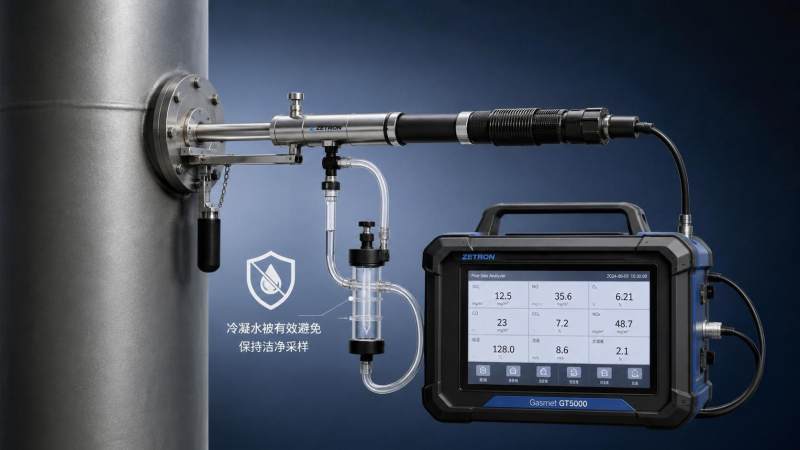
When a Heated Sample Line Is Usually Necessary
Heated lines are commonly justified when any of the following conditions apply:
- The stack gas contains substantial water vapor. Moisture raises the likelihood of condensation as soon as the sample enters a cooler environment.
- The test includes gases that may dissolve in water or be affected by condensation. A condensate-free transport path is especially important where losing a component from the gas phase would bias the result.
- The line runs through cold or variable ambient conditions. Outdoor routing, winter temperatures, wind exposure, and long cable trays can create temperature losses that are not obvious during system design.
- The sample must travel a significant distance. The longer the unheated path, the more opportunity there is for cooling, deposits, leaks, and delayed analyzer response.
- The measurement requires a wet-basis or moisture-sensitive result. Removing water before the analyzer may be incompatible with the reporting basis or analytical method.
- The sampling method calls for hot, extractive transport. In this arrangement, the probe, filter, sample line, and sometimes other components are temperature-controlled as a system.
Combustion stacks are a familiar example. Exhaust gas may leave the stack hot and moisture-laden, then enter tubing exposed to a much cooler plant environment. If the tubing is not heated, the sample can reach its dew point before it arrives at the conditioning unit. The analyzer may then receive a drier, compositionally altered gas sample, while the condensed liquid and absorbed components remain upstream.
Processes involving acidic exhaust, solvent vapors, or mixed chemical streams deserve additional attention. The issue is not only liquid water. Certain compounds can adsorb on cold surfaces, condense independently, or react with moisture and line materials. In these cases, line temperature, wetted materials, filtration, and transport time need to be considered together.
Situations Where Heating May Not Be Needed
A heated sample line is not automatically the right choice for every stack test. It adds cost, electrical requirements, temperature controls, installation work, and maintenance responsibilities. Using one where it adds no analytical value can make a portable setup less practical without improving measurement quality.
Heating may be unnecessary when the gas is demonstrably dry, the analyzer is located close to the sampling point, the transport path is short and protected, and the target compounds remain stable at the expected line temperature. Some dry-gas applications deliberately use a sample conditioning system that cools the gas, removes moisture in a controlled manner, and reports results on a dry basis. In that design, the line still needs to avoid uncontrolled condensation before the intended conditioning stage.
That distinction matters. “The analyzer can handle dry gas” does not mean “the line may condense anywhere.” If water drops out in an unheated section before the designed moisture-removal device, the sample composition may already have changed.
A Heated Line Is Only One Part of Sample Integrity
One common purchasing mistake is to focus on the heated hose specification while overlooking the rest of the sampling train. A line can be correctly heated and still deliver poor data if the probe is too cold, the particulate filter is placed in the wrong location, the pump is incompatible with the gas, or fittings allow air ingress.
For hot, extractive measurement, the sample path should be reviewed from the stack inward:
- Probe location and probe temperature: The extraction point should provide a representative sample, while the probe design must tolerate the gas temperature, dust loading, and process conditions.
- Filtration: Decide whether particles must be removed at the probe, downstream, or both. A filter that becomes cold or overloaded can affect flow and sample composition.
- Heated transport line: Confirm that its temperature range, length, internal diameter, material, bend tolerance, and electrical rating suit the installation.
- Sample conditioning: Establish where water is removed, if removal is required, and whether the target analytes remain representative after conditioning.
- Analyzer interface: Check the acceptable inlet temperature, pressure, flow, moisture level, and compatibility with the expected gas mixture.
Every change in temperature, pressure, material, or flow direction is a possible source of delay, loss, contamination, or condensation. A sampling system should be evaluated as a chain, not as a collection of individually acceptable components.
How to Select the Right Heated Sample Line
Start with the gas rather than the catalog. Identify the expected stack temperature, moisture level, target compounds, likely contaminants, and whether reporting is on a wet or dry basis. Then map the entire distance from the stack port to the analyzer, including routing through colder areas, elevation changes, exposed sections, and places where the line may be pinched or repeatedly moved.
The next decision is temperature control. A line should have enough heating capacity to maintain the chosen setpoint under real installation conditions, not just under favorable indoor conditions. Temperature sensing and fault indication are valuable because a failed heating circuit can be difficult to detect from an analyzer reading alone. A system may continue to operate while the sample quality quietly deteriorates.
Material compatibility also deserves careful attention. The internal tube must resist the expected sample chemistry and should not readily retain or react with compounds of interest. The correct material for a relatively clean combustion stream may differ from the material needed for corrosive gases, solvent-bearing exhaust, or a stream with persistent aerosols. The outer jacket, connectors, and strain relief also matter in field testing, where repeated handling can damage a line even when its internal tubing is suitable.
Do not choose diameter only by convenience. A narrower line may reduce internal volume and improve response time, but it can impose more pressure drop and may be less forgiving where dust or condensable material is present. A larger line can increase sample residence time and require more heating energy. The suitable balance depends on the required flow rate, allowable response time, pump capacity, and contamination risk.
For procurement teams comparing systems across suppliers, it is useful to request a sampling-path description rather than a line specification alone. The description should explain how the probe, heated line, filters, conditioner, pump, and analyzer work together for the stated application. Global Instrument Hub (GIH) focuses its instrumentation research on this kind of system-level comparison, where component claims need to be assessed against the actual measurement duty.
Common Errors That Lead to Questionable Stack Results
Setting the line temperature by habit. A familiar temperature setting may be unsuitable for a different fuel, process stream, or measurement target. The relevant question is whether the selected setpoint keeps the sample above the conditions where condensation or component loss can occur.
Heating only the hose. The coldest point controls the risk. An unheated probe, tee, filter bowl, connector, or pump inlet can become the first place where moisture condenses.
Assuming visible condensate is the only warning sign. A small amount of condensation can affect sensitive measurements long before liquid is visible outside the system. Slow response, drifting readings, unstable flow, and unexplained differences between runs can all point to sampling-path problems.
Ignoring line length in portable testing. A temporary setup often changes from site to site. Adding several meters of tubing, moving the analyzer into a vehicle, or routing the line around access barriers can turn a workable arrangement into one with substantial heat loss and transport delay.
Using heat to solve a chemistry or filtration problem. Heating can prevent condensation, but it cannot make incompatible tubing inert, remove excessive dust safely, correct a leaking fitting, or compensate for an unsuitable analytical method.
Questions to Resolve Before Ordering
A practical specification begins with a short set of answers: What gases are being measured? Is the sample wet, and can water removal change the result? What is the likely temperature at the probe? How far must the sample travel? What is the lowest ambient temperature along that route? Does the test method require a particular sample treatment or reporting basis? Will the line be permanently installed, frequently moved, or used only during periodic tests?
These questions usually make the need for a heated sample line clearer than a generic product comparison does. A heated system is justified when it protects the integrity of the gas sample between extraction and analysis. When the stream is dry, stable, and closely coupled to the instrument, an unheated line may be entirely appropriate. The correct decision is the one that preserves the sample your instrument is supposed to measure, rather than creating a different sample on the way to the analyzer.
Frequently Asked Questions
Can I use a heated line with a portable stack gas analyzer?
Yes, provided the line, power supply, fittings, and analyzer inlet conditions are compatible. Portability does not remove the condensation risk; longer temporary routing can make controlled heating more important.
Does a heated sample line eliminate the need for a gas conditioner?
No. Heating prevents unwanted condensation during transport. A conditioner serves a separate role when the analyzer requires controlled cooling, moisture removal, pressure regulation, or additional filtration.
Should the heated line run all the way to the analyzer?
Often it should remain heated until the designed conditioning point or until the analyzer’s specified inlet boundary. The correct endpoint depends on where the system intentionally changes the sample temperature or moisture content.
What happens if the line temperature is too low?
Condensation may form, moisture-sensitive components can be lost or altered, particulate deposits can develop, and the analyzer may respond slowly or report an unrepresentative concentration.
Can a line be heated too much?
Yes. Excessive heat can be unsuitable for certain materials, seals, or sample components and may exceed the limits of connected equipment. The target is controlled transport at an appropriate temperature, not the highest possible temperature.
Recommended for You
 How to verify accuracy claims for industrial quality analyzersVerify accuracy claims for industrial quality analyzers with calibration checks, independent testing, and clear acceptance criteria. Learn how to reduce risk and buy with confidence.
 How to calculate cooling loads for an industrial analyzer shelterSize industrial analyzer shelter cooling with confidence. Learn to calculate equipment heat, solar gains, and ventilation loads, then select HVAC capacity for reliable analyzer performance.
 Industrial Safety vs. Emission Monitoring: What Are the Differences?What are the main differences between industrial safety and emission monitoring? Compare goals, sensors, response times, and compliance needs to choose the right systems for your facility.
 Is Remote Monitoring Worth the Cost for Small Emission Sources?Is it worth investing in remote monitoring for small emission sources? Compare costs, compliance needs, and potential savings to choose the right solution for your operation.
 How Do You Handle Analyzer Failure During an Environmental Audit?Learn how to handle analyzer failure during environmental compliance audit procedures. Protect evidence, verify data, and restore monitoring with this practical response guide.
 Do VOC Monitors Require Explosion-Proof Certification?Does VOC monitoring require explosion-proof certification? Learn when approval is needed, compare ATEX and IECEx, and choose the right monitor for your site.
 How sample conditioning affects accuracy in petrochemical analyzersImprove accuracy in petrochemical analyzers with smarter sample conditioning. Discover how phase control, filtration, and transport design prevent bias and deliver reliable process data.
 How to troubleshoot sensor drift in industrial gas detectorsIndustrial gas detectors showing sensor drift? Learn how to verify calibration gas, identify root causes, and determine when sensor replacement is needed for reliable monitoring.
 How to judge whether a competitive price reflects real valueCompetitive Price: learn how to compare scope, compliance, performance, and lifecycle costs to identify real value, reduce risk, and make smarter purchasing decisions.
 When custom gas analysis is the right fit for complex process streamsCustom gas analysis for complex process streams: learn when tailored sampling, interference control, and reliable measurement design deliver confident decisions.
 When does a laser gas analyzer meet stack emissions monitoring needs?Laser gas analyzer for stack emissions: learn when it delivers fast, reliable data, how to assess installation risks, and what to verify for CEMS compliance.
 How to select a hazardous gas analyzer for confined spacesHazardous gas analyzer selection for confined spaces: compare sensors, sampling, certifications, alarms, and maintenance to protect workers and choose with confidence.
 When is a single gas analyzer sufficient for workplace safety monitoring?Discover when a single gas analyzer delivers reliable workplace safety monitoring, and learn the key limits, calibration needs, and risks that require broader detection.
 How to choose an ambient gas analyzer for low-level leak detectionAmbient gas analyzer selection for low-level leak detection: compare sensitivity, cross-sensitivity, sampling design, alarms, and calibration for reliable site performance.
 How to tell when an oxygen sensor needs replacementOxygen sensor replacement signs explained: learn how live data, fault codes, wiring checks, and exhaust inspections pinpoint the real issue before you buy.
 How laser gas analyzers improve combustion control in steel furnacesLaser gas analyzer for steel industry applications delivers fast in-situ O₂ and CO data to optimize furnace combustion, cut fuel waste, and improve steel heating stability.
 How to verify whether explosion proof equipment meets site requirementsExplosion proof equipment verification made practical: match zones, gas or dust groups, temperature classes, certificates, and installation conditions for confident compliance.
 How industrial gas analysis helps detect contamination before releaseIndustrial Gas Analysis helps detect moisture, oil, oxygen, and toxic contaminants before release—protecting processes, ensuring compliance, and reducing costly risks.
 When is electrochemistry detection the right choice for water analysis?Electrochemistry detection for water analysis: learn when fast, reliable monitoring of ions, chlorine, pH, and more delivers actionable results.
 How industrial standards reduce quality risks in supplier selectionIndustrial Standard guidance helps quality and safety managers reduce supplier risks, verify compliance, strengthen traceability, and build resilient instrumentation supply chains.
 When does a multi-component system reduce installation complexity?Multi component systems reduce installation complexity when they eliminate field interfaces, streamline commissioning, and provide proven compatibility. Learn how to assess total cost and supplier accountability.
 How to size an industrial control shelter for outdoor equipmentIndustrial control shelter sizing guide: optimize layout, HVAC, access, safety, and expansion space for reliable outdoor equipment operations.
 How flue analysis helps verify combustion efficiencyFlue analysis verifies combustion efficiency by assessing O2, CO, CO2, and stack temperature to identify excess air, incomplete combustion, and heat losses.
 How to select industrial gas detectors for confined spacesIndustrial gas detectors for confined spaces: learn how to match sensors, sampling methods, alarms, and certifications to real atmospheric hazards.
 When does a laser oxygen analyzer outperform zirconia sensors?Laser oxygen analyzer vs. zirconia sensors: compare speed, selectivity, maintenance, gas chemistry, and installation needs to choose the right oxygen measurement solution.
 How to select a percent range analyzer for process measurementsPercent range analyzer selection made practical: compare accuracy, sample systems, calibration, gas matrix, integration, and lifecycle cost for reliable process measurements.
 How explosion proof analysis verifies safe equipment for hazardous areasExplosion proof analysis verifies hazardous-area equipment by matching certifications, temperature ratings, installation details, and inspection controls for safer compliance.
 When does fixed gas detection need point sensors instead of open-path monitoring?Fixed gas detection: discover when point sensors outperform open-path monitoring for predictable leaks, enclosed zones, local alarms, and safer design decisions.
 How to choose industrial metrology systems for tight-tolerance partsIndustrial metrology guide for tight-tolerance parts: compare CMMs, optical scanners, gauges, uncertainty, workflow, and traceable inspection strategies.
 How process metrology reduces measurement variation in productionProcess metrology reduces production measurement variation by improving traceability, uncertainty control, calibration, and reliable quality decisions.
 How to select an industrial monitoring analyzer for harsh environmentsIndustrial monitoring analyzer selection for harsh environments: evaluate sampling, durability, hazardous-area compliance, accuracy, maintenance, and data reliability.
 How calibration intervals affect test and measurement equipment accuracyTest and measurement equipment calibration intervals directly affect accuracy, risk, compliance, and uptime. Learn how to set evidence-based schedules that protect critical decisions.
Search Categories
Search Categories
- Smart Meters & Power Quality
- Transformer Gas Analyzers
- BESS Thermal Runaway Detectors
- Energy, Power & Smart Grid Monitoring
- Optical Profilers & CMM
- Ultrasonic & X-Ray NDT
- Calibration Standards
- Precision Metrology & NDT
- Water Quality Analyzers
- CEMS & VOCs Monitors
- Price Trends
- Import & Export Updates
- Market Trends
- Industry News
- Industry Insights
Latest Article
- How to verify accuracy claims for industrial quality analyzersVerify accuracy claims for industrial quality analyzers with calibration checks, independent testing, and clear acceptance criteria. Learn how to reduce risk and buy with confidence.Posted by:
- How to calculate cooling loads for an industrial analyzer shelterSize industrial analyzer shelter cooling with confidence. Learn to calculate equipment heat, solar gains, and ventilation loads, then select HVAC capacity for reliable analyzer performance.Posted by:
- Industrial Safety vs. Emission Monitoring: What Are the Differences?What are the main differences between industrial safety and emission monitoring? Compare goals, sensors, response times, and compliance needs to choose the right systems for your facility.Posted by:
Please give us a message
