
How Can Fugitive Emission Monitoring Results Be Validated?


Fugitive emission monitoring results are valid only when the reported value can be traced back to a suitable method, a functioning instrument, a defined monitoring location, and a documented quality-control process. A sensor reading by itself is not proof of an emission rate, a regulatory exceedance, or the absence of a leak.
The central question is not simply whether an instrument detected hydrocarbons, methane, VOCs, or another target gas. It is whether the monitoring result is fit for its intended decision: identifying a leaking component, prioritizing repair, demonstrating conformance with a permit, estimating emissions, protecting personnel, or verifying the performance of a leak detection and repair (LDAR) program. Validation must be designed around that decision.
What does “validated” mean in fugitive emission monitoring?
Validation is the documented process of establishing that a monitoring result is technically credible for its intended use. It includes more than calibration. A properly calibrated instrument can still produce misleading results if the wrong detection technology is used, the sampling point is poorly selected, environmental conditions interfere with measurement, or the data are interpreted beyond the method’s capability.
For component-level screening, validation commonly addresses whether the instrument response, probe placement, calibration gas, and measurement procedure conform to the governing monitoring method. In many petroleum, chemical, and gas-handling applications, U.S. EPA Method 21 is used as a reference framework for VOC leak detection from equipment components. It is a screening method based on concentration at a component interface; it does not, by itself, provide a mass emission rate.
For optical gas imaging (OGI), fixed sensor networks, open-path systems, drones, or mobile surveys, the validation question is different. These systems may be highly effective for locating plumes or providing rapid area coverage, but their detection capability depends on gas composition, concentration, wind, temperature contrast, distance, optical background, and survey geometry. Their output must therefore be validated against the method’s stated detection limits and operating envelope rather than treated as interchangeable with a Method 21 reading.
Which monitoring method is being validated?
Results should never be assessed without first identifying what the method actually measures. This prevents a common but consequential error: comparing outputs from different technologies as though they represent the same physical quantity.
- Portable vapor analyzers typically measure a concentration response near a valve stem, flange, seal, connector, or other potential leak interface. Depending on the detector, they may respond to total hydrocarbons, specific organic compounds, or a broader group of VOCs.
- OGI cameras visualize a gas plume when the gas absorbs infrared radiation in the camera’s spectral band and when viewing conditions are adequate. A visible plume is not a quantified leak rate unless the workflow includes a validated quantification method.
- Fixed point sensors provide concentration information at their installed location. They do not necessarily identify the source component, particularly in congested areas or changing wind conditions.
- Open-path and remote sensing systems can indicate gas concentration along a path or across an area. Their readings are strongly influenced by meteorology, path length, source position, and atmospheric mixing.
- High-flow sampling and direct quantification methods may estimate mass flow from a source under defined conditions. Their validity depends on capture efficiency, flow measurement accuracy, and whether the sampling setup encompasses the entire release.
A valid report clearly distinguishes concentration, screening value, plume observation, path-integrated concentration, and emission rate. If a result is converted from one form to another, the conversion model, assumptions, and uncertainty need to be stated.
How should instrument calibration be checked?
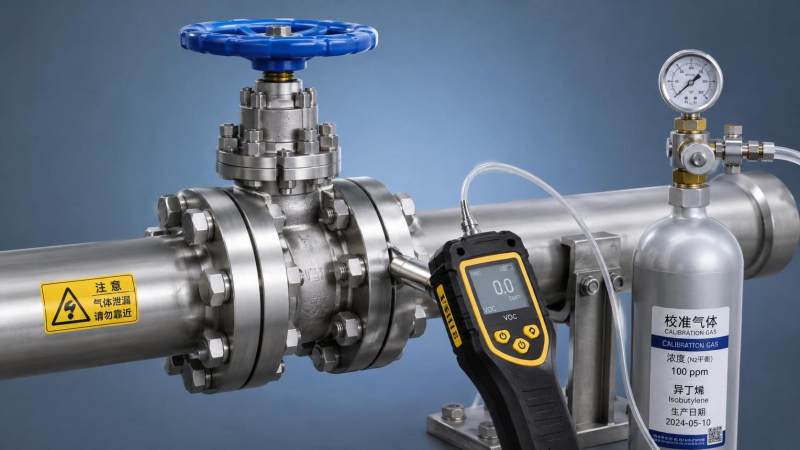
Calibration establishes the relationship between instrument response and a known gas concentration. It is necessary, but it is only one layer of validation. The calibration procedure should follow the instrument manufacturer’s instructions and the applicable monitoring method or site program.
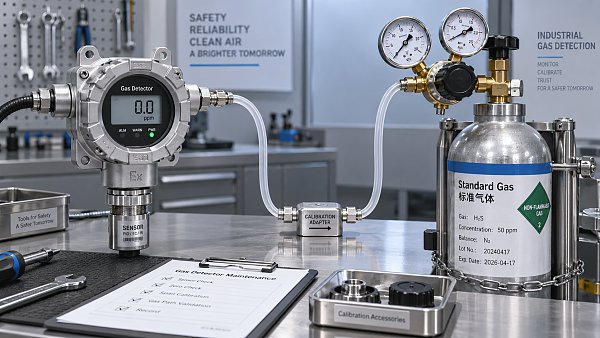
Before monitoring begins, records should show the instrument identification, detector type, calibration gas identity and concentration, gas-cylinder certification details, regulator and tubing condition, zero gas used, and the time of the check. Calibration gas must be appropriate for both the target analyte and the detector response characteristics. A flame ionization detector calibrated with methane, for example, may not respond identically to every organic compound present at the site. Where response factors are relevant, they should be addressed rather than assumed away.
Field checks are equally important. A pre-use response check confirms that the analyzer reacts to a known gas concentration before data collection. A post-survey check helps establish whether response drift occurred during the monitoring period. If a required calibration or drift criterion is not met, the affected measurements should be flagged and assessed under the governing quality procedure; they should not be presented as unquestioned valid data.
Calibration does not correct for a blocked probe, a leaking sample line, depleted fuel in an FID, contaminated filters, moisture interference, detector poisoning, improper warm-up, or an instrument range that is unsuitable for the observed concentration. These conditions need separate inspection and maintenance controls.
What field records are needed to validate a reading?
A result that cannot be reconstructed cannot be reliably defended. The field record should provide enough detail for another qualified reviewer to understand where, how, and under what conditions the result was obtained.
At minimum, documentation should link each reading or observation to a unique equipment identifier and component type. A valve is not merely “leaking”; the record should identify the process unit, line or equipment number, service type, component location, date and time, instrument used, method applied, screening value or observation, and any relevant repair status.
Operating conditions matter. Fugitive emissions can vary with pressure, temperature, throughput, product composition, valve position, compressor load, tank activity, and maintenance status. A low reading during shutdown or low-throughput operation may not represent normal operating emissions. Conversely, a high reading during a short abnormal event should not automatically be used as a normal annualized emission value.
Meteorological information is particularly important for remote and area-based methods. Wind speed and direction, atmospheric stability, precipitation, humidity, solar loading, and background gas levels can affect detectability and source attribution. For OGI, the survey record should also include camera model, operator qualification where required, imaging mode, distance, viewing angle, inspection coverage, and whether environmental conditions met the manufacturer’s or regulatory program’s specified limits.
How can data quality checks identify unreliable results?
Validation should include a review of the data set, not merely individual readings. The purpose is to find patterns that indicate a technical or procedural problem.
Useful checks include duplicate observations on selected components, repeat measurements of elevated readings, review of implausible zero values, comparison with prior inspections, and examination of unusually uniform data. A long sequence of identical or near-identical readings may reflect a recording issue, improper instrument response, or inappropriate rounding rather than stable field conditions.
Outliers require investigation, not automatic deletion. A very high concentration near a connector may represent a real leak, but it can also arise from residual vapors, nearby vents, contaminated sampling equipment, or measurement at the wrong interface. Re-screening after allowing the area to clear, checking background concentration, and confirming probe placement can distinguish a persistent component leak from a transient influence.
Data review should also test internal consistency. If an OGI survey identifies a plume but a subsequent component survey finds no elevated response, possible explanations include changing wind, intermittent emissions, source misidentification, an inaccessible release point, a gas outside the portable analyzer’s response range, or a failed follow-up procedure. The correct response is to investigate the discrepancy, not to declare one technology automatically wrong.
How are results compared with applicable standards or limits?
Comparison is valid only when the measurement method, unit, averaging period, and regulated source category match the requirement being applied. This point is frequently overlooked when companies operate across multiple jurisdictions or use internal standards alongside legal obligations.
A leak definition may be expressed as a screening concentration at a specific component type under a prescribed method. An air permit may instead impose a mass emission limit, a control-device destruction efficiency, a work-practice obligation, or a required inspection frequency. Occupational exposure limits concern worker breathing-zone exposure and should not be confused with equipment-leak criteria. A fence-line concentration target is also not equivalent to a component-level screening threshold.
For international operations, compliance programs often need to reconcile local environmental permits, national emission rules, corporate methane or VOC commitments, and customer reporting requirements. The governing document should specify which requirement controls where they differ. A report should cite the applicable standard or permit condition precisely enough that the reader can determine whether the comparison is appropriate.
When a monitoring result is used for emission inventory calculations, a documented estimation protocol is needed. Screening values may be used in correlation equations or factor-based models where permitted, but the uncertainty of those estimates can be material. A detector reading of several thousand parts per million does not translate directly into a fixed mass release without a valid model and the variables required by that model.
How should false positives and false negatives be handled?
A defensible validation system treats detection uncertainty as an operational issue rather than an inconvenience. False positives can lead to unnecessary repair work, while false negatives can leave genuine emissions unaddressed and undermine compliance claims.
False positives may result from background hydrocarbons, adjacent vents, vehicle exhaust, process sampling, solvent use, residual gas on surfaces, or an instrument that is not adequately zeroed. The source should be isolated where possible by checking background levels, changing the approach direction, examining nearby components, and repeating the reading after the immediate area has stabilized.
False negatives may arise when emissions are intermittent, wind disperses a plume before detection, the instrument is insensitive to the relevant compound, access prevents examination of the actual leak interface, or the survey is conducted under unsuitable conditions. OGI performance can also be limited by poor thermal contrast or an unfavorable background. Fixed sensors can miss a release if the plume does not travel through the sensor’s detection zone.
Where the consequence of a missed release is high, validation should not rely on a single technology or one observation. A complementary method may be justified: OGI for broad screening followed by close-range measurement, or fixed monitoring supported by periodic mobile source investigation. The methods should be selected for their distinct strengths, not used as superficial confirmation of a predetermined result.
What makes a third-party validation credible?
Independent review can strengthen confidence when results support regulatory submissions, emissions claims, asset transactions, insurance decisions, or disputes. Credibility depends less on the label “third party” than on competence, independence, traceability, and scope.
The reviewer should be qualified for the specific measurement technology and emission source involved. Calibration records, operator training, method procedures, raw data, data-processing steps, maintenance logs, and exception handling should be available for examination. Where laboratory testing, calibration services, or analytical measurements are part of the chain, accreditation to ISO/IEC 17025 may be relevant, provided the accredited scope covers the work performed.
An independent reviewer should be able to identify limitations rather than simply confirm a conclusion. For example, a report may properly state that a survey found no detectable emissions under the documented conditions. That is different from claiming that no emissions occurred at any time. The wording should match the capability and temporal coverage of the method.
When should monitoring results be rejected or remeasured?
Results should be remeasured, qualified, or excluded when essential controls fail. Examples include missed calibration checks, failed response checks, expired or unsuitable calibration gas, incomplete component identification, incorrect instrument range, invalid environmental conditions for the method, damaged sampling hardware, untraceable data edits, or a clear mismatch between the procedure and the stated compliance requirement.
Rejection is not necessarily a sign that the entire monitoring program failed. It is a data-quality decision that preserves the integrity of the remaining record. The corrective action should identify the affected data, determine whether the issue is isolated or systematic, repeat the inspection where necessary, and prevent recurrence through training, maintenance, procedural revision, or improved data controls.
The most reliable approach to how to validate fugitive emission monitoring results is therefore evidence-based: confirm method suitability, verify instrument performance, preserve field context, test data quality, apply the correct regulatory comparison, and state uncertainty honestly. That chain of evidence is what turns a field observation into information that can support repair priorities, compliance decisions, and credible environmental reporting.
Recommended for You
 How to verify accuracy claims for industrial quality analyzersVerify accuracy claims for industrial quality analyzers with calibration checks, independent testing, and clear acceptance criteria. Learn how to reduce risk and buy with confidence.
 How to calculate cooling loads for an industrial analyzer shelterSize industrial analyzer shelter cooling with confidence. Learn to calculate equipment heat, solar gains, and ventilation loads, then select HVAC capacity for reliable analyzer performance.
 Industrial Safety vs. Emission Monitoring: What Are the Differences?What are the main differences between industrial safety and emission monitoring? Compare goals, sensors, response times, and compliance needs to choose the right systems for your facility.
 Is Remote Monitoring Worth the Cost for Small Emission Sources?Is it worth investing in remote monitoring for small emission sources? Compare costs, compliance needs, and potential savings to choose the right solution for your operation.
 How Do You Handle Analyzer Failure During an Environmental Audit?Learn how to handle analyzer failure during environmental compliance audit procedures. Protect evidence, verify data, and restore monitoring with this practical response guide.
 Do VOC Monitors Require Explosion-Proof Certification?Does VOC monitoring require explosion-proof certification? Learn when approval is needed, compare ATEX and IECEx, and choose the right monitor for your site.
 How sample conditioning affects accuracy in petrochemical analyzersImprove accuracy in petrochemical analyzers with smarter sample conditioning. Discover how phase control, filtration, and transport design prevent bias and deliver reliable process data.
 How to troubleshoot sensor drift in industrial gas detectorsIndustrial gas detectors showing sensor drift? Learn how to verify calibration gas, identify root causes, and determine when sensor replacement is needed for reliable monitoring.
 How to judge whether a competitive price reflects real valueCompetitive Price: learn how to compare scope, compliance, performance, and lifecycle costs to identify real value, reduce risk, and make smarter purchasing decisions.
 When custom gas analysis is the right fit for complex process streamsCustom gas analysis for complex process streams: learn when tailored sampling, interference control, and reliable measurement design deliver confident decisions.
 When does a laser gas analyzer meet stack emissions monitoring needs?Laser gas analyzer for stack emissions: learn when it delivers fast, reliable data, how to assess installation risks, and what to verify for CEMS compliance.
 How to select a hazardous gas analyzer for confined spacesHazardous gas analyzer selection for confined spaces: compare sensors, sampling, certifications, alarms, and maintenance to protect workers and choose with confidence.
 When is a single gas analyzer sufficient for workplace safety monitoring?Discover when a single gas analyzer delivers reliable workplace safety monitoring, and learn the key limits, calibration needs, and risks that require broader detection.
 How to choose an ambient gas analyzer for low-level leak detectionAmbient gas analyzer selection for low-level leak detection: compare sensitivity, cross-sensitivity, sampling design, alarms, and calibration for reliable site performance.
 How to tell when an oxygen sensor needs replacementOxygen sensor replacement signs explained: learn how live data, fault codes, wiring checks, and exhaust inspections pinpoint the real issue before you buy.
 How laser gas analyzers improve combustion control in steel furnacesLaser gas analyzer for steel industry applications delivers fast in-situ O₂ and CO data to optimize furnace combustion, cut fuel waste, and improve steel heating stability.
 How to verify whether explosion proof equipment meets site requirementsExplosion proof equipment verification made practical: match zones, gas or dust groups, temperature classes, certificates, and installation conditions for confident compliance.
 How industrial gas analysis helps detect contamination before releaseIndustrial Gas Analysis helps detect moisture, oil, oxygen, and toxic contaminants before release—protecting processes, ensuring compliance, and reducing costly risks.
 When is electrochemistry detection the right choice for water analysis?Electrochemistry detection for water analysis: learn when fast, reliable monitoring of ions, chlorine, pH, and more delivers actionable results.
 How industrial standards reduce quality risks in supplier selectionIndustrial Standard guidance helps quality and safety managers reduce supplier risks, verify compliance, strengthen traceability, and build resilient instrumentation supply chains.
 When does a multi-component system reduce installation complexity?Multi component systems reduce installation complexity when they eliminate field interfaces, streamline commissioning, and provide proven compatibility. Learn how to assess total cost and supplier accountability.
 How to size an industrial control shelter for outdoor equipmentIndustrial control shelter sizing guide: optimize layout, HVAC, access, safety, and expansion space for reliable outdoor equipment operations.
 How flue analysis helps verify combustion efficiencyFlue analysis verifies combustion efficiency by assessing O2, CO, CO2, and stack temperature to identify excess air, incomplete combustion, and heat losses.
 How to select industrial gas detectors for confined spacesIndustrial gas detectors for confined spaces: learn how to match sensors, sampling methods, alarms, and certifications to real atmospheric hazards.
 When does a laser oxygen analyzer outperform zirconia sensors?Laser oxygen analyzer vs. zirconia sensors: compare speed, selectivity, maintenance, gas chemistry, and installation needs to choose the right oxygen measurement solution.
 How to select a percent range analyzer for process measurementsPercent range analyzer selection made practical: compare accuracy, sample systems, calibration, gas matrix, integration, and lifecycle cost for reliable process measurements.
 How explosion proof analysis verifies safe equipment for hazardous areasExplosion proof analysis verifies hazardous-area equipment by matching certifications, temperature ratings, installation details, and inspection controls for safer compliance.
 When does fixed gas detection need point sensors instead of open-path monitoring?Fixed gas detection: discover when point sensors outperform open-path monitoring for predictable leaks, enclosed zones, local alarms, and safer design decisions.
 How to choose industrial metrology systems for tight-tolerance partsIndustrial metrology guide for tight-tolerance parts: compare CMMs, optical scanners, gauges, uncertainty, workflow, and traceable inspection strategies.
 How process metrology reduces measurement variation in productionProcess metrology reduces production measurement variation by improving traceability, uncertainty control, calibration, and reliable quality decisions.
 How to select an industrial monitoring analyzer for harsh environmentsIndustrial monitoring analyzer selection for harsh environments: evaluate sampling, durability, hazardous-area compliance, accuracy, maintenance, and data reliability.
 How calibration intervals affect test and measurement equipment accuracyTest and measurement equipment calibration intervals directly affect accuracy, risk, compliance, and uptime. Learn how to set evidence-based schedules that protect critical decisions.



Search Categories
Search Categories
- Smart Meters & Power Quality
- Transformer Gas Analyzers
- BESS Thermal Runaway Detectors
- Energy, Power & Smart Grid Monitoring
- Optical Profilers & CMM
- Ultrasonic & X-Ray NDT
- Calibration Standards
- Precision Metrology & NDT
- Water Quality Analyzers
- CEMS & VOCs Monitors
- Price Trends
- Import & Export Updates
- Market Trends
- Industry News
- Industry Insights
Latest Article
- How to verify accuracy claims for industrial quality analyzersVerify accuracy claims for industrial quality analyzers with calibration checks, independent testing, and clear acceptance criteria. Learn how to reduce risk and buy with confidence.Posted by:
- How to calculate cooling loads for an industrial analyzer shelterSize industrial analyzer shelter cooling with confidence. Learn to calculate equipment heat, solar gains, and ventilation loads, then select HVAC capacity for reliable analyzer performance.Posted by:
- Industrial Safety vs. Emission Monitoring: What Are the Differences?What are the main differences between industrial safety and emission monitoring? Compare goals, sensors, response times, and compliance needs to choose the right systems for your facility.Posted by:
Please give us a message
