
How fixed gas detectors help prevent leaks in enclosed workspaces


How Fixed Gas Detectors Help Prevent Leaks in Enclosed Workspaces
In enclosed workspaces, a gas leak rarely announces itself in a useful way. There may be no visible plume, no immediate odor, and no obvious change in equipment performance. Yet a small release from a flange, valve stem, sampling point, cylinder connection, refrigerant line, battery room vent, or process seal can become a serious event when the air volume is limited and ventilation is inconsistent.
For safety and quality teams, the practical concern is not simply whether gas is present. It is whether an abnormal concentration can be detected early enough to protect people, stop escalation, preserve process control, and support a disciplined response. Fixed gas detectors address that gap by continuously monitoring defined locations rather than relying only on periodic inspections or workers carrying portable instruments.
This matters across more than chemical processing. Confined or semi-enclosed areas appear in water treatment plants, laboratories, utility tunnels, generator rooms, cold-storage facilities, battery energy storage areas, pharmaceutical production suites, wastewater pumping stations, marine spaces, and maintenance pits. The gas hazard changes from site to site, but the underlying challenge is familiar: the atmosphere can change faster than a routine check can catch it.
Why enclosed spaces turn minor leaks into major exposure risks
An enclosed workspace does not have to be a legally defined confined space to create a gas-monitoring problem. A poorly ventilated compressor room, basement process area, analyzer shelter, enclosed loading bay, or small laboratory can allow hazardous gas to accumulate or displace oxygen. Conditions also shift during shutdowns, cleaning, maintenance, seasonal temperature changes, or ventilation failures.
The behavior of the gas determines where risk develops. Lighter-than-air gases may collect near ceilings, cable trays, roof voids, or poorly ventilated high points. Heavier vapors and gases can settle in pits, trenches, sumps, lower platforms, or floor-level recesses. Some gases are toxic at low concentrations; others create flammability concerns before people recognize an exposure. Oxygen depletion is another overlooked risk, particularly where inert gases such as nitrogen, argon, or carbon dioxide are used. These gases may not be toxic in the conventional sense, but they can reduce the oxygen available for breathing.
A walk-through inspection remains valuable, especially when it includes leak checks, maintenance observations, and worker feedback. It is not, however, continuous protection. A portable detector gives a reading where a person is standing at that moment. A fixed gas detection system watches the area when the room is empty, when a release begins between shifts, or when an operator is focused on another task.
What a fixed gas detection system actually does
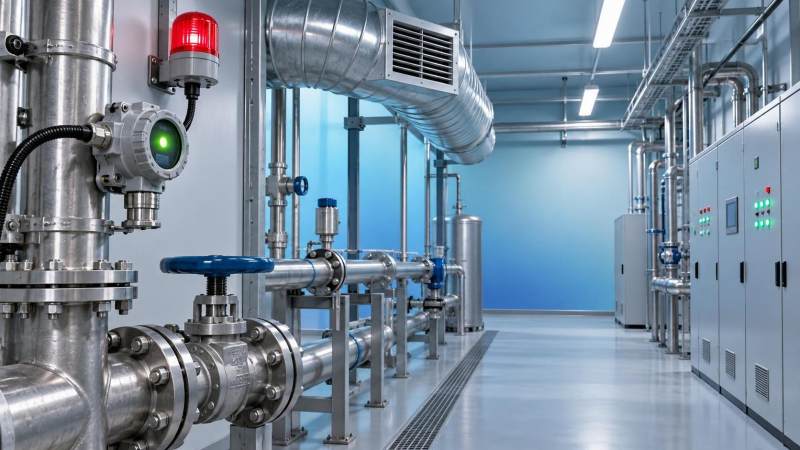
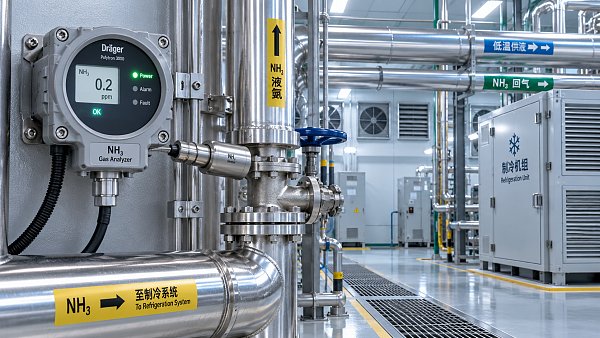
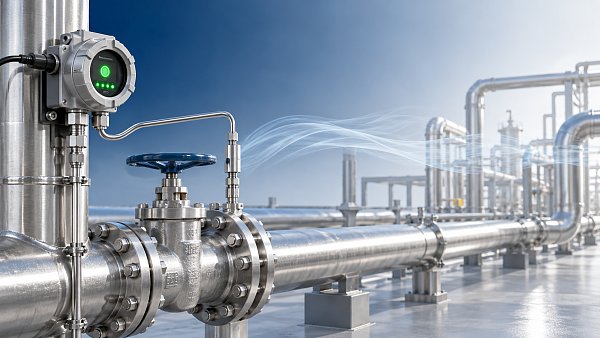
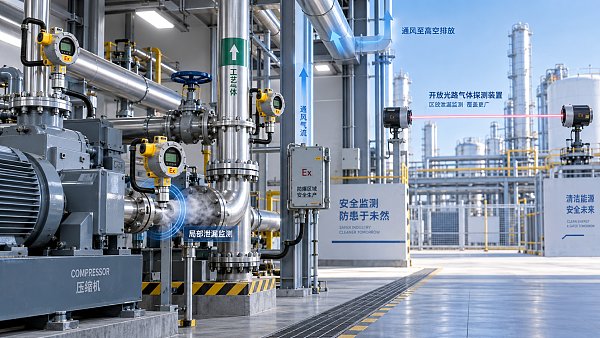
A fixed gas detector is permanently installed at a selected monitoring point and connected, depending on the design, to a local display, controller, building management system, PLC, DCS, alarm beacon, ventilation control, or emergency shutdown logic. The sensor continuously measures a target gas, vapor, or oxygen level and sends a signal when concentration reaches configured alarm thresholds.
That definition sounds straightforward, but the value is in what happens after detection. A well-designed system can provide an early warning alarm, trigger increased ventilation, notify a control room, close or isolate relevant equipment where appropriate, and create a time-stamped record for investigation. It transforms a leak from an unseen condition into an actionable process signal.
The detector itself is only one part of the protective layer. Alarm devices need to be audible and visible where workers are located. Interlocks need to be engineered carefully so that they reduce risk rather than create a new operational problem. A ventilation fan that starts automatically may be appropriate in one room but inadequate in another if the fan location, airflow path, or ignition protection has not been considered. In higher-risk installations, cause-and-effect logic should be reviewed with the same seriousness as the sensor selection.
Detection begins with knowing the real hazard, not choosing a familiar sensor
The most common design mistake is starting with a detector technology instead of the hazard assessment. “We need a gas detector” is not yet a specification. The first questions should be: What could leak? Under what pressure and temperature? Is the release likely to be continuous, intermittent, sudden, or slow? Where would it travel? Is the dominant concern toxicity, flammability, oxygen displacement, process contamination, or a combination of these?
For combustible gases and vapors, catalytic bead and infrared detection are often considered, but they do not behave identically in service. Catalytic sensors may be affected by sensor poisons or inhibitors in certain environments, while infrared sensing may be better suited to some hydrocarbon applications but does not detect every combustible gas. Toxic gas detection also needs gas-specific consideration. Electrochemical sensors are widely used for several toxic gases and oxygen monitoring, yet their expected service life, cross-sensitivities, environmental limits, and calibration requirements need to be understood before installation.
This is why an apparently inexpensive detector can become expensive in practice. If the sensing principle does not match the gas, ambient conditions, or maintenance capability of the site, the system may generate nuisance alarms, miss the intended hazard, or become unreliable between service visits. Procurement should ask for the full application basis, not just a catalog detection range.
Placement is a risk-engineering decision
There is no universal mounting height for fixed gas detectors. Placement should reflect gas density, likely release points, room geometry, airflow, obstructions, access for maintenance, and the location of people entering or working in the space. A detector mounted where it is easy to install but outside the gas migration path can provide false reassurance.
Consider a small chemical dosing room. If a potential leak source sits near floor level but the room has a strong extraction point near the ceiling, the gas may not behave exactly as a simple “heavy gas stays low” rule suggests. Air currents from doors, fans, heat sources, and process equipment can redirect it. A site survey should examine normal and abnormal ventilation patterns rather than rely on a generic installation drawing.
Detector accessibility matters too. Units placed above equipment or behind pipework may be difficult to bump test, calibrate, inspect, or replace. The sensor will eventually require attention. If access requires scaffolding, shutdown permits, or awkward manual handling every time, maintenance is likely to be delayed. Good placement balances detection performance with service practicality.
Alarm strategy: avoid both silence and alarm fatigue
An alarm threshold is not merely a number entered during commissioning. It is part of the site’s response plan. Many facilities use staged alarms so that an early warning prompts investigation or ventilation action, while a higher alarm initiates escalation such as evacuation, equipment isolation, or control-room intervention. The exact setpoints should be determined against the gas hazard, applicable rules, process conditions, and the organization’s risk assessment.
Overly sensitive settings can produce repeated nuisance alarms. Workers then begin to treat alarms as routine noise, which is precisely the behavior a gas detection system is meant to prevent. On the other hand, thresholds set too high may leave too little time for a controlled response. The better approach is to document why each alarm exists, what action follows, who owns that action, and how the response is tested.
Quality managers should also consider the traceability of alarm data. Repeated low-level alarms may reveal a developing seal failure, a recurring ventilation issue, an unstable process step, or poor cylinder handling. That information can support corrective action before the event becomes an exposure incident. A detector is not only a safety device; in many operations it is also a useful indicator of process discipline.
Fixed and portable detectors serve different jobs
It is tempting to frame the choice as fixed gas detection versus portable monitoring. In most enclosed-workspace programs, that is the wrong comparison. They solve different problems.
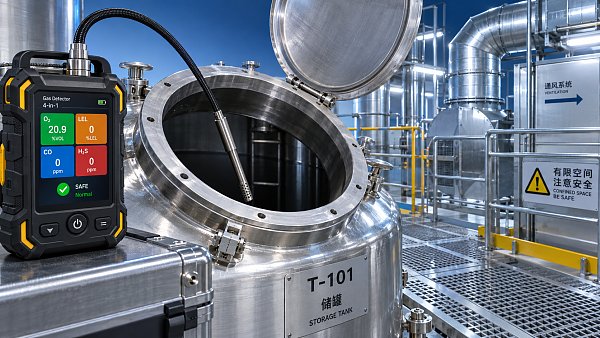
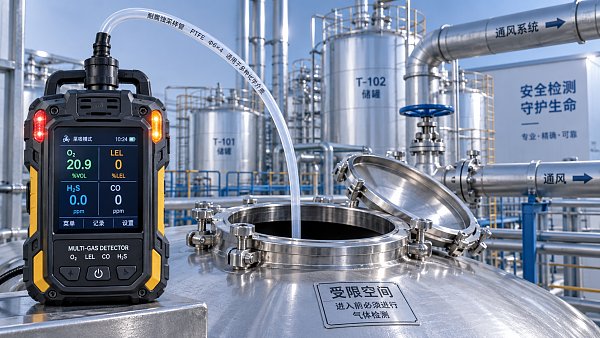
A worker entering an enclosed space may still need a portable instrument even where fixed gas detectors are installed. Fixed units monitor selected points; portable devices help verify conditions at the point of entry and within the breathing zone. The right combination depends on the task, the hazards, and site procedures.
Maintenance is where detection systems prove their worth
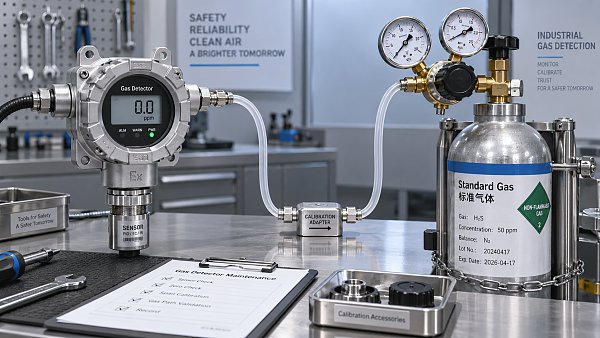
A detector that is installed but not maintained is not a dependable control. Sensors drift, age, become contaminated, or respond differently after environmental exposure. Filters can clog. Sample lines can leak or become blocked. Alarm circuits, relays, beacons, and communication links can fail independently of the sensor.
The maintenance program should follow the manufacturer’s instructions, the site’s risk assessment, and applicable local requirements. In practice, teams need clear ownership for routine visual checks, functional testing, calibration where required, fault response, replacement planning, and records. A calibration certificate alone does not prove that the complete protection function works. The signal path, controller logic, alarm devices, and linked ventilation or shutdown functions also need appropriate verification.
It is worth separating a bump test from calibration in internal procedures. A functional test generally checks whether the detector responds to test gas and activates the expected alarm behavior. Calibration adjusts or verifies measurement performance against a known reference. Both may be needed, but they answer different questions. Confusing them can leave gaps in assurance.
A more disciplined way to specify a fixed gas solution
For multinational procurement and engineering teams, the difficult part is often not finding a supplier. It is comparing technically credible options across regions without reducing the decision to price, enclosure rating, or a familiar brand name. Specifications should identify the target gases, environmental conditions, area classification where relevant, required interfaces, alarm philosophy, maintenance expectations, spare-parts availability, and documentation needs.
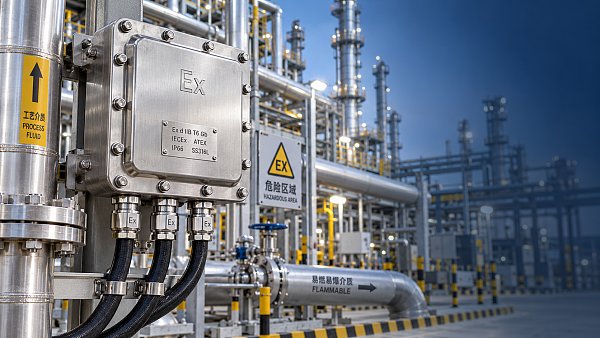
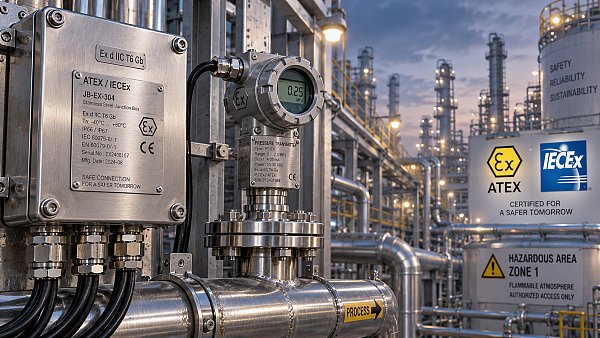
Where equipment will be used in potentially explosive atmospheres, the required hazardous-area suitability and applicable certification route need to be confirmed for the actual installation jurisdiction. References to ATEX or IECEx should not be treated as generic labels; the marking, equipment protection concept, temperature considerations, gas group, installation method, and local acceptance requirements all matter. Similarly, calibration traceability and laboratory competence may be relevant where measurement records support regulated quality systems, but the precise requirement depends on the project and industry.
This is the type of decision environment where industry intelligence has practical value. Global Instrument Hub tracks the instrumentation supply chain across industrial process control, laboratory operations, environmental monitoring, precision measurement, and energy systems. For gas detection projects, useful research goes beyond product listings: it includes sensing technology fit, integration compatibility, certification documentation, serviceability, and the supplier’s ability to support the equipment over its operating life.
The key question is whether the system will detect the leak that actually matters
Fixed gas detectors prevent leaks from becoming incidents by reducing the time between release and response. They do not eliminate the need for sound mechanical design, preventive maintenance, ventilation, training, permit controls, or emergency planning. They provide a continuous sensory layer—one that can reveal a developing problem before it becomes dependent on chance observation.
Before approving a system, walk the workspace with the process owner, maintenance lead, and safety representative. Identify where gas could escape, where it could collect, what workers would hear or see when alarms occur, and whether the intended response can actually be carried out on a night shift or during a fault condition. If those answers are clear, the fixed gas detection design is far more likely to provide real protection rather than simply another instrument on the wall.
Recommended for You
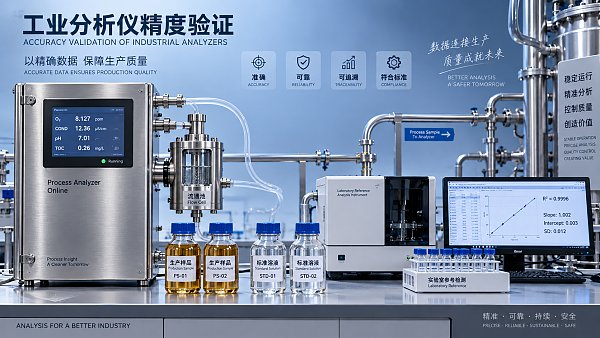
 How to verify accuracy claims for industrial quality analyzersVerify accuracy claims for industrial quality analyzers with calibration checks, independent testing, and clear acceptance criteria. Learn how to reduce risk and buy with confidence.
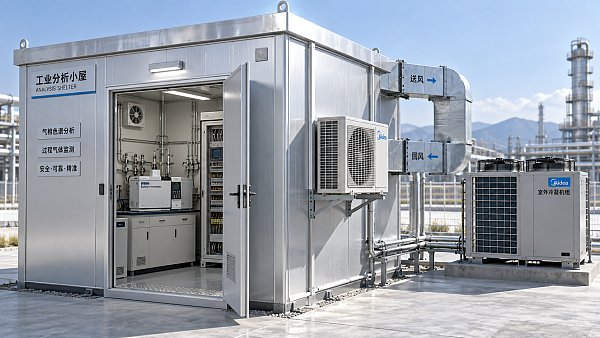
 How to calculate cooling loads for an industrial analyzer shelterSize industrial analyzer shelter cooling with confidence. Learn to calculate equipment heat, solar gains, and ventilation loads, then select HVAC capacity for reliable analyzer performance.
 Industrial Safety vs. Emission Monitoring: What Are the Differences?What are the main differences between industrial safety and emission monitoring? Compare goals, sensors, response times, and compliance needs to choose the right systems for your facility.
 Is Remote Monitoring Worth the Cost for Small Emission Sources?Is it worth investing in remote monitoring for small emission sources? Compare costs, compliance needs, and potential savings to choose the right solution for your operation.
 How Do You Handle Analyzer Failure During an Environmental Audit?Learn how to handle analyzer failure during environmental compliance audit procedures. Protect evidence, verify data, and restore monitoring with this practical response guide.
 Do VOC Monitors Require Explosion-Proof Certification?Does VOC monitoring require explosion-proof certification? Learn when approval is needed, compare ATEX and IECEx, and choose the right monitor for your site.
 How sample conditioning affects accuracy in petrochemical analyzersImprove accuracy in petrochemical analyzers with smarter sample conditioning. Discover how phase control, filtration, and transport design prevent bias and deliver reliable process data.
 How to troubleshoot sensor drift in industrial gas detectorsIndustrial gas detectors showing sensor drift? Learn how to verify calibration gas, identify root causes, and determine when sensor replacement is needed for reliable monitoring.
 How to judge whether a competitive price reflects real valueCompetitive Price: learn how to compare scope, compliance, performance, and lifecycle costs to identify real value, reduce risk, and make smarter purchasing decisions.
 When custom gas analysis is the right fit for complex process streamsCustom gas analysis for complex process streams: learn when tailored sampling, interference control, and reliable measurement design deliver confident decisions.
 When does a laser gas analyzer meet stack emissions monitoring needs?Laser gas analyzer for stack emissions: learn when it delivers fast, reliable data, how to assess installation risks, and what to verify for CEMS compliance.
 How to select a hazardous gas analyzer for confined spacesHazardous gas analyzer selection for confined spaces: compare sensors, sampling, certifications, alarms, and maintenance to protect workers and choose with confidence.
 When is a single gas analyzer sufficient for workplace safety monitoring?Discover when a single gas analyzer delivers reliable workplace safety monitoring, and learn the key limits, calibration needs, and risks that require broader detection.
 How to choose an ambient gas analyzer for low-level leak detectionAmbient gas analyzer selection for low-level leak detection: compare sensitivity, cross-sensitivity, sampling design, alarms, and calibration for reliable site performance.
 How to tell when an oxygen sensor needs replacementOxygen sensor replacement signs explained: learn how live data, fault codes, wiring checks, and exhaust inspections pinpoint the real issue before you buy.
 How laser gas analyzers improve combustion control in steel furnacesLaser gas analyzer for steel industry applications delivers fast in-situ O₂ and CO data to optimize furnace combustion, cut fuel waste, and improve steel heating stability.
 How to verify whether explosion proof equipment meets site requirementsExplosion proof equipment verification made practical: match zones, gas or dust groups, temperature classes, certificates, and installation conditions for confident compliance.
 How industrial gas analysis helps detect contamination before releaseIndustrial Gas Analysis helps detect moisture, oil, oxygen, and toxic contaminants before release—protecting processes, ensuring compliance, and reducing costly risks.
 When is electrochemistry detection the right choice for water analysis?Electrochemistry detection for water analysis: learn when fast, reliable monitoring of ions, chlorine, pH, and more delivers actionable results.
 How industrial standards reduce quality risks in supplier selectionIndustrial Standard guidance helps quality and safety managers reduce supplier risks, verify compliance, strengthen traceability, and build resilient instrumentation supply chains.
 When does a multi-component system reduce installation complexity?Multi component systems reduce installation complexity when they eliminate field interfaces, streamline commissioning, and provide proven compatibility. Learn how to assess total cost and supplier accountability.
 How to size an industrial control shelter for outdoor equipmentIndustrial control shelter sizing guide: optimize layout, HVAC, access, safety, and expansion space for reliable outdoor equipment operations.
 How flue analysis helps verify combustion efficiencyFlue analysis verifies combustion efficiency by assessing O2, CO, CO2, and stack temperature to identify excess air, incomplete combustion, and heat losses.
 How to select industrial gas detectors for confined spacesIndustrial gas detectors for confined spaces: learn how to match sensors, sampling methods, alarms, and certifications to real atmospheric hazards.
 When does a laser oxygen analyzer outperform zirconia sensors?Laser oxygen analyzer vs. zirconia sensors: compare speed, selectivity, maintenance, gas chemistry, and installation needs to choose the right oxygen measurement solution.
 How to select a percent range analyzer for process measurementsPercent range analyzer selection made practical: compare accuracy, sample systems, calibration, gas matrix, integration, and lifecycle cost for reliable process measurements.
 How explosion proof analysis verifies safe equipment for hazardous areasExplosion proof analysis verifies hazardous-area equipment by matching certifications, temperature ratings, installation details, and inspection controls for safer compliance.
 When does fixed gas detection need point sensors instead of open-path monitoring?Fixed gas detection: discover when point sensors outperform open-path monitoring for predictable leaks, enclosed zones, local alarms, and safer design decisions.
 How to choose industrial metrology systems for tight-tolerance partsIndustrial metrology guide for tight-tolerance parts: compare CMMs, optical scanners, gauges, uncertainty, workflow, and traceable inspection strategies.
 How process metrology reduces measurement variation in productionProcess metrology reduces production measurement variation by improving traceability, uncertainty control, calibration, and reliable quality decisions.
 How to select an industrial monitoring analyzer for harsh environmentsIndustrial monitoring analyzer selection for harsh environments: evaluate sampling, durability, hazardous-area compliance, accuracy, maintenance, and data reliability.
 How calibration intervals affect test and measurement equipment accuracyTest and measurement equipment calibration intervals directly affect accuracy, risk, compliance, and uptime. Learn how to set evidence-based schedules that protect critical decisions.
Search Categories
Search Categories
- Smart Meters & Power Quality
- Transformer Gas Analyzers
- BESS Thermal Runaway Detectors
- Energy, Power & Smart Grid Monitoring
- Optical Profilers & CMM
- Ultrasonic & X-Ray NDT
- Calibration Standards
- Precision Metrology & NDT
- Water Quality Analyzers
- CEMS & VOCs Monitors
- Price Trends
- Import & Export Updates
- Market Trends
- Industry News
- Industry Insights
Latest Article
- How to verify accuracy claims for industrial quality analyzersVerify accuracy claims for industrial quality analyzers with calibration checks, independent testing, and clear acceptance criteria. Learn how to reduce risk and buy with confidence.Posted by:
- How to calculate cooling loads for an industrial analyzer shelterSize industrial analyzer shelter cooling with confidence. Learn to calculate equipment heat, solar gains, and ventilation loads, then select HVAC capacity for reliable analyzer performance.Posted by:
- Industrial Safety vs. Emission Monitoring: What Are the Differences?What are the main differences between industrial safety and emission monitoring? Compare goals, sensors, response times, and compliance needs to choose the right systems for your facility.Posted by:
Please give us a message
