
NDIR vs. FTIR Gas Analyzers: Which Fits Your Environmental Research?


NDIR is a strong starting point when your environmental study needs continuous measurements of a small, defined set of gases and the selected instrument meets your sensitivity and response requirements. FTIR becomes more attractive when several infrared-active compounds must be measured together, particularly in variable mixtures such as combustion exhaust or process emissions. Neither technology is automatically the better research instrument: the choice depends on whether it can resolve the concentrations and changes that your study needs to detect.
When selecting an infrared gas analyzer for environmental research, begin with the measurement task: target compounds, expected concentration ranges, sample composition, and required time resolution. A reliable carbon dioxide record from a remote station presents a different problem from separating overlapping gas signals in humid exhaust. Comparing the two technologies without those conditions can produce a technically impressive purchase that leaves the central research question unanswered.
Start with the gases and the decisions the data must support
Nondispersive infrared, or NDIR, instruments measure absorption within selected wavelength bands. Their filters and optical configuration are designed around particular gases. This makes them well suited to focused monitoring, but the installed measurement channels define much of their scope. Adding another target compound may require different hardware rather than a software update.
Fourier transform infrared, or FTIR, instruments collect spectral information across a broader infrared range and use analytical models to derive concentrations. A suitable system can quantify multiple compounds from the same sample. That breadth is useful when relationships among gases matter—for example, when a study compares combustion products across changing operating conditions.
The distinction does not mean NDIR is always a single-gas instrument or that FTIR measures everything. Multichannel NDIR analyzers exist. FTIR measurements still depend on spectral coverage, absorption strength, optical path length, resolution, and a validated analysis method. Gases such as nitrogen and oxygen cannot be directly quantified through their fundamental infrared absorption using conventional NDIR or FTIR gas analysis.
For a study focused on carbon dioxide concentration trends, an appropriately specified NDIR analyzer may provide all the necessary information with manageable operational demands. If the study requires simultaneous measurements of carbon dioxide, carbon monoxide, nitrous oxide, ammonia, and other infrared-active compounds in a changing mixture, FTIR deserves closer evaluation. Each proposed analyte still needs its own performance assessment.
There is also a boundary where neither option should be accepted without comparison against other techniques. Very low atmospheric concentrations, demanding selectivity, or rapid flux measurements may favor a specialized laser absorption instrument or another analytical method. A two-technology shortlist should not override the scientific requirement.
Before comparing quotations, write a short measurement specification:
- Which gases are essential to the research outcome, and which are optional?
- What are the lowest concentrations and smallest changes that must be resolved?
- Which other gases, water vapor levels, and sample temperatures are expected?
- How quickly must the complete sampling system respond?
- Will the instrument operate in a controlled laboratory, a mobile campaign, or an unattended field station?
These answers make the comparison more useful than a general ranking of sensitivity, flexibility, or price.
Compare performance in the actual mixture
A detection limit quoted for one gas under controlled conditions does not establish performance in an environmental sample. Evaluators need to distinguish detection limit, precision, bias, drift, and usable measurement range. A low noise level may help detect a small change while a systematic interference still shifts the reported concentration.
For NDIR, a central question is whether absorption within the selected bands remains sufficiently specific in the expected mixture. Water vapor and other absorbing compounds can influence the signal, depending on the gas and instrument design. Reference channels, compensation algorithms, and calibration can reduce these effects, but their effectiveness should be demonstrated across the conditions relevant to the study.
FTIR provides more spectral information to separate compounds with overlapping absorption features. However, fitting several gases simultaneously introduces its own dependencies. Results rely on appropriate reference spectra, representative temperature and pressure conditions, adequate signal quality, and an analysis model that includes important interferents. An omitted compound can distort fitted concentrations even when the software produces plausible numbers.
A useful evaluation therefore challenges both systems with representative mixtures. Include the target gas near the lowest concentration that matters, alongside realistic water vapor and potential interferents. Where conditions vary substantially, examine several combinations rather than one nominal sample. The purpose is to establish whether changes in the surrounding mixture create an apparent change in the target gas.
Ask how the manufacturer calculated its detection limits and what averaging interval was used. Longer averaging can reduce noise, but it also smooths short events. Compare specifications at the time resolution you intend to use, and distinguish factory performance from results obtained through the proposed sampling line.
High concentrations deserve attention too. Strong absorption can limit the useful range, and a configuration optimized for trace measurements may be unsuitable for concentrated emissions. Dilution can extend the range, but introduces uncertainty from the dilution ratio and may change sample behavior. Specify the full expected concentration envelope before choosing cell length or measurement ranges.
For FTIR, access to raw spectra and fit diagnostics adds practical value. Spectral residuals—the difference between measured and modeled spectra—can help reveal unmodeled absorption or an inadequate fit. They do not prove that every reported concentration is correct, but they provide evidence that is unavailable from concentration values alone. For NDIR, useful diagnostic access includes raw or intermediate signals where available, compensation status, and calibration records.
Retaining FTIR spectra can also support later reanalysis, provided the relevant absorption features were captured with sufficient sensitivity and resolution. It is not a guarantee that any newly interesting compound can be recovered from an old dataset.
The sampling system can determine the winner
Many selection errors begin at the sample inlet. The analyzer measures the gas that reaches its optical cell, which may differ from the gas at the measurement location. Tubing, filters, pumps, dryers, and cell surfaces can introduce delay, remove compounds, or retain material that later reappears as carryover.
This matters especially for soluble or reactive gases such as ammonia. Moisture management that is acceptable for one target can compromise another. A dryer may affect target recovery, while cooling a wet sample can cause condensation and remove soluble compounds. Heated sampling can help preserve some mixtures, but its suitability depends on materials, temperature control, and the behavior of the intended analytes.
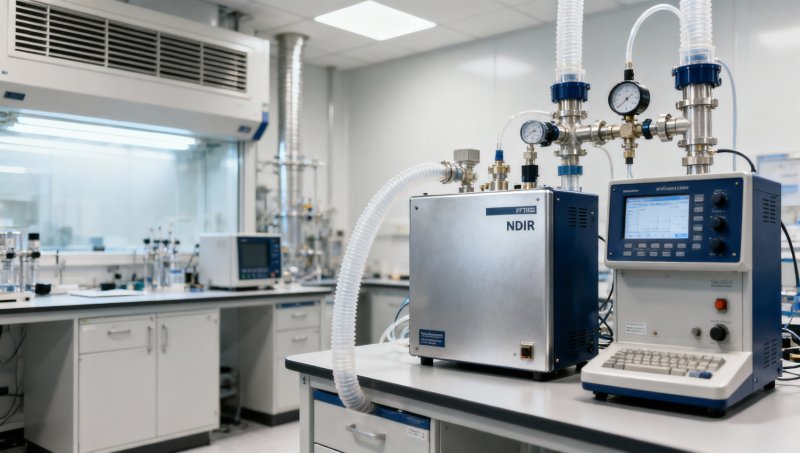
Consider the sampling train from inlet to reported result as one measurement system. Establish the sample temperature and pressure, line length, flow rate, filter arrangement, and any conditioning steps. Then assess recovery and response through that complete configuration. Introducing a calibration gas directly into the analyzer verifies a different part of the system from introducing it at the field inlet.
For humid measurements, also establish whether results are reported on a wet or dry basis. Removing water changes the concentration basis of the remaining gases. Comparing a dried NDIR measurement with an undried FTIR result without correcting that difference can create disagreement even when both analyzers function properly.
Response time requires similar care. Output frequency tells you how often a value is recorded; it does not tell you how quickly a changing sample reaches the cell or how much the signal is averaged. Transport delay, cell flushing, adsorption, spectral acquisition, and processing all contribute to the observed response.
NDIR can be well suited to rapid monitoring when its optical and sampling design supports the required bandwidth. FTIR acquisition may involve a tradeoff among time resolution, spectral resolution, and signal quality, depending on the instrument. These are configuration-specific questions. Neither technology name establishes whether a system can capture a short emission pulse.
For chamber studies, insufficient response can distort concentration slopes or obscure early changes after closure. For eddy covariance, instrument suitability additionally depends on fast concentration measurements, synchronization with wind data, and the treatment of delays and frequency losses. A general-purpose analyzer should not be assumed suitable simply because it provides frequent readings.
A practical acceptance exercise is to apply a concentration step at the intended inlet and observe arrival time, rise and fall behavior, and recovery after exposure. Slow decay may reveal surface retention that an analyzer-only response specification misses. Use relevant gases and humidity conditions because a response check with an easily transported gas may not characterize a reactive target.
Match analytical flexibility to the operating burden
For a stable, narrowly defined monitoring task, NDIR often offers a simpler operating arrangement. A focused system can reduce the work required for method development, interpretation, and routine checks. That advantage is most valuable where power, service access, or operator time is constrained.
It should not be confused with maintenance-free operation. Optical contamination, source changes, pressure and temperature effects, leaks, and calibration drift can still degrade measurements. Evaluate the particular analyzer’s environmental limits and service requirements, especially for unattended deployment.
FTIR can justify greater analytical and operational effort when simultaneous gas information materially improves the study. Its value increases when several separate analyzers would otherwise be required, or when archived spectra provide useful scope for future analysis. That value depends on staff having the time and expertise to review methods, investigate unusual spectra, and maintain consistent processing.
Compare ownership costs around a defined measurement plan. Include calibration standards, pumps, filters, heated lines where necessary, utilities, software access, training, service, and expected downtime. A lower purchase price can become less attractive if additional instruments are needed to complete the gas list. Conversely, broad spectral capability adds little value when most channels will never influence the research.
Data access should enter the evaluation before purchase. Determine whether raw measurements, spectra where applicable, diagnostic flags, calibration history, and processing settings can be exported. For FTIR, retain the method version and spectral references associated with reported concentrations. For both technologies, record the compensation settings and sampling conditions needed to interpret the results later.
A credible final comparison asks each supplier to address the same sample conditions and acceptance criteria. Request evidence for the essential gases at relevant concentrations, interference behavior under expected humidity, response through the sampling train, and stability over an operating period representative of the intended deployment. Where a compliance method applies, check its requirements separately; the analyzer’s measurement principle alone does not establish suitability.
Choose NDIR when a defined gas set, demonstrated performance, and manageable field operation satisfy the research objective. Choose FTIR when simultaneous analysis and spectral information resolve questions that a focused instrument cannot answer economically or reliably. If either system meets its specifications only under conditions your samples will not maintain, revise the sampling design or broaden the technology shortlist before committing the study to that measurement chain.
Recommended for You
 How to choose the right detection range for a custom gas analyzerChoose the right custom gas analyzer detection range with practical guidance on accuracy, exposure limits, calibration, and supplier evaluation.
 How does multi component monitoring detect gases in stack emissions?Discover how multi component monitoring detects stack gases, manages interference and supports reliable emissions reporting. Explore key CEMS selection factors.
 How bright should an industrial monitor be for outdoor use?Choosing an outdoor industrial monitor? Learn why 1,000 nits is a starting point and how glare, contrast, and heat affect sunlight readability.
 How does water vapor affect infrared gas analyzers?Infrared gas analyzers can be affected by humidity, condensation and spectral interference. Learn how to protect sample integrity and achieve reliable results.
 How to reduce customer support response timesReduce Customer Support response times with actionable tips for reporting equipment faults, choosing the right channel, and getting expert help faster.
 How to choose a low range analyzer for trace-level measurementsChoose the right low range analyzer for trace-level measurements. Compare detection limits, sampling, calibration and support to make a confident decision.
 How to choose combustible gas detectors for a specific gasChoose combustible gas detectors with confidence. Compare sensor technologies, gas response, calibration, placement, and certification for your application.
 How to choose an air quality analyzer for the pollutants you need to measureChoose an air quality analyzer with confidence. Compare pollutant measurement methods, sampling, accuracy and calibration to find the right fit for your needs.
 How to choose industrial metrology tools for tight tolerancesChoose industrial metrology tools for tight tolerances with confidence. Compare uncertainty, calibration, tool types, and costs to reduce inspection risk.
 How moisture affects fixed analyzer accuracy in stack gas monitoringImprove fixed analyzer accuracy in stack gas monitoring. Discover how moisture causes dilution, interference, and sample loss—and learn practical ways to protect emissions data.
 How does production line speed affect in-line measurement accuracy?Discover how production line speed affects in-line measurement accuracy. Explore sensor response, sampling, and timing to boost throughput without compromising quality.
 How condensation affects HCl concentration analyzer accuracyHCl concentration analyzer accuracy can suffer when condensation traps HCl. Learn how to spot sampling losses, prevent low readings, and improve measurement reliability.
 How does cross-interference affect multi-component gas analyzers?How does cross-interference affect multi component gas analyzers? Explore measurement errors, compensation limits, and validation tips to choose the right system for your process.
 How does temperature affect high-accuracy sensor performance?Explore how temperature affects high accuracy sensor performance. Learn to reduce thermal drift, evaluate compensation, and select the right sensor for reliable measurements.
 Can a C4H8O concentration analyzer distinguish between isomers?Can a C4H8O concentration analyzer distinguish isomers? Compare GC, FTIR and MS methods, uncover selectivity limits, and learn what to validate before choosing your instrument.
 How to identify a reliable supplier using on-time delivery recordsIdentify a Reliable Supplier by verifying on-time delivery records, original commitments, and complete shipments. Learn practical checks to reduce purchasing risk and protect your project schedule.
 How sensitive should a portable hydrogen analyzer be for lab use?Choose a portable hydrogen analyzer for laboratory use with the right quantification limit, accuracy, and range. Learn how to verify performance and avoid costly buying mistakes.
 How to set industrial calibration intervals based on equipment riskSet industrial calibration intervals based on equipment risk, drift, and as-found data. Learn when to shorten or extend schedules to improve reliability and avoid unnecessary costs.
 How to choose electrochemical analyzers for low-current measurementsCompare electrochemical analyzers for precise low-current measurements. Learn how noise, leakage, bandwidth, and real-cell testing help you choose the right instrument.
 What tolerance does a custom gas mixture need for calibration?Choose the right custom gas tolerance for calibration. Learn how blending tolerance, certified uncertainty, and stability affect accuracy—and avoid paying for precision you don’t need.
 How condensation affects stack detector readings in wet flue gasStack detector readings can drift when wet flue gas condenses. Learn how to identify moisture interference, prevent sample losses, and improve emissions monitoring reliability.
 How to prevent condensation in a CO2 analyzer sampling systemPrevent condensation in your CO2 analyzer sampling system. Learn how to control dew point, eliminate cold spots, and manage moisture for reliable readings and fewer costly disruptions.
 How to verify accuracy claims for industrial quality analyzersVerify accuracy claims for industrial quality analyzers with calibration checks, independent testing, and clear acceptance criteria. Learn how to reduce risk and buy with confidence.
 How to calculate cooling loads for an industrial analyzer shelterSize industrial analyzer shelter cooling with confidence. Learn to calculate equipment heat, solar gains, and ventilation loads, then select HVAC capacity for reliable analyzer performance.
 Hydrogen Analyzers for Energy Storage: Purity Monitoring vs. Leak DetectionChoosing a hydrogen analyzer for energy storage systems? Compare purity monitoring and leak detection to select the right sensors, improve safety, and protect fuel cell performance.
 NH3 Monitoring in Fertilizer Plants: Where Should Leak Analyzers Be Installed?NH3 analyzer for fertilizer production: discover where to place leak detectors around storage, compressors, and loading areas to reduce blind spots and improve early warning.
 Diesel Engine NOx Analyzers: Response Time and NO2 Conversion ExplainedChoosing a NOX analyzer for diesel engines? Learn how response time, NO2 conversion, and sampling design affect accuracy—and make a smarter, evidence-based purchase.
 SO2 Analyzers for Smelter Emissions: Sampling Hot, Dust-Laden Flue GasSelect an SO2 analyzer for smelting industry applications. Discover how to handle hot, dust-laden flue gas, prevent sample losses, and achieve reliable emissions monitoring.
 Unstable CH4 Readings in Biogas Monitoring? Check Moisture and Sample FlowCH4 analyzer for biogas monitoring giving unstable readings? Discover how moisture, sample flow, and pressure checks help pinpoint faults and restore reliable methane measurements.
 Buying a CO2 Analyzer for Brewery Gas Recovery: Costs Beyond the Purchase PriceBuying a CO2 analyzer for brewery applications? Compare sampling, installation, calibration, and downtime costs to uncover hidden expenses and make a smarter gas recovery investment.
 Where to Place CO Analyzers for Effective Parking Garage VentilationOptimize your CO analyzer for parking garage ventilation with practical placement tips. Learn how sensor height, airflow, and zone coverage support timely detection and effective fan control.
 NDIR vs. FTIR Gas Analyzers: Which Fits Your Environmental Research?Find the right infrared gas analyzer for environmental research. Compare NDIR vs. FTIR on sensitivity, gas coverage, sampling needs, and cost to choose confidently for your study.




Search Categories
Search Categories
- Smart Meters & Power Quality
- Transformer Gas Analyzers
- BESS Thermal Runaway Detectors
- Energy, Power & Smart Grid Monitoring
- Optical Profilers & CMM
- Ultrasonic & X-Ray NDT
- Calibration Standards
- Precision Metrology & NDT
- Water Quality Analyzers
- CEMS & VOCs Monitors
- Price Trends
- Import & Export Updates
- Market Trends
- Industry News
- Industry Insights
Latest Article
- How to choose the right detection range for a custom gas analyzerChoose the right custom gas analyzer detection range with practical guidance on accuracy, exposure limits, calibration, and supplier evaluation.Posted by:
- How does multi component monitoring detect gases in stack emissions?Discover how multi component monitoring detects stack gases, manages interference and supports reliable emissions reporting. Explore key CEMS selection factors.Posted by:
- How bright should an industrial monitor be for outdoor use?Choosing an outdoor industrial monitor? Learn why 1,000 nits is a starting point and how glare, contrast, and heat affect sunlight readability.Posted by:
Please give us a message
