
What Are the Risks of Using Low-Cost Electrochemical Gas Analyzers?


Low-cost electrochemical gas analyzers can be suitable for limited screening tasks, training, or non-critical spot checks, but their lower purchase price may conceal risks that matter far more than the instrument itself. In safety monitoring, emissions work, confined-space entry, process control, and laboratory analysis, an inaccurate reading can lead to an unsafe decision, a failed compliance result, a disrupted process, or an invalid dataset.
The central issue is not that an inexpensive analyzer is automatically unusable. It is whether its sensor quality, gas-path design, compensation logic, calibration controls, documentation, and service support are adequate for the measurement decision being made. Two instruments may list the same target gases and nominal ranges while delivering very different reliability under real temperature, humidity, pressure, interference, and maintenance conditions.
Why does price matter in electrochemical gas analysis?
Electrochemical sensors generate an electrical signal when a target gas reaches an electrode through a controlled diffusion barrier. The analyzer converts that signal into a concentration reading. This principle is well established and can provide useful results, but performance depends on more than the presence of a sensor cell.
Lower-cost instruments often reduce cost in areas that are not obvious on a specification sheet: electrode consistency, diffusion-barrier control, sensor-to-sensor matching, temperature compensation, inlet filtration, moisture management, circuit stability, enclosure sealing, quality inspection, and calibration software. A sensor may respond to a gas in a basic demonstration yet still produce unreliable values when exposed to a changing industrial environment.
For a non-critical indication, the consequence may be a repeat measurement. For an oxygen-deficiency alarm, toxic-gas exposure check, combustion adjustment, or regulated emissions record, the consequence can be substantially more serious.
What are the main technical risks?
Calibration drift can make apparently normal readings misleading
All electrochemical sensors drift. Their electrolyte and electrodes age, and their response changes with exposure history and storage conditions. The risk with lower-cost analyzers is not simply that drift exists, but that it may be less predictable, less visible to the user, or harder to correct through calibration.
An instrument may still power on, pass a simple zero check, and display plausible values while its sensitivity has shifted. If the span response is no longer correct, the reported concentration can be biased high or low. In many applications, a low reading is the more dangerous failure because it can create false confidence that the atmosphere or process condition is acceptable.
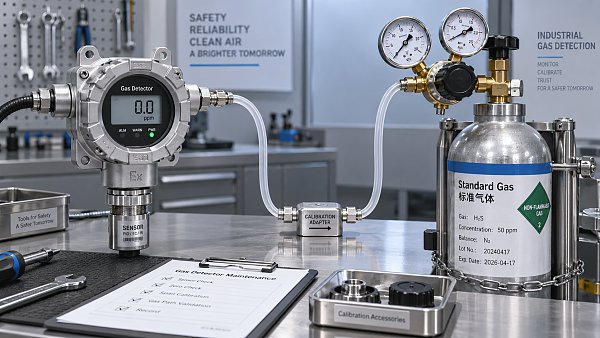
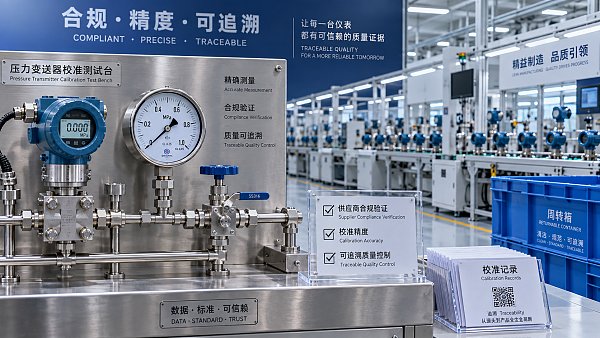
Calibration also depends on the quality of the procedure. A credible system should define the required calibration gases, concentration tolerances, flow conditions, warm-up requirements, adjustment method, and calibration interval. Cheap equipment sometimes provides only a generic statement that calibration is needed, without enough detail to establish traceability or repeatability.
Cross-sensitivity can be ignored or poorly compensated
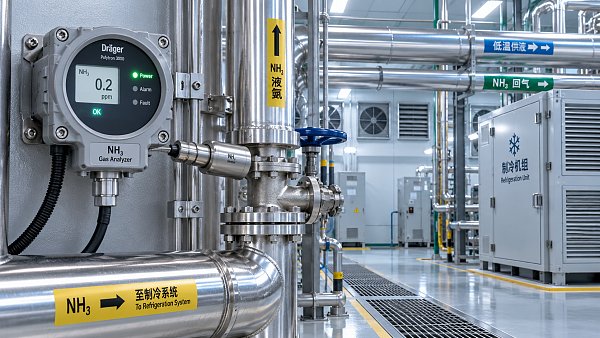
Electrochemical cells are selective, not perfectly specific. A carbon monoxide sensor, for example, can respond to gases other than CO; hydrogen sulfide, sulfur dioxide, nitrogen dioxide, chlorine, ammonia, and other sensor types have their own interference patterns. The magnitude and direction of interference depend on the sensor design and the interfering gas concentration.
A low-cost analyzer may identify a target gas but provide no usable cross-sensitivity table, no stated compensation method, or no information about the sensor supplier. That creates a serious problem in mixed-gas environments. A reading labelled as one gas may partly reflect another component of the sample.
This matters in exhaust streams, chemical manufacturing, wastewater treatment, combustion systems, battery rooms, sterilization areas, and laboratories where multiple reactive gases may coexist. A single-gas instrument should not be assumed to distinguish compounds merely because its display has one gas label.
Temperature, humidity, and pressure effects may exceed the published accuracy claim
Accuracy figures are often quoted under controlled reference conditions. Field conditions are different. Electrochemical sensor output can vary with ambient temperature; sample humidity may alter diffusion and reaction behavior; atmospheric pressure can influence gas concentration and sample delivery; and rapid temperature changes may temporarily destabilize readings.
Low-cost instruments may have basic temperature compensation, but the quality of compensation is rarely visible from a headline accuracy figure. The analyzer may also lack effective sample conditioning. Condensation in tubing, dust loading, aerosols, corrosive vapors, or a wet sample stream can affect the sensor response long before the instrument shows an obvious fault.
For flue-gas or stack-related measurements, hot and wet gas requires particular attention. Drawing untreated gas directly into an electrochemical analyzer can expose sensors to moisture, particulate matter, acidic condensate, and gas concentrations outside their intended range. A low instrument price does not offset the cost of damaged sensors or invalid measurements.
Response time and recovery time may be unsuitable for the task
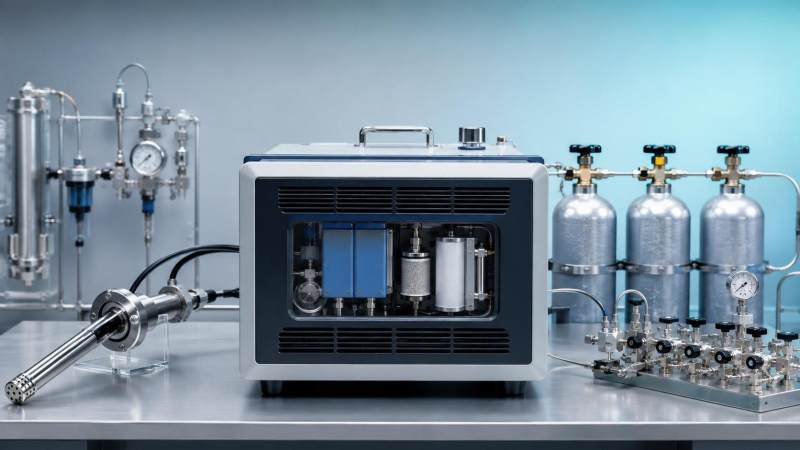
Specifications frequently list a response time such as T90, the time needed to reach 90% of the final reading after a concentration change. That figure should not be read in isolation. Total measurement delay also includes sample transport through probes and tubing, filters, water traps, pumps, sensor stabilization, and display averaging.
An analyzer with slow response or poor recovery can miss short gas releases, lag behind process changes, or retain a residual reading after the sample has changed. This is particularly relevant when checking confined spaces, locating leaks, monitoring intermittent emissions, or adjusting combustion. A fast-looking display update does not necessarily mean that the sensor has reached an accurate equilibrium.
Sensor poisoning and overload may cause permanent performance loss
Electrochemical sensors can be damaged by exposures that are not part of the normal target-gas measurement. Depending on sensor chemistry, risks may include high concentrations of target gas, solvent vapors, silicones, sulfur-containing compounds, halogenated gases, strong oxidants, and other contaminants. Oxygen sensors also have a finite service life because their internal chemistry is consumed during use.
Budget analyzers may provide limited overload protection, inadequate inlet filters, or no clear statement of exposure limits. A sensor that has been poisoned or overloaded may not fail immediately. It may instead show slower response, reduced sensitivity, elevated baseline noise, or a persistent calibration problem. Without disciplined bump testing and calibration, that deterioration can remain undetected.
Can a low-cost analyzer create safety and compliance problems?
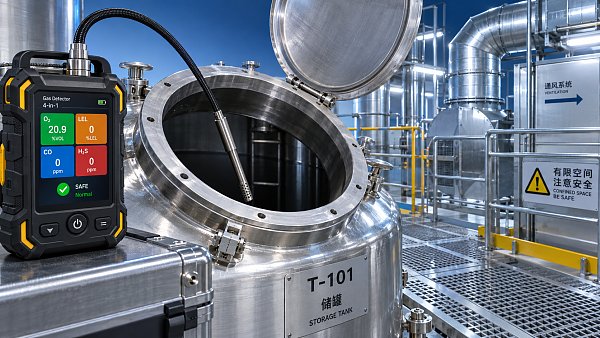
Yes, especially when an instrument is used as a safety control rather than as an informal indicator. Gas detection decisions commonly depend on alarm thresholds, measured exposure levels, oxygen concentration, lower explosive limit readings, or toxic-gas limits. An error around a decision threshold can change the action taken: whether an area is entered, ventilation is started, work is paused, or an incident is escalated.
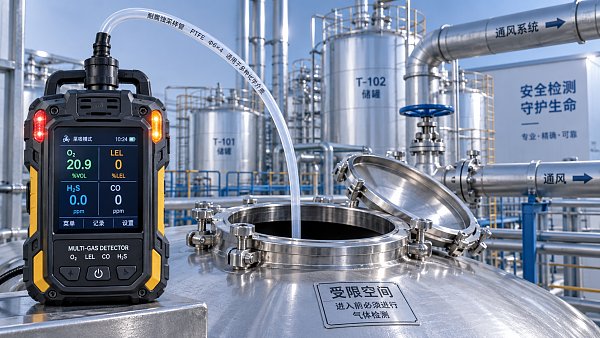
It is important to distinguish between an analyzer designed for process or laboratory measurement and a portable personal gas detector intended for life-safety use. They can use related sensor technologies, but their safety functions, alarm behavior, ruggedness, approvals, logging, and operational requirements are not interchangeable. A handheld analyzer that measures a gas concentration is not automatically suitable for personnel protection.
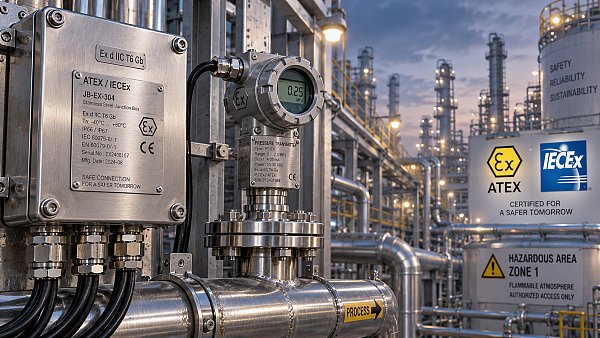
Where hazardous locations are involved, applicable explosion-protection requirements must also be assessed. ATEX and IECEx certifications apply only to the exact equipment configuration covered by the certificate, including markings, battery arrangements, and use conditions. A claim that a product is “explosion proof” or “ATEX type” is not a substitute for verifiable certification documentation.
For regulated monitoring, the issue is broader than the analyzer’s reading. Authorities, customers, laboratories, and quality systems may require documented calibration, traceable reference gases, maintenance records, data integrity controls, defined methods, and evidence that the instrument is fit for purpose. A low-cost unit with no calibration certificate, no serial-number traceability, and no stable service pathway can create a defensibility problem even if its readings appear reasonable.
What documentation gaps should raise concern?
Weak documentation is often an early warning that the instrument cannot be managed properly over its full life. A credible supplier should be able to provide a model-specific manual, technical specifications with stated test conditions, sensor cross-sensitivity information where relevant, calibration instructions, operating limits, replacement intervals, warranty terms, and a clear explanation of alarms or fault codes.
Several claims deserve careful scrutiny:
- “High accuracy” without conditions: Accuracy should state range, reference temperature, humidity conditions, calibration basis, and whether it applies across the full range.
- “Zero maintenance”: Electrochemical systems require checks, and sensors have finite lives. The maintenance burden can be reduced, but it cannot be eliminated.
- “CE certified” as proof of all compliance: CE marking is not a universal performance or hazardous-area approval. Its relevance depends on the applicable EU legislation and supporting conformity documentation.
- Unspecified sensor origin: The issue is not geography; it is whether the sensor model, batch control, expected lifetime, and replacement availability can be identified.
- Generic calibration certificates: A certificate should be tied to the individual instrument or defined calibration process, not merely be a reusable template.
Documentation shortcomings also affect international procurement. If replacement sensors, filters, pumps, chargers, or calibration accessories cannot be identified by part number and supplied consistently, the initial procurement decision creates a future operating dependency with no reliable support route.
Does lower purchase cost usually mean lower total cost?
Not necessarily. The relevant cost is the cost of obtaining dependable measurements over the required operating period. That includes calibration gas, regulators, tubing, filters, replacement sensors, labor, downtime, repair turnaround, records management, and the consequences of a wrong measurement.
A cheaper analyzer may require more frequent sensor replacement, fail sooner in corrosive service, or become unusable when a proprietary battery, pump, or sensor module is unavailable. Conversely, an expensive instrument is not automatically economical if it is over-specified for occasional non-critical checks. The decision should be based on the measurement consequence and the supportability of the device, not on purchase price alone.
There is also a hidden cost in inconsistent fleets. When nominally identical analyzers use different sensor revisions, different calibration procedures, or changing firmware without controlled documentation, organizations may struggle to compare results across sites or over time. That can affect process trends, maintenance decisions, supplier acceptance checks, and audit records.
When can a lower-cost electrochemical analyzer be reasonable?
It can be reasonable when the task has low consequence, the expected gas matrix is simple, environmental conditions are controlled, and results are confirmed by another method when needed. Examples may include educational demonstrations, preliminary equipment checks, or temporary indication where the reading does not independently authorize a safety-critical or compliance-critical decision.
Even in those settings, the instrument should be treated as a measuring device rather than a disposable electronic accessory. It needs a defined zeroing and calibration routine, known sensor life, compatible accessories, and a way to identify when its output is no longer credible.
The risk increases sharply when the analyzer is expected to perform in harsh environments, measure reactive gases at low concentrations, operate continuously, support legal reporting, control a process, or protect people. In these situations, a low-priced offer should trigger deeper technical review rather than automatic rejection or acceptance.
How should buyers evaluate a low-cost offer before placing an order?
The most useful question is: What decision will this measurement support, and what happens if it is wrong? That answer should determine the acceptance criteria.
Request the complete sensor and analyzer specifications, including measuring range, resolution, stated accuracy, repeatability if available, response time, warm-up behavior, operating temperature, humidity limits, pressure limits, cross-sensitivity data, expected sensor life, overload limits, and required calibration gases. Ask whether the quoted performance applies to a new instrument only or throughout the recommended calibration interval.
Confirm the sampling arrangement. A diffusion instrument and a pumped analyzer serve different purposes. If a pump is included, establish its flow stability, low-flow alarm behavior, filter arrangement, tubing compatibility, and whether the sample train can introduce delays or adsorption losses. For corrosive, wet, or particulate-laden samples, evaluate the entire gas path rather than only the sensor.
Before approving a supplier, clarify how calibration and repair will work after delivery. Useful evidence includes serial-numbered test records, calibration procedures, availability of replacement cells, firmware control, service contacts, and lead times for consumables. Where performance is consequential, define a receiving inspection using certified calibration gas and compare the instrument’s response against agreed acceptance limits.
Low-cost electrochemical gas analyzers are not risky because they are inexpensive in themselves. They become risky when buyers treat a measurement device as a commodity and assume that a displayed number is automatically trustworthy. The appropriate standard is simple: the instrument, its calibration system, and its support documentation must be reliable enough for the decision that the reading will drive.
Recommended for You
 How to verify accuracy claims for industrial quality analyzersVerify accuracy claims for industrial quality analyzers with calibration checks, independent testing, and clear acceptance criteria. Learn how to reduce risk and buy with confidence.
 How to calculate cooling loads for an industrial analyzer shelterSize industrial analyzer shelter cooling with confidence. Learn to calculate equipment heat, solar gains, and ventilation loads, then select HVAC capacity for reliable analyzer performance.
 Industrial Safety vs. Emission Monitoring: What Are the Differences?What are the main differences between industrial safety and emission monitoring? Compare goals, sensors, response times, and compliance needs to choose the right systems for your facility.
 Is Remote Monitoring Worth the Cost for Small Emission Sources?Is it worth investing in remote monitoring for small emission sources? Compare costs, compliance needs, and potential savings to choose the right solution for your operation.
 How Do You Handle Analyzer Failure During an Environmental Audit?Learn how to handle analyzer failure during environmental compliance audit procedures. Protect evidence, verify data, and restore monitoring with this practical response guide.
 Do VOC Monitors Require Explosion-Proof Certification?Does VOC monitoring require explosion-proof certification? Learn when approval is needed, compare ATEX and IECEx, and choose the right monitor for your site.
 How sample conditioning affects accuracy in petrochemical analyzersImprove accuracy in petrochemical analyzers with smarter sample conditioning. Discover how phase control, filtration, and transport design prevent bias and deliver reliable process data.
 How to troubleshoot sensor drift in industrial gas detectorsIndustrial gas detectors showing sensor drift? Learn how to verify calibration gas, identify root causes, and determine when sensor replacement is needed for reliable monitoring.
 How to judge whether a competitive price reflects real valueCompetitive Price: learn how to compare scope, compliance, performance, and lifecycle costs to identify real value, reduce risk, and make smarter purchasing decisions.
 When custom gas analysis is the right fit for complex process streamsCustom gas analysis for complex process streams: learn when tailored sampling, interference control, and reliable measurement design deliver confident decisions.
 When does a laser gas analyzer meet stack emissions monitoring needs?Laser gas analyzer for stack emissions: learn when it delivers fast, reliable data, how to assess installation risks, and what to verify for CEMS compliance.
 How to select a hazardous gas analyzer for confined spacesHazardous gas analyzer selection for confined spaces: compare sensors, sampling, certifications, alarms, and maintenance to protect workers and choose with confidence.
 When is a single gas analyzer sufficient for workplace safety monitoring?Discover when a single gas analyzer delivers reliable workplace safety monitoring, and learn the key limits, calibration needs, and risks that require broader detection.
 How to choose an ambient gas analyzer for low-level leak detectionAmbient gas analyzer selection for low-level leak detection: compare sensitivity, cross-sensitivity, sampling design, alarms, and calibration for reliable site performance.
 How to tell when an oxygen sensor needs replacementOxygen sensor replacement signs explained: learn how live data, fault codes, wiring checks, and exhaust inspections pinpoint the real issue before you buy.
 How laser gas analyzers improve combustion control in steel furnacesLaser gas analyzer for steel industry applications delivers fast in-situ O₂ and CO data to optimize furnace combustion, cut fuel waste, and improve steel heating stability.
 How to verify whether explosion proof equipment meets site requirementsExplosion proof equipment verification made practical: match zones, gas or dust groups, temperature classes, certificates, and installation conditions for confident compliance.
 How industrial gas analysis helps detect contamination before releaseIndustrial Gas Analysis helps detect moisture, oil, oxygen, and toxic contaminants before release—protecting processes, ensuring compliance, and reducing costly risks.
 When is electrochemistry detection the right choice for water analysis?Electrochemistry detection for water analysis: learn when fast, reliable monitoring of ions, chlorine, pH, and more delivers actionable results.
 How industrial standards reduce quality risks in supplier selectionIndustrial Standard guidance helps quality and safety managers reduce supplier risks, verify compliance, strengthen traceability, and build resilient instrumentation supply chains.
 When does a multi-component system reduce installation complexity?Multi component systems reduce installation complexity when they eliminate field interfaces, streamline commissioning, and provide proven compatibility. Learn how to assess total cost and supplier accountability.
 How to size an industrial control shelter for outdoor equipmentIndustrial control shelter sizing guide: optimize layout, HVAC, access, safety, and expansion space for reliable outdoor equipment operations.
 How flue analysis helps verify combustion efficiencyFlue analysis verifies combustion efficiency by assessing O2, CO, CO2, and stack temperature to identify excess air, incomplete combustion, and heat losses.
 How to select industrial gas detectors for confined spacesIndustrial gas detectors for confined spaces: learn how to match sensors, sampling methods, alarms, and certifications to real atmospheric hazards.
 When does a laser oxygen analyzer outperform zirconia sensors?Laser oxygen analyzer vs. zirconia sensors: compare speed, selectivity, maintenance, gas chemistry, and installation needs to choose the right oxygen measurement solution.
 How to select a percent range analyzer for process measurementsPercent range analyzer selection made practical: compare accuracy, sample systems, calibration, gas matrix, integration, and lifecycle cost for reliable process measurements.
 How explosion proof analysis verifies safe equipment for hazardous areasExplosion proof analysis verifies hazardous-area equipment by matching certifications, temperature ratings, installation details, and inspection controls for safer compliance.
 When does fixed gas detection need point sensors instead of open-path monitoring?Fixed gas detection: discover when point sensors outperform open-path monitoring for predictable leaks, enclosed zones, local alarms, and safer design decisions.
 How to choose industrial metrology systems for tight-tolerance partsIndustrial metrology guide for tight-tolerance parts: compare CMMs, optical scanners, gauges, uncertainty, workflow, and traceable inspection strategies.
 How process metrology reduces measurement variation in productionProcess metrology reduces production measurement variation by improving traceability, uncertainty control, calibration, and reliable quality decisions.
 How to select an industrial monitoring analyzer for harsh environmentsIndustrial monitoring analyzer selection for harsh environments: evaluate sampling, durability, hazardous-area compliance, accuracy, maintenance, and data reliability.
 How calibration intervals affect test and measurement equipment accuracyTest and measurement equipment calibration intervals directly affect accuracy, risk, compliance, and uptime. Learn how to set evidence-based schedules that protect critical decisions.
Search Categories
Search Categories
- Smart Meters & Power Quality
- Transformer Gas Analyzers
- BESS Thermal Runaway Detectors
- Energy, Power & Smart Grid Monitoring
- Optical Profilers & CMM
- Ultrasonic & X-Ray NDT
- Calibration Standards
- Precision Metrology & NDT
- Water Quality Analyzers
- CEMS & VOCs Monitors
- Price Trends
- Import & Export Updates
- Market Trends
- Industry News
- Industry Insights
Latest Article
- How to verify accuracy claims for industrial quality analyzersVerify accuracy claims for industrial quality analyzers with calibration checks, independent testing, and clear acceptance criteria. Learn how to reduce risk and buy with confidence.Posted by:
- How to calculate cooling loads for an industrial analyzer shelterSize industrial analyzer shelter cooling with confidence. Learn to calculate equipment heat, solar gains, and ventilation loads, then select HVAC capacity for reliable analyzer performance.Posted by:
- Industrial Safety vs. Emission Monitoring: What Are the Differences?What are the main differences between industrial safety and emission monitoring? Compare goals, sensors, response times, and compliance needs to choose the right systems for your facility.Posted by:
Please give us a message
