What detection limit is needed for NH3 environmental monitoring?


The detection limit needed for NH3 environmental monitoring depends less on the word “environmental” than on the decision the measurement must support. A monitor intended to identify background changes around an agricultural area needs to resolve much lower concentrations than one used to detect an accidental release near an ammonia storage or refrigeration installation. For most technical evaluations, the right starting point is to define the lowest concentration that would trigger an action, reporting obligation, investigation, or operating change, then specify an analyzer capable of measuring below that level with acceptable uncertainty.
A low advertised detection limit alone is not enough. Ammonia is reactive, water-soluble, prone to surface losses, and vulnerable to interference from humidity and changing sample conditions. A high accuracy NH3 analyzer for environmental monitoring must therefore provide useful sensitivity at the relevant concentration range while maintaining stable zero behavior, controlled sampling, adequate response time, and a defensible calibration approach.
Start with the monitoring objective, not the instrument brochure
“Detection limit” is often used as though it were a universal purchasing requirement. It is not. A sub-ppb capability may be appropriate for atmospheric research, regional deposition studies, or fence-line assessments where small concentration changes matter. The same capability may add cost and maintenance burden without improving decisions at a loading terminal, fertilizer handling area, wastewater treatment facility, or industrial site where the practical concern is identifying elevated releases against a much higher local baseline.
Technical evaluators should first write down the minimum concentration that matters operationally. That concentration may be the point at which a site begins an investigation, adjusts ventilation, checks abatement performance, confirms a process upset, or escalates a potential community odor complaint. The instrument’s reliable quantification capability should sit comfortably below that threshold. A common engineering approach is to seek a quantification level several times lower than the action threshold, so that readings near the threshold are distinguishable from ordinary measurement noise and drift.
For example, if a monitoring plan requires meaningful differentiation around a low-concentration ambient target, an analyzer that merely detects NH3 at that target may be inadequate. It may repeatedly report variable low-end readings without supporting a confident decision. Conversely, if the concern is identifying a large fugitive emission, specifying extreme low-level sensitivity can distract from more important requirements such as fast response, high-range capacity, robust sample conditioning, and alarm integration.
Detection limit is therefore a decision-performance parameter. It should be tied to the lowest concentration that must be measured reliably, not to the lowest theoretical concentration an instrument can report under favorable laboratory conditions.
Different environmental applications create very different lower-range requirements
Ambient NH3 monitoring is usually the most demanding application for detection limit and measurement stability. Concentrations can be low, variable, and strongly influenced by local meteorology, nearby land use, traffic patterns, fertilizer application, livestock activity, and atmospheric chemistry. A system used to observe these variations needs enough sensitivity to separate real concentration changes from instrument noise, baseline movement, and contamination within the sampling train. Long-term comparability can matter as much as instantaneous sensitivity.
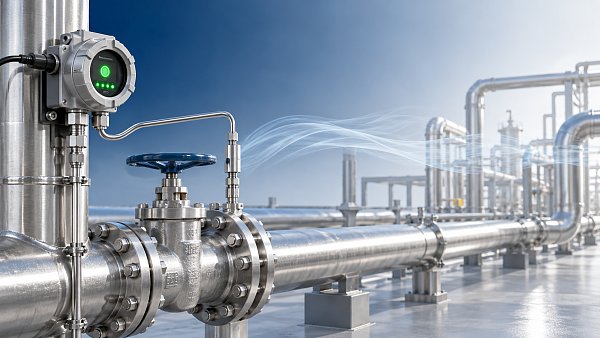
Fence-line monitoring occupies a different position. The goal may be to identify off-site migration, establish directional patterns, correlate concentration events with wind data, or provide evidence for follow-up inspections. Low-level performance can still be important, particularly where the site must distinguish its contribution from background ammonia. Yet the analyzer must also tolerate intermittent spikes that may be far above baseline. The selected range should be broad enough that elevated events do not saturate the instrument or produce lengthy recovery periods.
At industrial emission points, the lowest detectable value may be less important than the analyzer’s ability to operate in a difficult sample matrix. Stack gas, vents, exhaust ducts, and process-area sampling can involve high humidity, temperature variation, particulates, pressure changes, and chemically active compounds. In these cases, a nominally excellent detection limit is of limited value if NH3 is lost in an unheated line, dissolved in condensate, adsorbed onto filters, or altered by inconsistent sample extraction. Measurement integrity begins before the gas reaches the sensor.
Odor-response programs require an especially careful interpretation. Ammonia can contribute to a complaint or be a useful process indicator, but odor perception is not determined by NH3 concentration alone. Other nitrogen-containing compounds, sulfur compounds, volatile organic compounds, local humidity, and release timing can all affect the observed nuisance. A monitor selected solely because it detects extremely low ammonia may create a false sense that it can explain every odor event. The better approach is to decide whether NH3 is being used as a direct parameter, a screening indicator, or one element of a broader monitoring strategy.
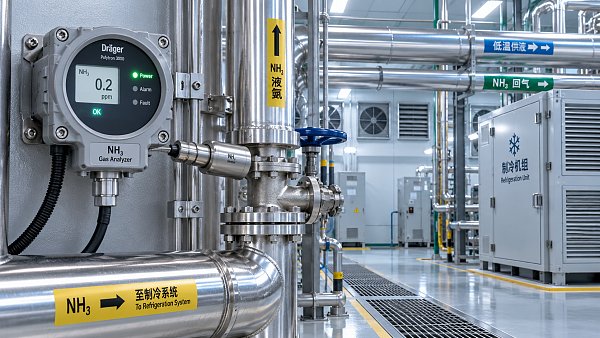
Near leak-prone equipment, such as refrigeration systems or chemical storage areas, rapid recognition of a release may be the primary requirement. Here, a safety detection system and an environmental monitoring analyzer may serve related but distinct purposes. Safety devices are selected around hazard detection, alarm behavior, placement, and response requirements. Environmental analyzers may support trend analysis, emission investigation, and recordkeeping. Combining both roles in one specification without defining which function governs can result in an instrument that is poorly optimized for either.
Detection limit, resolution, accuracy, and uncertainty should not be treated as interchangeable
Specifications often make these terms appear similar, but they answer different questions. Detection limit describes the lowest signal that can be distinguished from a defined noise condition. Resolution describes the smallest displayed or reported increment. Accuracy describes how close a measured value is to a reference value under stated conditions. Precision describes repeatability. For an environmental monitoring program, the decision risk usually comes from their interaction rather than from any one number.
An analyzer may display very small concentration increments while having substantial uncertainty at the bottom of its range. That display resolution does not prove low-level accuracy. Similarly, an instrument may achieve a favorable detection-limit specification during a short, controlled test but show greater drift during long unattended operation. Technical evaluations should ask how the quoted detection limit was determined: averaging time, temperature, humidity, sample matrix, zero-gas quality, calibration conditions, and whether the value represents an instrument-only test or an installed-system result.
The reporting interval also matters. A system designed to reveal slow ambient changes may use longer averaging periods to improve signal-to-noise performance. A leak-detection or plume-tracking application may need shorter measurement intervals, which can make low-level readings noisier. Neither choice is inherently better. The selected averaging time must match the event duration the monitoring program needs to observe. A long average can smooth a short release into a modest value; a very short average can create a stream of unstable low-level signals that are difficult to interpret.
For this reason, procurement documents should avoid a bare requirement such as “detection limit below X.” A more usable requirement defines the concentration range, averaging period, expected ambient conditions, maximum acceptable uncertainty near the decision point, and the required response behavior after elevated concentrations. This gives suppliers a clearer basis for stating whether their design can meet the application rather than simply quoting the best published figure.
Sampling design can erase the advantage of a sensitive analyzer
NH3 is one of the gases for which the sample path deserves the same scrutiny as the analyzer itself. It can adsorb to tubing, filters, fittings, and other wetted surfaces. Moisture can affect transport and create losses through condensation. A long, cool, contaminated, or poorly maintained sample line can delay the response to a real event and depress the measured concentration. In low-level monitoring, those losses can be comparable to the concentration difference the project is trying to resolve.
Material selection should be reviewed for the full path from inlet to measurement cell, including fittings, manifolds, filters, pumps, and calibration connections. The correct choice depends on the analytical method and operating conditions, but the evaluation should require the supplier to identify surfaces that contact the sample and explain their approach to minimizing NH3 retention. Heated or temperature-controlled sampling may be necessary in some applications, particularly where water condensation is plausible. It should not be added automatically, however, because heating can introduce power, maintenance, and installation implications.
Inlet location can be equally influential. A monitor placed too close to an exhaust, washdown area, livestock enclosure, loading point, or ventilation discharge may mainly measure highly local turbulence rather than representative environmental conditions. A fence-line monitor also needs meteorological context if the purpose is source attribution. Wind direction and speed, temperature, rainfall, and site activity records can be more useful than an additional decimal place in the NH3 reading when investigators need to explain a concentration event.
Calibration and zero checks must reflect the installed system. A technically sound analyzer can still produce misleading values when zero gas is contaminated, calibration gas delivery is inconsistent, or the calibration path bypasses components that affect normal sample transport. Evaluators should establish whether routine checks assess the analyzer only or the full sample system. The latter is often more revealing for ammonia applications.
Choose a range that preserves low-end performance without sacrificing event capability
NH3 monitoring frequently involves a wide dynamic range. Background values may be low, while nearby agricultural activity, process releases, cleaning operations, transfer activity, or equipment failures can create sharp excursions. A single-range analyzer may perform well at one end and poorly at the other. At the low end, the issue is noise and drift; at the high end, it may be saturation, nonlinearity, long recovery, or contamination of the sample system.
There are several practical ways to handle this. One is to select an analyzer with a sufficiently wide linear range and documented recovery performance. Another is to use separate monitoring approaches for low-level environmental characterization and high-concentration operational detection. A third is to design the monitoring plan around expected conditions, accepting that a background-oriented instrument may flag extreme events without providing their exact peak concentration.
The right decision depends on what happens after an elevated reading. If the response is simply to initiate an inspection, an over-range alarm may be adequate. If the reading is used to estimate emission magnitude, demonstrate performance of a control system, or support formal reporting, the usable upper range and recovery behavior require much closer attention. A system that takes a long time to return to baseline after a plume can obscure subsequent events and distort time-series data.
Questions that expose weak specifications during technical evaluation
Before selecting a high accuracy NH3 analyzer for environmental monitoring, technical teams should ask suppliers to answer a small set of application-specific questions in writing:
- At what averaging time and under what test conditions is the stated detection limit achieved?
- What is the expected uncertainty at the project’s lowest reportable concentration, rather than only at mid-range calibration points?
- How does humidity affect the measurement, and how is that effect measured, compensated, or controlled?
- Which sample-contact materials are used, and what response and recovery performance is expected after low and high NH3 exposure?
- What calibration frequency, zero-check procedure, consumables, and maintenance actions are required to sustain the stated performance?
- Can the instrument distinguish NH3 from relevant interferents in the expected sample matrix, or does the application require additional conditioning or confirmatory analysis?
- Does the proposed configuration measure the full installed sampling system, including inlet and line losses, during verification?
- How are data quality flags, communication failures, calibration events, and invalid readings recorded for later review?
These questions shift the assessment from a comparison of headline specifications to a comparison of usable measurement systems. They also reveal whether the proposed analyzer is suited to unattended field operation or primarily optimized for controlled conditions.
Set the specification around defensible decisions
For low-level ambient work, prioritize low noise, stable baseline behavior, controlled sampling, and documented performance across expected humidity and temperature conditions. For fence-line programs, balance sensitivity with a range that can capture intermittent site-related events and pair the analyzer with location and meteorological planning. For industrial source monitoring, give strong weight to sample extraction, material compatibility, conditioning, and recovery after elevated concentrations. For rapid release detection, make sure environmental measurement objectives are not being confused with life-safety alarm requirements.
The most defensible detection-limit requirement is the one that supports the smallest concentration difference a project must act on, under the conditions in which the instrument will actually operate. That may lead to an ultra-low-level analyzer, but it may also lead to a more robust system with a less impressive laboratory detection limit and stronger installed performance. In ammonia monitoring, that distinction often determines whether the data clarifies an environmental question or merely produces numbers.
Recommended for You
 How to verify accuracy claims for industrial quality analyzersVerify accuracy claims for industrial quality analyzers with calibration checks, independent testing, and clear acceptance criteria. Learn how to reduce risk and buy with confidence.
 How to calculate cooling loads for an industrial analyzer shelterSize industrial analyzer shelter cooling with confidence. Learn to calculate equipment heat, solar gains, and ventilation loads, then select HVAC capacity for reliable analyzer performance.
 Industrial Safety vs. Emission Monitoring: What Are the Differences?What are the main differences between industrial safety and emission monitoring? Compare goals, sensors, response times, and compliance needs to choose the right systems for your facility.
 Is Remote Monitoring Worth the Cost for Small Emission Sources?Is it worth investing in remote monitoring for small emission sources? Compare costs, compliance needs, and potential savings to choose the right solution for your operation.
 How Do You Handle Analyzer Failure During an Environmental Audit?Learn how to handle analyzer failure during environmental compliance audit procedures. Protect evidence, verify data, and restore monitoring with this practical response guide.
 Do VOC Monitors Require Explosion-Proof Certification?Does VOC monitoring require explosion-proof certification? Learn when approval is needed, compare ATEX and IECEx, and choose the right monitor for your site.
 How sample conditioning affects accuracy in petrochemical analyzersImprove accuracy in petrochemical analyzers with smarter sample conditioning. Discover how phase control, filtration, and transport design prevent bias and deliver reliable process data.
 How to troubleshoot sensor drift in industrial gas detectorsIndustrial gas detectors showing sensor drift? Learn how to verify calibration gas, identify root causes, and determine when sensor replacement is needed for reliable monitoring.
 How to judge whether a competitive price reflects real valueCompetitive Price: learn how to compare scope, compliance, performance, and lifecycle costs to identify real value, reduce risk, and make smarter purchasing decisions.
 When custom gas analysis is the right fit for complex process streamsCustom gas analysis for complex process streams: learn when tailored sampling, interference control, and reliable measurement design deliver confident decisions.
 When does a laser gas analyzer meet stack emissions monitoring needs?Laser gas analyzer for stack emissions: learn when it delivers fast, reliable data, how to assess installation risks, and what to verify for CEMS compliance.
 How to select a hazardous gas analyzer for confined spacesHazardous gas analyzer selection for confined spaces: compare sensors, sampling, certifications, alarms, and maintenance to protect workers and choose with confidence.
 When is a single gas analyzer sufficient for workplace safety monitoring?Discover when a single gas analyzer delivers reliable workplace safety monitoring, and learn the key limits, calibration needs, and risks that require broader detection.
 How to choose an ambient gas analyzer for low-level leak detectionAmbient gas analyzer selection for low-level leak detection: compare sensitivity, cross-sensitivity, sampling design, alarms, and calibration for reliable site performance.
 How to tell when an oxygen sensor needs replacementOxygen sensor replacement signs explained: learn how live data, fault codes, wiring checks, and exhaust inspections pinpoint the real issue before you buy.
 How laser gas analyzers improve combustion control in steel furnacesLaser gas analyzer for steel industry applications delivers fast in-situ O₂ and CO data to optimize furnace combustion, cut fuel waste, and improve steel heating stability.
 How to verify whether explosion proof equipment meets site requirementsExplosion proof equipment verification made practical: match zones, gas or dust groups, temperature classes, certificates, and installation conditions for confident compliance.
 How industrial gas analysis helps detect contamination before releaseIndustrial Gas Analysis helps detect moisture, oil, oxygen, and toxic contaminants before release—protecting processes, ensuring compliance, and reducing costly risks.
 When is electrochemistry detection the right choice for water analysis?Electrochemistry detection for water analysis: learn when fast, reliable monitoring of ions, chlorine, pH, and more delivers actionable results.
 How industrial standards reduce quality risks in supplier selectionIndustrial Standard guidance helps quality and safety managers reduce supplier risks, verify compliance, strengthen traceability, and build resilient instrumentation supply chains.
 When does a multi-component system reduce installation complexity?Multi component systems reduce installation complexity when they eliminate field interfaces, streamline commissioning, and provide proven compatibility. Learn how to assess total cost and supplier accountability.
 How to size an industrial control shelter for outdoor equipmentIndustrial control shelter sizing guide: optimize layout, HVAC, access, safety, and expansion space for reliable outdoor equipment operations.
 How flue analysis helps verify combustion efficiencyFlue analysis verifies combustion efficiency by assessing O2, CO, CO2, and stack temperature to identify excess air, incomplete combustion, and heat losses.
 How to select industrial gas detectors for confined spacesIndustrial gas detectors for confined spaces: learn how to match sensors, sampling methods, alarms, and certifications to real atmospheric hazards.
 When does a laser oxygen analyzer outperform zirconia sensors?Laser oxygen analyzer vs. zirconia sensors: compare speed, selectivity, maintenance, gas chemistry, and installation needs to choose the right oxygen measurement solution.
 How to select a percent range analyzer for process measurementsPercent range analyzer selection made practical: compare accuracy, sample systems, calibration, gas matrix, integration, and lifecycle cost for reliable process measurements.
 How explosion proof analysis verifies safe equipment for hazardous areasExplosion proof analysis verifies hazardous-area equipment by matching certifications, temperature ratings, installation details, and inspection controls for safer compliance.
 When does fixed gas detection need point sensors instead of open-path monitoring?Fixed gas detection: discover when point sensors outperform open-path monitoring for predictable leaks, enclosed zones, local alarms, and safer design decisions.
 How to choose industrial metrology systems for tight-tolerance partsIndustrial metrology guide for tight-tolerance parts: compare CMMs, optical scanners, gauges, uncertainty, workflow, and traceable inspection strategies.
 How process metrology reduces measurement variation in productionProcess metrology reduces production measurement variation by improving traceability, uncertainty control, calibration, and reliable quality decisions.
 How to select an industrial monitoring analyzer for harsh environmentsIndustrial monitoring analyzer selection for harsh environments: evaluate sampling, durability, hazardous-area compliance, accuracy, maintenance, and data reliability.
 How calibration intervals affect test and measurement equipment accuracyTest and measurement equipment calibration intervals directly affect accuracy, risk, compliance, and uptime. Learn how to set evidence-based schedules that protect critical decisions.
Search Categories
Search Categories
- Smart Meters & Power Quality
- Transformer Gas Analyzers
- BESS Thermal Runaway Detectors
- Energy, Power & Smart Grid Monitoring
- Optical Profilers & CMM
- Ultrasonic & X-Ray NDT
- Calibration Standards
- Precision Metrology & NDT
- Water Quality Analyzers
- CEMS & VOCs Monitors
- Price Trends
- Import & Export Updates
- Market Trends
- Industry News
- Industry Insights
Latest Article
- How to verify accuracy claims for industrial quality analyzersVerify accuracy claims for industrial quality analyzers with calibration checks, independent testing, and clear acceptance criteria. Learn how to reduce risk and buy with confidence.Posted by:
- How to calculate cooling loads for an industrial analyzer shelterSize industrial analyzer shelter cooling with confidence. Learn to calculate equipment heat, solar gains, and ventilation loads, then select HVAC capacity for reliable analyzer performance.Posted by:
- Industrial Safety vs. Emission Monitoring: What Are the Differences?What are the main differences between industrial safety and emission monitoring? Compare goals, sensors, response times, and compliance needs to choose the right systems for your facility.Posted by:
Please give us a message