
When does a laser oxygen analyzer outperform zirconia sensors?


A laser oxygen analyzer outperforms a zirconia sensor when the measurement problem is defined by gas-path selectivity, rapid process changes, difficult sample chemistry, or the practical burden of keeping a hot electrochemical probe clean and representative. Zirconia remains a strong choice for many combustion duties: it is direct, mature, and well suited to stable high-temperature flue gas when oxygen is the dominant measurement concern. The advantage shifts when the process gas contains compounds that disturb the probe, when a fast control loop needs a near-real-time oxygen signal, or when extracting and conditioning a sample introduces more error than the analyzer itself.
The distinction begins with the sensing principle. A zirconia probe measures oxygen partial pressure through an electrochemical cell operating at elevated temperature. It compares the process gas with a reference gas and converts the resulting cell voltage into oxygen concentration. A laser oxygen analyzer generally uses tunable diode laser absorption spectroscopy, directing a narrow optical wavelength through the gas and measuring oxygen-specific absorption. The laser does not require contact between a ceramic electrolyte and the process stream. That difference affects response, maintenance, installation, and the kinds of interference that matter.
Situations that favor optical oxygen measurement
Fast oxygen changes are the clearest reason to consider laser absorption. In a furnace with changing fuel composition, staged combustion, rapid load transitions, or burner balancing, the useful signal is the oxygen concentration at the point where combustion is occurring. A zirconia installation can respond quickly when mounted correctly, but response is still influenced by probe temperature, protective hardware, gas diffusion around the tip, and any sampling arrangement. A laser path can observe the gas directly across a duct, stack, or process chamber, avoiding the transport delay caused by a sample line.
That advantage is meaningful only when the optical path sees a representative section of gas. A laser beam installed too near an air leak, wall boundary layer, dilution port, or poorly mixed injection point may produce a fast but misleading value. The result can look like superior responsiveness while actually reflecting local stratification. Before assigning value to a short response specification, the measurement location must be compared with the control objective: burner-zone trimming, furnace excess oxygen, post-combustion verification, or emissions-related monitoring do not necessarily require the same point of measurement.
High dust loading changes the comparison in a more conditional way. Zirconia probes are exposed to ash, particulates, slagging, and deposits at the sensing end. A blocked diffusion path or coated electrode can slow the reading and bias it. Cross-duct laser systems avoid inserting a sensing cell into the gas, but their windows still need to remain optically clear. Purge air, window material, sight-tube geometry, and alignment stability become part of the measurement design. A laser system is preferable when window protection can be engineered reliably and probe fouling has been the limiting failure mode. It is not automatically preferable in a duct where deposits repeatedly obscure any optical opening.
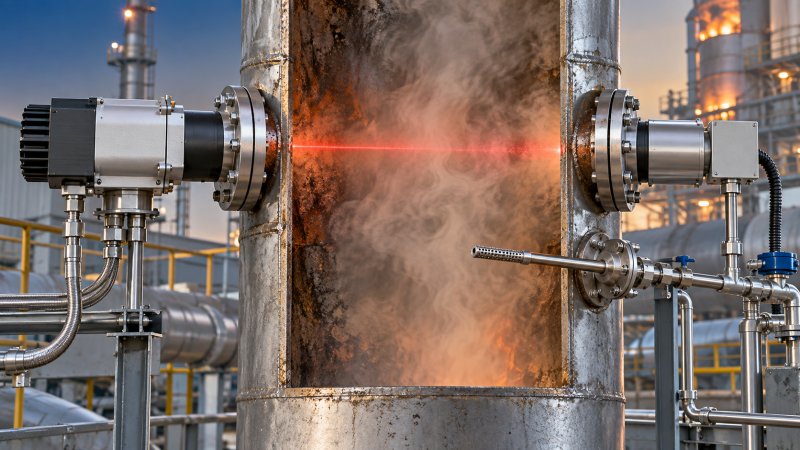
Corrosive or reducing gas chemistry can also move the balance toward laser technology. Sulfur-bearing species, halogens, metallic vapors, alkalis, reducing gases, and condensable contaminants may shorten zirconia cell life or alter its apparent behavior. The exact impact depends on temperature, concentration, thermal cycling, probe construction, and exposure duration. An optical analyzer is separated from the gas by windows and a measurement path rather than an electrochemical cell, so it removes several probe-degradation mechanisms. It does not remove all materials concerns: window coatings, corrosive attack on flanges, and purge-system compatibility still require review.
Where zirconia remains the more appropriate instrument
A laser oxygen analyzer is not a universal upgrade. For a conventional combustion application with reasonably clean, hot, well-mixed flue gas and a straightforward excess-oxygen control target, zirconia can be the simpler and more proportionate solution. Its operating principle is closely matched to oxygen measurement in such conditions, and a single in-situ probe may involve less mechanical arrangement than opposing optical heads, a clear beam path, purging hardware, and alignment access.
Very low oxygen duties need careful comparison rather than a general assumption that laser is inherently better. A laser analyzer’s attainable performance depends on optical path length, pressure, temperature, spectral line selection, detector design, background absorption, and signal processing. Zirconia performance is affected by reference-gas integrity, cell condition, process pressure, temperature stability, and leakage. The required range, alarm point, and allowable error at that alarm point should be written before comparing headline accuracy values. An accuracy statement expressed as a percentage of reading does not answer the same question as one expressed relative to full scale.
Limited access can favor either technology. A zirconia probe needs a suitable nozzle, insertion depth, thermal protection where required, and physical access for removal. A cross-stack laser system needs two opposing ports or a reflective arrangement, stable mounting, purge connections, and a line of sight that will not be interrupted by internal equipment. A single-sided laser configuration can solve the second-port issue, yet it introduces its own optical geometry and maintenance considerations. Space constraints should be assessed with installation drawings rather than treated as a general preference for one method.
Gas temperature and pressure are not secondary inputs
Zirconia cells require elevated operating temperature, whether supplied by process heat, an internal heater, or both. If the surrounding gas is too cool, wet, or thermally unstable, probe behavior and warm-up performance become important. A heated probe in a cool stream may work well, but the installation must prevent condensation at the sensing region and avoid conditions that cause thermal shock. High process temperatures bring different concerns: material limits, radiation shielding, insertion length, and mechanical distortion all affect service life.
Laser spectroscopy measures molecular absorption, and absorption strength is influenced by gas temperature and pressure. Pressure broadens spectral features; temperature changes molecular population and line shape. A properly configured analyzer accounts for these variables within its specified operating envelope, but the process description still matters. A stream that cycles between vacuum and elevated pressure, or a reactor with strong temperature gradients across the optical path, should not be evaluated from a nominal operating condition alone. The manufacturer’s stated pressure and temperature limits must be separated from the actual range at the measurement location, including startup, purge, regeneration, and upset conditions.
Moisture deserves similar attention. Oxygen concentration may be reported on a wet or dry basis, and the two are not interchangeable. Water vapor dilutes the oxygen fraction in a wet stream. A sampled system that cools gas can remove water and change the reported concentration unless the basis is controlled. Direct laser measurement preserves the gas in its original state, which is useful when wet-basis oxygen is needed. When a dry-basis value is required, the conversion needs a dependable moisture measurement or a justified process assumption. Apparent disagreement between instruments is often a basis mismatch rather than analyzer error.
Selectivity is valuable, but spectral interference still needs review
A laser oxygen analyzer targets a specific oxygen absorption line, giving it strong analytical selectivity compared with methods that infer oxygen from broader electrochemical behavior. This is particularly useful where the sample contains combustible gases, variable carbon dioxide, steam, or nitrogen-rich components that make indirect interpretations undesirable. Yet “selective” does not mean immune to every process effect. Nearby spectral features, pressure-related line broadening, dust attenuation, window contamination, and changes in optical transmission can influence signal quality. The vendor should be asked to evaluate the full expected gas composition, not merely the normal composition.
Zirconia has its own interference pattern. It responds to oxygen activity, and combustible species reaching the probe can consume oxygen locally or create a false low-oxygen indication. CO, hydrogen, hydrocarbons, and reducing components are especially important where incomplete combustion or process upsets occur. A catalytic filter or sampling arrangement may address certain conditions, but it may also alter response time or add maintenance. The relevant question is whether the oxygen at the probe represents the oxygen needed for control, not whether the sensor produces a stable number.
Maintenance moves rather than disappears
Comparisons sometimes frame laser technology as maintenance-free and zirconia as maintenance-intensive. That is too broad to support a selection. Zirconia maintenance centers on calibration checks, reference air, heater and cell condition, protective filters, probe removal, and inspection for deposits or cracking. Service intervals can be acceptable when the process is compatible with the probe and access is well planned.
Laser systems replace several of those tasks with optical and mechanical responsibilities. Windows require inspection and cleaning; purge flow must be available and clean; mounting must resist vibration; alignment should remain stable through thermal expansion; and signal diagnostics need to distinguish genuine oxygen changes from declining transmission. A good optical instrument reports signal strength, transmission, and fault status separately from concentration. Without those diagnostics, a contaminated window can be misread as a process issue or, conversely, a real process deviation can be dismissed as an optical problem.
Maintenance access should be evaluated at the engineering stage. Window assemblies placed behind insulation, high above a furnace floor, or beside hot pipework may be technically installable but difficult to service. The same applies to zirconia probes installed where removal requires scaffolding or a shutdown. A technology choice that ignores access commonly creates later pressure to extend maintenance intervals beyond what the gas conditions support.
A practical basis for selection
Start with a short operating envelope rather than an analyzer datasheet. Record oxygen range, normal and upset gas composition, wet or dry reporting basis, pressure range, temperature at the sensing point, dust character, moisture behavior, flow regime, expected response requirement, and available mounting locations. Include startup and shutdown conditions. These periods often contain the temperature swings, condensation risk, or reducing gas excursions that determine instrument reliability.
Then define what a bad reading would look like in the control system. A slow but accurate signal can be unsuitable for burner control. A rapid local reading can be unsuitable for furnace-average optimization. A stable zirconia signal drifting because of probe contamination and an optical signal falling because of dirty windows can both appear as an oxygen trend. Diagnostic signals, inspection methods, and validation against a reference method should therefore be part of the functional requirement.
Laser absorption earns its advantage when its line-of-sight measurement captures the required gas state while avoiding the zirconia probe’s exposure, thermal, or response constraints. Zirconia remains the sounder choice where direct insertion is compatible with the process and an optical installation would create a less representative or less maintainable measurement. The final selection should follow the gas path and failure mechanisms, not a generic ranking of analyzer technologies.
Recommended for You
 How to choose the right detection range for a custom gas analyzerChoose the right custom gas analyzer detection range with practical guidance on accuracy, exposure limits, calibration, and supplier evaluation.
 How does multi component monitoring detect gases in stack emissions?Discover how multi component monitoring detects stack gases, manages interference and supports reliable emissions reporting. Explore key CEMS selection factors.
 How bright should an industrial monitor be for outdoor use?Choosing an outdoor industrial monitor? Learn why 1,000 nits is a starting point and how glare, contrast, and heat affect sunlight readability.
 How does water vapor affect infrared gas analyzers?Infrared gas analyzers can be affected by humidity, condensation and spectral interference. Learn how to protect sample integrity and achieve reliable results.
 How to reduce customer support response timesReduce Customer Support response times with actionable tips for reporting equipment faults, choosing the right channel, and getting expert help faster.
 How to choose a low range analyzer for trace-level measurementsChoose the right low range analyzer for trace-level measurements. Compare detection limits, sampling, calibration and support to make a confident decision.
 How to choose combustible gas detectors for a specific gasChoose combustible gas detectors with confidence. Compare sensor technologies, gas response, calibration, placement, and certification for your application.
 How to choose an air quality analyzer for the pollutants you need to measureChoose an air quality analyzer with confidence. Compare pollutant measurement methods, sampling, accuracy and calibration to find the right fit for your needs.
 How to choose industrial metrology tools for tight tolerancesChoose industrial metrology tools for tight tolerances with confidence. Compare uncertainty, calibration, tool types, and costs to reduce inspection risk.
 How moisture affects fixed analyzer accuracy in stack gas monitoringImprove fixed analyzer accuracy in stack gas monitoring. Discover how moisture causes dilution, interference, and sample loss—and learn practical ways to protect emissions data.
 How does production line speed affect in-line measurement accuracy?Discover how production line speed affects in-line measurement accuracy. Explore sensor response, sampling, and timing to boost throughput without compromising quality.
 How condensation affects HCl concentration analyzer accuracyHCl concentration analyzer accuracy can suffer when condensation traps HCl. Learn how to spot sampling losses, prevent low readings, and improve measurement reliability.
 How does cross-interference affect multi-component gas analyzers?How does cross-interference affect multi component gas analyzers? Explore measurement errors, compensation limits, and validation tips to choose the right system for your process.
 How does temperature affect high-accuracy sensor performance?Explore how temperature affects high accuracy sensor performance. Learn to reduce thermal drift, evaluate compensation, and select the right sensor for reliable measurements.
 Can a C4H8O concentration analyzer distinguish between isomers?Can a C4H8O concentration analyzer distinguish isomers? Compare GC, FTIR and MS methods, uncover selectivity limits, and learn what to validate before choosing your instrument.
 How to identify a reliable supplier using on-time delivery recordsIdentify a Reliable Supplier by verifying on-time delivery records, original commitments, and complete shipments. Learn practical checks to reduce purchasing risk and protect your project schedule.
 How sensitive should a portable hydrogen analyzer be for lab use?Choose a portable hydrogen analyzer for laboratory use with the right quantification limit, accuracy, and range. Learn how to verify performance and avoid costly buying mistakes.
 How to set industrial calibration intervals based on equipment riskSet industrial calibration intervals based on equipment risk, drift, and as-found data. Learn when to shorten or extend schedules to improve reliability and avoid unnecessary costs.
 How to choose electrochemical analyzers for low-current measurementsCompare electrochemical analyzers for precise low-current measurements. Learn how noise, leakage, bandwidth, and real-cell testing help you choose the right instrument.
 What tolerance does a custom gas mixture need for calibration?Choose the right custom gas tolerance for calibration. Learn how blending tolerance, certified uncertainty, and stability affect accuracy—and avoid paying for precision you don’t need.
 How condensation affects stack detector readings in wet flue gasStack detector readings can drift when wet flue gas condenses. Learn how to identify moisture interference, prevent sample losses, and improve emissions monitoring reliability.
 How to prevent condensation in a CO2 analyzer sampling systemPrevent condensation in your CO2 analyzer sampling system. Learn how to control dew point, eliminate cold spots, and manage moisture for reliable readings and fewer costly disruptions.
 How to verify accuracy claims for industrial quality analyzersVerify accuracy claims for industrial quality analyzers with calibration checks, independent testing, and clear acceptance criteria. Learn how to reduce risk and buy with confidence.
 How to calculate cooling loads for an industrial analyzer shelterSize industrial analyzer shelter cooling with confidence. Learn to calculate equipment heat, solar gains, and ventilation loads, then select HVAC capacity for reliable analyzer performance.
 Hydrogen Analyzers for Energy Storage: Purity Monitoring vs. Leak DetectionChoosing a hydrogen analyzer for energy storage systems? Compare purity monitoring and leak detection to select the right sensors, improve safety, and protect fuel cell performance.
 NH3 Monitoring in Fertilizer Plants: Where Should Leak Analyzers Be Installed?NH3 analyzer for fertilizer production: discover where to place leak detectors around storage, compressors, and loading areas to reduce blind spots and improve early warning.
 Diesel Engine NOx Analyzers: Response Time and NO2 Conversion ExplainedChoosing a NOX analyzer for diesel engines? Learn how response time, NO2 conversion, and sampling design affect accuracy—and make a smarter, evidence-based purchase.
 SO2 Analyzers for Smelter Emissions: Sampling Hot, Dust-Laden Flue GasSelect an SO2 analyzer for smelting industry applications. Discover how to handle hot, dust-laden flue gas, prevent sample losses, and achieve reliable emissions monitoring.
 Unstable CH4 Readings in Biogas Monitoring? Check Moisture and Sample FlowCH4 analyzer for biogas monitoring giving unstable readings? Discover how moisture, sample flow, and pressure checks help pinpoint faults and restore reliable methane measurements.
 Buying a CO2 Analyzer for Brewery Gas Recovery: Costs Beyond the Purchase PriceBuying a CO2 analyzer for brewery applications? Compare sampling, installation, calibration, and downtime costs to uncover hidden expenses and make a smarter gas recovery investment.
 Where to Place CO Analyzers for Effective Parking Garage VentilationOptimize your CO analyzer for parking garage ventilation with practical placement tips. Learn how sensor height, airflow, and zone coverage support timely detection and effective fan control.
 NDIR vs. FTIR Gas Analyzers: Which Fits Your Environmental Research?Find the right infrared gas analyzer for environmental research. Compare NDIR vs. FTIR on sensitivity, gas coverage, sampling needs, and cost to choose confidently for your study.




Search Categories
Search Categories
- Smart Meters & Power Quality
- Transformer Gas Analyzers
- BESS Thermal Runaway Detectors
- Energy, Power & Smart Grid Monitoring
- Optical Profilers & CMM
- Ultrasonic & X-Ray NDT
- Calibration Standards
- Precision Metrology & NDT
- Water Quality Analyzers
- CEMS & VOCs Monitors
- Price Trends
- Import & Export Updates
- Market Trends
- Industry News
- Industry Insights
Latest Article
- How to choose the right detection range for a custom gas analyzerChoose the right custom gas analyzer detection range with practical guidance on accuracy, exposure limits, calibration, and supplier evaluation.Posted by:
- How does multi component monitoring detect gases in stack emissions?Discover how multi component monitoring detects stack gases, manages interference and supports reliable emissions reporting. Explore key CEMS selection factors.Posted by:
- How bright should an industrial monitor be for outdoor use?Choosing an outdoor industrial monitor? Learn why 1,000 nits is a starting point and how glare, contrast, and heat affect sunlight readability.Posted by:
Please give us a message
