
Thermal Analysis for Early Battery Failure Detection


Battery failures rarely happen without warning; they often begin as subtle heat signatures, abnormal temperature gradients, or unstable charge-discharge behavior.
For quality control and safety teams, thermal analysis provides a practical way to detect early warnings before performance loss, swelling, leakage, or thermal runaway.
By combining precise temperature measurement with data-driven interpretation, thermal analysis strengthens inspection workflows across production, storage, transportation, and field applications.
What Is Thermal Analysis in Early Battery Failure Detection?
Thermal analysis is the systematic study of how a battery generates, transfers, stores, and releases heat during operation or testing.
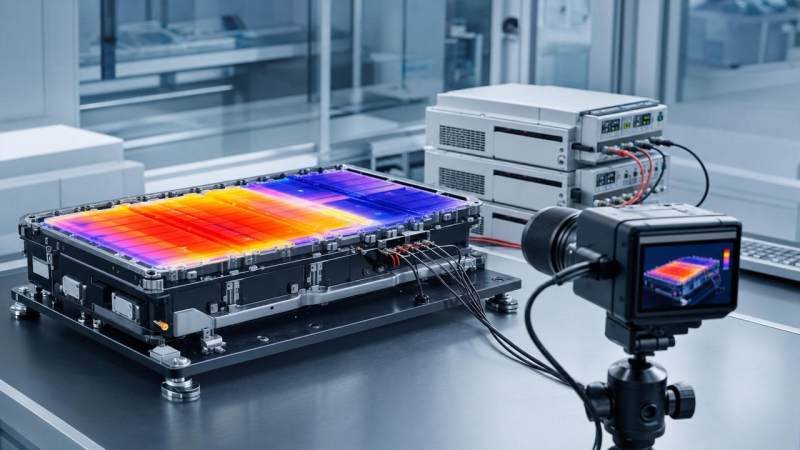
In battery inspection, thermal analysis focuses on temperature rise, heat distribution, cooling response, and abnormal hot spots under controlled conditions.
It helps reveal internal defects that may not appear in voltage, resistance, or visual inspection at an early stage.
Common battery problems often create measurable heat behavior before visible damage occurs. These include internal shorts, contamination, tab welding defects, and separator damage.
Thermal analysis also supports comparison between normal cells and suspicious cells within the same batch, pack, or operating profile.
A reliable thermal analysis workflow does not only capture surface temperature. It links thermal behavior with time, load, environment, and electrical response.
For lithium-ion cells, small thermal deviations can indicate uneven electrochemical activity, micro-short development, or excessive localized resistance.
For larger modules, thermal analysis can expose weak cooling channels, poor compression, mismatched cells, and unbalanced current distribution.
Why does heat appear before obvious failure?
A battery converts chemical energy into electrical energy. Every inefficiency produces heat, even under normal operation.
When materials age, connections weaken, or internal paths become unstable, heat generation changes faster than many external symptoms.
This makes thermal analysis valuable for early detection, especially where destructive testing is too slow, expensive, or limited.
Which Battery Failure Signals Can Thermal Analysis Identify?
Thermal analysis can identify several early signals that point toward reliability, safety, or process-control risks.
The most direct signal is abnormal temperature rise during charging, discharging, rest, pulse loading, or storage.
Another key signal is an unusual temperature gradient across a cell, module, busbar, terminal, or cooling plate.
Thermal analysis can also detect delayed cooling, which may indicate poor heat dissipation, weak bonding, or hidden internal resistance.
In many cases, the absolute temperature matters less than the deviation from a known reference population.
- Localized hot spots may suggest internal short risk or poor current distribution.
- Fast temperature rise may suggest excessive impedance or abnormal side reactions.
- Uneven cooling may suggest mechanical defects or poor thermal interface materials.
- Heat during rest may suggest self-discharge or latent internal instability.
For production environments, thermal analysis is useful because it supports screening without waiting for long aging cycles.
For field service, it helps prioritize packs requiring deeper electrical diagnostics, teardown analysis, or replacement.
Can thermal analysis detect thermal runaway?
Thermal analysis is not a magic shield against thermal runaway. It is an early-warning and investigation method.
It can help detect conditions that increase runaway risk, such as unstable heat growth or abnormal self-heating.
However, final risk assessment should include electrical data, materials knowledge, abuse testing, and safety design review.
Where Is Thermal Analysis Most Useful Across the Battery Lifecycle?
Thermal analysis applies across multiple lifecycle stages, from materials development to recycling and post-failure investigation.
In research, thermal analysis helps evaluate cell chemistry behavior, separator stability, electrolyte reactions, and heat generation mechanisms.
In manufacturing, it supports screening after formation, aging, welding, sealing, and module assembly.
In logistics, thermal analysis can help verify whether storage temperature history has affected battery safety margins.
In operation, it supports battery management systems, predictive maintenance, warranty investigation, and fleet safety monitoring.
For energy storage systems, thermal analysis is especially valuable because large packs hide individual cell abnormalities inside dense assemblies.
For electric mobility, it helps evaluate charging stress, fast-charge temperature rise, cooling balance, and module-to-module consistency.
For consumer electronics, thermal analysis helps investigate compact designs where limited space magnifies heat concentration.
How Should Thermal Analysis Be Performed for Reliable Results?
Reliable thermal analysis starts with a controlled test plan, not with random temperature images.
The test should define battery type, state of charge, ambient temperature, airflow, load profile, sampling rate, and pass-fail criteria.
Temperature measurement may use thermocouples, resistance temperature detectors, infrared cameras, heat flux sensors, or embedded sensing systems.
Each instrument has strengths and limitations. Contact sensors offer stable point data, while infrared imaging reveals spatial patterns.
A strong thermal analysis method often combines surface imaging with electrical data such as voltage, current, impedance, and capacity.
Calibration is essential. Sensor drift, emissivity errors, reflections, and airflow changes can create false alarms.
The reference baseline should come from stable batteries tested under identical conditions.
Without a baseline, thermal analysis may confuse normal design behavior with a defect signal.
- Define the failure mode of interest before selecting instruments.
- Stabilize ambient temperature and airflow before testing.
- Record electrical and thermal data on the same timeline.
- Compare suspicious units against statistically meaningful references.
- Confirm critical findings with complementary diagnostics.
What measurements matter most?
Peak temperature is important, but it is rarely enough for robust thermal analysis.
Rate of temperature rise, temperature difference, recovery time, repeatability, and spatial location often provide better failure clues.
For packs, the relationship between neighboring cells can be more informative than one isolated temperature value.
How Does Thermal Analysis Compare with Electrical Testing?
Electrical testing measures how the battery performs. Thermal analysis reveals how the battery manages energy loss and internal stress.
The two approaches are complementary. Neither should replace the other in serious safety and reliability programs.
Voltage, capacity, and impedance may appear acceptable while localized heating still indicates a developing defect.
Conversely, a temperature rise may be caused by external cooling problems rather than internal cell defects.
This is why thermal analysis should be interpreted together with load history, design architecture, and measurement uncertainty.
A practical inspection program may use electrical screening first, then thermal analysis for risk confirmation and root-cause direction.
For high-value packs, continuous thermal monitoring can also feed predictive maintenance models and digital quality records.
What Are Common Mistakes When Using Thermal Analysis?
The first mistake is treating a thermal image as a complete diagnosis.
Thermal analysis shows heat behavior, but root causes require process knowledge, electrical correlation, and sometimes destructive confirmation.
The second mistake is ignoring emissivity. Shiny metal tabs and reflective surfaces can distort infrared readings.
The third mistake is comparing batteries tested at different ambient conditions, airflow levels, or states of charge.
The fourth mistake is using one threshold for every chemistry, format, pack design, and application.
Good thermal analysis uses contextual thresholds. Pouch cells, cylindrical cells, and prismatic cells may show different normal patterns.
Another risk is overreacting to harmless design-related hot zones while missing unusual trends over time.
- Do not judge early failure risk from one static image alone.
- Do not ignore sensor calibration and placement repeatability.
- Do not compare unlike batteries without normalization.
- Do not separate thermal analysis from electrical data.
What Should Be Considered Before Implementing Thermal Analysis?
Implementation should match the risk level, production volume, battery value, and safety consequences.
A laboratory investigation may need high-resolution instruments and flexible test protocols.
A production line may need faster thermal analysis, automated pass-fail logic, and stable fixture design.
A field monitoring system may need rugged sensors, cloud analytics, alarms, and integration with battery management data.
Cost depends on instrument type, channel count, automation level, data storage, and validation requirements.
The return comes from reduced recalls, fewer unsafe shipments, improved process control, and faster failure investigation.
FAQ: Practical Questions About Thermal Analysis
Is thermal analysis suitable for every battery type?
Thermal analysis can support many chemistries and formats, but test limits must match the battery design and safety rules.
Can it be used for incoming quality inspection?
Yes, thermal analysis can screen incoming cells or packs when paired with defined load profiles and acceptance criteria.
Does a hot spot always mean failure?
No. A hot spot may reflect normal current paths, cooling design, or measurement error. Trend comparison is essential.
How often should thermal analysis be repeated?
Frequency depends on risk. High-power, fast-charging, or safety-critical systems benefit from more frequent monitoring.
What data should be stored?
Store temperature curves, images, load conditions, ambient conditions, serial data, and related electrical measurements.
Conclusion: Turning Heat Signatures into Safer Battery Decisions
Thermal analysis gives battery teams a measurable view of hidden stress before failure becomes visible or dangerous.
Its value is strongest when temperature data is precise, contextual, repeatable, and connected to electrical performance.
For early battery failure detection, thermal analysis should be treated as a structured decision tool, not just an imaging method.
A practical next step is to define target failure modes, build baseline datasets, validate thresholds, and integrate results into quality workflows.
Global Instrument Hub continues to track instrumentation methods that improve battery reliability, safety monitoring, and high-confidence industrial decision-making.
Recommended for You
 How to choose the right detection range for a custom gas analyzerChoose the right custom gas analyzer detection range with practical guidance on accuracy, exposure limits, calibration, and supplier evaluation.
 How does multi component monitoring detect gases in stack emissions?Discover how multi component monitoring detects stack gases, manages interference and supports reliable emissions reporting. Explore key CEMS selection factors.
 How bright should an industrial monitor be for outdoor use?Choosing an outdoor industrial monitor? Learn why 1,000 nits is a starting point and how glare, contrast, and heat affect sunlight readability.
 How does water vapor affect infrared gas analyzers?Infrared gas analyzers can be affected by humidity, condensation and spectral interference. Learn how to protect sample integrity and achieve reliable results.
 How to reduce customer support response timesReduce Customer Support response times with actionable tips for reporting equipment faults, choosing the right channel, and getting expert help faster.
 How to choose a low range analyzer for trace-level measurementsChoose the right low range analyzer for trace-level measurements. Compare detection limits, sampling, calibration and support to make a confident decision.
 How to choose combustible gas detectors for a specific gasChoose combustible gas detectors with confidence. Compare sensor technologies, gas response, calibration, placement, and certification for your application.
 How to choose an air quality analyzer for the pollutants you need to measureChoose an air quality analyzer with confidence. Compare pollutant measurement methods, sampling, accuracy and calibration to find the right fit for your needs.
 How to choose industrial metrology tools for tight tolerancesChoose industrial metrology tools for tight tolerances with confidence. Compare uncertainty, calibration, tool types, and costs to reduce inspection risk.
 How moisture affects fixed analyzer accuracy in stack gas monitoringImprove fixed analyzer accuracy in stack gas monitoring. Discover how moisture causes dilution, interference, and sample loss—and learn practical ways to protect emissions data.
 How does production line speed affect in-line measurement accuracy?Discover how production line speed affects in-line measurement accuracy. Explore sensor response, sampling, and timing to boost throughput without compromising quality.
 How condensation affects HCl concentration analyzer accuracyHCl concentration analyzer accuracy can suffer when condensation traps HCl. Learn how to spot sampling losses, prevent low readings, and improve measurement reliability.
 How does cross-interference affect multi-component gas analyzers?How does cross-interference affect multi component gas analyzers? Explore measurement errors, compensation limits, and validation tips to choose the right system for your process.
 How does temperature affect high-accuracy sensor performance?Explore how temperature affects high accuracy sensor performance. Learn to reduce thermal drift, evaluate compensation, and select the right sensor for reliable measurements.
 Can a C4H8O concentration analyzer distinguish between isomers?Can a C4H8O concentration analyzer distinguish isomers? Compare GC, FTIR and MS methods, uncover selectivity limits, and learn what to validate before choosing your instrument.
 How to identify a reliable supplier using on-time delivery recordsIdentify a Reliable Supplier by verifying on-time delivery records, original commitments, and complete shipments. Learn practical checks to reduce purchasing risk and protect your project schedule.
 How sensitive should a portable hydrogen analyzer be for lab use?Choose a portable hydrogen analyzer for laboratory use with the right quantification limit, accuracy, and range. Learn how to verify performance and avoid costly buying mistakes.
 How to set industrial calibration intervals based on equipment riskSet industrial calibration intervals based on equipment risk, drift, and as-found data. Learn when to shorten or extend schedules to improve reliability and avoid unnecessary costs.
 How to choose electrochemical analyzers for low-current measurementsCompare electrochemical analyzers for precise low-current measurements. Learn how noise, leakage, bandwidth, and real-cell testing help you choose the right instrument.
 What tolerance does a custom gas mixture need for calibration?Choose the right custom gas tolerance for calibration. Learn how blending tolerance, certified uncertainty, and stability affect accuracy—and avoid paying for precision you don’t need.
 How condensation affects stack detector readings in wet flue gasStack detector readings can drift when wet flue gas condenses. Learn how to identify moisture interference, prevent sample losses, and improve emissions monitoring reliability.
 How to prevent condensation in a CO2 analyzer sampling systemPrevent condensation in your CO2 analyzer sampling system. Learn how to control dew point, eliminate cold spots, and manage moisture for reliable readings and fewer costly disruptions.
 How to verify accuracy claims for industrial quality analyzersVerify accuracy claims for industrial quality analyzers with calibration checks, independent testing, and clear acceptance criteria. Learn how to reduce risk and buy with confidence.
 How to calculate cooling loads for an industrial analyzer shelterSize industrial analyzer shelter cooling with confidence. Learn to calculate equipment heat, solar gains, and ventilation loads, then select HVAC capacity for reliable analyzer performance.
 Hydrogen Analyzers for Energy Storage: Purity Monitoring vs. Leak DetectionChoosing a hydrogen analyzer for energy storage systems? Compare purity monitoring and leak detection to select the right sensors, improve safety, and protect fuel cell performance.
 NH3 Monitoring in Fertilizer Plants: Where Should Leak Analyzers Be Installed?NH3 analyzer for fertilizer production: discover where to place leak detectors around storage, compressors, and loading areas to reduce blind spots and improve early warning.
 Diesel Engine NOx Analyzers: Response Time and NO2 Conversion ExplainedChoosing a NOX analyzer for diesel engines? Learn how response time, NO2 conversion, and sampling design affect accuracy—and make a smarter, evidence-based purchase.
 SO2 Analyzers for Smelter Emissions: Sampling Hot, Dust-Laden Flue GasSelect an SO2 analyzer for smelting industry applications. Discover how to handle hot, dust-laden flue gas, prevent sample losses, and achieve reliable emissions monitoring.
 Unstable CH4 Readings in Biogas Monitoring? Check Moisture and Sample FlowCH4 analyzer for biogas monitoring giving unstable readings? Discover how moisture, sample flow, and pressure checks help pinpoint faults and restore reliable methane measurements.
 Buying a CO2 Analyzer for Brewery Gas Recovery: Costs Beyond the Purchase PriceBuying a CO2 analyzer for brewery applications? Compare sampling, installation, calibration, and downtime costs to uncover hidden expenses and make a smarter gas recovery investment.
 Where to Place CO Analyzers for Effective Parking Garage VentilationOptimize your CO analyzer for parking garage ventilation with practical placement tips. Learn how sensor height, airflow, and zone coverage support timely detection and effective fan control.
 NDIR vs. FTIR Gas Analyzers: Which Fits Your Environmental Research?Find the right infrared gas analyzer for environmental research. Compare NDIR vs. FTIR on sensitivity, gas coverage, sampling needs, and cost to choose confidently for your study.





Search Categories
Search Categories
- Smart Meters & Power Quality
- Transformer Gas Analyzers
- BESS Thermal Runaway Detectors
- Energy, Power & Smart Grid Monitoring
- Optical Profilers & CMM
- Ultrasonic & X-Ray NDT
- Calibration Standards
- Precision Metrology & NDT
- Water Quality Analyzers
- CEMS & VOCs Monitors
- Price Trends
- Import & Export Updates
- Market Trends
- Industry News
- Industry Insights
Latest Article
- How to choose the right detection range for a custom gas analyzerChoose the right custom gas analyzer detection range with practical guidance on accuracy, exposure limits, calibration, and supplier evaluation.Posted by:
- How does multi component monitoring detect gases in stack emissions?Discover how multi component monitoring detects stack gases, manages interference and supports reliable emissions reporting. Explore key CEMS selection factors.Posted by:
- How bright should an industrial monitor be for outdoor use?Choosing an outdoor industrial monitor? Learn why 1,000 nits is a starting point and how glare, contrast, and heat affect sunlight readability.Posted by:
Please give us a message
