
Thermal Monitoring in BESS: Early Warning Signs That Matter Most


Thermal Monitoring in BESS: Early Warning Signs That Matter Most
In battery energy storage systems, thermal monitoring is more than a safety function. It is the earliest defense against failure, downtime, and thermal runaway.
For BESS teams, the real value of thermal monitoring is not just alarm generation. It is seeing weak signals early enough to act before performance, safety, and project economics start slipping.
That matters across the full lifecycle. Design reviews, commissioning, routine operation, augmentation, and warranty management all depend on reliable temperature insight.
The challenge is simple to describe but hard to manage. Not every hot spot is critical, and not every normal reading means the system is healthy.
What matters most is context. Good thermal monitoring connects temperature data with load, ambient conditions, airflow, state of charge, and equipment behavior over time.
Why thermal monitoring matters beyond compliance
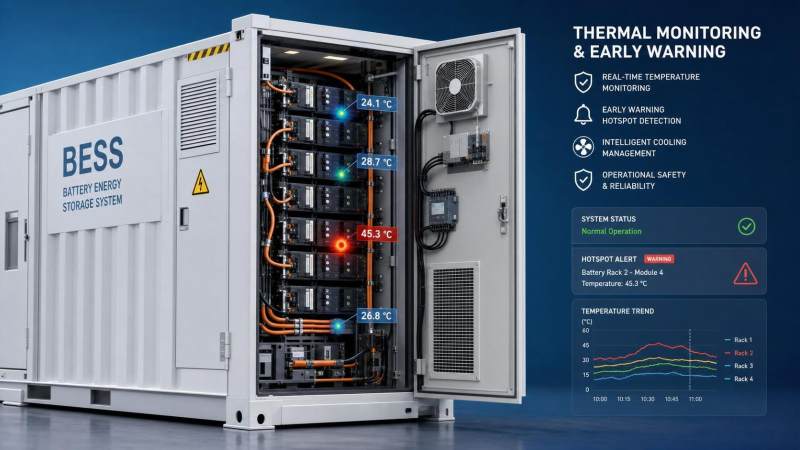
Many BESS projects treat thermal monitoring as a box to check. In practice, it should support faster decisions, cleaner maintenance planning, and better protection of high-value assets.
A weak thermal monitoring strategy often creates blind spots. Those blind spots can hide cell imbalance, blocked airflow, coolant issues, sensor drift, or enclosure-level heat accumulation.
From a project perspective, the costs are rarely limited to one event. Small thermal problems can trigger repeated derating, lost dispatch opportunities, higher service visits, and shorter asset life.
This is why thermal monitoring should be framed as an operational intelligence layer. It supports risk control, availability targets, and performance guarantees at the same time.
The early warning signs that matter most
Not every temperature change deserves escalation. The most useful thermal monitoring signals are the ones that reveal change patterns, not just threshold violations.
1. Persistent temperature spread between cells or racks
A growing temperature delta is often more important than the absolute temperature itself. If one rack consistently runs warmer, the problem may involve internal resistance, cooling distribution, or connection quality.
In actual operation, even a modest spread can become serious during peak cycling. Thermal monitoring should track whether the same location repeatedly leads the system temperature profile.
2. Faster-than-normal temperature rise during charge or discharge
A normal peak temperature can still hide abnormal behavior. If the temperature climbs faster than historical patterns under similar load, that is an actionable warning sign.
This usually points to degraded cooling efficiency, rising electrical losses, or developing cell stress. Thermal monitoring should compare ramp rates, not just high-temperature alarms.
3. Slow cooling after peak operation
More obvious signals often appear after the event. When a compartment cools down slower than expected, it may indicate restricted airflow, fan issues, fouled filters, or reduced coolant performance.
This also means the next operating cycle begins with less thermal margin. Over time, that weakens system resilience and increases thermal runaway risk.
4. Repeated hot spots in the same physical zone
Thermal monitoring becomes far more valuable when temperature data is mapped to physical layout. Recurring hot spots near busbars, connectors, power electronics, or corner cells deserve rapid review.
A repeated pattern usually signals a design, installation, or maintenance issue. It is rarely random, especially if the same zone heats under similar duty cycles.
5. Mismatch between ambient conditions and internal temperatures
If ambient temperature is stable but internal temperatures drift upward, thermal monitoring should flag that mismatch. It often reveals enclosure heat trapping or underperforming thermal management equipment.
The same logic applies in reverse. If internal temperatures drop too slowly during cool weather, there may be hidden ventilation or control issues.
6. Sensor inconsistency or suspiciously stable readings
A thermal monitoring system is only as trustworthy as its sensing layer. Flat readings during variable load, or values that do not align with neighboring sensors, may signal drift, failure, or poor placement.
This point is often overlooked. Bad temperature data can create false confidence, which is more dangerous than a visible alarm.
How to build a thermal monitoring strategy that works
Effective thermal monitoring is not only about adding more sensors. It is about choosing the right measurement points, defining useful logic, and linking alerts to clear operating actions.
- Track trends, gradients, and ramp rates, not only alarm thresholds.
- Correlate temperature with load, state of charge, ambient conditions, and cooling status.
- Separate cell-level, rack-level, and enclosure-level thermal monitoring logic.
- Create escalation rules for warning, intervention, and shutdown stages.
- Validate sensor health during commissioning and scheduled maintenance.
In real projects, the best results come from combining thermal monitoring with operating context. A rising temperature during aggressive dispatch does not mean the same thing as the same rise during partial load.
This is where instrumentation quality matters. Reliable sensors, stable signal transmission, and clean integration with BMS, EMS, and SCADA improve response speed and decision confidence.
Common thermal monitoring gaps in BESS projects
Several avoidable mistakes keep appearing across utility-scale and commercial storage deployments. Most of them come from treating thermal monitoring as a static feature instead of a living risk tool.
- Too few sensing points in thermally uneven zones.
- Alarm limits set without historical baseline review.
- No distinction between transient spikes and persistent abnormal trends.
- Limited visibility into HVAC, fan, or coolant system behavior.
- Weak handoff between monitoring alarms and field maintenance actions.
From a delivery standpoint, these gaps often surface after commissioning. The system may appear compliant, yet daily operation exposes unstable cooling performance or poor thermal data quality.
That is why post-commissioning review is critical. Thermal monitoring settings should be refined using the first months of operating data, especially across seasonal changes.
What project teams should review before problems escalate
A practical review process helps turn thermal monitoring into a decision tool. The goal is not more dashboards. The goal is faster recognition of risk and clearer intervention timing.
This review structure also supports supplier and integrator accountability. It creates a common basis for discussing system performance, warranty evidence, and needed corrective actions.
From monitoring to action: the practical next step
The strongest thermal monitoring programs do one thing well. They turn temperature signals into timely operating decisions before the system enters a fragile state.
That may mean adjusting dispatch strategy, inspecting airflow paths, checking electrical connections, validating sensors, or reviewing thermal management controls after unusual events.
For organizations managing multiple assets, thermal monitoring should also feed portfolio learning. Repeated warning patterns across sites often reveal shared design or maintenance weaknesses.
GIH closely follows this intersection of instrumentation, energy monitoring, and storage safety because better measurement leads to better control. In BESS, that principle is not abstract. It is operational and immediate.
If thermal monitoring is already installed, the next move is to test whether it truly catches the warning signs that matter most. If it does not, the risk is already larger than it looks.
Recommended for You
 How to choose the right detection range for a custom gas analyzerChoose the right custom gas analyzer detection range with practical guidance on accuracy, exposure limits, calibration, and supplier evaluation.
 How does multi component monitoring detect gases in stack emissions?Discover how multi component monitoring detects stack gases, manages interference and supports reliable emissions reporting. Explore key CEMS selection factors.
 How bright should an industrial monitor be for outdoor use?Choosing an outdoor industrial monitor? Learn why 1,000 nits is a starting point and how glare, contrast, and heat affect sunlight readability.
 How does water vapor affect infrared gas analyzers?Infrared gas analyzers can be affected by humidity, condensation and spectral interference. Learn how to protect sample integrity and achieve reliable results.
 How to reduce customer support response timesReduce Customer Support response times with actionable tips for reporting equipment faults, choosing the right channel, and getting expert help faster.
 How to choose a low range analyzer for trace-level measurementsChoose the right low range analyzer for trace-level measurements. Compare detection limits, sampling, calibration and support to make a confident decision.
 How to choose combustible gas detectors for a specific gasChoose combustible gas detectors with confidence. Compare sensor technologies, gas response, calibration, placement, and certification for your application.
 How to choose an air quality analyzer for the pollutants you need to measureChoose an air quality analyzer with confidence. Compare pollutant measurement methods, sampling, accuracy and calibration to find the right fit for your needs.
 How to choose industrial metrology tools for tight tolerancesChoose industrial metrology tools for tight tolerances with confidence. Compare uncertainty, calibration, tool types, and costs to reduce inspection risk.
 How moisture affects fixed analyzer accuracy in stack gas monitoringImprove fixed analyzer accuracy in stack gas monitoring. Discover how moisture causes dilution, interference, and sample loss—and learn practical ways to protect emissions data.
 How does production line speed affect in-line measurement accuracy?Discover how production line speed affects in-line measurement accuracy. Explore sensor response, sampling, and timing to boost throughput without compromising quality.
 How condensation affects HCl concentration analyzer accuracyHCl concentration analyzer accuracy can suffer when condensation traps HCl. Learn how to spot sampling losses, prevent low readings, and improve measurement reliability.
 How does cross-interference affect multi-component gas analyzers?How does cross-interference affect multi component gas analyzers? Explore measurement errors, compensation limits, and validation tips to choose the right system for your process.
 How does temperature affect high-accuracy sensor performance?Explore how temperature affects high accuracy sensor performance. Learn to reduce thermal drift, evaluate compensation, and select the right sensor for reliable measurements.
 Can a C4H8O concentration analyzer distinguish between isomers?Can a C4H8O concentration analyzer distinguish isomers? Compare GC, FTIR and MS methods, uncover selectivity limits, and learn what to validate before choosing your instrument.
 How to identify a reliable supplier using on-time delivery recordsIdentify a Reliable Supplier by verifying on-time delivery records, original commitments, and complete shipments. Learn practical checks to reduce purchasing risk and protect your project schedule.
 How sensitive should a portable hydrogen analyzer be for lab use?Choose a portable hydrogen analyzer for laboratory use with the right quantification limit, accuracy, and range. Learn how to verify performance and avoid costly buying mistakes.
 How to set industrial calibration intervals based on equipment riskSet industrial calibration intervals based on equipment risk, drift, and as-found data. Learn when to shorten or extend schedules to improve reliability and avoid unnecessary costs.
 How to choose electrochemical analyzers for low-current measurementsCompare electrochemical analyzers for precise low-current measurements. Learn how noise, leakage, bandwidth, and real-cell testing help you choose the right instrument.
 What tolerance does a custom gas mixture need for calibration?Choose the right custom gas tolerance for calibration. Learn how blending tolerance, certified uncertainty, and stability affect accuracy—and avoid paying for precision you don’t need.
 How condensation affects stack detector readings in wet flue gasStack detector readings can drift when wet flue gas condenses. Learn how to identify moisture interference, prevent sample losses, and improve emissions monitoring reliability.
 How to prevent condensation in a CO2 analyzer sampling systemPrevent condensation in your CO2 analyzer sampling system. Learn how to control dew point, eliminate cold spots, and manage moisture for reliable readings and fewer costly disruptions.
 How to verify accuracy claims for industrial quality analyzersVerify accuracy claims for industrial quality analyzers with calibration checks, independent testing, and clear acceptance criteria. Learn how to reduce risk and buy with confidence.
 How to calculate cooling loads for an industrial analyzer shelterSize industrial analyzer shelter cooling with confidence. Learn to calculate equipment heat, solar gains, and ventilation loads, then select HVAC capacity for reliable analyzer performance.
 Hydrogen Analyzers for Energy Storage: Purity Monitoring vs. Leak DetectionChoosing a hydrogen analyzer for energy storage systems? Compare purity monitoring and leak detection to select the right sensors, improve safety, and protect fuel cell performance.
 NH3 Monitoring in Fertilizer Plants: Where Should Leak Analyzers Be Installed?NH3 analyzer for fertilizer production: discover where to place leak detectors around storage, compressors, and loading areas to reduce blind spots and improve early warning.
 Diesel Engine NOx Analyzers: Response Time and NO2 Conversion ExplainedChoosing a NOX analyzer for diesel engines? Learn how response time, NO2 conversion, and sampling design affect accuracy—and make a smarter, evidence-based purchase.
 SO2 Analyzers for Smelter Emissions: Sampling Hot, Dust-Laden Flue GasSelect an SO2 analyzer for smelting industry applications. Discover how to handle hot, dust-laden flue gas, prevent sample losses, and achieve reliable emissions monitoring.
 Unstable CH4 Readings in Biogas Monitoring? Check Moisture and Sample FlowCH4 analyzer for biogas monitoring giving unstable readings? Discover how moisture, sample flow, and pressure checks help pinpoint faults and restore reliable methane measurements.
 Buying a CO2 Analyzer for Brewery Gas Recovery: Costs Beyond the Purchase PriceBuying a CO2 analyzer for brewery applications? Compare sampling, installation, calibration, and downtime costs to uncover hidden expenses and make a smarter gas recovery investment.
 Where to Place CO Analyzers for Effective Parking Garage VentilationOptimize your CO analyzer for parking garage ventilation with practical placement tips. Learn how sensor height, airflow, and zone coverage support timely detection and effective fan control.
 NDIR vs. FTIR Gas Analyzers: Which Fits Your Environmental Research?Find the right infrared gas analyzer for environmental research. Compare NDIR vs. FTIR on sensitivity, gas coverage, sampling needs, and cost to choose confidently for your study.





Search Categories
Search Categories
- Smart Meters & Power Quality
- Transformer Gas Analyzers
- BESS Thermal Runaway Detectors
- Energy, Power & Smart Grid Monitoring
- Optical Profilers & CMM
- Ultrasonic & X-Ray NDT
- Calibration Standards
- Precision Metrology & NDT
- Water Quality Analyzers
- CEMS & VOCs Monitors
- Price Trends
- Import & Export Updates
- Market Trends
- Industry News
- Industry Insights
Latest Article
- How to choose the right detection range for a custom gas analyzerChoose the right custom gas analyzer detection range with practical guidance on accuracy, exposure limits, calibration, and supplier evaluation.Posted by:
- How does multi component monitoring detect gases in stack emissions?Discover how multi component monitoring detects stack gases, manages interference and supports reliable emissions reporting. Explore key CEMS selection factors.Posted by:
- How bright should an industrial monitor be for outdoor use?Choosing an outdoor industrial monitor? Learn why 1,000 nits is a starting point and how glare, contrast, and heat affect sunlight readability.Posted by:
Please give us a message
