
Utility Monitoring Equipment Selection for Stable Energy Data


Stable energy data starts with disciplined equipment selection, not with dashboards alone. Utility monitoring equipment sits between physical energy flows and business decisions, so any weakness in sensing, logging, or communication quickly turns into blind spots, billing disputes, and poor control logic.
That matters across manufacturing, commercial estates, laboratories, hospitals, data centers, and utility-scale infrastructure. As digital transformation expands, energy data is no longer a monthly reporting exercise. It is an operational signal tied to uptime, compliance, asset health, and the credibility of efficiency claims.
Within that context, utility monitoring equipment should be judged as part of a measurement architecture. The most useful systems do more than count kilowatt-hours. They capture quality, timing, context, and consistency, which is where stable energy data becomes genuinely actionable.
What Utility Monitoring Equipment Really Covers
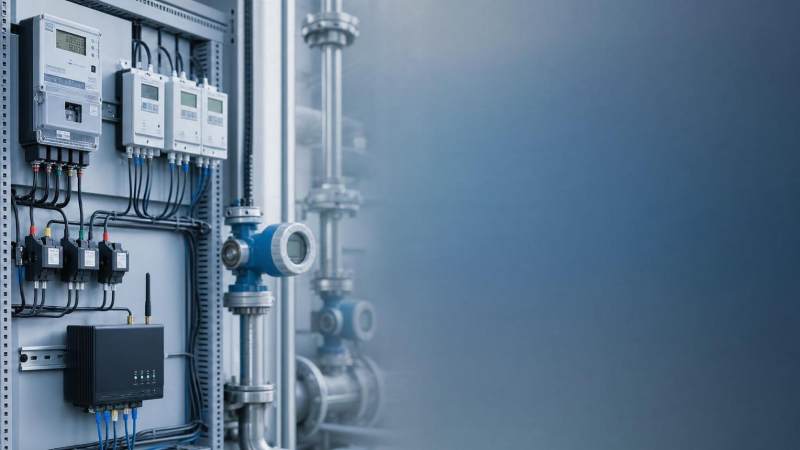
In practice, utility monitoring equipment includes meters, power quality analyzers, submeters, current transformers, flow meters, pressure and temperature sensors, data loggers, gateways, and supervisory software.
The exact mix depends on whether the target is electricity, gas, steam, chilled water, compressed air, or process utilities. A site may need one integrated view, but each utility behaves differently and creates different measurement risks.
Electricity often demands interval data, harmonics analysis, event capture, and load profiling. Steam and gas monitoring may depend more on pressure compensation, flow stability, and leak detection. Water systems often need continuous balance checks between supply, distribution, and discharge.
A common mistake is to treat all energy points as equal. They are not. Some points support billing, some support diagnostics, and some support sustainability reporting. Selection criteria should reflect that difference from the beginning.
Why Selection Has Become More Critical
Energy systems are under pressure from several directions at once. Facilities need tighter cost control, stronger resilience, traceable carbon data, and better visibility into distributed assets.
At the same time, electrical environments are becoming more complex. Variable frequency drives, EV charging, battery storage, solar integration, and mixed critical loads can distort power conditions and complicate interpretation.
This is where the instrumentation mindset becomes valuable. Global Instrument Hub has long framed instrumentation as the sensory and nervous system of industrial modernization. That view fits energy monitoring well. If the sensing layer is weak, the control layer becomes speculative.
More organizations also face external scrutiny. Internal data may need to support ISO-aligned management systems, tenant settlement, utility reconciliation, ESG disclosures, or engineering investigations after a disturbance. Stable records are expected, not optional.
The Difference Between Data Availability and Data Stability
Many sites already have meters installed, yet still struggle with unstable energy data. The issue is rarely a single device failure. More often, it is a chain problem involving sampling, calibration, network design, timestamp accuracy, or inconsistent engineering units.
A reading that arrives every fifteen minutes is available data. A reading that remains accurate across seasonal loads, transient events, maintenance cycles, and software updates is stable data.
Stable data typically shows five characteristics:
- Measurement repeatability under normal and stressed operating conditions.
- Reliable timestamps and synchronized records across devices.
- Minimal gaps caused by communication dropouts or buffer loss.
- Traceable scaling, configuration history, and calibration status.
- Context that explains anomalies instead of hiding them.
This distinction is essential when comparing utility monitoring equipment. A lower-cost device may satisfy a basic metering line item, while creating long-term uncertainty that overwhelms any initial savings.
Key Selection Criteria That Hold Up in Real Operations
The best evaluations move beyond brochure specifications. They ask how the equipment will behave after installation, integration, and several years of operation.
Measurement performance
Accuracy class matters, but operating range matters just as much. Check whether the device remains reliable at low load, partial flow, distorted waveforms, and expected ambient conditions.
For electrical systems, evaluate true RMS capability, event capture thresholds, harmonic measurement depth, and compatibility with CT or VT arrangements. For thermal utilities, confirm compensation logic and sensor matching.
Communications and integration
Utility monitoring equipment should fit the existing automation landscape without excessive middleware. Common protocols include Modbus, BACnet, OPC UA, IEC 61850, M-Bus, and vendor APIs.
Integration should not only be possible. It should be maintainable. Clear register maps, stable firmware, and accessible diagnostics usually matter more than long feature lists.
Data retention and cybersecurity
Local buffering protects data during network outages. Secure configuration control protects it during routine administration. Both are essential when equipment feeds billing, audits, or critical alarms.
Cybersecurity should be reviewed as a lifecycle issue. Password policy, port management, patch practices, and network segmentation should be visible at the selection stage.
Serviceability and traceability
A technically strong device can still underperform if configuration records are poor or calibration support is weak. GIH often emphasizes trust signals in supply assessment, and that logic applies here.
Suppliers should demonstrate documentation quality, firmware governance, test evidence, regional support capacity, and alignment with recognized standards such as ISO/IEC 17025 where calibration traceability is relevant.
How Requirements Change by Site and Utility Type
Selection improves when the monitoring point is tied to a business purpose. The table below shows how that usually shifts the specification.
This is why a generic shortlist rarely performs well. Utility monitoring equipment must be matched to electrical behavior, utility physics, reporting obligations, and the consequences of bad data.
Where Projects Commonly Go Wrong
Selection errors are often introduced before procurement. A specification may ask for monitoring, but fail to define the resolution, retention, or decision use.
Several warning signs appear repeatedly:
- Choosing devices only by purchase price.
- Ignoring sensor installation quality and wiring topology.
- Using incompatible protocols across expansion phases.
- Overlooking calibration intervals and replacement logistics.
- Expecting analytics software to correct poor source data.
A better approach is to evaluate the full data path. That means source measurement, edge collection, transport, normalization, storage, and validation routines. Stability depends on the chain, not one box.
Building a Practical Evaluation Framework
For most projects, the next step is not a larger vendor list. It is a cleaner decision framework. Start by ranking monitoring points according to risk, reporting impact, and operational value.
Then define which data must be trusted for billing, which data supports diagnostics, and which data is mainly exploratory. Those categories justify different levels of accuracy, redundancy, and documentation.
From there, compare utility monitoring equipment against a short set of evidence-based questions:
- Does the device perform reliably in the actual operating envelope?
- Can it integrate cleanly with present and future systems?
- Will the data remain traceable after maintenance and upgrades?
- Is supplier support credible across regions and compliance needs?
That is also where an intelligence-driven source such as GIH becomes useful. Not as a sales layer, but as a way to compare standards, supplier maturity, and instrumentation fit before gaps become costly on site.
Stable energy data is rarely the result of one premium device. It comes from a coherent monitoring strategy. The strongest next move is to map critical utility points, define the required confidence level for each, and review equipment choices against long-term data reliability rather than short-term specification comfort.
Recommended for You
 How to choose the right detection range for a custom gas analyzerChoose the right custom gas analyzer detection range with practical guidance on accuracy, exposure limits, calibration, and supplier evaluation.
 How does multi component monitoring detect gases in stack emissions?Discover how multi component monitoring detects stack gases, manages interference and supports reliable emissions reporting. Explore key CEMS selection factors.
 How bright should an industrial monitor be for outdoor use?Choosing an outdoor industrial monitor? Learn why 1,000 nits is a starting point and how glare, contrast, and heat affect sunlight readability.
 How does water vapor affect infrared gas analyzers?Infrared gas analyzers can be affected by humidity, condensation and spectral interference. Learn how to protect sample integrity and achieve reliable results.
 How to reduce customer support response timesReduce Customer Support response times with actionable tips for reporting equipment faults, choosing the right channel, and getting expert help faster.
 How to choose a low range analyzer for trace-level measurementsChoose the right low range analyzer for trace-level measurements. Compare detection limits, sampling, calibration and support to make a confident decision.
 How to choose combustible gas detectors for a specific gasChoose combustible gas detectors with confidence. Compare sensor technologies, gas response, calibration, placement, and certification for your application.
 How to choose an air quality analyzer for the pollutants you need to measureChoose an air quality analyzer with confidence. Compare pollutant measurement methods, sampling, accuracy and calibration to find the right fit for your needs.
 How to choose industrial metrology tools for tight tolerancesChoose industrial metrology tools for tight tolerances with confidence. Compare uncertainty, calibration, tool types, and costs to reduce inspection risk.
 How moisture affects fixed analyzer accuracy in stack gas monitoringImprove fixed analyzer accuracy in stack gas monitoring. Discover how moisture causes dilution, interference, and sample loss—and learn practical ways to protect emissions data.
 How does production line speed affect in-line measurement accuracy?Discover how production line speed affects in-line measurement accuracy. Explore sensor response, sampling, and timing to boost throughput without compromising quality.
 How condensation affects HCl concentration analyzer accuracyHCl concentration analyzer accuracy can suffer when condensation traps HCl. Learn how to spot sampling losses, prevent low readings, and improve measurement reliability.
 How does cross-interference affect multi-component gas analyzers?How does cross-interference affect multi component gas analyzers? Explore measurement errors, compensation limits, and validation tips to choose the right system for your process.
 How does temperature affect high-accuracy sensor performance?Explore how temperature affects high accuracy sensor performance. Learn to reduce thermal drift, evaluate compensation, and select the right sensor for reliable measurements.
 Can a C4H8O concentration analyzer distinguish between isomers?Can a C4H8O concentration analyzer distinguish isomers? Compare GC, FTIR and MS methods, uncover selectivity limits, and learn what to validate before choosing your instrument.
 How to identify a reliable supplier using on-time delivery recordsIdentify a Reliable Supplier by verifying on-time delivery records, original commitments, and complete shipments. Learn practical checks to reduce purchasing risk and protect your project schedule.
 How sensitive should a portable hydrogen analyzer be for lab use?Choose a portable hydrogen analyzer for laboratory use with the right quantification limit, accuracy, and range. Learn how to verify performance and avoid costly buying mistakes.
 How to set industrial calibration intervals based on equipment riskSet industrial calibration intervals based on equipment risk, drift, and as-found data. Learn when to shorten or extend schedules to improve reliability and avoid unnecessary costs.
 How to choose electrochemical analyzers for low-current measurementsCompare electrochemical analyzers for precise low-current measurements. Learn how noise, leakage, bandwidth, and real-cell testing help you choose the right instrument.
 What tolerance does a custom gas mixture need for calibration?Choose the right custom gas tolerance for calibration. Learn how blending tolerance, certified uncertainty, and stability affect accuracy—and avoid paying for precision you don’t need.
 How condensation affects stack detector readings in wet flue gasStack detector readings can drift when wet flue gas condenses. Learn how to identify moisture interference, prevent sample losses, and improve emissions monitoring reliability.
 How to prevent condensation in a CO2 analyzer sampling systemPrevent condensation in your CO2 analyzer sampling system. Learn how to control dew point, eliminate cold spots, and manage moisture for reliable readings and fewer costly disruptions.
 How to verify accuracy claims for industrial quality analyzersVerify accuracy claims for industrial quality analyzers with calibration checks, independent testing, and clear acceptance criteria. Learn how to reduce risk and buy with confidence.
 How to calculate cooling loads for an industrial analyzer shelterSize industrial analyzer shelter cooling with confidence. Learn to calculate equipment heat, solar gains, and ventilation loads, then select HVAC capacity for reliable analyzer performance.
 Hydrogen Analyzers for Energy Storage: Purity Monitoring vs. Leak DetectionChoosing a hydrogen analyzer for energy storage systems? Compare purity monitoring and leak detection to select the right sensors, improve safety, and protect fuel cell performance.
 NH3 Monitoring in Fertilizer Plants: Where Should Leak Analyzers Be Installed?NH3 analyzer for fertilizer production: discover where to place leak detectors around storage, compressors, and loading areas to reduce blind spots and improve early warning.
 Diesel Engine NOx Analyzers: Response Time and NO2 Conversion ExplainedChoosing a NOX analyzer for diesel engines? Learn how response time, NO2 conversion, and sampling design affect accuracy—and make a smarter, evidence-based purchase.
 SO2 Analyzers for Smelter Emissions: Sampling Hot, Dust-Laden Flue GasSelect an SO2 analyzer for smelting industry applications. Discover how to handle hot, dust-laden flue gas, prevent sample losses, and achieve reliable emissions monitoring.
 Unstable CH4 Readings in Biogas Monitoring? Check Moisture and Sample FlowCH4 analyzer for biogas monitoring giving unstable readings? Discover how moisture, sample flow, and pressure checks help pinpoint faults and restore reliable methane measurements.
 Buying a CO2 Analyzer for Brewery Gas Recovery: Costs Beyond the Purchase PriceBuying a CO2 analyzer for brewery applications? Compare sampling, installation, calibration, and downtime costs to uncover hidden expenses and make a smarter gas recovery investment.
 Where to Place CO Analyzers for Effective Parking Garage VentilationOptimize your CO analyzer for parking garage ventilation with practical placement tips. Learn how sensor height, airflow, and zone coverage support timely detection and effective fan control.
 NDIR vs. FTIR Gas Analyzers: Which Fits Your Environmental Research?Find the right infrared gas analyzer for environmental research. Compare NDIR vs. FTIR on sensitivity, gas coverage, sampling needs, and cost to choose confidently for your study.




Search Categories
Search Categories
- Smart Meters & Power Quality
- Transformer Gas Analyzers
- BESS Thermal Runaway Detectors
- Energy, Power & Smart Grid Monitoring
- Optical Profilers & CMM
- Ultrasonic & X-Ray NDT
- Calibration Standards
- Precision Metrology & NDT
- Water Quality Analyzers
- CEMS & VOCs Monitors
- Price Trends
- Import & Export Updates
- Market Trends
- Industry News
- Industry Insights
Latest Article
- How to choose the right detection range for a custom gas analyzerChoose the right custom gas analyzer detection range with practical guidance on accuracy, exposure limits, calibration, and supplier evaluation.Posted by:
- How does multi component monitoring detect gases in stack emissions?Discover how multi component monitoring detects stack gases, manages interference and supports reliable emissions reporting. Explore key CEMS selection factors.Posted by:
- How bright should an industrial monitor be for outdoor use?Choosing an outdoor industrial monitor? Learn why 1,000 nits is a starting point and how glare, contrast, and heat affect sunlight readability.Posted by:
Please give us a message
