What Monthly Maintenance Does a Wireless Measurement Node Need?


What Monthly Maintenance Does a Wireless Measurement Node Need?
Reliable wireless measurement depends on more than a clean installation and a successful commissioning report. A node can continue transmitting while its sensor drifts, its battery reserve becomes uncertain, or its radio path quietly degrades after a process change. That is why the practical answer to what maintenance does a wireless measurement node need monthly is not simply “replace batteries when low.” A useful monthly routine checks the health of the complete measurement chain: sensing element, local electronics, power source, enclosure, wireless link, gateway visibility, and the plausibility of the data entering the control or reporting system.
The workload is usually modest when a wireless network has been designed correctly. But it needs to be disciplined. In a chemical unit, a lost temperature trend may hide a developing process issue. In a water-monitoring station, a dirty conductivity probe can send believable but wrong readings. In a warehouse or construction site, a node that has moved only a few centimeters may suddenly sit behind steelwork or a new equipment enclosure. Monthly maintenance is where these small changes are caught before they become blind spots.
Start With the Dashboard, Not the Field Round
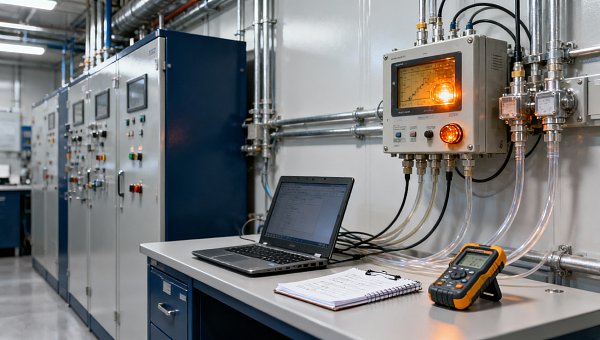
The most efficient monthly inspection begins from the network management platform or historian. Before sending a technician into a hazardous area, review which nodes have missed transmissions, produced repeated values, generated invalid-status flags, or shown unusual changes in signal quality. This gives the field visit a purpose. A technician who arrives with a list of suspicious devices can inspect connections, mounting conditions, and process context rather than performing the same generic check at every location.
Look at trends rather than a single day’s status. A battery estimate that remains stable is reassuring; an estimate that drops sharply after several months of normal service deserves attention. The same principle applies to radio diagnostics. One weak signal reading may be caused by temporary interference or weather. A steady decline in link quality, retries, or packet delivery is more meaningful. It can indicate antenna damage, water ingress, changed topology, nearby metal obstructions, or a gateway that is no longer well positioned for the actual site layout.
For installations connected to PLC, DCS, SCADA, cloud dashboards, or environmental reporting software, confirm that the problem is not downstream. A healthy node does not help if a tag mapping changed, a server certificate expired, or a gateway is forwarding stale values. The distinction matters: field crews should not be asked to troubleshoot a sensor that is functioning normally at the network edge.
The Core Monthly Check: Power, Signal, Data, and Physical Condition
Most monthly rounds can be organized around four questions. Is the node powered with adequate reserve? Is it communicating consistently? Does the measured value make engineering sense? Has anything physically changed around the device?
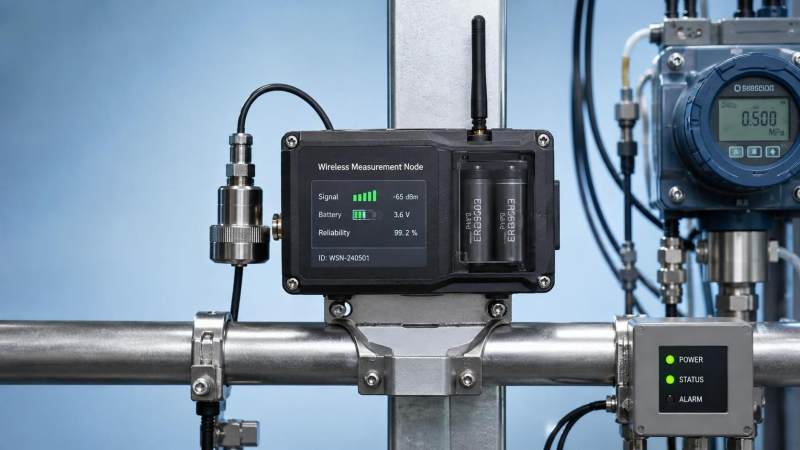
Battery review should be predictive, not reactive. Many industrial wireless nodes estimate remaining battery life from reporting interval, radio activity, ambient temperature, and battery chemistry. Treat that estimate as a planning signal rather than an absolute guarantee. A device in a cold outdoor cabinet, a vibrating machine area, or a location with poor signal may consume power differently from its original design assumptions. If the node is retried frequently because the radio path is weak, battery life can shorten without any obvious change in the measured process.
Do not automatically replace batteries every month. Unnecessary opening of a sealed enclosure introduces its own risks: damaged gaskets, incorrect replacement cells, improper torque, or contamination in a regulated area. Replace or schedule replacement according to the manufacturer’s approved battery type, the observed reserve trend, site access constraints, and the criticality of the measurement. In hazardous locations, follow the device instructions and site permit procedures exactly; battery work can be subject to requirements that do not apply in a general utility area.
Signal Strength Is Useful, but It Is Not the Whole Story
Teams often focus heavily on RSSI or another received-signal indicator. It is useful, but it is not a complete diagnosis. A strong radio signal does not prove that data packets are arriving reliably, and a modest signal can still support stable communication in a well-designed mesh or redundant network. The practical monthly question is whether the node is delivering complete, timely, authenticated data at the required reporting interval.
Inspect the antenna and its surroundings during the field round. Check that it is not bent, loosened, coated with process residue, blocked by temporary scaffolding, or enclosed by recently installed metal panels. In process plants, even a parked maintenance vehicle or a temporary access platform can alter a radio path. In energy facilities, new cable trays and switchgear extensions can change the local electromagnetic and physical environment. These are ordinary site changes, yet they are frequently overlooked when a wireless system is assumed to be “maintenance-free.”
If a node has recurring communication alarms, do not immediately increase its reporting interval or add a larger battery. First determine whether the root cause is antenna orientation, gateway placement, network congestion, firmware compatibility, an obstructed path, or a configuration issue. Extending the interval may reduce battery consumption, but it can also weaken process visibility. The right trade-off depends on what the measurement is used for: condition monitoring, safety support, quality assurance, environmental reporting, or routine asset tracking.
Check the Sensor, Not Just the Node
Wireless hardware and sensing hardware age differently. The radio may be perfectly healthy while the process connection, probe surface, impulse line, thermowell, electrode, optical window, or sampling point is compromised. Monthly maintenance should therefore include a reasonableness review of the measurement itself.
For temperature monitoring, compare suspicious readings with nearby instruments or known operating conditions. A sensor that suddenly settles at an unlikely fixed value may be disconnected, poorly seated, or affected by local heat transfer changes. For pressure measurement, look for zero shifts when the process condition should be stable and inspect impulse connections where applicable. For level, flow, water-quality, or analytical measurements, contamination and fouling may matter more than wireless performance. A clean network cannot correct a dirty sensing surface.
A monthly check is not necessarily a monthly calibration. That distinction matters, particularly in laboratories, regulated manufacturing, custody-related measurement, and critical process control. Calibration intervals should be based on the instrument’s documented requirements, process risk, historical stability, quality procedures, and applicable standards. Where formal calibration is required, traceability and documented methods may need to align with the organization’s quality system and, where relevant, ISO/IEC 17025 practices. A quick field comparison can identify concern; it does not automatically replace a controlled calibration activity.
Enclosures, Seals, and Mounting Are Quiet Failure Points
A wireless node is often installed precisely where cabling is difficult: outdoors, on rotating or remote assets, near washdown zones, high on structures, or in cramped skid assemblies. Those locations expose the enclosure to conditions that may never appear in a commissioning checklist. Monthly visual inspection should look for cracked housings, loose fasteners, damaged cable glands, faded or missing identification labels, standing water around the mounting point, and signs of condensation inside inspection windows where fitted.
Pay particular attention after shutdowns, turnarounds, severe weather, washdowns, or construction work. A node might have been bumped by a lifting operation, painted over, isolated by new insulation, or left with an enclosure cover not fully secured. If the device is installed in a classified area, never treat a compromised gland or cover as cosmetic. The equipment’s ATEX or IECEx suitability, where applicable, depends on the installed condition as well as the nameplate rating. Any repair or opening procedure should follow the manufacturer’s documentation and site safety rules.
Configuration Changes Need Their Own Record
A surprising number of “device failures” are configuration changes that no one documented. Reporting interval, engineering units, alarm thresholds, damping, radio settings, gateway assignments, and firmware versions can all affect how the measurement appears to operations. During the monthly review, check for unauthorized or unexplained changes, especially after contractor work, software updates, or replacement of a gateway.
Keep a practical maintenance record for each exception, not merely a checkbox that says “inspected.” Record the node ID, observed condition, diagnostic status, corrective action, battery replacement details if relevant, and whether the reading was verified against another source. This is valuable for recurring faults and is often necessary where measurements support environmental monitoring, quality records, or safety-related operating decisions. It also prevents the next technician from repeating a test that already showed a developing pattern.
How Monthly Maintenance Changes by Application
Not every wireless measurement node deserves the same depth of attention. A low-consequence ambient temperature sensor in a warehouse and a pressure node supporting a high-pressure process should not be treated identically. The monthly task should reflect consequence, accessibility, environmental exposure, and the cost of missing data.
In industrial process control, focus on sensor plausibility, network availability, enclosure integrity, and any alarm that could mask an abnormal operating condition. In environmental monitoring, sample-path condition and sensor fouling may be central, particularly for online water quality or emissions-related systems. In laboratories and life-science environments, documentation, controlled changes, and calibration status can be as important as the physical device inspection. In smart-grid and energy applications, inspect power supply condition, communications resilience, and signs of heat, moisture, or vibration near electrical equipment.
This is one reason procurement teams should look beyond a node’s advertised battery life or wireless range. The right device is the one whose diagnostics, enclosure design, approved service procedure, sensor compatibility, and documentation fit the maintenance reality of the site. Global Instrument Hub tracks these practical considerations across industrial process control, laboratory instrumentation, environmental systems, precision metrology, and energy monitoring because long-term measurement confidence is rarely determined by one specification alone.
A Sensible Monthly Routine Prevents False Confidence
So, what maintenance does a wireless measurement node need monthly? Review network diagnostics and data trends, inspect available battery reserve, confirm that readings remain credible, examine the enclosure and antenna, and document anything that changed. Add targeted sensor cleaning, functional checks, or formal calibration only where the application, manufacturer guidance, and site procedures require them.
The goal is not to turn wireless instrumentation into a labor-intensive burden. It is to avoid the more expensive mistake: assuming that a device which still appears online is providing trustworthy measurement. In any operation that depends on high-quality signals, the monthly round should test confidence in the data—not merely confirm that the node has power.
Recommended for You
 How to verify accuracy claims for industrial quality analyzersVerify accuracy claims for industrial quality analyzers with calibration checks, independent testing, and clear acceptance criteria. Learn how to reduce risk and buy with confidence.
 How to calculate cooling loads for an industrial analyzer shelterSize industrial analyzer shelter cooling with confidence. Learn to calculate equipment heat, solar gains, and ventilation loads, then select HVAC capacity for reliable analyzer performance.
 Industrial Safety vs. Emission Monitoring: What Are the Differences?What are the main differences between industrial safety and emission monitoring? Compare goals, sensors, response times, and compliance needs to choose the right systems for your facility.
 Is Remote Monitoring Worth the Cost for Small Emission Sources?Is it worth investing in remote monitoring for small emission sources? Compare costs, compliance needs, and potential savings to choose the right solution for your operation.
 How Do You Handle Analyzer Failure During an Environmental Audit?Learn how to handle analyzer failure during environmental compliance audit procedures. Protect evidence, verify data, and restore monitoring with this practical response guide.
 Do VOC Monitors Require Explosion-Proof Certification?Does VOC monitoring require explosion-proof certification? Learn when approval is needed, compare ATEX and IECEx, and choose the right monitor for your site.
 How sample conditioning affects accuracy in petrochemical analyzersImprove accuracy in petrochemical analyzers with smarter sample conditioning. Discover how phase control, filtration, and transport design prevent bias and deliver reliable process data.
 How to troubleshoot sensor drift in industrial gas detectorsIndustrial gas detectors showing sensor drift? Learn how to verify calibration gas, identify root causes, and determine when sensor replacement is needed for reliable monitoring.
 How to judge whether a competitive price reflects real valueCompetitive Price: learn how to compare scope, compliance, performance, and lifecycle costs to identify real value, reduce risk, and make smarter purchasing decisions.
 When custom gas analysis is the right fit for complex process streamsCustom gas analysis for complex process streams: learn when tailored sampling, interference control, and reliable measurement design deliver confident decisions.
 When does a laser gas analyzer meet stack emissions monitoring needs?Laser gas analyzer for stack emissions: learn when it delivers fast, reliable data, how to assess installation risks, and what to verify for CEMS compliance.
 How to select a hazardous gas analyzer for confined spacesHazardous gas analyzer selection for confined spaces: compare sensors, sampling, certifications, alarms, and maintenance to protect workers and choose with confidence.
 When is a single gas analyzer sufficient for workplace safety monitoring?Discover when a single gas analyzer delivers reliable workplace safety monitoring, and learn the key limits, calibration needs, and risks that require broader detection.
 How to choose an ambient gas analyzer for low-level leak detectionAmbient gas analyzer selection for low-level leak detection: compare sensitivity, cross-sensitivity, sampling design, alarms, and calibration for reliable site performance.
 How to tell when an oxygen sensor needs replacementOxygen sensor replacement signs explained: learn how live data, fault codes, wiring checks, and exhaust inspections pinpoint the real issue before you buy.
 How laser gas analyzers improve combustion control in steel furnacesLaser gas analyzer for steel industry applications delivers fast in-situ O₂ and CO data to optimize furnace combustion, cut fuel waste, and improve steel heating stability.
 How to verify whether explosion proof equipment meets site requirementsExplosion proof equipment verification made practical: match zones, gas or dust groups, temperature classes, certificates, and installation conditions for confident compliance.
 How industrial gas analysis helps detect contamination before releaseIndustrial Gas Analysis helps detect moisture, oil, oxygen, and toxic contaminants before release—protecting processes, ensuring compliance, and reducing costly risks.
 When is electrochemistry detection the right choice for water analysis?Electrochemistry detection for water analysis: learn when fast, reliable monitoring of ions, chlorine, pH, and more delivers actionable results.
 How industrial standards reduce quality risks in supplier selectionIndustrial Standard guidance helps quality and safety managers reduce supplier risks, verify compliance, strengthen traceability, and build resilient instrumentation supply chains.
 When does a multi-component system reduce installation complexity?Multi component systems reduce installation complexity when they eliminate field interfaces, streamline commissioning, and provide proven compatibility. Learn how to assess total cost and supplier accountability.
 How to size an industrial control shelter for outdoor equipmentIndustrial control shelter sizing guide: optimize layout, HVAC, access, safety, and expansion space for reliable outdoor equipment operations.
 How flue analysis helps verify combustion efficiencyFlue analysis verifies combustion efficiency by assessing O2, CO, CO2, and stack temperature to identify excess air, incomplete combustion, and heat losses.
 How to select industrial gas detectors for confined spacesIndustrial gas detectors for confined spaces: learn how to match sensors, sampling methods, alarms, and certifications to real atmospheric hazards.
 When does a laser oxygen analyzer outperform zirconia sensors?Laser oxygen analyzer vs. zirconia sensors: compare speed, selectivity, maintenance, gas chemistry, and installation needs to choose the right oxygen measurement solution.
 How to select a percent range analyzer for process measurementsPercent range analyzer selection made practical: compare accuracy, sample systems, calibration, gas matrix, integration, and lifecycle cost for reliable process measurements.
 How explosion proof analysis verifies safe equipment for hazardous areasExplosion proof analysis verifies hazardous-area equipment by matching certifications, temperature ratings, installation details, and inspection controls for safer compliance.
 When does fixed gas detection need point sensors instead of open-path monitoring?Fixed gas detection: discover when point sensors outperform open-path monitoring for predictable leaks, enclosed zones, local alarms, and safer design decisions.
 How to choose industrial metrology systems for tight-tolerance partsIndustrial metrology guide for tight-tolerance parts: compare CMMs, optical scanners, gauges, uncertainty, workflow, and traceable inspection strategies.
 How process metrology reduces measurement variation in productionProcess metrology reduces production measurement variation by improving traceability, uncertainty control, calibration, and reliable quality decisions.
 How to select an industrial monitoring analyzer for harsh environmentsIndustrial monitoring analyzer selection for harsh environments: evaluate sampling, durability, hazardous-area compliance, accuracy, maintenance, and data reliability.
 How calibration intervals affect test and measurement equipment accuracyTest and measurement equipment calibration intervals directly affect accuracy, risk, compliance, and uptime. Learn how to set evidence-based schedules that protect critical decisions.















Search Categories
Search Categories
- Smart Meters & Power Quality
- Transformer Gas Analyzers
- BESS Thermal Runaway Detectors
- Energy, Power & Smart Grid Monitoring
- Optical Profilers & CMM
- Ultrasonic & X-Ray NDT
- Calibration Standards
- Precision Metrology & NDT
- Water Quality Analyzers
- CEMS & VOCs Monitors
- Price Trends
- Import & Export Updates
- Market Trends
- Industry News
- Industry Insights
Latest Article
- How to verify accuracy claims for industrial quality analyzersVerify accuracy claims for industrial quality analyzers with calibration checks, independent testing, and clear acceptance criteria. Learn how to reduce risk and buy with confidence.Posted by:
- How to calculate cooling loads for an industrial analyzer shelterSize industrial analyzer shelter cooling with confidence. Learn to calculate equipment heat, solar gains, and ventilation loads, then select HVAC capacity for reliable analyzer performance.Posted by:
- Industrial Safety vs. Emission Monitoring: What Are the Differences?What are the main differences between industrial safety and emission monitoring? Compare goals, sensors, response times, and compliance needs to choose the right systems for your facility.Posted by:
Please give us a message