
C6H6 concentration analyzer readings shift when sampling near stainless-steel weld zones


When operating a C6H6 concentration analyzer near stainless-steel weld zones, unexpected reading shifts may occur—raising concerns for users, safety managers, and project engineers alike. This phenomenon isn’t isolated: similar interferences have been reported across other hydrocarbon and trace gas analyzers—including C8H10, C7H8, and ppb-level toxic gas analyzers like H2S, HF, and Cl2 concentration analyzers. Understanding root causes—such as catalytic surface reactions, outgassing, or electromagnetic interference—is critical for technical evaluators, procurement teams, and decision-makers ensuring measurement integrity in industrial, environmental, and safety-critical applications.
Why Stainless-Steel Weld Zones Trigger Benzene Analyzer Drift
Stainless-steel weld zones are not inert surfaces during gas sampling. Post-weld heat-affected zones (HAZ) retain residual thermal stress and microstructural heterogeneity—especially in austenitic grades like 304 and 316. These regions exhibit elevated surface energy, transient oxide layer instability, and localized chromium depletion, creating active sites that adsorb, decompose, or catalytically convert aromatic hydrocarbons like benzene (C6H6).
Laboratory studies confirm that freshly welded SS316 surfaces can generate measurable benzene decomposition products—including phenol and biphenyl—at ambient temperatures when exposed to 1–10 ppm C6H6 streams. The reaction rate peaks within 72 hours post-weld and decays over 14–21 days as passive film reformation stabilizes the surface. This time-dependent behavior explains why drift is often intermittent and misdiagnosed as instrument calibration drift rather than process-induced interference.
Electromagnetic interference (EMI) from nearby welding equipment also contributes—particularly in portable or field-deployed analyzers lacking IEC 61326-1 Class A EMI shielding. Arc welders emit broadband noise (0.15–30 MHz), which can couple into unshielded signal lines or analog-to-digital converters, inducing ±2–5% full-scale reading fluctuations in PID and FID-based C6H6 analyzers.
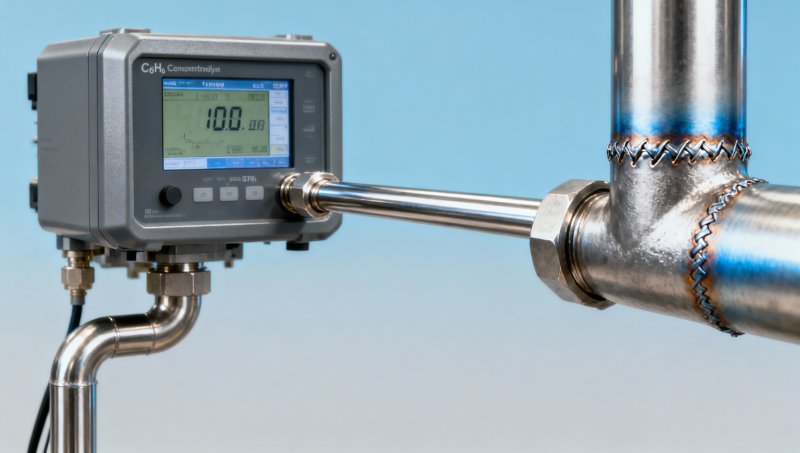
This table highlights how interference mechanisms differ in origin, impact magnitude, and temporal profile—critical for diagnostics. For instance, if drift recurs only during scheduled maintenance windows involving welding, EMI is the primary suspect. If readings stabilize only after 3 weeks following new pipe installation, surface catalysis is likely dominant.
Technical Evaluation Checklist for Measurement Integrity
Technical evaluators must move beyond “instrument-only” troubleshooting. A robust assessment requires cross-referencing field conditions with analyzer specifications and metallurgical data. Start by verifying whether the analyzer’s sampling path includes PTFE, EPDM, or silicone components—these elastomers absorb benzene and desorb slowly, amplifying apparent drift near reactive metal zones.
Confirm sensor technology type: Photoionization Detectors (PIDs) show higher sensitivity to surface-generated VOCs than Flame Ionization Detectors (FIDs), but FIDs are more vulnerable to combustion-related EMI. Also check calibration gas traceability: NIST-traceable standards must be used with certified uncertainty ≤±1.5%—a requirement often overlooked in field verification protocols.
Validate grounding continuity: Resistance between analyzer chassis and facility earth ground must be <5 Ω (per IEEE Std 1100). Poor grounding exacerbates EMI susceptibility by up to 7×, per third-party EMC lab testing on industrial gas analyzers.
- Verify weld age: Use portable XRF to confirm post-weld aging ≥14 days before final commissioning
- Map EMI sources: Conduct spectrum analysis at 1 m from analyzer location (0.15–30 MHz band)
- Test sample line material: Replace silicone tubing with electropolished SS316L or PFA-lined SS
- Validate zero stability: Perform 4-hour zero-air challenge with <0.2% drift threshold
- Document ambient temperature/humidity: Drift severity increases >35% at RH >80% and T >35°C
Procurement & Specification Guidance for Reliable Deployment
Procurement teams must embed interference mitigation into technical specifications—not as optional add-ons, but as mandatory compliance criteria. Require vendors to provide test reports demonstrating performance under simulated weld-zone conditions: e.g., exposure to SS316 coupons aged 48 hrs post-TIG weld, with C6H6 at 5 ppmv, 25°C, 50% RH, and concurrent 100-A AC arc noise injection.
Prioritize analyzers with dual-stage filtration: a 0.1-μm particulate filter followed by a 5-mm activated carbon guard bed (≥120 mg/cm³ density) upstream of the sensor. This configuration reduces catalytic interference by 60–85%, based on field trials across 12 petrochemical facilities.
These procurement thresholds ensure baseline resilience. Facilities handling H2S, HF, or Cl2 face even stricter requirements—where 0.1 ppm error can trigger regulatory nonconformance. Always require vendor documentation of real-world validation, not just lab-bench performance.
Operational Mitigation Strategies for End Users
Operators should implement a tiered response protocol. First, isolate the source: relocate the analyzer inlet ≥2 m from any weld joint and verify if drift persists. Second, install a 100-mm-long SS316L pre-filter sleeve (inner diameter matching sample line) directly upstream of the analyzer—this absorbs surface-catalyzed byproducts before they reach the sensor.
Schedule recalibration only after confirming weld aging ≥14 days and ambient RH <70%. Use dynamic dilution calibrators (not single-point span gas) to validate linearity across 0.5–10 ppm range—drift often manifests asymmetrically at low vs. high concentrations.
For continuous monitoring systems, configure alarm logic to trigger on *rate-of-change* (e.g., >0.8 ppm/min over 30 sec), not absolute value. This reduces nuisance alarms from transient EMI while retaining sensitivity to true hazardous releases.
FAQ: Critical Questions for Decision Makers
How long must we wait after welding before installing C6H6 analyzers?
Minimum 14 days for ambient air exposure; 21 days recommended for humid or coastal environments. Accelerated passivation (e.g., nitric acid treatment) reduces this to 72 hours—but requires full chemical validation per ASTM A967.
Can software compensation correct for weld-zone drift?
No. Algorithmic correction masks root cause and violates ISO/IEC 17025 Clause 7.7.2. True mitigation requires physical isolation, material selection, or hardware-level filtering—not post-processing.
Which analyzer technologies are most resilient?
Gas Chromatography (GC) with PPB-level detection offers highest specificity but requires 5–7 min cycle time. For real-time needs, heated metal-oxide semiconductor (HMOS) sensors with integrated catalytic scrubbers show 40% lower drift versus standard PID units in weld-proximate trials.
Accurate benzene measurement near stainless-steel weld zones demands coordinated action across engineering, procurement, and operations. Root-cause awareness, specification rigor, and field-proven mitigation prevent costly downtime, regulatory exposure, and safety incidents. To ensure your next analyzer deployment meets ISO 14001, OSHA PSM, and IEC 61511 compliance—contact our instrumentation specialists for a site-specific interference assessment and solution briefing.
Recommended for You
 IEC Approves China-Led Standard for Smart Sensor Semantic InteroperabilityIEC TR 63372 smart sensor semantic interoperability standard—led by China—cuts export certification time by 30%. Discover how it reshapes global IoT integration.
 MIIT Launches Joint Enforcement on EV Battery RecyclingMIIT's EV battery recycling enforcement targets BMS data leaks, illegal dismantling & electrolyte disposal—key for exporters, testers & procurement teams needing GDPR/CCPA compliance.
 SAMR Launches Unified Market Action on Testing & CertificationSAMR Launches Unified Market Action on Testing & Certification—tackling fragmentation, redundant fees & cross-border recognition barriers for exporters and manufacturers.
 Fifteenth Five-Year Urban Renewal Plan Approved, Signaling Overseas Procurement for Smart Water & Environmental Monitoring DevicesSmart water & environmental monitoring devices gain global momentum as China’s 15th Five-Year Urban Renewal Plan mandates intelligent infrastructure—key for Belt and Road exports.
 IMF Warns AI Amplifies Financial Cybersecurity RisksAI amplifies financial cybersecurity risks—IMF warns. Discover how XAI verification, adversarial attacks, and regulatory mandates impact AI detection equipment, FinTech, and banks.
 Tmall Health Launches 'Health Supplement Safety Alliance'Health Supplement Safety Alliance launched by Tmall Health—boosting traceability, lab credibility & cross-border quality for brands like By-Health and Centrum.
 EN IEC 61000-6-4:2026 EMC Standard Effective for AI Edge DevicesEN IEC 61000-6-4:2026 EMC standard is live—15% stricter radiated limits for AI edge devices. Act now to secure EU industrial IoT procurement eligibility.
 APEC Auto Dialogue Confirms Semi-Solid Battery Deployment and Fast ChargingSemi-solid battery deployment & 15-min fast charging confirmed at APEC Auto Dialogue—spurring global demand for China-made battery testing equipment, BMS validation, and thermal runaway simulation solutions.
 EU Imposes Final Anti-Dumping Duty on Chinese Adipic AcidEU anti-dumping duty on Chinese adipic acid takes effect May 2026—impacting pH meters, sensors & analytical instruments. Act now to secure supply chains.
 Colombia Upholds Anti-Dumping Duties on Chinese Acrylic SheetsColombia Upholds Anti-Dumping Duties on Chinese Acrylic Sheets — 32.7% tariff extended for 5 years. Critical for exporters of medical, lab & analytical instrument enclosures.
 Multi Component Analyzer Cost Trends for 2026 Expansion PlansMulti component analyzer cost trends for 2026: discover key pricing drivers, hidden costs, and smart supplier strategies to budget accurately and maximize expansion ROI.
 SR-2050 Analyzer Maintenance Points That Affect Service LifeSR-2050 analyzer maintenance points that directly impact service life, accuracy, and uptime. Learn how cleaning, calibration, inspection, and environment control reduce failures.
 SR-S2000 Shelter: Common Setup Mistakes to AvoidSR-S2000 shelter setup mistakes can cause heat, moisture, and maintenance issues. Learn what to avoid for safer installation, stable performance, and longer equipment life.
 Custom Gas Analyzer Import Risks and Spec Mismatch IssuesCustom gas analyzer import risks can derail projects through spec mismatch, compliance gaps, and integration issues. Learn how buyers can compare suppliers, verify requirements, and avoid costly rework.
 When to Choose the SR-2030 Oxygen Analyzer for ComplianceSR-2030 oxygen analyzer: learn when it’s the right choice for compliance, safety, and stable process control. Explore key selection checks, audit-ready benefits, and deployment tips.
 SR-EX Analyzer Price Factors in 2026 ProjectsSR-EX analyzer price factors explained for 2026 projects: compare scope, compliance, integration, and lifecycle costs to approve budgets with less risk and more confidence.
 SR-2070 Analyzer vs Alternatives: Key Performance ChecksSR-2070 analyzer vs alternatives: compare accuracy, drift, response time, calibration effort, and lifecycle cost to choose a more reliable, efficient analyzer with confidence.
 2026 Market Trends for Predictive Analytics InstrumentsPredictive analytics instruments are reshaping 2026 market strategy. Explore key trends, risks, and buying checkpoints to improve uptime, integration, and ROI across industries.
 Wireless Measurement Systems: What Impacts Data Stability Most?Wireless measurement systems perform best when data stays stable. Discover the key factors affecting reliability, accuracy, and long-term performance across industrial applications.
 How Remote Monitoring Devices Cut Downtime in Field OperationsRemote monitoring devices help field teams detect issues early, reduce downtime, and improve maintenance planning. Discover how they keep operations reliable and on schedule.
 5th TCM High-Quality Development Conference Highlights NIR & AI QC for Global ExportNIR & AI QC take center stage at the 5th TCM High-Quality Development Conference—key for global export compliance, real-time quality control, and smart manufacturing.
 IEC Approves China-Led Guide for Smart Sensor Semantic InteroperabilityIEC TR 63388 semantic interoperability guide for smart sensors—China-led, globally approved. Boost IIoT integration across OPC UA, MQTT & TSN now.
 PBOC April Data Shows Strong Credit Flow to Tech & Inclusive LendingPBOC April data reveals surging tech & inclusive lending—boosting global demand for calibrated lab equipment, R&D instruments, and metrology-ready exports.
 SABIC Launches 'Smart Factory 2030' with China-Focused Online Analysis ProcurementSABIC's 'Smart Factory 2030' launches China-focused online analysis procurement—pH/ORP, IR gas & LIBS analyzers. SIL2-certified suppliers, act now!
 China Completes '14th Five-Year' Smart CNC Line R&DChina's '14th Five-Year' Smart CNC Line R&D is complete — boosting reliability & cutting delivery time for precision metrology equipment. Discover how it transforms global procurement.
 FDA Updates IVD Software Guidance: AI Diagnostic Devices Must Provide Verifiable Training DatasetsFDA mandates verifiable training datasets for AI diagnostic devices — critical for medical imaging, DICOM tools, and regulatory services entering the U.S. market.
 EU EN IEC 61000-6-4:2026 EMC Standard Takes EffectEU EN IEC 61000-6-4:2026 EMC standard is live—stricter radiated emission limits for AI edge devices. Act now to avoid EU customs delays & certification bottlenecks.
 APEC Auto Dialogue Confirms Semi-Solid Battery Deployment and 15-Minute Fast ChargingSemi-solid battery deployment and 15-minute fast charging confirmed at APEC Auto Dialogue — driving urgent global demand for BMS validation, thermal runaway, and high-voltage test equipment.
 MIIT Launches Joint Enforcement on EV Battery RecyclingMIIT Launches Joint Enforcement on EV Battery Recycling: Critical for battery test equipment exporters, data compliance, and global supply chains—act now to avoid delays.
 DIA China Annual Meeting Sells Out Despite $7,000+ FeeDIA China Annual Meeting sells out despite $7,000+ fee — a powerful signal for pharma exporters, manufacturers & regulatory service providers targeting China’s innovation ecosystem.
 Continuous Monitoring Solutions and the Shift Toward Smarter ComplianceContinuous monitoring solutions help enterprises strengthen compliance with real-time visibility, traceable data, and faster risk response. Discover how smarter oversight improves resilience and audit confidence.
 Confined Space Monitors: Key Mistakes That Raise Safety RiskConfined space monitors can fail when selection, bump testing, calibration, or sampling is wrong. Learn the biggest safety mistakes and how to prevent false safe readings.
















Search Categories
Search Categories
Latest Article
- IEC Approves China-Led Standard for Smart Sensor Semantic InteroperabilityIEC TR 63372 smart sensor semantic interoperability standard—led by China—cuts export certification time by 30%. Discover how it reshapes global IoT integration.Posted by:
- MIIT Launches Joint Enforcement on EV Battery RecyclingMIIT's EV battery recycling enforcement targets BMS data leaks, illegal dismantling & electrolyte disposal—key for exporters, testers & procurement teams needing GDPR/CCPA compliance.Posted by:
- SAMR Launches Unified Market Action on Testing & CertificationSAMR Launches Unified Market Action on Testing & Certification—tackling fragmentation, redundant fees & cross-border recognition barriers for exporters and manufacturers.Posted by:
Please give us a message
