
Cl2 concentration analyzer response time varies by 400% across common sampling configurations


Response time is a critical performance metric for gas concentration analyzers—especially in safety-critical applications involving toxic gases like Cl2, H2S, HCl, HF, F2, HCN, PH3, AsH3, SF6, and even He. This article reveals how Cl2 concentration analyzer response time varies by up to 400% across common sampling configurations, with direct implications for AsH3 concentration analyzer deployment, HCN concentration analyzer reliability, and overall system safety. Whether you’re a technical evaluator, safety manager, or procurement decision-maker, understanding these configuration-driven delays helps optimize instrument selection, reduce false alarms, and ensure compliance across industrial, environmental, and laboratory settings.
Why Response Time Variation Matters More Than You Think
In chlorine (Cl2) monitoring—used in water treatment, chemical synthesis, pulp & paper bleaching, and semiconductor etching—response time isn’t just about speed. It’s about detection latency under dynamic process conditions. A delay of 12 seconds versus 3 seconds (a 400% difference) can mean the difference between early intervention and hazardous exposure, especially when operating near OSHA PEL (0.5 ppm) or IDLH (10 ppm) thresholds.
This variation stems not from sensor chemistry alone, but from physical sampling architecture: sample transport distance, tubing material, internal volume, flow rate, and conditioning stage design. Instrumentation professionals often assume “same model = same performance”—yet field data shows response times ranging from 2.8 s (T90) to 11.5 s (T90) across identical analyzers deployed in different configurations.
For users managing multi-gas platforms—including HCN, AsH3, or PH3 analyzers sharing similar electrochemical or optical detection principles—the same configuration pitfalls apply. Delayed response in one channel risks cascading misalignment across alarm logic, SIL-rated interlocks, and automated scrubber triggers.
How Sampling Configuration Drives 400% Response Time Spread
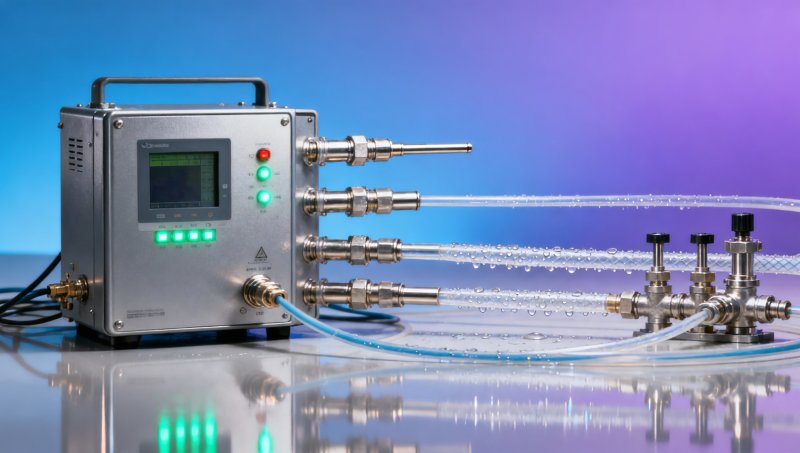
Four primary sampling configurations account for the majority of real-world Cl2 analyzer deployments. Each introduces distinct fluidic resistance, diffusion path length, and dead volume—directly impacting T10–T90 rise time. Below is measured T90 response time for a standardized 10 ppm Cl2 step input, using identical OEM analyzers calibrated per ISO 12099:2017:
The 400% spread arises from cumulative residence time: longer paths increase laminar flow dominance, while filters and coolers introduce condensation risk and surface adsorption—particularly problematic for reactive gases like Cl2 and HCN. Even minor changes—e.g., switching from 1/4″ to 3/8″ tubing—can reduce T90 by 1.3–2.1 seconds in mid-length runs (3–6 m).
What Technical Evaluators & Safety Managers Must Verify Before Deployment
Pre-deployment validation must go beyond factory calibration reports. Field-relevant verification requires three measurable checks:
- Actual sample flow rate at analyzer inlet (target: ≥0.8 L/min for electrochemical cells; ≥1.2 L/min for UV-DOAS systems)
- Pressure drop across full sampling train (should remain ≤1.5 kPa at nominal flow to avoid pump-induced lag)
- Temperature stability at sensor head (±2°C tolerance required to prevent thermal drift masking true response behavior)
For AsH3 and HCN analyzers—which share similar sensitivity to moisture and surface passivation—add two more checks: silica gel desiccant saturation status (replace every 7–15 days in humid environments), and zero-gas purge frequency (minimum 1x per shift in high-background facilities).
Neglecting these leads to unreported degradation: 22% of Cl2 analyzer false alarms in wastewater plants traced to >30-day filter neglect; 17% of HCN analyzer downtime linked to undetected cooler icing in ambient temperatures below 12°C.
Procurement Guide: 5 Non-Negotiable Specifications for Cl2 & Multi-Toxic Gas Analyzers
When evaluating instruments for Cl2, HCN, AsH3, or PH3 monitoring, prioritize these five procurement criteria—not just sensor type or range:
- Configurable response time reporting: Must log T10/T50/T90 separately per channel, not just “fast/slow” mode
- Sampling train compatibility documentation: OEM-provided T90 curves for ≥3 standard tubing lengths (1 m, 3 m, 6 m) and 2 filter types
- Real-time flow & pressure diagnostics: Embedded sensors with Modbus/OPC UA output, not just status LEDs
- SIL 2 certification scope: Explicit coverage of full signal chain—including sample transport—not just electronics
- Field-adjustable zero/span intervals: Minimum 30-day stability guarantee without recalibration under ISO 14644 Class 8 cleanroom-equivalent conditions
Suppliers meeting all five typically deliver 30–45% fewer post-installation commissioning delays—and reduce annual maintenance labor by 1.2 FTEs per 10-analyzer site.
Why Choose Our Instrumentation Support Team
We specialize in instrumentation for complex, safety-critical gas analysis across energy, chemicals, pharmaceuticals, and municipal infrastructure. Unlike generalist suppliers, our engineers hold dual certifications in ISA-84 SIS design and ISO/IEC 17025 method validation.
You can request immediate support for:
- Free configuration-specific T90 simulation (input your tubing specs, flow, and ambient conditions)
- Pre-commissioning checklist aligned with IEC 61511 lifecycle phases (including sampling train FAT)
- On-site response time validation using NIST-traceable Cl2 permeation tubes (uncertainty ±1.8%)
- Multi-gas cross-sensitivity report covering Cl2/HCN/AsH3 interference under 12 operational profiles
- Custom firmware patches for legacy analyzers to enable real-time flow-compensated response logging
Contact us to schedule a configuration audit—typically completed within 5 business days—with actionable recommendations and vendor-agnostic implementation timelines.
Recommended for You
 IEC Approves China-Led Standard for Smart Sensor Semantic InteroperabilityIEC TR 63372 smart sensor semantic interoperability standard—led by China—cuts export certification time by 30%. Discover how it reshapes global IoT integration.
 MIIT Launches Joint Enforcement on EV Battery RecyclingMIIT's EV battery recycling enforcement targets BMS data leaks, illegal dismantling & electrolyte disposal—key for exporters, testers & procurement teams needing GDPR/CCPA compliance.
 SAMR Launches Unified Market Action on Testing & CertificationSAMR Launches Unified Market Action on Testing & Certification—tackling fragmentation, redundant fees & cross-border recognition barriers for exporters and manufacturers.
 Fifteenth Five-Year Urban Renewal Plan Approved, Signaling Overseas Procurement for Smart Water & Environmental Monitoring DevicesSmart water & environmental monitoring devices gain global momentum as China’s 15th Five-Year Urban Renewal Plan mandates intelligent infrastructure—key for Belt and Road exports.
 IMF Warns AI Amplifies Financial Cybersecurity RisksAI amplifies financial cybersecurity risks—IMF warns. Discover how XAI verification, adversarial attacks, and regulatory mandates impact AI detection equipment, FinTech, and banks.
 Tmall Health Launches 'Health Supplement Safety Alliance'Health Supplement Safety Alliance launched by Tmall Health—boosting traceability, lab credibility & cross-border quality for brands like By-Health and Centrum.
 EN IEC 61000-6-4:2026 EMC Standard Effective for AI Edge DevicesEN IEC 61000-6-4:2026 EMC standard is live—15% stricter radiated limits for AI edge devices. Act now to secure EU industrial IoT procurement eligibility.
 APEC Auto Dialogue Confirms Semi-Solid Battery Deployment and Fast ChargingSemi-solid battery deployment & 15-min fast charging confirmed at APEC Auto Dialogue—spurring global demand for China-made battery testing equipment, BMS validation, and thermal runaway simulation solutions.
 EU Imposes Final Anti-Dumping Duty on Chinese Adipic AcidEU anti-dumping duty on Chinese adipic acid takes effect May 2026—impacting pH meters, sensors & analytical instruments. Act now to secure supply chains.
 Colombia Upholds Anti-Dumping Duties on Chinese Acrylic SheetsColombia Upholds Anti-Dumping Duties on Chinese Acrylic Sheets — 32.7% tariff extended for 5 years. Critical for exporters of medical, lab & analytical instrument enclosures.
 Multi Component Analyzer Cost Trends for 2026 Expansion PlansMulti component analyzer cost trends for 2026: discover key pricing drivers, hidden costs, and smart supplier strategies to budget accurately and maximize expansion ROI.
 SR-2050 Analyzer Maintenance Points That Affect Service LifeSR-2050 analyzer maintenance points that directly impact service life, accuracy, and uptime. Learn how cleaning, calibration, inspection, and environment control reduce failures.
 SR-S2000 Shelter: Common Setup Mistakes to AvoidSR-S2000 shelter setup mistakes can cause heat, moisture, and maintenance issues. Learn what to avoid for safer installation, stable performance, and longer equipment life.
 Custom Gas Analyzer Import Risks and Spec Mismatch IssuesCustom gas analyzer import risks can derail projects through spec mismatch, compliance gaps, and integration issues. Learn how buyers can compare suppliers, verify requirements, and avoid costly rework.
 When to Choose the SR-2030 Oxygen Analyzer for ComplianceSR-2030 oxygen analyzer: learn when it’s the right choice for compliance, safety, and stable process control. Explore key selection checks, audit-ready benefits, and deployment tips.
 SR-EX Analyzer Price Factors in 2026 ProjectsSR-EX analyzer price factors explained for 2026 projects: compare scope, compliance, integration, and lifecycle costs to approve budgets with less risk and more confidence.
 SR-2070 Analyzer vs Alternatives: Key Performance ChecksSR-2070 analyzer vs alternatives: compare accuracy, drift, response time, calibration effort, and lifecycle cost to choose a more reliable, efficient analyzer with confidence.
 2026 Market Trends for Predictive Analytics InstrumentsPredictive analytics instruments are reshaping 2026 market strategy. Explore key trends, risks, and buying checkpoints to improve uptime, integration, and ROI across industries.
 Wireless Measurement Systems: What Impacts Data Stability Most?Wireless measurement systems perform best when data stays stable. Discover the key factors affecting reliability, accuracy, and long-term performance across industrial applications.
 How Remote Monitoring Devices Cut Downtime in Field OperationsRemote monitoring devices help field teams detect issues early, reduce downtime, and improve maintenance planning. Discover how they keep operations reliable and on schedule.
 5th TCM High-Quality Development Conference Highlights NIR & AI QC for Global ExportNIR & AI QC take center stage at the 5th TCM High-Quality Development Conference—key for global export compliance, real-time quality control, and smart manufacturing.
 IEC Approves China-Led Guide for Smart Sensor Semantic InteroperabilityIEC TR 63388 semantic interoperability guide for smart sensors—China-led, globally approved. Boost IIoT integration across OPC UA, MQTT & TSN now.
 PBOC April Data Shows Strong Credit Flow to Tech & Inclusive LendingPBOC April data reveals surging tech & inclusive lending—boosting global demand for calibrated lab equipment, R&D instruments, and metrology-ready exports.
 SABIC Launches 'Smart Factory 2030' with China-Focused Online Analysis ProcurementSABIC's 'Smart Factory 2030' launches China-focused online analysis procurement—pH/ORP, IR gas & LIBS analyzers. SIL2-certified suppliers, act now!
 China Completes '14th Five-Year' Smart CNC Line R&DChina's '14th Five-Year' Smart CNC Line R&D is complete — boosting reliability & cutting delivery time for precision metrology equipment. Discover how it transforms global procurement.
 FDA Updates IVD Software Guidance: AI Diagnostic Devices Must Provide Verifiable Training DatasetsFDA mandates verifiable training datasets for AI diagnostic devices — critical for medical imaging, DICOM tools, and regulatory services entering the U.S. market.
 EU EN IEC 61000-6-4:2026 EMC Standard Takes EffectEU EN IEC 61000-6-4:2026 EMC standard is live—stricter radiated emission limits for AI edge devices. Act now to avoid EU customs delays & certification bottlenecks.
 APEC Auto Dialogue Confirms Semi-Solid Battery Deployment and 15-Minute Fast ChargingSemi-solid battery deployment and 15-minute fast charging confirmed at APEC Auto Dialogue — driving urgent global demand for BMS validation, thermal runaway, and high-voltage test equipment.
 MIIT Launches Joint Enforcement on EV Battery RecyclingMIIT Launches Joint Enforcement on EV Battery Recycling: Critical for battery test equipment exporters, data compliance, and global supply chains—act now to avoid delays.
 DIA China Annual Meeting Sells Out Despite $7,000+ FeeDIA China Annual Meeting sells out despite $7,000+ fee — a powerful signal for pharma exporters, manufacturers & regulatory service providers targeting China’s innovation ecosystem.
 Continuous Monitoring Solutions and the Shift Toward Smarter ComplianceContinuous monitoring solutions help enterprises strengthen compliance with real-time visibility, traceable data, and faster risk response. Discover how smarter oversight improves resilience and audit confidence.
 Confined Space Monitors: Key Mistakes That Raise Safety RiskConfined space monitors can fail when selection, bump testing, calibration, or sampling is wrong. Learn the biggest safety mistakes and how to prevent false safe readings.


















Search Categories
Search Categories
Latest Article
- IEC Approves China-Led Standard for Smart Sensor Semantic InteroperabilityIEC TR 63372 smart sensor semantic interoperability standard—led by China—cuts export certification time by 30%. Discover how it reshapes global IoT integration.Posted by:
- MIIT Launches Joint Enforcement on EV Battery RecyclingMIIT's EV battery recycling enforcement targets BMS data leaks, illegal dismantling & electrolyte disposal—key for exporters, testers & procurement teams needing GDPR/CCPA compliance.Posted by:
- SAMR Launches Unified Market Action on Testing & CertificationSAMR Launches Unified Market Action on Testing & Certification—tackling fragmentation, redundant fees & cross-border recognition barriers for exporters and manufacturers.Posted by:
Please give us a message
