
High Purity Analyzer Contamination Risks Often Go Unnoticed


In quality-critical environments, contamination threats in a high purity analyzer are often subtle, cumulative, and easy to overlook until they affect data accuracy, product consistency, or safety compliance. For quality control and safety managers, understanding where these hidden risks originate is essential to preventing false readings, process deviations, and costly operational consequences across modern industrial and laboratory applications.
Why contamination risk in a high purity analyzer is becoming a bigger industry concern
Across industrial manufacturing, energy systems, laboratory analysis, environmental monitoring, and automated process control, expectations for cleaner sampling, tighter tolerances, and faster verification cycles have increased noticeably in the past 3 to 5 years. A high purity analyzer is no longer used only as a niche instrument in specialized gas lines or semiconductor-adjacent processes. It is increasingly part of broader quality assurance architectures where even a low-level contamination event can trigger larger production, compliance, or safety consequences.
This change matters because contamination is no longer judged only by visible residue or obvious sensor drift. Many facilities now work with trace-level measurement windows, short batch runs, and stricter release decisions. In such settings, a contamination load that once seemed operationally acceptable may now be enough to distort trend data, delay root-cause analysis, or create false confidence in process stability. For quality control teams, the issue is not simply whether contamination exists, but whether it remains below the threshold that preserves decision-quality data.
Safety managers are also paying closer attention. When a high purity analyzer is connected to gas systems, solvent streams, emissions checks, medical testing support, or laboratory validation work, contamination can affect both measurement credibility and risk visibility. A delayed response of even 30 to 90 seconds in a critical monitoring sequence may reduce the value of alarm logic, especially where purge cycles, calibration transitions, or sample switching occur frequently.
Key trend signals quality and safety teams are seeing
Several signals explain why the contamination discussion is expanding beyond instrumentation specialists. First, more facilities are integrating online analysis into digital quality systems, meaning poor analyzer hygiene now affects dashboards, batch records, and automated reporting rather than a single standalone reading. Second, procurement teams increasingly ask for compatibility with ultra-clean tubing, low-outgassing wetted parts, and controlled installation practices. Third, maintenance intervals are becoming more condition-based, which raises the need for cleaner baseline performance over longer operating windows such as 6, 12, or 24 months.
Another trend is the widening use of multi-gas, multi-stream, or shared manifold configurations. These setups improve utilization but can also increase the probability of carryover, adsorption, or back-diffusion if system design is not disciplined. In practice, contamination risk often grows when a high purity analyzer is expected to support broader operating scenarios without equivalent upgrades in sample conditioning, purge validation, or operator control.
The result is a shift in mindset: contamination is now treated less as an isolated maintenance fault and more as a systems-level reliability issue. That shift is especially important in comprehensive industries where instrumentation supports multiple sectors and the same decision-makers must balance uptime, compliance, worker protection, and product consistency.
The table below summarizes common shifts that are making contamination risk in a high purity analyzer more visible than before.
These shifts do not mean every installation is at high risk, but they do mean historical assumptions are less reliable. A high purity analyzer that performed acceptably in a simpler process setup may require new contamination controls when used in a more connected, lower-threshold, or faster-cycle environment.
What is driving the hidden contamination problem
The hidden nature of contamination often comes from the fact that it develops in layers rather than in a single failure event. Material outgassing, seal aging, improper line cleaning, dead-leg geometry, poor valve sequencing, and inconsistent calibration gas handling can all contribute small loads that accumulate over weeks or months. By the time performance drift appears, the contamination source may already be embedded in multiple parts of the sample path.
A second driver is the mismatch between analyzer capability and supporting infrastructure. Many quality and safety teams review analyzer specifications carefully, yet sampling lines, regulators, fittings, filters, and enclosure conditions receive less scrutiny. In reality, a high purity analyzer can only perform as cleanly as the least controlled upstream component. A low-adsorption analyzer paired with unsuitable elastomers or unverified tubing preparation may still show baseline instability, slow recovery, or false residual peaks.
A third driver is operational pressure. Fast commissioning schedules, frequent product changeovers, and decentralized maintenance can reduce discipline around cleaning validation and post-service verification. When teams assume that a stable display equals a clean system, contamination can remain hidden in response lag, biased zero points, or periodic anomalies that only appear under certain humidity, flow, or load conditions.
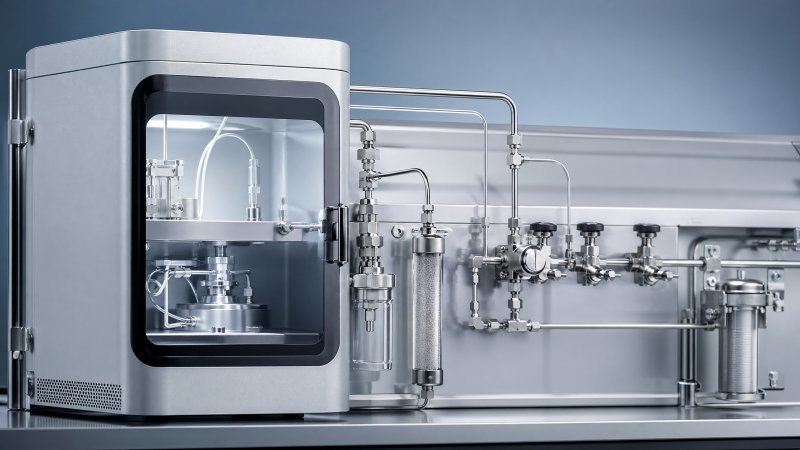
Common contamination sources that are underestimated
In many facilities, the most underestimated sources are not catastrophic failures but routine design and handling details. For example, a sample line with excess internal volume may increase purge time by 2 to 4 times compared with a compact layout. Similarly, low-flow dead zones around tees, valves, or switching blocks can trap prior sample content and release it slowly into the next measurement cycle.
Operational contributors that often go unnoticed
- Incomplete cleaning after installation, especially when fabrication oils, particles, or packaging residue remain in the line.
- Using materials with higher outgassing or adsorption behavior than the application allows, particularly in trace moisture or oxygen monitoring.
- Calibration cylinders, regulators, or transfer hoses that are clean enough for general service but not for a high purity analyzer.
- Maintenance interventions that open the system briefly but do not include adequate purge and recovery confirmation afterward.
- Condensation or ambient ingress caused by poor enclosure control, especially when temperature swings exceed typical 5 to 10°C daily ranges.
These issues are difficult because each one may seem minor in isolation. Yet together they can alter repeatability, delay stabilization, and distort the confidence that quality personnel place in trend charts. For safety managers, the same conditions can weaken the reliability of threshold alarms or verification routines used in permit control, gas handling, or process release checks.
The table below groups contamination drivers by where they originate and how they typically show up in daily operations.
For decision-makers, the practical lesson is clear: contamination prevention is less about one component and more about controlling the entire measurement chain. That is why a high purity analyzer should be assessed as part of a clean measurement system, not only as a standalone instrument.
How these contamination shifts affect quality control and safety management
For quality control personnel, contamination risk changes the meaning of data confidence. A reading may appear stable enough for routine operation while still masking a bias large enough to affect release decisions, trend interpretation, or supplier comparisons. In high-spec environments, even a small offset can trigger avoidable scrap, unnecessary retesting, or delayed troubleshooting. The operational cost may be felt long before anyone identifies the analyzer as the source.
Safety managers face a related but distinct issue. If a high purity analyzer supports hazardous gas verification, confined process areas, inerting validation, or emissions-related monitoring, contamination can alter response speed and alarm trustworthiness. A contamination-related delay of 1 to 2 minutes may not matter in a slow lab check, but it can be significant in a dynamic process state change, startup sequence, or incident investigation.
There is also a governance impact. As organizations move toward traceable digital operations, analyzer records are increasingly reviewed across departments. A questionable data series may lead to broader audits of procedures, training, maintenance logs, and calibration methods. In other words, contamination in a high purity analyzer can create a cross-functional credibility issue, not just an instrumentation issue.
Who feels the impact most directly
Different roles experience the same contamination problem in different ways. The impact table below can help teams prioritize where attention is most urgent.
This distribution of impact shows why contamination should be discussed early, especially during system design, analyzer selection, and commissioning. Waiting until alarms, drift, or product variation appear often means that the contamination source has already influenced multiple business functions.
Signs that deserve escalation rather than routine observation
- Recovery to baseline consistently takes longer than the validated expectation after calibration or stream switching.
- Readings vary by operating shift, ambient season, or maintenance team without a clear process explanation.
- A high purity analyzer passes basic checks yet disagrees repeatedly with laboratory confirmation or parallel instruments.
- Service events are followed by 24 to 72 hours of unstable performance that normalizes only after extended purging.
When these patterns appear, the decision should not be limited to recalibration. Teams should review cleanliness control, material compatibility, purge logic, and the integrity of the full sample handling path.
What organizations should now evaluate before risk turns into nonconformance
The strongest response to contamination risk is not reactive cleaning alone. It is a structured evaluation model that connects design, operation, service, and verification. Organizations using a high purity analyzer should review whether cleanliness assumptions were documented during specification and whether those assumptions still match current operating demands. This is especially relevant where the analyzer has been repurposed, connected to new lines, or integrated into a faster production rhythm.
A practical review usually begins with three time horizons. In the short term, teams should confirm current baseline stability, purge performance, and post-maintenance recovery. In the medium term, they should compare maintenance frequency, drift behavior, and calibration consistency over the last 6 to 12 months. In the longer term, they should assess whether the existing analyzer architecture still supports future cleanliness targets, digital traceability, and cross-functional risk expectations.
This evaluation does not require overstating the problem. It requires asking better questions earlier. For example, if the process now demands more frequent switching, lower impurity thresholds, or broader reporting integration, then the contamination tolerance of the current high purity analyzer setup may no longer be adequate even if the instrument itself is technically functional.
A focused review checklist for current operations
- Verify whether all wetted materials, seals, regulators, and tubing are suitable for the target purity level and sample chemistry.
- Check whether purge and stabilization times were validated under real operating flows, not only during commissioning.
- Review whether calibration gases, connection hardware, and storage practices match the cleanliness requirement of the high purity analyzer.
- Confirm that maintenance procedures include cleanliness protection, leak control, and post-service performance verification.
- Assess whether trend anomalies correlate with temperature changes, batch transitions, shift patterns, or recent interventions.
What stronger governance looks like
Stronger governance usually means setting explicit acceptance windows for response time, baseline recovery, and repeatability instead of relying only on pass-fail calibration status. For some applications, a response deviation above a predefined internal threshold or a recovery period extending beyond the validated cycle time should trigger investigation. Even where no formal regulation specifies these limits, internal discipline reduces hidden risk.
It also helps to define ownership across teams. Engineering may own compatibility review, maintenance may own service cleanliness, quality may own data acceptance criteria, and safety may own alarm reliability expectations. A high purity analyzer performs best when these responsibilities are connected rather than fragmented.
Where applicable, organizations may align internal procedures with recognized quality, calibration, and safety frameworks used in industrial and laboratory settings. The exact standard set will vary by sector, but the principle remains the same: the cleaner the measurement requirement, the more disciplined the control of the total measurement chain must be.
How to prepare for the next phase of analyzer reliability expectations
Looking ahead, contamination control in a high purity analyzer is likely to become more visible during procurement, system integration, and audit preparation. Buyers are increasingly comparing not only analyzer performance specifications but also sample path design support, material guidance, commissioning discipline, and serviceability. This reflects a larger trend in instrumentation: reliability is being judged as an outcome of system quality, not just device accuracy.
For quality control and safety leaders, the most useful next step is to shift from reactive troubleshooting to risk-based planning. That means identifying where contamination would create the greatest operational consequence, whether in batch release, hazardous gas verification, environmental compliance, laboratory reference integrity, or automated process control. Once those critical points are mapped, teams can prioritize upgrades that bring measurable risk reduction rather than pursuing broad changes without direction.
The best preparation often combines modest design refinement with better procedure control. Examples include reducing dead volume, improving enclosure stability, tightening calibration gas handling, documenting recovery criteria, and selecting service parts intended for cleaner applications. In many cases, these measures deliver more value than replacing the analyzer alone.
Why choose us
If your team is evaluating contamination risks around a high purity analyzer, we can help you look beyond catalog specifications and focus on what affects real operating reliability. We support discussions around application conditions, sampling path compatibility, response expectations, integration concerns, and practical maintenance planning for industrial and laboratory environments.
You can contact us to discuss parameter confirmation, product selection, delivery cycle expectations, customized solution planning, compatibility with your current instrumentation layout, sample handling recommendations, and quotation communication. If your concern involves trace-level stability, cross-stream contamination, calibration handling, or post-installation verification, we can help structure the key questions before procurement or retrofit decisions are made.
For organizations facing tighter quality targets, faster production changes, or stronger safety accountability, now is the right time to review whether the current high purity analyzer setup still matches future requirements. Contact us to explore a more suitable configuration path and reduce hidden contamination risk before it affects data trust, compliance performance, or operational continuity.
Recommended for You
 US-China Trade Talks Agree on Tariff Cuts for Key Test Equipment PartsUS-China tariff cuts on key test equipment parts—like pressure sensor chips & infrared thermal imaging modules—boost margins, cut costs, and strengthen global competitiveness for manufacturers.
 G7 Paris Meeting Focuses on Critical Mineral Supply SecurityCritical mineral supply security takes center stage at the G7 Paris meeting—key for rare-earth sensor exporters. Learn EU compliance impacts & actionable readiness steps.
 Brent Crude Surpasses $106/bbl, Raising Sea Freight Costs for Small Testing Equipment ExportsBrent Crude Surpasses $106/bbl—sea freight costs surge, impacting small testing equipment exporters. Learn how SMEs can adapt pricing, terms & logistics now.
 WTO Forecasts 1.9% Global Goods Trade Growth in 2026 Amid Supply Chain ShorteningWTO forecasts 1.9% global goods trade growth in 2026—sparking nearshoring demand for testing equipment, calibration services & OTA-ready solutions in ASEAN, Middle East & Mexico.
 UK-China Export Control Working Group Holds Second Meeting in LondonUK-China Export Control Working Group: Key updates on dual-use items—laser interferometers, quantum sensors & oscilloscopes. Learn compliance implications for exporters now.
 Japan's 10Y Yield Drop to 2.745% Lifts Yen, Raising China-Made Testing Equipment CostsJapan's 10Y yield drop to 2.745% lifts yen, raising costs for China-made testing equipment — explore FX impacts, procurement shifts & strategic responses.
 KOSPI 200 Futures Circuit Breaker Triggered, Impacting Industrial Automation Instrument Export TimelinesKOSPI 200 futures circuit breaker triggered — impact on PLC modules, transmitters & fieldbus instrument exports to Korea. Urgent timeline insights inside.
 South Korea’s Chip Exports Surge 202% in May 2026 Amid AI Test Equipment DemandAI test equipment demand surges as South Korea’s chip exports jump 202% in May 2026 — PCIe 6.0 & USB4.1 validation tools see sharp global procurement rise.
 Emission Gas Analyzer News in 2026: Regulatory Shifts Affecting DemandEmission gas analyzer demand is changing fast in 2026 as new regulations tighten limits, expand continuous monitoring, and raise data compliance standards. Explore key trends shaping smarter buying decisions.
 When a High Accuracy Analyzer Delivers Real ROI in Process ControlHigh accuracy analyzer ROI starts with better process control. Learn where tighter measurements cut waste, improve stability, reduce compliance risk, and deliver measurable operational savings.
 SR-2030P Analyzer Import Updates in 2026: Compliance Points to ReviewSR-2030P analyzer import updates for 2026: review classification, certification, customs documents, and market access risks to reduce delays, control costs, and source with confidence.
 Industrial Oxygen Analyzer Price Trends in 2026: Cost Drivers to WatchIndustrial oxygen analyzer price trends in 2026 explained: compare sensor, compliance, installation, and maintenance cost drivers to make smarter, lower-risk buying decisions.
 Laser Oxygen Analyzer or Industrial Oxygen Analyzer: Which Fits BetterLaser oxygen analyzer or industrial oxygen analyzer? Compare speed, accuracy, maintenance, and cost to find the best fit for smarter, more reliable process control.
 ATEX Gas Analyzer Demand in 2026: What Is Shaping the MarketATEX gas analyzer demand in 2026 is driven by safety, digital integration, and lifecycle value. See what shapes buying decisions across industry, utilities, hydrogen, and automation.
 Fixed Gas Analyzer vs Portable Options: What Matters for Plant UseFixed gas analyzer or portable detector for plant use? Compare safety, response time, maintenance, and cost to choose the right monitoring solution with confidence.
 Explosion Proof Analyzer Selection Mistakes That Increase Site RiskExplosion proof analyzer selection mistakes can raise compliance, maintenance, and safety risks. Learn the key errors to avoid and how to choose a safer, more reliable solution.
 SR-2000 Infrared Analyzer: Key Performance Checks Before InstallationSR-2000 infrared analyzer pre-installation guide: learn how to verify accuracy, drift, site readiness, and calibration support to reduce startup risk and ensure stable long-term performance.
 How to Choose a Continuous Gas Analyzer for Stable 24/7 MonitoringContinuous gas analyzer selection guide for stable 24/7 monitoring. Learn how to compare accuracy, response time, maintenance, and integration for smarter industrial decisions.
 IEC Approves China-Led Standard for Smart Sensor Semantic InteroperabilityIEC TR 63372 smart sensor semantic interoperability standard—led by China—cuts export certification time by 30%. Discover how it reshapes global IoT integration.
 MIIT Launches Joint Enforcement on EV Battery RecyclingMIIT's EV battery recycling enforcement targets BMS data leaks, illegal dismantling & electrolyte disposal—key for exporters, testers & procurement teams needing GDPR/CCPA compliance.
 SAMR Launches Unified Market Action on Testing & CertificationSAMR Launches Unified Market Action on Testing & Certification—tackling fragmentation, redundant fees & cross-border recognition barriers for exporters and manufacturers.
 Fifteenth Five-Year Urban Renewal Plan Approved, Signaling Overseas Procurement for Smart Water & Environmental Monitoring DevicesSmart water & environmental monitoring devices gain global momentum as China’s 15th Five-Year Urban Renewal Plan mandates intelligent infrastructure—key for Belt and Road exports.
 IMF Warns AI Amplifies Financial Cybersecurity RisksAI amplifies financial cybersecurity risks—IMF warns. Discover how XAI verification, adversarial attacks, and regulatory mandates impact AI detection equipment, FinTech, and banks.
 Tmall Health Launches 'Health Supplement Safety Alliance'Health Supplement Safety Alliance launched by Tmall Health—boosting traceability, lab credibility & cross-border quality for brands like By-Health and Centrum.
 EN IEC 61000-6-4:2026 EMC Standard Effective for AI Edge DevicesEN IEC 61000-6-4:2026 EMC standard is live—15% stricter radiated limits for AI edge devices. Act now to secure EU industrial IoT procurement eligibility.
 APEC Auto Dialogue Confirms Semi-Solid Battery Deployment and Fast ChargingSemi-solid battery deployment & 15-min fast charging confirmed at APEC Auto Dialogue—spurring global demand for China-made battery testing equipment, BMS validation, and thermal runaway simulation solutions.
 EU Imposes Final Anti-Dumping Duty on Chinese Adipic AcidEU anti-dumping duty on Chinese adipic acid takes effect May 2026—impacting pH meters, sensors & analytical instruments. Act now to secure supply chains.
 Colombia Upholds Anti-Dumping Duties on Chinese Acrylic SheetsColombia Upholds Anti-Dumping Duties on Chinese Acrylic Sheets — 32.7% tariff extended for 5 years. Critical for exporters of medical, lab & analytical instrument enclosures.
 Multi Component Analyzer Cost Trends for 2026 Expansion PlansMulti component analyzer cost trends for 2026: discover key pricing drivers, hidden costs, and smart supplier strategies to budget accurately and maximize expansion ROI.
 SR-2050 Analyzer Maintenance Points That Affect Service LifeSR-2050 analyzer maintenance points that directly impact service life, accuracy, and uptime. Learn how cleaning, calibration, inspection, and environment control reduce failures.
 SR-S2000 Shelter: Common Setup Mistakes to AvoidSR-S2000 shelter setup mistakes can cause heat, moisture, and maintenance issues. Learn what to avoid for safer installation, stable performance, and longer equipment life.
 Custom Gas Analyzer Import Risks and Spec Mismatch IssuesCustom gas analyzer import risks can derail projects through spec mismatch, compliance gaps, and integration issues. Learn how buyers can compare suppliers, verify requirements, and avoid costly rework.


Search Categories
Search Categories
Latest Article
- US-China Trade Talks Agree on Tariff Cuts for Key Test Equipment PartsUS-China tariff cuts on key test equipment parts—like pressure sensor chips & infrared thermal imaging modules—boost margins, cut costs, and strengthen global competitiveness for manufacturers.Posted by:
- G7 Paris Meeting Focuses on Critical Mineral Supply SecurityCritical mineral supply security takes center stage at the G7 Paris meeting—key for rare-earth sensor exporters. Learn EU compliance impacts & actionable readiness steps.Posted by:
- Brent Crude Surpasses $106/bbl, Raising Sea Freight Costs for Small Testing Equipment ExportsBrent Crude Surpasses $106/bbl—sea freight costs surge, impacting small testing equipment exporters. Learn how SMEs can adapt pricing, terms & logistics now.Posted by:
Please give us a message
