
Percent Range Analyzer vs Low Range Analyzer: A Practical Difference


Choosing between a percent range analyzer and a low range analyzer can directly affect data accuracy, process safety, and operating efficiency. For researchers comparing gas analysis solutions, understanding how each instrument performs under different concentration ranges is essential. This guide explains the practical differences, typical applications, and selection factors to help you evaluate the right option for industrial, laboratory, or environmental monitoring needs.
Why This Comparison Matters More Now
In the instrumentation industry, gas measurement is no longer judged only by whether an analyzer can produce a reading. Buyers and technical teams are increasingly asking whether the selected device matches the operating range, compliance target, and process risk of the application. That change is why the discussion around a percent range analyzer versus a low range analyzer has become more practical and more urgent.
Across industrial manufacturing, energy systems, laboratories, and environmental monitoring, processes are becoming tighter, data reporting is becoming more traceable, and control systems are becoming more automated. Under these conditions, range selection is no longer a secondary specification. It influences calibration frequency, alarm quality, maintenance cost, and even whether process decisions are made on trustworthy information.
A percent range analyzer is generally used where target gases are present in relatively high concentrations, often expressed in percentage terms. A low range analyzer is designed for far smaller concentrations, often where trace-level sensitivity is needed. On paper, that distinction sounds simple. In real operations, however, the difference affects investment decisions, plant reliability, environmental reporting, and product quality control.
The Market Signal: Users Are Prioritizing Fit Over Broad Capability
One notable shift in the market is that buyers are moving away from selecting instruments based on broad claims such as “multi-purpose” or “high performance” alone. They now want fit-for-purpose analysis. This is especially visible when teams compare a percent range analyzer with a low range analyzer for combustion control, inert gas blanketing, emissions checking, fermentation, gas purity verification, and research applications.
Several forces are behind this shift. First, process optimization programs are pushing operators to monitor smaller changes in gas composition. Second, digital control platforms can react rapidly to analyzer signals, so a poorly matched measurement range can create unstable control behavior. Third, quality and compliance teams are paying closer attention to documented accuracy across the actual operating range, not only at a nominal center point.
The Practical Difference Between a Percent Range Analyzer and a Low Range Analyzer
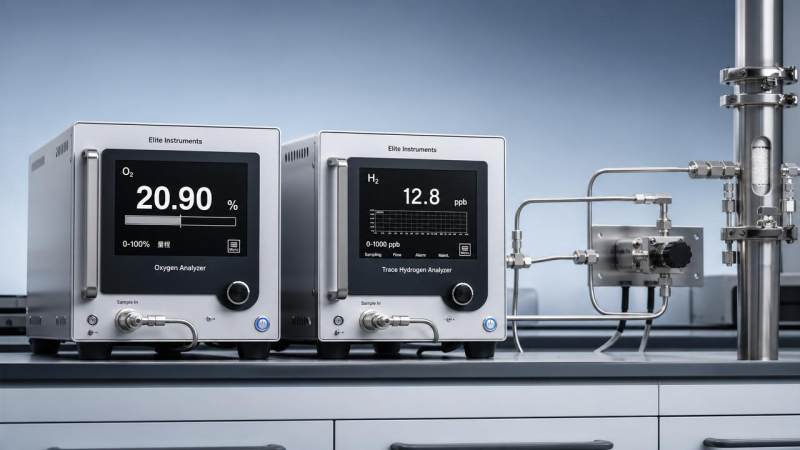
The central difference lies in measurement intent. A percent range analyzer is optimized for gases present at comparatively high concentrations. In these cases, the main concern is often process balance, combustion efficiency, blending ratio, or bulk gas composition. A low range analyzer, by contrast, is built to detect and quantify much smaller concentrations where impurity control, leak detection, trace contamination, or regulatory sensitivity matter more.
This difference affects several performance dimensions:
- Measurement resolution: low range analyzers generally need finer sensitivity to identify small concentration changes.
- Signal stability: trace measurement often requires stronger control of drift, sample conditioning, and interference.
- Calibration approach: higher range applications may tolerate broader calibration intervals, while low range applications usually demand tighter verification.
- Application risk: selecting the wrong range can create misleading confidence, especially if the instrument reads but does not read meaningfully.
In practical terms, using a percent range analyzer in a trace-level application may lead to unreadable variation or weak control confidence. Using a low range analyzer in a high concentration process may expose the sensor or optical system to unsuitable conditions, increase maintenance burden, or simply offer unnecessary precision at a higher operating cost.
What Is Driving the Shift Toward Better Range Matching
The increased attention to the percent range analyzer decision is closely tied to broader technology and operational changes in instrumentation.
1. Smarter control systems expose poor analyzer choices
As industrial control platforms become more responsive, poor analyzer range selection shows up faster. If the instrument lacks useful sensitivity within the true operating band, the control system may overreact, underreact, or trigger avoidable alarms.
2. Environmental and quality expectations are rising
Many sectors now require clearer evidence of gas composition, residual oxygen levels, impurities, or process byproducts. This pushes users to determine whether a percent range analyzer is enough or whether a low range analyzer is needed for more defensible data.
3. Downtime is more expensive than before
Instrumentation is increasingly tied to production continuity. A mismatch between analyzer range and process conditions can lead to recalibration delays, bad product batches, or troubleshooting cycles that cost far more than the original instrument.
4. Users want lifecycle clarity
Purchasing teams are less interested in a nominally flexible analyzer if its total ownership cost rises because of maintenance complexity, specialist calibration gases, or repeated performance validation. Range suitability has become a lifecycle issue, not just a technical one.
Where Each Analyzer Type Fits Best
The best choice depends less on product marketing and more on the concentration profile, decision threshold, and business consequence of a wrong reading.
Who Is Most Affected by This Choice
The difference between a percent range analyzer and a low range analyzer affects multiple stakeholders, not only instrumentation engineers.
Process engineers care because range mismatch can reduce control quality and distort optimization work. Maintenance teams are affected because unsuitable analyzers often require more intervention, recalibration, and sample system troubleshooting. Quality managers need confidence that readings support product conformity. Environmental and safety teams need evidence that low concentration events are not being overlooked. Procurement teams must balance initial budget against long-term reliability and compliance exposure.
This is why the decision has moved from being a narrow technical specification issue to a cross-functional judgment. The more a facility depends on automated control, auditability, and process consistency, the more important it becomes to choose the right analyzer range from the start.
Common Misjudgments in Analyzer Selection
A recurring market pattern is that users either overspecify or underspecify the instrument. Overspecification happens when a low range analyzer is selected for prestige or caution, even though the process only needs robust percentage measurement. This can increase cost and complexity without improving decisions. Underspecification happens when a percent range analyzer is chosen because it appears simpler, but the application actually depends on detecting small deviations near a critical threshold.
Another mistake is relying only on the maximum possible gas concentration instead of the normal operating band. If the process spends most of its time in a narrow lower band, the useful question is not “What is the highest concentration the analyzer can tolerate?” but “Where do I need the most reliable information for action?”
A third issue is ignoring sample quality. Even the best low range analyzer can disappoint if moisture, particulates, temperature variation, or cross-sensitivity are not managed well. In trend-sensitive environments, the sample system deserves nearly as much attention as the analyzer itself.
How to Evaluate the Right Direction in a Changing Market
For information researchers and technical evaluators, a useful framework is to judge the analyzer decision through five practical filters rather than through product labels alone.
- Operating reality: What concentration range does the process usually run in, and where do critical decisions happen?
- Decision consequence: What happens if the analyzer misses a small change or cannot distinguish variation clearly?
- Compliance and quality need: Are trace-level records, residual measurements, or purity assurance required?
- Maintenance capacity: Can the site support calibration discipline and sample conditioning suitable for low range work?
- Future flexibility: Is the process likely to tighten in specification, making a current percent range analyzer insufficient later?
These questions help shift the conversation from “Which analyzer sounds more advanced?” to “Which analyzer supports the process direction and business risk profile?”
What to Watch Next
Looking ahead, the distinction between a percent range analyzer and a low range analyzer will remain important even as sensor technologies improve. Instruments may become easier to integrate, more digital, and more stable, but the core issue of selecting the right measurement range will not disappear. In fact, as facilities demand stronger analytics and remote diagnostics, poor range matching may become even easier to identify.
The most important signal to watch is whether your application is moving toward tighter thresholds. If a process that once tolerated broad concentration variation now requires narrower control, cleaner emissions performance, better gas purity, or stronger audit evidence, a previous analyzer choice may no longer be sufficient. Trend direction matters more than legacy habit.
Final Judgment and Action Points
The practical difference between a percent range analyzer and a low range analyzer is not simply technical range. It reflects a broader shift in the instrumentation industry toward application-specific accuracy, measurable process value, and defensible operational decisions. A percent range analyzer remains highly relevant where concentration levels are substantial and process control is based on broad composition management. A low range analyzer becomes essential when small deviations carry quality, safety, or compliance impact.
If your team wants to judge the impact on its own operations, focus on a short list of questions: where are the true decision thresholds, how costly is an unnoticed deviation, what level of documentation is required, and is the process becoming more demanding over time? Those answers will usually reveal whether a percent range analyzer is the practical fit or whether low range capability is now the more strategic choice.
Recommended for You
 US-China Trade Talks Agree on Tariff Cuts for Key Test Equipment PartsUS-China tariff cuts on key test equipment parts—like pressure sensor chips & infrared thermal imaging modules—boost margins, cut costs, and strengthen global competitiveness for manufacturers.
 G7 Paris Meeting Focuses on Critical Mineral Supply SecurityCritical mineral supply security takes center stage at the G7 Paris meeting—key for rare-earth sensor exporters. Learn EU compliance impacts & actionable readiness steps.
 Brent Crude Surpasses $106/bbl, Raising Sea Freight Costs for Small Testing Equipment ExportsBrent Crude Surpasses $106/bbl—sea freight costs surge, impacting small testing equipment exporters. Learn how SMEs can adapt pricing, terms & logistics now.
 WTO Forecasts 1.9% Global Goods Trade Growth in 2026 Amid Supply Chain ShorteningWTO forecasts 1.9% global goods trade growth in 2026—sparking nearshoring demand for testing equipment, calibration services & OTA-ready solutions in ASEAN, Middle East & Mexico.
 UK-China Export Control Working Group Holds Second Meeting in LondonUK-China Export Control Working Group: Key updates on dual-use items—laser interferometers, quantum sensors & oscilloscopes. Learn compliance implications for exporters now.
 Japan's 10Y Yield Drop to 2.745% Lifts Yen, Raising China-Made Testing Equipment CostsJapan's 10Y yield drop to 2.745% lifts yen, raising costs for China-made testing equipment — explore FX impacts, procurement shifts & strategic responses.
 KOSPI 200 Futures Circuit Breaker Triggered, Impacting Industrial Automation Instrument Export TimelinesKOSPI 200 futures circuit breaker triggered — impact on PLC modules, transmitters & fieldbus instrument exports to Korea. Urgent timeline insights inside.
 South Korea’s Chip Exports Surge 202% in May 2026 Amid AI Test Equipment DemandAI test equipment demand surges as South Korea’s chip exports jump 202% in May 2026 — PCIe 6.0 & USB4.1 validation tools see sharp global procurement rise.
 Emission Gas Analyzer News in 2026: Regulatory Shifts Affecting DemandEmission gas analyzer demand is changing fast in 2026 as new regulations tighten limits, expand continuous monitoring, and raise data compliance standards. Explore key trends shaping smarter buying decisions.
 When a High Accuracy Analyzer Delivers Real ROI in Process ControlHigh accuracy analyzer ROI starts with better process control. Learn where tighter measurements cut waste, improve stability, reduce compliance risk, and deliver measurable operational savings.
 SR-2030P Analyzer Import Updates in 2026: Compliance Points to ReviewSR-2030P analyzer import updates for 2026: review classification, certification, customs documents, and market access risks to reduce delays, control costs, and source with confidence.
 Industrial Oxygen Analyzer Price Trends in 2026: Cost Drivers to WatchIndustrial oxygen analyzer price trends in 2026 explained: compare sensor, compliance, installation, and maintenance cost drivers to make smarter, lower-risk buying decisions.
 Laser Oxygen Analyzer or Industrial Oxygen Analyzer: Which Fits BetterLaser oxygen analyzer or industrial oxygen analyzer? Compare speed, accuracy, maintenance, and cost to find the best fit for smarter, more reliable process control.
 ATEX Gas Analyzer Demand in 2026: What Is Shaping the MarketATEX gas analyzer demand in 2026 is driven by safety, digital integration, and lifecycle value. See what shapes buying decisions across industry, utilities, hydrogen, and automation.
 Fixed Gas Analyzer vs Portable Options: What Matters for Plant UseFixed gas analyzer or portable detector for plant use? Compare safety, response time, maintenance, and cost to choose the right monitoring solution with confidence.
 Explosion Proof Analyzer Selection Mistakes That Increase Site RiskExplosion proof analyzer selection mistakes can raise compliance, maintenance, and safety risks. Learn the key errors to avoid and how to choose a safer, more reliable solution.
 SR-2000 Infrared Analyzer: Key Performance Checks Before InstallationSR-2000 infrared analyzer pre-installation guide: learn how to verify accuracy, drift, site readiness, and calibration support to reduce startup risk and ensure stable long-term performance.
 How to Choose a Continuous Gas Analyzer for Stable 24/7 MonitoringContinuous gas analyzer selection guide for stable 24/7 monitoring. Learn how to compare accuracy, response time, maintenance, and integration for smarter industrial decisions.
 IEC Approves China-Led Standard for Smart Sensor Semantic InteroperabilityIEC TR 63372 smart sensor semantic interoperability standard—led by China—cuts export certification time by 30%. Discover how it reshapes global IoT integration.
 MIIT Launches Joint Enforcement on EV Battery RecyclingMIIT's EV battery recycling enforcement targets BMS data leaks, illegal dismantling & electrolyte disposal—key for exporters, testers & procurement teams needing GDPR/CCPA compliance.
 SAMR Launches Unified Market Action on Testing & CertificationSAMR Launches Unified Market Action on Testing & Certification—tackling fragmentation, redundant fees & cross-border recognition barriers for exporters and manufacturers.
 Fifteenth Five-Year Urban Renewal Plan Approved, Signaling Overseas Procurement for Smart Water & Environmental Monitoring DevicesSmart water & environmental monitoring devices gain global momentum as China’s 15th Five-Year Urban Renewal Plan mandates intelligent infrastructure—key for Belt and Road exports.
 IMF Warns AI Amplifies Financial Cybersecurity RisksAI amplifies financial cybersecurity risks—IMF warns. Discover how XAI verification, adversarial attacks, and regulatory mandates impact AI detection equipment, FinTech, and banks.
 Tmall Health Launches 'Health Supplement Safety Alliance'Health Supplement Safety Alliance launched by Tmall Health—boosting traceability, lab credibility & cross-border quality for brands like By-Health and Centrum.
 EN IEC 61000-6-4:2026 EMC Standard Effective for AI Edge DevicesEN IEC 61000-6-4:2026 EMC standard is live—15% stricter radiated limits for AI edge devices. Act now to secure EU industrial IoT procurement eligibility.
 APEC Auto Dialogue Confirms Semi-Solid Battery Deployment and Fast ChargingSemi-solid battery deployment & 15-min fast charging confirmed at APEC Auto Dialogue—spurring global demand for China-made battery testing equipment, BMS validation, and thermal runaway simulation solutions.
 EU Imposes Final Anti-Dumping Duty on Chinese Adipic AcidEU anti-dumping duty on Chinese adipic acid takes effect May 2026—impacting pH meters, sensors & analytical instruments. Act now to secure supply chains.
 Colombia Upholds Anti-Dumping Duties on Chinese Acrylic SheetsColombia Upholds Anti-Dumping Duties on Chinese Acrylic Sheets — 32.7% tariff extended for 5 years. Critical for exporters of medical, lab & analytical instrument enclosures.
 Multi Component Analyzer Cost Trends for 2026 Expansion PlansMulti component analyzer cost trends for 2026: discover key pricing drivers, hidden costs, and smart supplier strategies to budget accurately and maximize expansion ROI.
 SR-2050 Analyzer Maintenance Points That Affect Service LifeSR-2050 analyzer maintenance points that directly impact service life, accuracy, and uptime. Learn how cleaning, calibration, inspection, and environment control reduce failures.
 SR-S2000 Shelter: Common Setup Mistakes to AvoidSR-S2000 shelter setup mistakes can cause heat, moisture, and maintenance issues. Learn what to avoid for safer installation, stable performance, and longer equipment life.
 Custom Gas Analyzer Import Risks and Spec Mismatch IssuesCustom gas analyzer import risks can derail projects through spec mismatch, compliance gaps, and integration issues. Learn how buyers can compare suppliers, verify requirements, and avoid costly rework.
Search Categories
Search Categories
Latest Article
- US-China Trade Talks Agree on Tariff Cuts for Key Test Equipment PartsUS-China tariff cuts on key test equipment parts—like pressure sensor chips & infrared thermal imaging modules—boost margins, cut costs, and strengthen global competitiveness for manufacturers.Posted by:
- G7 Paris Meeting Focuses on Critical Mineral Supply SecurityCritical mineral supply security takes center stage at the G7 Paris meeting—key for rare-earth sensor exporters. Learn EU compliance impacts & actionable readiness steps.Posted by:
- Brent Crude Surpasses $106/bbl, Raising Sea Freight Costs for Small Testing Equipment ExportsBrent Crude Surpasses $106/bbl—sea freight costs surge, impacting small testing equipment exporters. Learn how SMEs can adapt pricing, terms & logistics now.Posted by:
Please give us a message
