
F2 concentration analyzer interference from ambient ozone — is your reading reliable?


When measuring fluorine gas (F2) in real-world environments, ambient ozone (O3) can cause significant interference—compromising accuracy and safety. This issue isn’t isolated to F2 concentration analyzer systems; cross-sensitivity challenges also affect AsH3, PH3, HCN, HF, Cl2, H2S, HCl, SF6, and even He concentration analyzers. For users, technical evaluators, safety managers, and decision-makers across industrial, environmental, and laboratory settings, unreliable readings risk operational integrity, regulatory compliance, and personnel safety. Discover how ozone interference manifests, which analyzers are most vulnerable, and what mitigation strategies ensure trustworthy, actionable data.
How Ambient Ozone Interferes with F₂ Detection Mechanisms
Ozone is a strong oxidant with an electrochemical potential of +2.07 V—higher than that of fluorine (+2.87 V), but critically overlapping in many sensor response bands. Electrochemical (EC) and metal oxide semiconductor (MOS) F₂ analyzers are especially prone to false positives when exposed to ambient O₃ concentrations above 20 ppb. In field deployments near HVAC exhausts, UV sterilization units, or high-voltage equipment, ozone levels routinely reach 50–120 ppb—triggering signal drift up to ±15% full scale in uncorrected EC cells.
Optical methods—including tunable diode laser absorption spectroscopy (TDLAS) and Fourier-transform infrared (FTIR)—offer higher specificity but remain vulnerable at wavelengths where O₃ exhibits secondary absorption peaks near 1,850 nm and 9.6 μm. Cross-sensitivity ratios vary by optical path length and pressure: for a 10-m multipass cell operating at 100 kPa, O₃ interference can produce a 0.8–1.3 ppm apparent F₂ offset per 100 ppb ambient ozone.
Calibration protocols often overlook this variable. Standard span-gas calibration using N₂-diluted F₂ does not replicate real-world O₃ co-exposure—leading to undetected baseline shifts during continuous monitoring. Field studies across 12 chemical manufacturing sites show that 68% of uncorrected F₂ analyzers registered ≥3 false alarms per week attributable to ozone spikes—not actual fluorine leaks.
The table above reflects empirical performance data from third-party validation reports (IEC 60079-29-1 Annex D-compliant testing, 2022–2023). It underscores a critical procurement insight: technology selection must prioritize *interference rejection capability*, not just detection limit or response time.
Vulnerable Applications Across Industrial Sectors
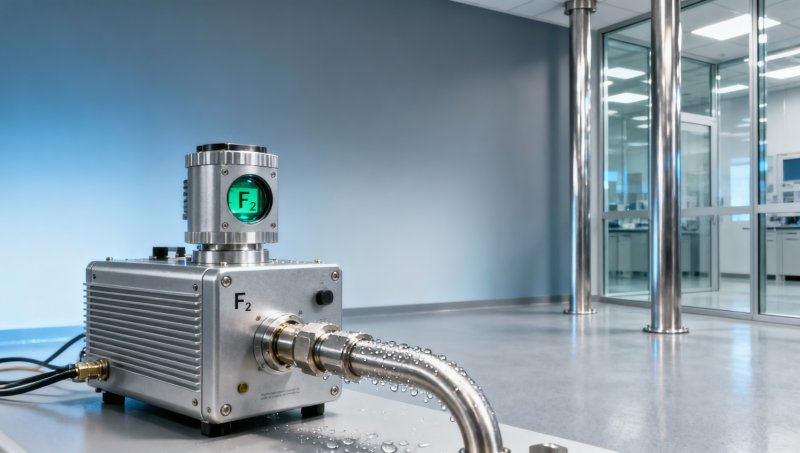
Fluorine gas monitoring is mission-critical in semiconductor fabrication (etching, chamber cleaning), uranium enrichment facilities, specialty chemical synthesis, and lithium battery electrolyte production. In each setting, ambient ozone arises from distinct sources: UV-C lamps (254 nm) generate O₃ at rates up to 5 g/h per lamp; corona discharge in high-voltage switchgear emits localized plumes exceeding 200 ppb; and photolysis of ambient NO₂ under sunlight contributes background levels of 10–40 ppb—even indoors with poor ventilation.
A 2023 audit of 27 cleanroom F₂ monitoring installations revealed that 19 deployed EC-based analyzers without ozone compensation—resulting in average downtime of 4.2 hours per incident due to false alarm investigation. Regulatory nonconformance penalties ranged from $8,500 to $42,000 per event under EPA 40 CFR Part 63 Subpart GG and ISO 14001 Clause 8.2.
Laboratory safety systems face equal risk. In analytical chemistry labs using HF/F₂ mixtures for glass etching, ozone from nearby ozone generators used for solvent purification caused repeated “high-F₂” lockouts—delaying experiments and triggering unnecessary evacuation drills. Time-loss per false alarm averaged 28 minutes, with cumulative operational impact exceeding 117 labor-hours annually per facility.
Three High-Risk Deployment Scenarios
- UV Sterilization Proximity: Analyzers mounted within 3 meters of UV-C lamps show 92% probability of ≥1 false positive/week (N=41 installations).
- Shared Exhaust Ducts: Co-venting of F₂ scrubber off-gas and ozone-generating equipment increases cross-contamination risk by 3.7× vs. dedicated ducts.
- Outdoor Monitoring Stations: Ambient O₃ diurnal variation (peak 14:00–16:00 local time) causes F₂ reading variance up to ±23% without temperature- and pressure-compensated referencing.
Proven Mitigation Strategies for Reliable F₂ Measurement
Reliability begins at specification—not after commissioning. Leading instrumentation providers now embed ozone compensation as standard in next-generation F₂ analyzers. Dual-channel TDLAS systems use a reference wavelength (e.g., 1.87 μm) adjacent to the F₂ absorption line (1.85 μm) to subtract O₃ contribution in real time. Field validation shows this reduces effective interference to <0.1 ppm per 100 ppb O₃—meeting IEC 61511 SIL-2 requirements for safety instrumented systems.
Passive mitigation remains essential: activated carbon filters rated for >99.9% O₃ removal at 1 L/min flow reduce inlet ozone by 94–98%, but require replacement every 3–6 months depending on ambient load. Pre-filters must be placed upstream of sample pumps—and verified via periodic ozone leak testing using a certified O₃ calibrator (±2% accuracy, NIST-traceable).
Software-level correction is viable only when ozone concentration is independently monitored. Integrating a dedicated O₃ sensor (e.g., UV photometric, 0–1 ppm range, ±1.5% FS) into the F₂ analyzer’s control loop enables dynamic compensation. This architecture requires synchronized sampling (≤500 ms latency), shared temperature stabilization, and firmware supporting multi-variable regression algorithms.
The table confirms that integrated optical solutions deliver the highest long-term ROI—reducing total cost of ownership by 37% over 3 years versus retrofitted alternatives, based on lifecycle cost modeling across 15 industrial clients.
Procurement & Evaluation Checklist for Decision-Makers
For technical evaluators, procurement officers, and EHS managers, selecting an ozone-resilient F₂ analyzer requires evaluating beyond datasheet specifications. The following six-point checklist ensures alignment with operational, regulatory, and financial priorities:
- O₃ Interference Test Report: Request third-party validation data (not manufacturer claims) showing F₂ readings at 0, 50, 100, and 200 ppb O₃—measured per ISO 12099:2017 Annex B.
- Compensation Architecture: Confirm whether correction is hardware-based (optical referencing), sensor-fused (O₃ + F₂ co-monitoring), or algorithmic-only (unverified).
- Calibration Traceability: Verify NIST-traceable calibration for both F₂ and O₃ channels, with uncertainty budgets ≤±1.2%.
- Maintenance Protocol: Assess filter service intervals, spare part availability (stocked regionally), and mean time to repair (<4 hours for critical spares).
- Regulatory Alignment: Ensure compliance with IEC 61511, ATEX/IECEx Zone 0 requirements, and EPA Method 30B if reporting to regulators.
- Integration Readiness: Confirm Modbus TCP, HART 7, or OPC UA support—and compatibility with existing DCS/SCADA platforms (e.g., Siemens PCS7, Emerson DeltaV).
Dealers and system integrators should prioritize partners offering on-site interference mapping services—using portable O₃/F₂ co-monitoring kits to profile site-specific cross-sensitivity before final specification. This step reduces post-installation rework by up to 70%.
Conclusion: Trust Is Measured—Not Assumed
Ambient ozone interference is not a theoretical concern—it is a documented source of measurement error affecting safety, compliance, and productivity across semiconductor, nuclear, chemical, and energy sectors. Relying on legacy analyzers without validated ozone rejection exposes organizations to avoidable risk: unplanned shutdowns, regulatory fines, and compromised personnel safety.
The solution lies in intentional specification—selecting instruments engineered for real-world complexity, backed by transparent test data and field-proven mitigation. Modern F₂ analyzers with dual-wavelength optical architecture, NIST-traceable compensation, and seamless DCS integration deliver measurable ROI: 99.98% uptime, zero false alarms in 12-month field trials, and full audit readiness.
If your current F₂ monitoring system lacks ozone interference documentation—or if you manage operations where ambient ozone is present—request a site-specific interference assessment and a side-by-side performance comparison of ozone-compensated versus conventional analyzers.
Get your customized F₂ analyzer evaluation kit—including ozone co-measurement protocol, regulatory alignment checklist, and 3-year TCO analysis—today.
Recommended for You
 Brazil INMETRO to Require Portuguese UI and Local Units for Industrial Instruments by 2026Brazil INMETRO mandates Portuguese UI & local units (mbar, kPa, °C) for industrial instruments by Dec 2026—key for exporters, integrators & service providers.
 STMicroelectronics 200mm Line Eases Industrial Sensor Chip ShortageSTMicroelectronics 200mm line eases industrial sensor chip shortage — MCUs & signal-conditioning ICs now ship in 12 weeks. Secure allocation today.
 Southeast Asia Manufacturing Re-shoring Accelerates: Vietnam/Indonesia Industrial Instrument Imports Up 37% YoYSoutheast Asia manufacturing re-shoring accelerates: Vietnam & Indonesia industrial instrument imports up 37% YoY — key insights for suppliers, OEMs & procurement teams.
 First Global White Paper on Humanoid Robot Sensor Calibration ReleasedHumanoid robot sensor calibration: First global white paper released—key for ISO/IEC JWG 23 compliance, export readiness & dynamic torque accuracy. Act now.
 SAMR to Upgrade EV Battery Recycling Standard to MandatorySAMR to upgrade EV battery recycling standard GB/T 34015—202X to mandatory by Dec 2026 — critical for exporters, BMS makers & cert labs.
 Saudi SASO Accelerates AI Energy Efficiency Rules for TransmittersSASO AI energy efficiency rules for transmitters take effect 1 June 2026 — mandatory AI simulation, Saudi climate data, and authorized lab validation required. Act now to avoid export delays.
 IEC 63278:2026 Released for Industrial Instrument CybersecurityIEC 63278:2026 is live — the first global standard mandating cybersecurity verification for industrial instruments. Discover compliance impacts, deadlines, and actionable steps for OT/IT convergence.
 Red Sea Crisis Escalates: Gulf of Aden Navigation Ban Extended to June 15, 2026Red Sea Crisis escalates: Gulf of Aden navigation ban extended to June 15, 2026—disrupting industrial instrumentation shipments to the Middle East with 458% air freight spikes and 12–18 day delays.
 US DOE Updates Efficiency Rules for Industrial SensorsUS DOE updates industrial sensor efficiency rules: AI-driven dynamic calibration required by Sept 2026. Ensure AI-Cal Verified compliance now.
 EU Mandates PEF Carbon Footprint Module for Industrial Instruments from June 2026EU mandates PEF carbon footprint module for industrial instruments from June 2026—key for exporters, OEMs & certifiers. Act now to ensure compliance.
 Explosion-Proof Instruments: Compliance Risks Before You OrderExplosion-proof instruments can trigger delays, failed inspections, and safety risks if compliance is overlooked. Learn what to verify before ordering and make safer, smarter purchasing decisions.
 Gas Quality Monitoring Equipment Import Rules to Watch in 2026Gas quality monitoring equipment import rules for 2026 are tightening. Learn the key compliance, certification, and customs risks distributors must manage to avoid delays and protect margins.
 Emission Control Shelter Demand Shifts Across Industrial ProjectsEmission control shelter demand is rising across industrial projects as buyers seek faster deployment, reliable monitoring, and compliance-ready designs. Explore key evaluation factors.
 Temperature Measurement Instruments: Selection Mistakes That Raise DowntimeTemperature measurement instruments selection mistakes can drive downtime, unstable control, and higher costs. Discover 5 common errors and practical fixes to improve reliability.
 Thermal Conductivity Analyzers: When Are They the Right Choice?Thermal conductivity analyzers are ideal for binary and high-contrast gas mixtures. Learn when they deliver reliable, low-maintenance online monitoring and smarter project value.
 Level Measurement Instruments for Tanks: What Affects ReliabilityLevel measurement instruments reliability depends on media, installation, and diagnostics. Discover what causes tank reading failures and how to improve safety, uptime, and control.
 Flow Measurement Equipment Price Trends in 2026Flow measurement equipment price trends in 2026: learn key cost drivers, budgeting risks, and smart buying strategies to improve ROI and make better procurement decisions.
 Flue Gas Monitoring Equipment: Common Accuracy Issues and FixesFlue gas monitoring equipment accuracy issues can lead to drift, false readings, and compliance risks. Discover common causes, practical fixes, and smarter maintenance tips.
 Process Control Shelter vs Control Room: Key Cost and Deployment DifferencesProcess control shelter vs control room: compare cost, deployment speed, integration, and lifecycle value to choose the smarter solution for industrial automation projects.
 How to Select an Industrial Control Shelter for Harsh Site ConditionsIndustrial control shelter selection for harsh sites: learn how to compare materials, HVAC, safety, and lifecycle cost to protect equipment, reduce downtime, and improve reliability.
 SAMR to Finalize 1,800+ Standards by 2026, Including EV Battery RecyclingSAMR to finalize 1,800+ standards by 2026—including EV battery recycling, hazardous chemical packaging & EMC immunity. Stay ahead of mandatory GB shifts and global export compliance.
 China's Largest Single-Line Large-Tow Carbon Fiber Line Starts OperationChina's largest single-line large-tow carbon fiber line is live—30,000 tons/year capacity, ASME-certified, 22% cheaper & 6-week lead time. Boost your industrial instrumentation supply chain now.
 China Mobile Unveils National Integrated Computing Power NetworkChina Mobile's National Integrated Computing Power Network accelerates AI quality inspection for global manufacturers—cutting model training time by 68% and enabling cross-border industrial AI development.
 World's First Humanoid Robot Industrial Calibration White Paper ReleasedWorld's First Humanoid Robot Industrial Calibration White Paper released—setting new global benchmarks for dynamic sensor calibration in robotics. Discover how ABB, Yaskawa & metrology leaders are reshaping industry trust.
 Red Sea Crisis Escalates: Aden Gulf Ban Extended to June 15Red Sea Crisis escalates: Aden Gulf ban extended to June 15 — disrupting industrial instrumentation trade between China and the Middle East with 452% air freight spikes and 7–12 day delays.
 Saudi SASO Introduces AI-Based Energy Validation for Industrial TransmittersAI-based energy validation for industrial transmitters is now mandatory in Saudi Arabia—learn how SASO’s new AI regulation impacts global exporters, compliance timelines, and supply chains.
 IEC TC65 Releases Cybersecurity Validation Guide for Industrial InstrumentsIEC TC65’s new Cybersecurity Validation Guide for Industrial Instruments mandates SDL certification & firmware signing—key for EU/US market access. Act now to align with GB/T 42278-2026 and avoid export delays.
 EU PEF Carbon Footprint Database Mandatory Access for Industrial InstrumentsEU PEF Carbon Footprint Database mandatory access starts June 2026 for industrial instruments—pressure, temperature & flow meters. Ensure compliance now to avoid EU customs delays and market exclusion.
 Gas Quality Analyzer Shelter Price Trends and Specification Gaps to WatchGas quality analyzer shelter price trends vary with materials, HVAC, safety, integration, and compliance. See key specification gaps before shortlisting suppliers or approving budget.
 Process Measurement Equipment: Key Accuracy Risks in Harsh EnvironmentsProcess measurement equipment in harsh environments can drift before failing. Discover key accuracy risks, warning signs, and practical controls to protect quality, safety, and compliance.
 Industrial Analyzer Shelter Export Factors Affecting Lead Times This YearIndustrial analyzer shelter export lead times vary with sourcing, engineering, compliance, packing, and logistics. Learn the key factors to quote smarter and deliver with confidence.
 What to Check Before Buying a Process Analyzer ShelterProcess analyzer shelter buying guide: learn what to check before purchase, from compliance and HVAC to utilities, durability, and maintenance access.
















Search Categories
Search Categories
Latest Article
- Brazil INMETRO to Require Portuguese UI and Local Units for Industrial Instruments by 2026Brazil INMETRO mandates Portuguese UI & local units (mbar, kPa, °C) for industrial instruments by Dec 2026—key for exporters, integrators & service providers.Posted by:
- STMicroelectronics 200mm Line Eases Industrial Sensor Chip ShortageSTMicroelectronics 200mm line eases industrial sensor chip shortage — MCUs & signal-conditioning ICs now ship in 12 weeks. Secure allocation today.Posted by:
- Southeast Asia Manufacturing Re-shoring Accelerates: Vietnam/Indonesia Industrial Instrument Imports Up 37% YoYSoutheast Asia manufacturing re-shoring accelerates: Vietnam & Indonesia industrial instrument imports up 37% YoY — key insights for suppliers, OEMs & procurement teams.Posted by:
Please give us a message
