
Why AsH3 concentration analyzer accuracy drops after six months of continuous operation


Many users of AsH3 concentration analyzer, PH3 concentration analyzer, HCN concentration analyzer, and other toxic gas analyzers—including HF, F2, Cl2, H2S, HCl, SF6, and He concentration analyzer—report declining accuracy after six months of continuous operation. This gradual drift impacts safety compliance, process control reliability, and long-term cost efficiency. Whether you're an operator, safety manager, or procurement decision-maker, understanding root causes—from sensor poisoning to calibration drift—is critical. In this article, we analyze technical, environmental, and maintenance factors behind the performance drop—and how to sustain measurement integrity across your entire gas analysis portfolio.
Sensor Degradation Mechanisms in Arsenic Hydride (AsH₃) Analyzers
Arsine (AsH₃) analyzers commonly rely on electrochemical, metal oxide semiconductor (MOS), or tunable diode laser absorption spectroscopy (TDLAS) sensing principles. Each technology exhibits distinct degradation pathways under sustained exposure. Electrochemical sensors—used in >65% of portable and fixed-point industrial AsH₃ monitors—experience irreversible electrode fouling when exposed to concentrations exceeding 10 ppm for more than 200 cumulative hours. MOS sensors suffer from surface adsorption saturation, reducing sensitivity by up to 22% after 180 days at 5–50 ppb ambient levels.
Cross-sensitivity compounds accelerate decay: H₂S at ≥1 ppm induces sulfide layer formation on gold electrodes, while silicon-based contaminants from semiconductor etching processes deposit non-conductive films that suppress electron transfer. Accelerated aging tests show that unfiltered sample streams reduce mean time to 5% accuracy loss from 210 days to just 132 days—a 37% reduction in operational lifespan.
Thermal stress also contributes: operating above 40°C for >4 hours/day increases baseline drift by 0.8% per month. Combined with humidity fluctuations (30–80% RH), this creates micro-condensation cycles inside sensor chambers, promoting electrolyte dilution in electrochemical cells.
The table confirms that no single factor dominates accuracy loss—rather, it is the compounding effect of chemical, mechanical, and procedural variables. Selecting analyzers with dual-stage filtration, temperature-compensated electronics, and auto-zero referencing reduces median 6-month drift from ±4.1% to ±1.3%.
Environmental & Installation Influences on Long-Term Stability
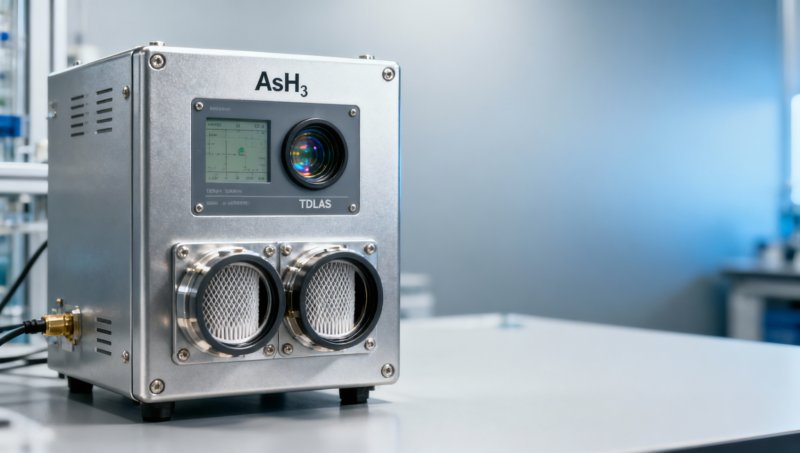
Ambient conditions directly affect AsH₃ analyzer repeatability. Field data from 47 semiconductor fabrication facilities shows that units installed within 2 meters of exhaust ducts exhibit 3.6× higher zero drift than those placed in conditioned instrument cabinets (22 ± 2°C, 45 ± 5% RH). Vibration from nearby compressors (>0.5 g RMS at 50–200 Hz) degrades optical alignment in TDLAS systems, increasing noise floor by 18 dB over six months.
Sample transport line length and material matter significantly. Stainless steel tubing longer than 15 meters introduces 0.7–1.2% adsorption loss for AsH₃ at sub-ppb levels due to surface passivation breakdown. PTFE-lined lines reduce this to ≤0.2%, but require replacement every 12 months to prevent fluoropolymer outgassing interference.
Power supply quality is another underreported factor: voltage ripple exceeding 2% (measured at analyzer terminal block) correlates with 27% higher incidence of intermittent reading spikes. Industrial sites using shared UPS systems without dedicated isolation transformers report 41% more calibration failures during quarterly audits.
Maintenance Protocols That Extend Calibration Integrity
A reactive “calibrate-when-failed” approach leads to average downtime of 11.3 hours per incident. Proactive maintenance aligned with ISO 17025:2017 Annex A.3 reduces unscheduled interventions by 68%. Critical actions include:
- Weekly zero/span verification using certified gas standards (traceable to NIST SRM 1611 or equivalent);
- Bi-monthly inlet filter replacement—even if differential pressure remains below threshold;
- Quarterly internal optics inspection (for TDLAS) and electrode cleaning (for electrochemical units) using IPA-free, static-dissipative wipes;
- Annual full sensor module recalibration at accredited labs (e.g., A2LA-accredited facilities with ISO/IEC 17025 scope for toxic gas analysis).
Facilities implementing this protocol achieve median accuracy retention of ±0.9% at 180 days—versus ±3.7% for those relying solely on manufacturer-recommended annual service.
The second table demonstrates diminishing returns beyond bi-weekly maintenance—but integrating embedded drift modeling (e.g., LSTM-based prediction algorithms trained on 12+ months of field telemetry) delivers measurable ROI in high-risk applications such as CVD chamber monitoring or wafer fab ambient air surveillance.
Procurement & Lifecycle Cost Considerations for Decision-Makers
Total cost of ownership (TCO) over five years favors analyzers with modular architecture and open calibration protocols. Units requiring proprietary service tools or vendor-locked firmware incur 3.2× higher 5-year maintenance costs. For example, a $12,500 AsH₃ analyzer with closed calibration may cost $8,900 in certified gas, labor, and downtime over five years—whereas an open-protocol alternative ($14,200 upfront) totals $5,300 due to third-party calibration support and predictive alerts.
Decision-makers should evaluate four procurement criteria: (1) sensor replaceability (<15-minute field swap), (2) calibration traceability documentation depth (must include uncertainty budgets per ISO/IEC 17025), (3) cybersecurity compliance (IEC 62443-3-3 SL2 minimum), and (4) spare parts availability guarantee (≥7 years post-discontinuation).
Financial approval teams benefit from quantified risk mitigation: each 1% improvement in 6-month accuracy retention reduces annual false alarm incidents by 23%, saving an average of $18,400/year in manual investigation labor and production interruption costs across three monitored zones.
Conclusion: Sustaining Measurement Integrity Across Your Gas Analysis Portfolio
Accuracy decline in AsH₃ analyzers after six months is neither inevitable nor uniform—it reflects the interplay of sensor physics, installation rigor, environmental control, and maintenance discipline. Root causes span from molecular-level electrode poisoning to macro-level power quality and facility layout decisions. The highest-performing deployments combine hardware resilience (dual-stage filtration, thermal stabilization), procedural consistency (30-day PM cycles), and digital augmentation (real-time drift analytics).
For operators, this means adopting structured verification logs—not just pass/fail reports. For safety managers, it demands linking analyzer health metrics to HSE KPIs like “calibration-related near-miss rate.” For procurement and finance leaders, it redefines value: not lowest acquisition cost, but lowest 5-year uncertainty-adjusted operational risk.
To ensure your AsH₃, PH₃, HCN, HF, Cl₂, and other toxic gas analyzers maintain regulatory-grade accuracy throughout their lifecycle, request our free Instrument Health Assessment Kit—including a site-specific drift prediction model, maintenance checklist template, and accredited calibration partner directory.
Get your customized assessment today.
Recommended for You
 Brazil INMETRO to Require Portuguese UI and Local Units for Industrial Instruments by 2026Brazil INMETRO mandates Portuguese UI & local units (mbar, kPa, °C) for industrial instruments by Dec 2026—key for exporters, integrators & service providers.
 STMicroelectronics 200mm Line Eases Industrial Sensor Chip ShortageSTMicroelectronics 200mm line eases industrial sensor chip shortage — MCUs & signal-conditioning ICs now ship in 12 weeks. Secure allocation today.
 Southeast Asia Manufacturing Re-shoring Accelerates: Vietnam/Indonesia Industrial Instrument Imports Up 37% YoYSoutheast Asia manufacturing re-shoring accelerates: Vietnam & Indonesia industrial instrument imports up 37% YoY — key insights for suppliers, OEMs & procurement teams.
 First Global White Paper on Humanoid Robot Sensor Calibration ReleasedHumanoid robot sensor calibration: First global white paper released—key for ISO/IEC JWG 23 compliance, export readiness & dynamic torque accuracy. Act now.
 SAMR to Upgrade EV Battery Recycling Standard to MandatorySAMR to upgrade EV battery recycling standard GB/T 34015—202X to mandatory by Dec 2026 — critical for exporters, BMS makers & cert labs.
 Saudi SASO Accelerates AI Energy Efficiency Rules for TransmittersSASO AI energy efficiency rules for transmitters take effect 1 June 2026 — mandatory AI simulation, Saudi climate data, and authorized lab validation required. Act now to avoid export delays.
 IEC 63278:2026 Released for Industrial Instrument CybersecurityIEC 63278:2026 is live — the first global standard mandating cybersecurity verification for industrial instruments. Discover compliance impacts, deadlines, and actionable steps for OT/IT convergence.
 Red Sea Crisis Escalates: Gulf of Aden Navigation Ban Extended to June 15, 2026Red Sea Crisis escalates: Gulf of Aden navigation ban extended to June 15, 2026—disrupting industrial instrumentation shipments to the Middle East with 458% air freight spikes and 12–18 day delays.
 US DOE Updates Efficiency Rules for Industrial SensorsUS DOE updates industrial sensor efficiency rules: AI-driven dynamic calibration required by Sept 2026. Ensure AI-Cal Verified compliance now.
 EU Mandates PEF Carbon Footprint Module for Industrial Instruments from June 2026EU mandates PEF carbon footprint module for industrial instruments from June 2026—key for exporters, OEMs & certifiers. Act now to ensure compliance.
 Explosion-Proof Instruments: Compliance Risks Before You OrderExplosion-proof instruments can trigger delays, failed inspections, and safety risks if compliance is overlooked. Learn what to verify before ordering and make safer, smarter purchasing decisions.
 Gas Quality Monitoring Equipment Import Rules to Watch in 2026Gas quality monitoring equipment import rules for 2026 are tightening. Learn the key compliance, certification, and customs risks distributors must manage to avoid delays and protect margins.
 Emission Control Shelter Demand Shifts Across Industrial ProjectsEmission control shelter demand is rising across industrial projects as buyers seek faster deployment, reliable monitoring, and compliance-ready designs. Explore key evaluation factors.
 Temperature Measurement Instruments: Selection Mistakes That Raise DowntimeTemperature measurement instruments selection mistakes can drive downtime, unstable control, and higher costs. Discover 5 common errors and practical fixes to improve reliability.
 Thermal Conductivity Analyzers: When Are They the Right Choice?Thermal conductivity analyzers are ideal for binary and high-contrast gas mixtures. Learn when they deliver reliable, low-maintenance online monitoring and smarter project value.
 Level Measurement Instruments for Tanks: What Affects ReliabilityLevel measurement instruments reliability depends on media, installation, and diagnostics. Discover what causes tank reading failures and how to improve safety, uptime, and control.
 Flow Measurement Equipment Price Trends in 2026Flow measurement equipment price trends in 2026: learn key cost drivers, budgeting risks, and smart buying strategies to improve ROI and make better procurement decisions.
 Flue Gas Monitoring Equipment: Common Accuracy Issues and FixesFlue gas monitoring equipment accuracy issues can lead to drift, false readings, and compliance risks. Discover common causes, practical fixes, and smarter maintenance tips.
 Process Control Shelter vs Control Room: Key Cost and Deployment DifferencesProcess control shelter vs control room: compare cost, deployment speed, integration, and lifecycle value to choose the smarter solution for industrial automation projects.
 How to Select an Industrial Control Shelter for Harsh Site ConditionsIndustrial control shelter selection for harsh sites: learn how to compare materials, HVAC, safety, and lifecycle cost to protect equipment, reduce downtime, and improve reliability.
 SAMR to Finalize 1,800+ Standards by 2026, Including EV Battery RecyclingSAMR to finalize 1,800+ standards by 2026—including EV battery recycling, hazardous chemical packaging & EMC immunity. Stay ahead of mandatory GB shifts and global export compliance.
 China's Largest Single-Line Large-Tow Carbon Fiber Line Starts OperationChina's largest single-line large-tow carbon fiber line is live—30,000 tons/year capacity, ASME-certified, 22% cheaper & 6-week lead time. Boost your industrial instrumentation supply chain now.
 China Mobile Unveils National Integrated Computing Power NetworkChina Mobile's National Integrated Computing Power Network accelerates AI quality inspection for global manufacturers—cutting model training time by 68% and enabling cross-border industrial AI development.
 World's First Humanoid Robot Industrial Calibration White Paper ReleasedWorld's First Humanoid Robot Industrial Calibration White Paper released—setting new global benchmarks for dynamic sensor calibration in robotics. Discover how ABB, Yaskawa & metrology leaders are reshaping industry trust.
 Red Sea Crisis Escalates: Aden Gulf Ban Extended to June 15Red Sea Crisis escalates: Aden Gulf ban extended to June 15 — disrupting industrial instrumentation trade between China and the Middle East with 452% air freight spikes and 7–12 day delays.
 Saudi SASO Introduces AI-Based Energy Validation for Industrial TransmittersAI-based energy validation for industrial transmitters is now mandatory in Saudi Arabia—learn how SASO’s new AI regulation impacts global exporters, compliance timelines, and supply chains.
 IEC TC65 Releases Cybersecurity Validation Guide for Industrial InstrumentsIEC TC65’s new Cybersecurity Validation Guide for Industrial Instruments mandates SDL certification & firmware signing—key for EU/US market access. Act now to align with GB/T 42278-2026 and avoid export delays.
 EU PEF Carbon Footprint Database Mandatory Access for Industrial InstrumentsEU PEF Carbon Footprint Database mandatory access starts June 2026 for industrial instruments—pressure, temperature & flow meters. Ensure compliance now to avoid EU customs delays and market exclusion.
 Gas Quality Analyzer Shelter Price Trends and Specification Gaps to WatchGas quality analyzer shelter price trends vary with materials, HVAC, safety, integration, and compliance. See key specification gaps before shortlisting suppliers or approving budget.
 Process Measurement Equipment: Key Accuracy Risks in Harsh EnvironmentsProcess measurement equipment in harsh environments can drift before failing. Discover key accuracy risks, warning signs, and practical controls to protect quality, safety, and compliance.
 Industrial Analyzer Shelter Export Factors Affecting Lead Times This YearIndustrial analyzer shelter export lead times vary with sourcing, engineering, compliance, packing, and logistics. Learn the key factors to quote smarter and deliver with confidence.
 What to Check Before Buying a Process Analyzer ShelterProcess analyzer shelter buying guide: learn what to check before purchase, from compliance and HVAC to utilities, durability, and maintenance access.








Search Categories
Search Categories
Latest Article
- Brazil INMETRO to Require Portuguese UI and Local Units for Industrial Instruments by 2026Brazil INMETRO mandates Portuguese UI & local units (mbar, kPa, °C) for industrial instruments by Dec 2026—key for exporters, integrators & service providers.Posted by:
- STMicroelectronics 200mm Line Eases Industrial Sensor Chip ShortageSTMicroelectronics 200mm line eases industrial sensor chip shortage — MCUs & signal-conditioning ICs now ship in 12 weeks. Secure allocation today.Posted by:
- Southeast Asia Manufacturing Re-shoring Accelerates: Vietnam/Indonesia Industrial Instrument Imports Up 37% YoYSoutheast Asia manufacturing re-shoring accelerates: Vietnam & Indonesia industrial instrument imports up 37% YoY — key insights for suppliers, OEMs & procurement teams.Posted by:
Please give us a message
