
C3H8 Concentration Analyzer Basics for Safer Daily Operation


A C3H8 concentration analyzer helps operators detect propane levels quickly and accurately, reducing safety risks in daily work. In industrial environments where stable measurement and fast response matter, understanding the basic functions, applications, and maintenance needs of this instrument is essential. This article explains the fundamentals in a practical way, helping users improve routine operation, support compliance, and maintain a safer workplace.
For operators in manufacturing plants, gas handling stations, energy facilities, laboratories, and automated process lines, propane is both useful and hazardous. A small leak can quickly turn into a serious ignition risk, especially in enclosed or poorly ventilated areas. That is why a reliable C3H8 concentration analyzer is not just a measurement device; it is part of a daily safety system that supports faster decisions, better process control, and more consistent compliance with site procedures.
In the instrumentation industry, analyzers are expected to deliver repeatable readings, stable performance, and clear signals for operators who often work under time pressure. Knowing what the analyzer measures, how it responds, where it should be installed, and how it should be maintained can reduce false alarms, limit downtime, and improve operator confidence. The basics below focus on practical operation rather than theory alone.
What a C3H8 Concentration Analyzer Does in Daily Industrial Use
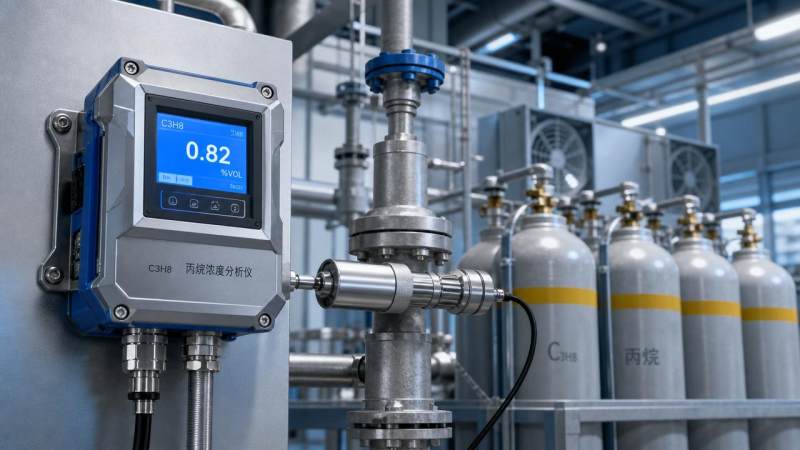
A C3H8 concentration analyzer measures the amount of propane in air or process gas streams. In most daily applications, the instrument is used to detect leaks, verify safe atmospheric conditions, support combustion control, or confirm that ventilation and gas handling systems are working as intended. Typical installations include cylinder storage rooms, filling lines, burner systems, enclosed maintenance areas, and chemical process zones.
Depending on the site requirement, the analyzer may provide continuous online monitoring or spot-check measurement. Continuous systems are common where propane is present for 24 hours a day or where response time must be within a few seconds. Portable units are more suitable for inspection rounds, confined space checks, and temporary maintenance tasks. For operators, the key issue is not only detection but also how fast the reading stabilizes and how clearly alarms are communicated.
Why propane monitoring matters
Propane is heavier than air, so leaked gas can accumulate near floors, trenches, cable ducts, or low points in a work area. This creates a hidden risk that may not be obvious during visual inspection. In many facilities, alarm thresholds are set in stages, such as a pre-alarm for early warning and a high alarm for immediate action. A 2-stage or 3-stage alarm strategy helps operators react before gas reaches a dangerous level.
In routine operation, even a difference of a few seconds in alarm response can affect evacuation, valve isolation, or ventilation startup. That is why operators usually care about 4 practical factors first: detection range, response speed, signal stability, and maintenance effort. A C3H8 concentration analyzer that reads accurately but drifts too often can create as many problems as one that misses low-level gas buildup.
Common measurement principles and operator impact
Different analyzers use different sensing principles, and each has strengths in specific environments. Operators do not need to become design engineers, but they should understand how the sensing method affects warm-up time, cross-sensitivity, calibration frequency, and service life. This helps when reading manuals, preparing maintenance records, or discussing replacement parts with purchasing and engineering teams.
The table below compares typical analyzer approaches used for propane-related monitoring in industrial instrumentation settings.
For most operators, the practical takeaway is simple: match the analyzer type to the environment, not just the gas name. A C3H8 concentration analyzer used in a dusty filling station may face different challenges than one installed in a cleaner control room sample system. Sensor choice affects service interval, alarm behavior, and confidence in the reading over a 6-month to 12-month operating cycle.
Basic outputs operators should understand
Most units provide one or more of the following outputs: local display, relay alarm, analog signal such as 4–20 mA, and digital communication to a PLC, DCS, or building management system. If operators know how each output behaves during normal operation, fault mode, calibration mode, and alarm status, they can avoid misreading maintenance conditions as process events.
- Local display for direct reading during rounds or inspections
- Low and high alarm relays for ventilation, siren, or shutdown logic
- 4–20 mA output for continuous trend monitoring in control systems
- Digital interface for event logs, remote diagnostics, and parameter checks
Where It Is Used and How Placement Affects Safety
A C3H8 concentration analyzer is widely used across mixed industrial settings because propane appears in more places than many operators expect. It can be found in heat treatment processes, forklift fueling zones, test chambers, gas blending systems, temporary heating setups, backup energy systems, and packaged utility skids. In each case, the installation point strongly affects whether the instrument detects real risk early enough.
Because propane tends to settle low, mounting height is a major factor. In many practical layouts, sensors are installed 0.3 m to 1.0 m above floor level or near likely accumulation points, but exact placement depends on airflow, obstruction, equipment geometry, and maintenance access. A poorly placed analyzer may remain technically functional while missing the most dangerous gas pocket in the room.
Typical application scenarios
The table below shows where operators most often rely on propane monitoring and what they should watch during routine checks.
The key conclusion is that application context changes what “good performance” means. In a storage room, early leak detection may be the top priority. In a process skid, stability during pressure or flow changes may matter more. Operators should therefore judge the analyzer not only by its range, but also by whether it fits the physical behavior of propane at that site.
Placement mistakes that reduce effectiveness
Three common mistakes appear in daily industrial use. First, the analyzer is mounted too high, away from likely gas accumulation zones. Second, it is installed behind equipment where airflow bypasses the sensor. Third, it is placed where operators cannot easily inspect or calibrate it, leading to missed maintenance windows. Any of these can turn a good instrument into a weak safety point.
- Review gas source points within a 3 m to 5 m radius of the sensor.
- Check whether fans, louvers, or open doors change gas travel direction.
- Confirm that the sensor is accessible for monthly inspection and periodic calibration.
- Make sure alarm indicators are visible or linked to the control system.
These simple checks can often improve detection reliability without major redesign. In retrofit projects, relocation of only 1 or 2 devices may produce better real-world protection than adding more analyzers in poor positions.
How to Read Key Specifications Before Operation or Purchase
Operators are not always the final buyers, but they often influence whether the selected C3H8 concentration analyzer performs well after installation. Reading the main specifications correctly can prevent mismatch between paper performance and daily field conditions. A good review usually takes 10 to 15 minutes and should cover range, accuracy, response time, output options, environmental rating, and service needs.
Core specification points
Range determines whether the analyzer is meant for low-level leak detection, percent-level process measurement, or broader combustible gas monitoring. Response time, often listed as T90 or a similar figure, indicates how quickly the reading reaches a stable percentage of the actual gas concentration. In safety-related work, a faster response can support quicker operator action, but response time should be judged together with stability and false alarm resistance.
Accuracy should be interpreted carefully. A specification such as a percentage of full scale may look acceptable, but if the measuring range is very wide, the absolute error at low concentration can still be significant. Operators should also ask whether performance changes under temperature swings, humidity, vibration, or dirty process air. In many industrial areas, ambient conditions vary more than the catalog assumes.
A practical review checklist
- Is the measuring range suitable for the expected leak or process concentration?
- Is the response time fast enough for the site’s alarm and evacuation procedure?
- Does the instrument support the required 4–20 mA, relay, or digital outputs?
- Can the enclosure tolerate the actual dust, moisture, and temperature conditions?
- How often are bump tests, calibration, and sensor replacement recommended?
- Are spare parts and technical support available within a practical lead time, such as 7–15 days?
For routine industrial procurement, the comparison below helps align field needs with specification reading.
When field teams, engineering, and purchasing use the same checklist, selection errors drop significantly. Even in a general industrial setting, 4 or 5 disciplined review points are often more valuable than chasing the most complex specification sheet.
Daily Operation, Calibration, and Maintenance Basics
A C3H8 concentration analyzer only supports safety when it is treated as a living part of the system, not a device that can be ignored after installation. Daily operation should include visual inspection, status verification, and awareness of any process change that could affect readings. Over a 30-day cycle, small issues such as blocked inlets, damaged cable glands, or overdue calibration can build into serious reliability problems.
Routine checks for operators
A short inspection routine can often be completed in 3 to 5 minutes per unit. This is especially useful at shift start or before a high-risk job. Operators should confirm normal display behavior, alarm lamp status, communication with the control system, and any unusual odor or gas handling activity nearby. If the analyzer includes a sample line, flow condition should also be checked.
- Confirm power and normal operating indication.
- Check the display for stable baseline and absence of fault code.
- Verify alarm relay or system signal if status lamps show abnormality.
- Inspect sensor head or sample inlet for dust, oil, water, or physical blockage.
- Record unusual trends, including repeated small spikes or delayed recovery.
Calibration and bump testing
Calibration frequency depends on instrument type, site condition, and internal safety procedures. In many industrial settings, bump tests may be performed more frequently than full calibration, because they quickly confirm that the sensor responds to gas. Full calibration may be scheduled monthly, quarterly, or at another defined interval based on risk and manufacturer guidance. Dirt, solvent vapor, silicone exposure, and temperature cycling can all shorten the effective interval.
Operators should also know that calibration is not just a technical maintenance event. During calibration mode, signals may be held, suppressed, or simulated depending on system design. If this is not communicated to the control room, a planned maintenance action can be mistaken for a fault or a real gas event. A simple lockout and communication step can prevent unnecessary shutdowns.
Signs that service is needed sooner
- Repeated zero drift over several days
- Slow response compared with previous bump test behavior
- Frequent false alarms during humidity or ventilation changes
- Visible corrosion, cracked housing, or contaminated sensor surface
- Unstable analog output or intermittent communication loss
If two or more of these warning signs appear within a 1-month period, the analyzer should be reviewed before normal operation continues. Waiting for a complete failure is rarely a good maintenance strategy in gas safety applications.
Common Mistakes, Risk Points, and Better Operating Decisions
Most analyzer problems in the field are not caused by one major defect. They are caused by a series of small decisions: a delayed calibration, poor mounting location, ignored drift, missing spare filter, or no clear action plan after alarm activation. Operators who understand these patterns can reduce risk without waiting for a full redesign or capital upgrade.
Frequent mistakes seen in propane monitoring
One mistake is assuming that any gas detector is suitable for propane. Another is installing a C3H8 concentration analyzer without reviewing airflow and low-point accumulation. A third is treating a passed calibration as proof that installation is correct. Calibration confirms response; it does not guarantee ideal placement or complete area coverage. In larger rooms, 1 detector may not be enough if there are multiple leak sources or partitions.
There is also a documentation gap in some facilities. Alarm setpoints, maintenance intervals, and relay logic may be known by engineering but not by daily operators. When procedures are unclear, response becomes slower and more inconsistent. Posting a 1-page local instruction sheet near the instrument can solve many of these issues at very low cost.
How operators can improve decision quality
Good operation starts with asking the right questions. Is the reading credible based on recent plant activity? Has ventilation changed? Was the analyzer recently serviced? Is the alarm coming from process gas, cleaning solvent, or a real propane release? This kind of structured thinking helps separate instrument problems from process events and supports faster escalation when needed.
- Compare the reading with recent operating conditions and known gas use points.
- Check whether nearby ventilation or process changes explain the trend.
- Confirm analyzer status and maintenance record before dismissing an alarm.
- Escalate quickly if rising readings continue for more than a few minutes.
This approach is especially useful in multi-discipline facilities where instrumentation, utilities, and production teams share responsibility. A C3H8 concentration analyzer becomes much more valuable when its data is interpreted consistently across shifts and departments.
FAQ for daily users
How often should an analyzer be checked?
A visual and status check is often suitable once per shift or once per day, depending on risk level. Bump testing and calibration should follow site procedure and manufacturer guidance, with tighter intervals in dirty or high-use areas.
Can one analyzer protect a whole room?
Not always. Coverage depends on room size, obstructions, ventilation pattern, and the number of potential leak points. In some areas, 2 or more sensors are needed for practical protection.
What should be done after a false alarm?
Do not assume the event is harmless. Review environmental conditions, recent maintenance activity, contamination sources, and analyzer history. Repeated false alarms usually indicate either placement issues, sensor degradation, or process interference that needs correction.
A dependable C3H8 concentration analyzer supports safer operation when it is properly selected, correctly positioned, and maintained with discipline. For operators, the essentials are clear: understand the measurement method, monitor the right locations, review key specifications, and follow a repeatable inspection and calibration routine. These steps improve alarm reliability, reduce unnecessary downtime, and strengthen propane risk control across daily industrial work.
If you are evaluating analyzers for a new installation, upgrading an existing monitoring point, or improving maintenance practice, now is a good time to review your site requirements in detail. Contact us to discuss product details, get a tailored monitoring solution, or learn more about practical gas analysis options for safer routine operation.
Recommended for You
 N2 Concentration Analyzer Cost Factors for Bulk Industrial ProcurementN2 concentration analyzer cost depends on more than unit price. Compare process, purity, and safety applications with total cost logic to source smarter and reduce lifecycle risk.
 Oxygen Concentration Analyzer vs Sensor Systems: Which Fits Continuous UseOxygen concentration analyzer or sensor system? Compare stability, drift, maintenance, and uptime for continuous use to choose the most reliable fit for your process.
 SO2 Concentration Analyzer News: Compliance Demands Reshaping Product SpecsSO2 concentration analyzer trends are shifting with stricter compliance rules. Learn how new specs, data integrity, and uptime demands are reshaping smarter buying decisions.
 He Concentration Analyzer Maintenance Tips for Stable Long-Term ReadingsHe concentration analyzer maintenance tips for stable long-term readings. Learn how to reduce drift, improve calibration accuracy, cut downtime, and keep industrial systems reliable.
 CH4 Concentration Analyzer Selection Mistakes That Raise Operating RiskCH4 concentration analyzer selection mistakes can raise safety, compliance, and maintenance risk. Learn how to choose the right analyzer for reliable performance and lower lifecycle cost.
 CO Concentration Analyzer Import Rules to Watch in 2026CO concentration analyzer import rules for 2026: learn the key customs, certification, labeling, and compliance checks to reduce risk, avoid delays, and source with confidence.
 NH3 Concentration Analyzer Market Trends for Industrial Process Control in 2026NH3 concentration analyzer market trends in 2026: explore technologies, industrial applications, selection tips, and how smarter monitoring improves compliance, safety, and process control.
 Ar Concentration Analyzer Accuracy Issues in High-Purity Gas ApplicationsAr concentration analyzer accuracy issues can compromise high-purity gas quality, safety, and compliance. Learn the key causes, practical fixes, and how to improve reliable measurement performance.
 CO2 Concentration Analyzer Price Trends in 2026: What Shapes Total CostCO2 concentration analyzer price trends in 2026 depend on technology, accuracy, calibration, compliance, and integration. Discover total cost drivers to compare quotes smarter and control lifecycle risk.
 How to Choose a NOX Concentration Analyzer for Low-Emission MonitoringNOX concentration analyzer selection for low-emission monitoring made easier. Learn how to compare accuracy, response time, compliance, and lifecycle cost before you buy.
 2026 Summit Highlights China's Smart Inspection Equipment as New Global Cooperation FocusSmart inspection equipment takes center stage at the 2026 Summit—unlocking new global cooperation, standards alignment, and market opportunities for exporters, OEMs, and tech suppliers.
 White House Warns Oil Shock May Fuel Core Inflation, Delaying Industrial Instrument ExportsWhite House warns oil shock may fuel core inflation—impacting industrial instrument exports. Discover how pressure, temperature & flow instrumentation exporters can mitigate delays and optimize trade finance workflows now.
 New AI Agent Guidelines Impact Export of AI-Powered Testing EquipmentAI agent guidelines impact export of AI-powered testing equipment—learn how new China security & controllability rules affect global compliance, supply chains, and market access.
 Canton Fair Phase III Boosts Sensor & Energy Testing ExportsSensor & energy testing exports surge at Canton Fair Phase III—driven by global demand for new energy home appliances and smart furniture compliance solutions.
 UAE Announces $150B Energy Infrastructure InvestmentUAE's $150B energy infrastructure push drives demand for IP68/IP69K, ATEX/IECEx, and LPWAN-enabled industrial sensors — act now to align with ADNOC tenders.
 WTI Net Longs Surge, Boosting Demand for Lubricant Monitoring SystemsLubricant monitoring systems surge in demand as WTI net longs rise—real-time viscosity, moisture & oxidation tracking now critical for global manufacturers.
 Shanghai Pudong Launches E-Label Pilot for Imported CosmeticsShanghai Pudong’s e-label pilot for imported cosmetics drives global demand for RFID/NFC readers, traceability solutions & certified testing equipment—act now to comply and lead.
 G7 Prioritizes Critical Mineral Supply Chain SecurityCritical mineral supply chain security takes center stage at G7 Paris meeting—impacting industrial sensors, rare-earth magnets & global procurement strategies.
 US-China Talks Yield Breakthrough on Agricultural NTBs for Testing EquipmentUS-China talks break ground on agricultural NTBs—key win for makers of residue detection, mycotoxin & spectral testing equipment targeting USDA/FDA markets.
 Fruit Attraction 2026 Booth Bookings Exceed 90%Fruit Attraction 2026 booth bookings exceed 90% — a strong signal for food safety instrumentation, cold-chain monitoring & EU compliance solution providers to secure visibility and drive qualified leads.
 Kuwait Bans HCFC Air Conditioners, Boosts IR Camera ExportsKuwait bans HCFC air conditioners—boosting demand for IR cameras, leak detectors & refrigerant analyzers. Discover GCC compliance insights and export opportunities.
 China's IC Exports Surge 78.3% in First Four Months of 2026China's IC exports surge 78.3% in early 2026 — driven by soaring global demand for AI chip test equipment, SMUs, and parametric analyzers. Discover the supply chain shift.
 Chile Enforces Mandatory INN Safety Certification for Industrial Temperature ControllersChile mandates INN safety certification (NCh Elec 4/2025) for industrial temperature controllers starting Aug 1, 2026—act now to avoid shipment delays & market bans.
 K-REACH Supply-Shortage Exemption Launches for pH/ORP ElectrodesK-REACH Supply-Shortage Exemption now applies to pH/ORP electrodes—act before June 30, 2026 to avoid customs delays & penalties. Key for exporters & manufacturers.
 4th China International Supply Chain Expo to Focus on Smart Sensing & In-Process InspectionSmart Sensing & In-Process Inspection take center stage at the 4th China International Supply Chain Expo in Beijing, Nov 26–30, 2026 — discover next-gen inspection tech, AI vision modules, and calibrated sensing solutions for global industrial buyers.
 ASTM F2100-26 Medical Mask Standard Takes Effect in USASTM F2100-26 medical mask standard is now in force—driving global demand for biosafety cabinets, particle counters & air velocity calibrators, especially China-made instruments.
 South Africa Enforces SABS Certification for IoT Monitoring DevicesSABS certification now mandatory for IoT monitoring devices entering South Africa via e-commerce—act before 1 June 2026 to avoid customs rejection and ensure market access.
 EU REACH Adds Fluorinated Substances; SVHC Reporting Required for Gas AnalyzersEU REACH now restricts fluorinated substances in gas analyzers—SVHC reporting is mandatory by 30 Nov 2026. Ensure compliance for sensors, membranes & monitoring systems.
 Revised Maritime Code Takes Effect May 1, 2026: Shift in Unclaimed Cargo LiabilityRevised Maritime Code (2026): Shippers now liable for unclaimed cargo—critical for industrial instrument exporters, logistics providers & cross-border supply chains. Act now.
 China Imposes Zero Tariffs on Goods from All African Diplomatic Partners Starting May 1, 2026China’s zero-tariff policy for African instrumentation & automation exports starts May 1, 2026—boosting competitiveness in EPC tenders and market access for exporters.
 Import and Export Shifts in the PPM Gas Analyzer Marketppm gas analyzer market insights: discover how import tariffs, export controls, and compliance shifts impact cost, supply stability, and growth opportunities across key applications.
 Single Gas Analyzer Maintenance Issues That Raise DowntimeSingle gas analyzer maintenance issues can quietly increase downtime. Learn how to spot drift, calibration errors, and sample path faults early to improve uptime and field efficiency.



Search Categories
Search Categories
Latest Article
- N2 Concentration Analyzer Cost Factors for Bulk Industrial ProcurementN2 concentration analyzer cost depends on more than unit price. Compare process, purity, and safety applications with total cost logic to source smarter and reduce lifecycle risk.Posted by:
- Oxygen Concentration Analyzer vs Sensor Systems: Which Fits Continuous UseOxygen concentration analyzer or sensor system? Compare stability, drift, maintenance, and uptime for continuous use to choose the most reliable fit for your process.Posted by:
- SO2 Concentration Analyzer News: Compliance Demands Reshaping Product SpecsSO2 concentration analyzer trends are shifting with stricter compliance rules. Learn how new specs, data integrity, and uptime demands are reshaping smarter buying decisions.Posted by:
Please give us a message
