
CO Analyzer for Parking Garage Ventilation: What Good Control Looks Like


A reliable CO analyzer for parking garage ventilation is more than a compliance tool—it is the basis of safe, efficient air quality control. For quality control and safety managers, good control means accurate detection, fast response, stable operation, and energy-saving ventilation that matches real CO levels. Understanding what effective control looks like helps reduce risk, improve system performance, and support smarter facility management.
When people search for a CO analyzer for parking garage ventilation, they are usually not looking for a basic definition. They want to know what “good control” actually means in day-to-day operation: how to detect carbon monoxide accurately, how to avoid false alarms or blind spots, how to keep occupants safe, and how to run fans only when needed. For quality and safety teams, the real question is practical: what should a trustworthy system do, and how can you tell if a design or product will perform well in the field?
The short answer is this: good control is built on reliable sensing, proper detector placement, sensible alarm and fan logic, system stability, and maintainability over time. A garage ventilation system that looks good on paper but drifts out of calibration, responds too slowly, or ignores airflow realities will not deliver safe or efficient control. A better system gives you dependable measurements, clear action thresholds, and auditable performance.
What quality and safety managers really need from a CO analyzer system
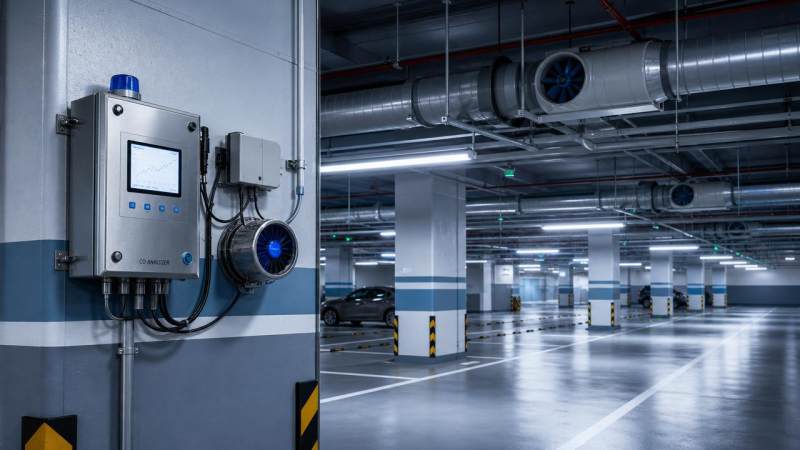
For most target readers in this field, the concern is not simply whether a sensor can measure CO. The concern is whether the full system can reduce risk in a real parking structure with uneven airflow, changing traffic patterns, cold starts, ramps, dead zones, and varying occupancy. The measurement device is only one part of a larger control loop.
From a quality control perspective, the first priority is measurement integrity. If the reading is inaccurate, every downstream decision becomes unreliable. Fans may start too late, too early, or too often. That creates two different risks: unsafe exposure when ventilation is insufficient, and wasted energy when ventilation runs harder than necessary.
From a safety management perspective, the second priority is response confidence. You need to know that when CO rises, the system will detect it quickly enough and trigger the correct ventilation stage or alarm sequence. In an enclosed parking garage, delays matter, especially during peak vehicle movement, winter idling, or congestion at exits.
The third priority is operational stability. A good CO analyzer for parking garage ventilation should support repeatable performance across different environmental conditions, including humidity, dust, vibration, and temperature swings. If maintenance teams are constantly troubleshooting sensor faults or signal drift, the control strategy may be technically sound but operationally weak.
Finally, managers care about traceability and decision support. It is easier to defend budgets, pass inspections, and improve procedures when the system produces clear logs, trends, alarms, and performance data. Good control is not only about reacting to today’s CO level. It is also about proving that the system works consistently over time.
What “good control” looks like in practice
In practice, good control starts with accurate low-level detection and remains dependable as concentration changes. Parking garages often operate at relatively low background CO levels, with temporary spikes near traffic lanes, ramps, payment points, or loading areas. That means the analyzer or sensor must perform well not only during obvious events, but also in the lower ranges where ventilation staging decisions are often made.
A well-designed system should deliver fast enough response to capture rising concentrations before they become a broader exposure problem. Response speed should be balanced with filtering and control stability. If the system reacts to every tiny fluctuation, it may short-cycle fans and create unnecessary wear. If it is too slow or too heavily averaged, it may miss meaningful local buildup. Good control uses logic that is responsive without being erratic.
Another sign of good control is zoning. Large or multi-level garages rarely behave like a single uniform air volume. Concentrations can vary sharply by area. Effective systems divide the structure into meaningful ventilation zones, each supported by properly placed CO sensors and independent or staged fan control where appropriate. This prevents one clean area from masking a polluted one and avoids over-ventilating the entire structure for a localized issue.
Good control also includes clear thresholds and escalation logic. For example, low-level fan activation may begin at one setpoint, with additional ventilation stages triggered at higher levels. Alarm functions, supervisory notifications, and fault conditions should be distinct and easy to interpret. A system that blends alarm, fan control, and maintenance status into confusing outputs increases risk rather than reducing it.
Just as important, good control remains functional when something goes wrong. Sensor fault detection, communications loss handling, and fail-safe fan behavior should be part of the design. Safety managers should ask a simple question: if a sensor fails, what exactly happens next? A robust system does not wait silently for the next manual inspection to reveal a dangerous blind spot.
Sensor accuracy alone is not enough: placement, coverage, and airflow matter
One of the most common mistakes in garage ventilation projects is assuming that buying a high-quality CO analyzer automatically guarantees high-quality control. It does not. Even a good instrument can produce poor control if it is installed in the wrong location, blocked by local airflow effects, or used in insufficient numbers for the garage layout.
Parking structures have complex air movement patterns shaped by ramps, columns, beam pockets, entrances, exhaust points, supply fans, and vehicle movement. CO may not distribute evenly, especially during transient conditions. That is why placement strategy matters as much as instrument quality. Sensors should be positioned where representative exposure risk exists, not merely where installation is easiest.
Quality and safety teams should pay close attention to known trouble zones. These often include low-airflow corners, queuing areas near exits, enclosed lower levels, loading sections, and places where cold engines idle before departure. If only central open areas are monitored, the system may appear compliant while still missing local accumulation.
Coverage design should also reflect traffic behavior. A garage used by office tenants may have sharp arrival and departure peaks. A hospital or mixed-use facility may experience continuous turnover. A retail site may have weekend surges. Good control takes these patterns seriously and aligns sensor density, zoning, and fan sequencing with realistic operating conditions.
Commissioning should verify actual field behavior rather than relying only on drawings. Trend testing, smoke or airflow observation, and response checks under simulated CO events can reveal whether the sensor network is capturing the garage’s real ventilation dynamics. For safety managers, this step is often where theoretical adequacy becomes operational confidence.
How to evaluate a CO analyzer for parking garage ventilation before approval
If you are responsible for specification review, vendor comparison, or acceptance testing, it helps to evaluate systems through a practical checklist rather than marketing claims. The first area to examine is sensing performance: measurement range, accuracy, repeatability, response characteristics, long-term stability, and expected calibration interval. These factors directly affect whether the control strategy can remain reliable over time.
Next, review environmental suitability. Parking garages are not clean laboratory spaces. Dust, moisture, temperature variation, and occasional vibration are normal. A CO analyzer that performs well in theory but requires ideal conditions may create avoidable maintenance burden. Ask how the device handles contamination, what its enclosure rating is, and how often filters or sensing elements need attention.
Then look at integration. A good sensor is more valuable when it communicates clearly with the building management system, ventilation controller, or standalone fan panel. Outputs, protocol compatibility, alarm mapping, trend logging, and fault reporting all matter. Quality managers should know whether the system supports historical review and whether abnormal behavior can be diagnosed without excessive manual effort.
Maintenance requirements deserve special scrutiny. Safety systems often degrade quietly through skipped calibration, sensor aging, blocked inlets, or unnoticed faults. Evaluate how easy it is to test, calibrate, replace, and verify each unit. If routine service is too complicated, it may not happen consistently. A simpler maintenance workflow often produces better long-term safety outcomes than a theoretically advanced but service-heavy design.
Finally, ask vendors to explain control logic in plain terms. What triggers stage 1 ventilation? What triggers stage 2? How are delays, averaging, and reset conditions handled? How are alarms differentiated from maintenance faults? If these answers are vague, the system may be difficult to manage after installation. Clear control logic is a sign of a mature solution.
Balancing compliance, safety, and energy efficiency
Many facilities first consider CO monitoring because codes, standards, or project requirements call for garage ventilation control. But for most operators, compliance is only the starting point. A well-executed system protects people and also reduces unnecessary fan runtime, which can have a meaningful impact on energy consumption and equipment wear.
This balance is exactly why good control matters. Running fans continuously may seem safe, but it often wastes energy and shortens equipment life. Running them too little creates exposure and liability risk. The role of a CO analyzer for parking garage ventilation is to support demand-based operation, where airflow responds to actual conditions instead of assumptions.
For quality control teams, the value is process stability and verifiable performance. For safety managers, the value is lower risk and faster detection of abnormal air quality conditions. For facility leadership, the value includes better operating efficiency and more defensible maintenance planning. These benefits depend on control quality, not just on the presence of a sensor network.
It is also worth noting that energy savings should never be pursued by weakening detection quality or reducing sensor coverage below what the space requires. The better path is to improve measurement accuracy, zoning, fan logic, and system tuning. When the control loop is designed well, safety and efficiency reinforce each other instead of competing.
Common warning signs that control quality is poor
In existing garages, poor control often reveals itself through patterns rather than one dramatic failure. Frequent occupant complaints about exhaust smell, fan systems that run almost all the time, unexplained alarm events, inconsistent readings between adjacent zones, or repeated maintenance resets can all indicate a control problem.
Another warning sign is the absence of meaningful data. If the system cannot show historical trends, alarm timestamps, fault events, or basic zone behavior, it becomes difficult to prove performance or investigate incidents. Lack of visibility often allows minor issues to persist until they become larger operational or safety concerns.
Watch for overdependence on manual override. If operators routinely bypass automatic mode because the system seems unreliable or annoying, good control is already lost. A ventilation system should be trusted enough to run automatically under most conditions, with manual intervention reserved for true exceptions, testing, or emergency response.
Uneven maintenance records are another clue. If some sensors are regularly checked while others are hard to access and rarely serviced, overall control quality may be weaker than the documentation suggests. Safety managers should treat maintainability as a design feature, not an afterthought.
What an effective specification or upgrade strategy should include
Whether you are planning a new installation or upgrading an older system, a stronger specification begins with operational goals. Define what the system must achieve: safe CO control across all occupied periods, zone-level responsiveness, fault transparency, efficient fan staging, and manageable lifecycle maintenance. This is more useful than specifying hardware in isolation.
Include requirements for sensor performance, environmental durability, placement review, zoning logic, alarm hierarchy, communications, and trend logging. Require commissioning tests that demonstrate actual control response, not just electrical completion. If possible, tie acceptance to documented functional performance under simulated conditions.
It is also wise to define maintenance expectations in advance. Specify calibration verification intervals, fault notification behavior, replacement procedures, and access considerations. If a system is difficult to maintain, its real-world safety value declines over time, even if its initial design was strong.
For upgrades, do not assume the best solution is simply replacing old sensors with new ones in the same locations. Reassess airflow patterns, traffic use, zone design, and fan control logic. In many garages, the biggest gains come from improving placement and control strategy rather than changing sensor brand alone.
Conclusion: good control is measurable, practical, and worth demanding
A good CO analyzer for parking garage ventilation should do far more than display a number. It should support a control system that detects risk early, responds appropriately, operates reliably, and helps ventilation match real conditions. For quality control and safety managers, that means looking beyond basic product claims to the full picture: sensing integrity, placement, zoning, logic, maintenance, and data visibility.
If the system provides accurate readings, dependable response, clear fault handling, and maintainable performance over time, it is doing its job. If it creates blind spots, confusion, or constant overrides, it is not good control, even if it appears compliant on paper.
The best decisions in this area come from asking practical questions: Will this system detect what matters in the spaces that matter? Will it respond fast enough? Can we maintain it consistently? Can we verify performance when challenged? When the answer to those questions is yes, you are much closer to a ventilation strategy that is both safer and smarter.
Recommended for You
![]() SiH4 Concentration Analyzer Import Rules to Watch in 2026SiH4 concentration analyzer import rules are tightening in 2026. Learn the key documents, compliance checks, and procurement tips to avoid delays and speed project delivery.
SiH4 Concentration Analyzer Import Rules to Watch in 2026SiH4 concentration analyzer import rules are tightening in 2026. Learn the key documents, compliance checks, and procurement tips to avoid delays and speed project delivery. HF Concentration Analyzer Demand Shifts Across Key IndustriesHF concentration analyzer demand is shifting across chemical, refining, environmental, and advanced manufacturing sectors—learn what drives safer control, compliance, and precision upgrades.
 Common HCN Concentration Analyzer Mistakes in Daily OperationHCN concentration analyzer daily mistakes can quietly damage accuracy and uptime. Learn common errors, practical checks, and smart operating tips to improve reliability.
 PH3 Concentration Analyzer Price Trends in 2026PH3 concentration analyzer price trends in 2026 reveal what really drives cost, compliance, and performance. Explore key buying factors to compare quotes smarter and reduce total ownership risk.
 How to Choose an AsH3 Concentration Analyzer for Trace Gas SafetyAsH3 concentration analyzer selection starts with the right application context. Learn how to compare response, interference, integration, and lifecycle fit for safer trace gas monitoring.
 Released") China's Business Environment Report (2026) ReleasedChina's Business Environment Report (2026) reveals 92% digital CMA/CNAS coverage—cutting export test report time to 15 days. Boost CE, UKCA & UL certification for pressure gauges, thermostats & analyzers.
China's Business Environment Report (2026) ReleasedChina's Business Environment Report (2026) reveals 92% digital CMA/CNAS coverage—cutting export test report time to 15 days. Boost CE, UKCA & UL certification for pressure gauges, thermostats & analyzers. US MMA Tank Incident Triggers Regional Safety UpgradesUS MMA tank incident sparks urgent demand for VOCs monitoring, toxic gas modeling & intrinsically safe transmitters across LATAM and SEA.
 NDRC Expands Energy-Saving and Carbon-Reduction Oversight to Dyeing, Chemical Fibers, and PapermakingNDRC expands energy-saving & carbon-reduction oversight to dyeing, chemical fibers, and papermaking—boosting demand for COD/NH₃-N analyzers, VOCs monitors, and CEMS systems.
 MIIT Sets 2026 Energy-Saving Inspection Targets for High-Energy ChemicalsMIIT Sets 2026 Energy-Saving Inspection Targets for High-Energy Chemicals—urgent demand surges for certified pH meters, gas analyzers & explosion-proof controllers.
 MOFCOM: FDI in China Down 10.3% Jan–Apr 2026, but Manufacturing Up 12.1%FDI in China fell 10.3% Jan–Apr 2026—but manufacturing FDI surged 12.1%, led by high-tech sectors. Discover what this means for precision metrology, sensors & calibration providers.
 PBOC Conducts 600-Billion-Yuan MLF Operation, Boosting RMB Stability for Testing Equipment ExportsPBOC's 600-billion-yuan MLF operation boosts RMB stability—key for NDT equipment exporters using LC/DA terms. Reduce FX risk, optimize hedging & improve cash flow planning now.
 EU Steel Strategy Upgrade: CBAM Expansion to Machinery & InstrumentsEU Steel Strategy Upgrade expands CBAM to machinery & instruments (HS 84/90) — LCA data mandatory from 1 July 2026. Act now to avoid delays & ensure compliance.
 Global EV Energy Consumption Standard to Take Effect Oct 1, 2026Global EV Energy Consumption Standard (GTR No. 22) takes effect Oct 1, 2026 — learn how it reshapes battery testing, certification & supply chains worldwide.
 WTO Report Shows Strong Global Trade, Easing Export Pressure for Industrial Monitoring DevicesIndustrial monitoring devices exporters benefit as WTO reports 4.2% global trade growth—easing export pressure, improving delivery predictability & cash flow.
 South Korea MFDS Revises Food Contact Materials StandardsSouth Korea MFDS revises food contact materials standards: new nickel/chromium migration limits & NIAS verification—critical for lab instrument exporters and compliance providers.
 Brazil to Eliminate Import Duties on Cross-Border E-Commerce Orders Under USD 50Brazil to eliminate import duties on cross-border e-commerce orders under USD 50—key for portable testing instruments exporters targeting Mercado Livre & DIY buyers.
 New AI Agent Guidelines Impact Smart Inspection Device ExportsAI Agent Guidelines impact smart inspection device exports—learn how new China AI safety rules affect EU, US & Middle East market access.
 UPS Freight Rates Increase Effective May 17, 2026UPS freight rates increase effective May 17, 2026—impact FOB pricing for industrial monitoring equipment exporters. Act now to optimize packaging, revise quotes, and secure margins.
 新修订《海商法》施行:卸货港无人提货责任转向托运人,检测设备出口交期风控升级New Maritime Code shifts unclaimed cargo liability to shippers at discharge ports—critical for testing equipment exporters managing delivery timelines and compliance risk.
 China Imposes Zero Tariffs on Lab Analyzers for 20 African NationsChina's zero tariffs on lab analyzers for 20 African nations boost export competitiveness—pH meters, spectrophotometers & more now duty-free from May 2026.
 CA Toxic Chemical Tank Overheating Sparks Explosion Risk, Monitoring Equipment Orders SurgeGas leak detectors, remote temperature warning systems & explosion-proof thermal imagers surge in demand after CA toxic tank overheating incident.
 EU REACH Adds DBDPE to SVHC List, Impacting Brominated Flame Retardant Testing for Export EquipmentDBDPE added to EU REACH SVHC list—impact on brominated flame retardant testing for industrial instruments, sensors & export compliance. Act now.
 Thailand Customs Digital Reform Spurs RFID Equipment DemandRFID equipment demand surges in Thailand as Customs digital reform mandates e-labeling, real-time parcel tracking & API compliance—act now to meet TISI specs and platform rules.
 Lazada Thailand Cuts Import Duties on 528 CategoriesLazada Thailand cuts import duties on 528 categories — including wired headphones & notebooks — lowering costs for Chinese exporters and Thai SMEs via LGS.
 US Delays 400 Tomahawk Missiles to Japan Amid Iran Inventory ReplenishmentTomahawk missiles delay to Japan sparks urgent demand for alternative guidance, navigation & secure comms suppliers—key opportunity for export-ready defense electronics firms.
 What to Check Before Importing an F2 Concentration Analyzer in 2026F2 concentration analyzer import guide for 2026: learn what to check on compliance, performance, integration, lifecycle cost, and supplier support before you buy.
 SF6 Concentration Analyzer Market Trends for Power and Gas Applications in 2026SF6 concentration analyzer market trends for 2026: explore accuracy, digital integration, emissions control, and buying tips for power and gas applications.
 Common HCl Concentration Analyzer Mistakes That Lead to Unstable ReadingsHCl concentration analyzer unstable readings? Discover the most common installation, calibration, sampling, and maintenance mistakes—and the practical fixes that improve accuracy fast.
 H2S Concentration Analyzer Price Trends: What’s Driving Costs in 2026H2S concentration analyzer price trends in 2026: discover what drives costs, from sensor technology and compliance to materials and digital features, and make smarter buying decisions.
 How to Choose a Cl2 Concentration Analyzer for Process Safety in 2026Cl2 concentration analyzer selection in 2026 starts with process safety. Learn how to match scenarios, improve reliability, avoid costly mistakes, and choose with confidence.
 N2 Concentration Analyzer Cost Factors for Bulk Industrial ProcurementN2 concentration analyzer cost depends on more than unit price. Compare process, purity, and safety applications with total cost logic to source smarter and reduce lifecycle risk.
 Oxygen Concentration Analyzer vs Sensor Systems: Which Fits Continuous UseOxygen concentration analyzer or sensor system? Compare stability, drift, maintenance, and uptime for continuous use to choose the most reliable fit for your process.





Search Categories
Search Categories
Latest Article
- SiH4 Concentration Analyzer Import Rules to Watch in 2026SiH4 concentration analyzer import rules are tightening in 2026. Learn the key documents, compliance checks, and procurement tips to avoid delays and speed project delivery.Posted by:
- HF Concentration Analyzer Demand Shifts Across Key IndustriesHF concentration analyzer demand is shifting across chemical, refining, environmental, and advanced manufacturing sectors—learn what drives safer control, compliance, and precision upgrades.Posted by:
- Common HCN Concentration Analyzer Mistakes in Daily OperationHCN concentration analyzer daily mistakes can quietly damage accuracy and uptime. Learn common errors, practical checks, and smart operating tips to improve reliability.Posted by:
Please give us a message
