
Gas Analyzer Enclosure Options: Which Design Fits Outdoor Installations


Choosing the right gas analyzer enclosure is critical for outdoor installations where weather, temperature swings, corrosion, and safety requirements can directly affect performance and uptime. For project managers and engineering leaders, the ideal design must balance protection, accessibility, compliance, and long-term operating cost. This guide explores enclosure options to help you identify which solution best fits your application, site conditions, and project goals.
Why a Checklist Approach Works Better for Outdoor Enclosure Selection
For outdoor projects, a gas analyzer enclosure is not just a box around instruments. It is part of the measurement system, the safety strategy, and the lifecycle cost model. A poor choice can lead to analyzer drift, condensation damage, maintenance delays, unexpected shutdowns, and even hazardous-area noncompliance. That is why project teams should evaluate enclosure options through a structured checklist instead of relying on a single factor such as material or price.
A checklist-based method helps decision-makers compare enclosure designs across real operating conditions: climate, area classification, utility availability, installation footprint, access requirements, and maintenance frequency. It also improves communication between engineering, procurement, operations, and EHS teams, reducing redesign risk later in the project.
Start Here: The First Questions to Confirm Before Comparing Designs
Before reviewing any gas analyzer enclosure option, confirm the following project inputs. These items shape whether you need a basic weatherproof housing, a heated cabinet, a pressurized shelter, or a fully integrated analyzer house.
- What analyzers will be installed, and how sensitive are they to temperature, dust, vibration, and moisture?
- Is the site classified as safe area, Zone 2, Class I Division 2, or a stricter hazardous environment?
- What are the local ambient conditions, including summer peak temperature, winter low temperature, humidity, salt exposure, rainfall, and solar loading?
- Will operators need frequent calibration, filter changes, or sample system inspection?
- Are utilities such as power, instrument air, purge gas, HVAC support, or heat tracing readily available?
- What is the target design life, and how important are uptime, remote monitoring, and serviceability?
If these answers are not clear, enclosure selection becomes guesswork. For project managers, locking down these inputs early can prevent costly field modifications.
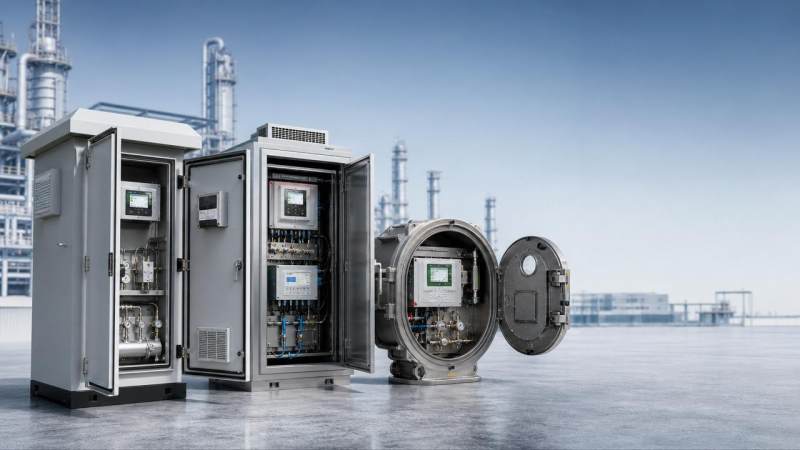
Core Gas Analyzer Enclosure Options and When Each One Fits
1. Weatherproof Cabinet Enclosures
This is the most common gas analyzer enclosure format for moderate outdoor conditions. It typically uses stainless steel or coated steel construction with sealed doors, internal mounting panels, and basic environmental protection.
Best fit scenarios include temperate climates, low-to-moderate maintenance frequency, and applications where the analyzer can tolerate limited ambient swings. This design is often preferred when project budgets are tight and hazardous-area demands are manageable.
Key check points include ingress protection rating, corrosion resistance, sun shielding, and door seal performance. A standard weatherproof cabinet may be enough for simple online monitoring, but it may not protect precision analyzers in extreme climates.
2. Heated or Air-Conditioned Analyzer Cabinets
If your analyzers require a controlled temperature range, a conditioned gas analyzer enclosure is usually the safer choice. These systems may include electric heaters, vortex coolers, panel air conditioners, insulation, thermostats, and condensation control devices.
This option is well suited for desert heat, freezing winters, coastal humidity, and locations where analyzer accuracy is strongly affected by enclosure temperature. It also supports more stable operation for sample handling components such as regulators, pumps, and flowmeters.
The main selection caution is utility dependency. Cooling and heating equipment increase power demand, maintenance needs, and potential failure points. Project teams should verify whether site support can handle continuous environmental conditioning over the full operating year.
3. Purged and Pressurized Enclosures
For hazardous locations, a purged or pressurized gas analyzer enclosure may provide a compliant way to house standard instruments while preventing ignition risk. These designs use purge gas and pressure monitoring systems to keep flammable atmospheres out of the enclosure.
They are valuable when the analyzer technology itself is not rated for the area, but the project still needs outdoor installation close to the process. They can also reduce the cost of using fully explosion-proof equipment for every internal component.
However, this approach requires discipline. Teams must confirm certification strategy, purge logic, alarms, shutdown sequences, and the reliability of the purge gas supply. A pressurized enclosure that loses pressure without proper interlocks can quickly become a safety concern.
4. Walk-In Analyzer Shelters or Houses
When the analyzer package is large, complex, or maintenance-intensive, a walk-in shelter may be the most effective gas analyzer enclosure solution. These enclosed buildings often contain multiple analyzers, sample conditioning systems, calibration gas manifolds, HVAC, lighting, fire and gas detection, and workspace for technicians.
This design fits refinery, petrochemical, power, emissions, and process plants where downtime is expensive and service access is a major priority. It also helps standardize the installation of complete analyzer systems across multiple project sites.
The tradeoff is obvious: higher capital cost, larger footprint, transportation complexity, and more civil and utility coordination. Still, for demanding outdoor applications, a shelter often delivers the best long-term maintainability.
Selection Checklist: The Most Important Evaluation Criteria
Use the following checklist to compare gas analyzer enclosure designs in a practical, project-focused way.
How Site Conditions Change the Best Enclosure Choice
Not every outdoor installation needs the same gas analyzer enclosure strategy. The best design depends on how site risks combine, not just on one specification line.
- Hot and sunny climates: Prioritize reflective finishes, insulation, sunshades, and cooling capacity. Internal temperature can exceed ambient by a wide margin if solar gain is ignored.
- Cold climates: Check low-temperature instrument ratings, heater redundancy, freeze protection for sample lines, and door gasket performance.
- Coastal or corrosive areas: Choose high-grade stainless steel, corrosion-resistant hardware, and coating systems suitable for salt or chemical exposure.
- Dusty process sites: Confirm filtration, positive-pressure ventilation where appropriate, and maintenance plans for blocked vents or cooling units.
- Remote locations: Fewer moving parts and simpler conditioning systems may be better than sophisticated designs that are hard to support.
Commonly Overlooked Risks in Gas Analyzer Enclosure Projects
Several issues are frequently underestimated during specification and procurement:
- Condensation risk is often more damaging than rainfall. Warm humid air entering the enclosure can create moisture on electronics and optical components.
- Service clearance is ignored until startup. A compact gas analyzer enclosure may save space but can make calibration and repairs slow and unsafe.
- Sample system heat management is separated from enclosure design. In reality, analyzer performance depends on both working together.
- Hazardous-area details are assumed to be “vendor standard.” Certification scope, purge compliance, and gland selection must be reviewed specifically.
- Lifecycle operating cost is missed. A low-cost enclosure with high cooling demand or frequent corrosion issues may become the expensive option within a few years.
Execution Advice for Project Managers and Engineering Leads
If you are preparing to specify a gas analyzer enclosure, start with a short but complete data package for suppliers and internal reviewers. Include analyzer list, ambient design conditions, hazardous-area classification, utility availability, maintenance philosophy, preferred materials, and any site layout restrictions.
Next, ask vendors to explain not just what enclosure they propose, but why it fits your outdoor application. Good proposals should show thermal logic, access planning, corrosion protection, compliance assumptions, and expected maintenance impact. This makes technical comparison much more meaningful than comparing dimensions alone.
It is also wise to define acceptance criteria early. For example, decide the allowable internal temperature range, target ingress rating, door access requirements, and any required redundancy for heating, cooling, or purge functions. These decision standards prevent specification drift during procurement.
FAQ: Practical Questions Teams Often Ask
Is stainless steel always the best material for a gas analyzer enclosure?
Not always. Stainless steel is often preferred for corrosion resistance, especially outdoors, but coated carbon steel may be acceptable in less aggressive environments with tighter budgets. The right choice depends on site chemistry, humidity, and maintenance expectations.
When should a project choose a shelter instead of a cabinet?
Choose a shelter when the analyzer package is complex, requires frequent technician access, includes multiple systems, or needs stable environmental control beyond what a cabinet can efficiently provide.
Can one gas analyzer enclosure design work across all project sites?
A standard platform can help, but it should be adapted for local climate, area classification, and utility conditions. Outdoor installations vary too much for a one-size-fits-all approach to be optimal.
Final Decision Guide and Next Step
The best gas analyzer enclosure for outdoor installation is the one that matches the analyzer’s environmental limits, the site’s hazard profile, the maintenance strategy, and the project’s lifecycle priorities. In simple terms: use cabinets for straightforward protection needs, conditioned enclosures for temperature-sensitive equipment, pressurized designs for hazardous compliance, and shelters for larger or maintenance-intensive systems.
If your team is moving toward specification or procurement, the most useful next discussion points are clear: required protection level, hazardous-area basis, ambient extremes, material preference, service access expectations, utility constraints, expansion allowance, delivery schedule, and total cost over the operating life. Confirming these items early will make your gas analyzer enclosure decision faster, safer, and more cost-effective.
Recommended for You
![]() SiH4 Concentration Analyzer Import Rules to Watch in 2026SiH4 concentration analyzer import rules are tightening in 2026. Learn the key documents, compliance checks, and procurement tips to avoid delays and speed project delivery.
SiH4 Concentration Analyzer Import Rules to Watch in 2026SiH4 concentration analyzer import rules are tightening in 2026. Learn the key documents, compliance checks, and procurement tips to avoid delays and speed project delivery. HF Concentration Analyzer Demand Shifts Across Key IndustriesHF concentration analyzer demand is shifting across chemical, refining, environmental, and advanced manufacturing sectors—learn what drives safer control, compliance, and precision upgrades.
 Common HCN Concentration Analyzer Mistakes in Daily OperationHCN concentration analyzer daily mistakes can quietly damage accuracy and uptime. Learn common errors, practical checks, and smart operating tips to improve reliability.
 PH3 Concentration Analyzer Price Trends in 2026PH3 concentration analyzer price trends in 2026 reveal what really drives cost, compliance, and performance. Explore key buying factors to compare quotes smarter and reduce total ownership risk.
 How to Choose an AsH3 Concentration Analyzer for Trace Gas SafetyAsH3 concentration analyzer selection starts with the right application context. Learn how to compare response, interference, integration, and lifecycle fit for safer trace gas monitoring.
 Released") China's Business Environment Report (2026) ReleasedChina's Business Environment Report (2026) reveals 92% digital CMA/CNAS coverage—cutting export test report time to 15 days. Boost CE, UKCA & UL certification for pressure gauges, thermostats & analyzers.
China's Business Environment Report (2026) ReleasedChina's Business Environment Report (2026) reveals 92% digital CMA/CNAS coverage—cutting export test report time to 15 days. Boost CE, UKCA & UL certification for pressure gauges, thermostats & analyzers. US MMA Tank Incident Triggers Regional Safety UpgradesUS MMA tank incident sparks urgent demand for VOCs monitoring, toxic gas modeling & intrinsically safe transmitters across LATAM and SEA.
 NDRC Expands Energy-Saving and Carbon-Reduction Oversight to Dyeing, Chemical Fibers, and PapermakingNDRC expands energy-saving & carbon-reduction oversight to dyeing, chemical fibers, and papermaking—boosting demand for COD/NH₃-N analyzers, VOCs monitors, and CEMS systems.
 MIIT Sets 2026 Energy-Saving Inspection Targets for High-Energy ChemicalsMIIT Sets 2026 Energy-Saving Inspection Targets for High-Energy Chemicals—urgent demand surges for certified pH meters, gas analyzers & explosion-proof controllers.
 MOFCOM: FDI in China Down 10.3% Jan–Apr 2026, but Manufacturing Up 12.1%FDI in China fell 10.3% Jan–Apr 2026—but manufacturing FDI surged 12.1%, led by high-tech sectors. Discover what this means for precision metrology, sensors & calibration providers.
 PBOC Conducts 600-Billion-Yuan MLF Operation, Boosting RMB Stability for Testing Equipment ExportsPBOC's 600-billion-yuan MLF operation boosts RMB stability—key for NDT equipment exporters using LC/DA terms. Reduce FX risk, optimize hedging & improve cash flow planning now.
 EU Steel Strategy Upgrade: CBAM Expansion to Machinery & InstrumentsEU Steel Strategy Upgrade expands CBAM to machinery & instruments (HS 84/90) — LCA data mandatory from 1 July 2026. Act now to avoid delays & ensure compliance.
 Global EV Energy Consumption Standard to Take Effect Oct 1, 2026Global EV Energy Consumption Standard (GTR No. 22) takes effect Oct 1, 2026 — learn how it reshapes battery testing, certification & supply chains worldwide.
 WTO Report Shows Strong Global Trade, Easing Export Pressure for Industrial Monitoring DevicesIndustrial monitoring devices exporters benefit as WTO reports 4.2% global trade growth—easing export pressure, improving delivery predictability & cash flow.
 South Korea MFDS Revises Food Contact Materials StandardsSouth Korea MFDS revises food contact materials standards: new nickel/chromium migration limits & NIAS verification—critical for lab instrument exporters and compliance providers.
 Brazil to Eliminate Import Duties on Cross-Border E-Commerce Orders Under USD 50Brazil to eliminate import duties on cross-border e-commerce orders under USD 50—key for portable testing instruments exporters targeting Mercado Livre & DIY buyers.
 New AI Agent Guidelines Impact Smart Inspection Device ExportsAI Agent Guidelines impact smart inspection device exports—learn how new China AI safety rules affect EU, US & Middle East market access.
 UPS Freight Rates Increase Effective May 17, 2026UPS freight rates increase effective May 17, 2026—impact FOB pricing for industrial monitoring equipment exporters. Act now to optimize packaging, revise quotes, and secure margins.
 新修订《海商法》施行:卸货港无人提货责任转向托运人,检测设备出口交期风控升级New Maritime Code shifts unclaimed cargo liability to shippers at discharge ports—critical for testing equipment exporters managing delivery timelines and compliance risk.
 China Imposes Zero Tariffs on Lab Analyzers for 20 African NationsChina's zero tariffs on lab analyzers for 20 African nations boost export competitiveness—pH meters, spectrophotometers & more now duty-free from May 2026.
 CA Toxic Chemical Tank Overheating Sparks Explosion Risk, Monitoring Equipment Orders SurgeGas leak detectors, remote temperature warning systems & explosion-proof thermal imagers surge in demand after CA toxic tank overheating incident.
 EU REACH Adds DBDPE to SVHC List, Impacting Brominated Flame Retardant Testing for Export EquipmentDBDPE added to EU REACH SVHC list—impact on brominated flame retardant testing for industrial instruments, sensors & export compliance. Act now.
 Thailand Customs Digital Reform Spurs RFID Equipment DemandRFID equipment demand surges in Thailand as Customs digital reform mandates e-labeling, real-time parcel tracking & API compliance—act now to meet TISI specs and platform rules.
 Lazada Thailand Cuts Import Duties on 528 CategoriesLazada Thailand cuts import duties on 528 categories — including wired headphones & notebooks — lowering costs for Chinese exporters and Thai SMEs via LGS.
 US Delays 400 Tomahawk Missiles to Japan Amid Iran Inventory ReplenishmentTomahawk missiles delay to Japan sparks urgent demand for alternative guidance, navigation & secure comms suppliers—key opportunity for export-ready defense electronics firms.
 What to Check Before Importing an F2 Concentration Analyzer in 2026F2 concentration analyzer import guide for 2026: learn what to check on compliance, performance, integration, lifecycle cost, and supplier support before you buy.
 SF6 Concentration Analyzer Market Trends for Power and Gas Applications in 2026SF6 concentration analyzer market trends for 2026: explore accuracy, digital integration, emissions control, and buying tips for power and gas applications.
 Common HCl Concentration Analyzer Mistakes That Lead to Unstable ReadingsHCl concentration analyzer unstable readings? Discover the most common installation, calibration, sampling, and maintenance mistakes—and the practical fixes that improve accuracy fast.
 H2S Concentration Analyzer Price Trends: What’s Driving Costs in 2026H2S concentration analyzer price trends in 2026: discover what drives costs, from sensor technology and compliance to materials and digital features, and make smarter buying decisions.
 How to Choose a Cl2 Concentration Analyzer for Process Safety in 2026Cl2 concentration analyzer selection in 2026 starts with process safety. Learn how to match scenarios, improve reliability, avoid costly mistakes, and choose with confidence.
 N2 Concentration Analyzer Cost Factors for Bulk Industrial ProcurementN2 concentration analyzer cost depends on more than unit price. Compare process, purity, and safety applications with total cost logic to source smarter and reduce lifecycle risk.
 Oxygen Concentration Analyzer vs Sensor Systems: Which Fits Continuous UseOxygen concentration analyzer or sensor system? Compare stability, drift, maintenance, and uptime for continuous use to choose the most reliable fit for your process.


Search Categories
Search Categories
Latest Article
- SiH4 Concentration Analyzer Import Rules to Watch in 2026SiH4 concentration analyzer import rules are tightening in 2026. Learn the key documents, compliance checks, and procurement tips to avoid delays and speed project delivery.Posted by:
- HF Concentration Analyzer Demand Shifts Across Key IndustriesHF concentration analyzer demand is shifting across chemical, refining, environmental, and advanced manufacturing sectors—learn what drives safer control, compliance, and precision upgrades.Posted by:
- Common HCN Concentration Analyzer Mistakes in Daily OperationHCN concentration analyzer daily mistakes can quietly damage accuracy and uptime. Learn common errors, practical checks, and smart operating tips to improve reliability.Posted by:
Please give us a message
