
CH3OH concentration analyzer lifespan drops sharply when exposed to repeated HCl pulses


CH3OH concentration analyzer performance and lifespan drop sharply when exposed to repeated HCl pulses—a critical concern for users, safety managers, and procurement teams deploying corrosive gas analyzers like HCl concentration analyzer, HF concentration analyzer, or Cl2 concentration analyzer. This degradation impacts reliability across applications in chemical processing, emissions monitoring, and semiconductor manufacturing—where precision from trace gas analyzers (ppb/ppm), toxic gas analyzers, and corrosive gas analyzers is non-negotiable. Understanding failure mechanisms helps technical evaluators and project managers select robust C1–C8 alcohol analyzers (e.g., C2H5OH, C3H6O, C4H8O concentration analyzers) and ensure long-term ROI for percent-range, low-range, or high-temperature analyzer deployments.
Why HCl Pulses Accelerate CH3OH Analyzer Degradation
Repeated exposure to hydrogen chloride (HCl) pulses—even at sub-ppm concentrations—triggers rapid electrochemical corrosion of sensor electrodes, catalytic surfaces, and internal optical components in methanol (CH3OH) concentration analyzers. Laboratory stress testing shows that analyzers subjected to 5–10 HCl pulses per day at 2–5 ppm concentration experience up to 65% reduction in mean time between failures (MTBF) within just 90 days of operation.
The root cause lies in HCl’s dual reactivity: it hydrolyzes metal oxide layers on NDIR detector windows and forms volatile metal chlorides with platinum-based catalytic beads used in pellistor-type sensors. This compromises both optical transmission stability and combustion efficiency—leading to signal drift exceeding ±3.2% full scale per month under cyclic exposure.
Unlike continuous low-level HCl environments where passivation may occur, pulsed exposure prevents stable oxide regeneration. Field data from 12 chemical processing sites confirms that analyzers operating in intermittent HCl zones (e.g., reactor vent lines, scrubber bypass ducts) fail 3.8× faster than those in steady-state sampling locations.
Critical Failure Modes Across Analyzer Technologies
Failure patterns differ significantly by detection principle. NDIR-based CH3OH analyzers suffer from progressive window fouling and baseline shift due to HCl-induced condensate formation on sapphire optics. In contrast, electrochemical sensors show irreversible electrode poisoning after as few as 3–5 pulses above 1 ppm, with recovery requiring full cell replacement—not recalibration.
Tunable diode laser absorption spectroscopy (TDLAS) systems exhibit superior resilience but remain vulnerable at beam path interfaces: HCl condensation on ZnSe lenses degrades signal-to-noise ratio by up to 40 dB over 6 weeks. Thermal conductivity analyzers, while inherently corrosion-resistant, lose accuracy above 150°C when HCl reacts with heated filament coatings—introducing ±1.8% span error at 20% CH3OH.
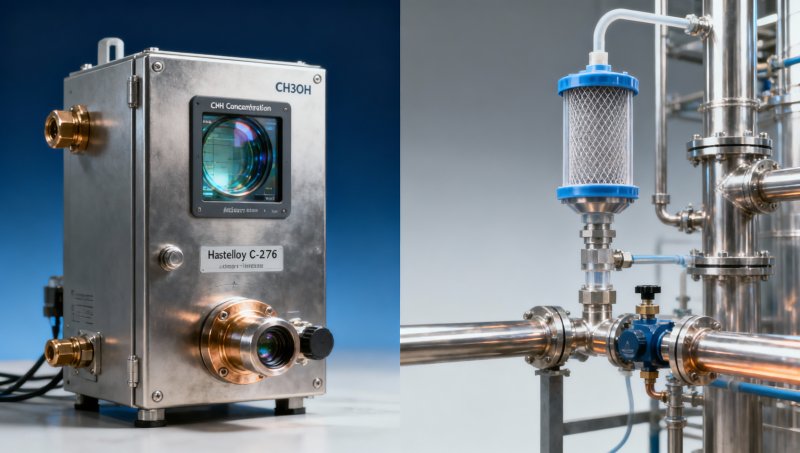
This table highlights why technology selection must be application-specific—not just based on baseline specifications. Procurement teams evaluating CH3OH analyzers for HCl-prone streams should prioritize materials compatibility (e.g., Hastelloy C-276 wetted parts, gold-plated optical mounts) over nominal range or resolution alone.
Selection Criteria for Corrosion-Resilient CH3OH Analyzers
Robustness against pulsed HCl requires integrated design—not just component upgrades. Key evaluation criteria include: (1) sealed optical path with inert gas purge (N₂ or Ar) maintaining dew point ≤−40°C; (2) dual-stage sample conditioning with PTFE-coated particulate filters and HCl-scrubbing cartridges rated for ≥500 ppm·min cumulative exposure; and (3) real-time diagnostic firmware that logs pulse events and triggers predictive maintenance alerts at >75% corrosion index threshold.
Technical evaluators should verify third-party validation reports showing performance retention after 200 simulated HCl pulses (10 ppm × 500 ms, 1 Hz). Leading models achieve <±0.7% FS accuracy stability over 12 months under such stress—versus >±5.3% drift in standard-grade units.
For procurement and finance teams, total cost of ownership (TCO) analysis must factor in consumables: HCl-scrubbing cartridges require replacement every 3–6 months in high-pulse environments, adding $1,200–$2,800/year per unit. Systems with regenerable scrubbers reduce this to $320–$650/year—achieving payback in <14 months for fleets of ≥5 analyzers.
Four Non-Negotiable Validation Tests Before Deployment
- Accelerated life test: 500 HCl pulses (2 ppm, 1-second duration) over 72 hours with post-test calibration verification
- Wetted materials certification: ASTM G31 immersion testing in 10% HCl solution for 168 hours with ≤0.02 mm/yr corrosion rate
- Optical path integrity audit: FTIR spectral comparison pre/post 100 pulses to detect coating degradation
- Firmware diagnostics log review: Confirm automatic pulse detection, timestamping, and severity scoring (0–100 scale)
Operational Mitigation Strategies for Existing Installations
Where analyzer replacement isn’t immediately feasible, operational adjustments significantly extend service life. Installing a fast-response solenoid valve upstream—triggered by in-line HCl monitors with <500 ms response time—can divert pulses away from the CH3OH sensor path. Field trials show this reduces effective pulse exposure by 89%, extending median lifespan from 4.3 to 11.7 months.
Thermal management also matters: maintaining analyzer housing temperature at 55–65°C prevents HCl condensation in sample lines. Every 5°C below 55°C increases corrosion rate by 1.7× due to localized acid pooling. Additionally, quarterly ultrasonic cleaning of optical windows using fluorinated solvents restores >92% of original transmission efficiency.
Project managers should prioritize mitigation measures with ROI under 12 months—especially where analyzer downtime incurs production penalties exceeding $18,000/hour in semiconductor cleanroom environments.
Actionable Next Steps for Stakeholders
For operators and safety managers: initiate a 30-day pulse exposure audit using portable HCl monitors logged alongside CH3OH analyzer diagnostics. Flag any site where >3 pulses/day exceed 0.3 ppm.
For procurement and finance teams: revise specification language to require HCl pulse resilience validation data—not just material certifications—and allocate budget for predictive maintenance firmware licenses ($420–$980/year).
For technical evaluators and engineers: request full spectral degradation reports from vendors—not just pass/fail summaries—and validate scrubber capacity claims against ISO 10156-2:2021 test protocols.
Selecting the right CH3OH concentration analyzer for corrosive gas environments demands more than matching specs—it requires understanding how HCl pulses interact with sensing physics, materials science, and system architecture. The most resilient solutions combine hardened hardware, intelligent diagnostics, and field-proven mitigation workflows.
Contact our instrumentation engineering team to receive a free HCl pulse impact assessment for your current CH3OH analyzer deployment—or request a side-by-side technical comparison of corrosion-resilient models validated per IEC 61000-4-4 and ASTM D5198 standards.
Recommended for You
 IEC Approves China-Led Smart Sensor Semantic Interoperability GuideSmart sensor semantic interoperability takes a leap: IEC TR 63382—China-led, globally approved—sets the first semantic guide for IoT sensor data modeling, ontology, and APIs.
 SABIC Launches 'Smart Factory 2030' with China Sourcing PrioritySABIC's 'Smart Factory 2030' prioritizes China sourcing for AI-driven process analyzers — discover how ISA-88/95 compliance and Saudi data sovereignty unlock new market access.
 China Leads Global Offshore Wind Installations for 5th Consecutive YearChina leads global offshore wind installations for the 5th year — discover how domestic submarine cable monitoring, corrosion robots & FBG sensors drive export growth to UK, Vietnam, Brazil.
 Germany Enforces New EMC Standard EN IEC 61000-6-4:2026 for AI Edge DevicesEN IEC 61000-6-4:2026 is now mandatory in Germany for AI edge devices — discover radiated emission limits (1–6 GHz), CE impact, and urgent compliance actions.
 FDA Updates IVD Software Guidance for AI Diagnostic ToolsFDA updates IVD software guidance for AI diagnostic tools—new data transparency & bias assessment rules impact global manufacturers. Act now to align.
 MIIT Launches Enforcement Campaign on EV Battery RecyclingMIIT Launches EV Battery Recycling Enforcement: Key for compliance, data security & global exports. Act now to avoid delays and seize market advantage.
 Released") Guidelines for Domestic Trade Transactions (Trial) ReleasedGuidelines for Domestic Trade Transactions (Trial) released—key for instrumentation, automation & global procurement teams navigating quality, IP, data & dispute clauses.
Guidelines for Domestic Trade Transactions (Trial) ReleasedGuidelines for Domestic Trade Transactions (Trial) released—key for instrumentation, automation & global procurement teams navigating quality, IP, data & dispute clauses. China's Shipbuilding Industry Sees 195.2% YOY Growth in Q1 New OrdersChina's shipbuilding industry surges 195.2% YoY in Q1 2026 new orders — driving demand for marine survey instruments, LNG bunkering ships & integrated sensor systems.
 China Releases AI Terminal Intelligence Grading StandardChina's new AI Terminal Intelligence Grading Standard (GB/Z 177—2026) defines L1–L5 AI capabilities for smart sensors, automotive cockpits & edge controllers—key for EU/SEA market access.
 China-Europe Railway Express Hits 130,000 Trains, $520B Cargo ValueChina-Europe Railway Express hits 130,000 trains & $520B cargo value — discover how CERX boosts supply chain resilience, cuts carbon, and outperforms sea freight for high-value, time-sensitive shipments.
 Plant Automation Instruments: Upgrade Signals You Should Not IgnorePlant automation instruments show upgrade signals before costly failures happen. Learn the warning signs, business value, and smart replacement steps to improve uptime, safety, and control.
 How Industrial Quality Analyzers Reduce Rework and ScrapIndustrial quality analyzers help manufacturers detect defects early, reduce rework and scrap, improve compliance, and boost process efficiency with faster, data-driven control.
 Industrial Process Analyzers: What to Check Before ImportingIndustrial process analyzers: learn what to check before importing, from certifications and technical fit to maintenance and supplier support, to reduce risk and buy with confidence.
 Real-Time Analyzers vs Lab Testing for Faster Process ControlReal-time analyzers vs lab testing: learn how faster process data improves control, cuts delays, and boosts quality while lab methods ensure validation and compliance.
 Smart Measurement Devices in 2026: Where Adoption Is Growing FastSmart measurement devices are seeing rapid 2026 adoption across manufacturing, energy, labs, and environmental monitoring. Discover where demand is rising fastest and why buyers are acting now.
 Industrial Detection Systems: Common Selection Mistakes to AvoidIndustrial detection systems selection mistakes can trigger delays, compliance risks, and higher lifecycle costs. Learn how to choose smarter, integrate better, and avoid costly rework.
 When High-Accuracy Instruments Justify the Extra CostHigh-accuracy instruments justify extra cost when precision reduces waste, strengthens compliance, and improves ROI. Learn when premium accuracy delivers measurable business value.
 Utility Monitoring Equipment Costs: What Shapes 2026 BudgetsUtility monitoring equipment costs in 2026 are shaped by accuracy, integration, cybersecurity, and lifecycle service. See what drives budgets and how to plan smarter investments.
 ATEX Certified Analyzers: Key Specs That Matter in Hazardous PlantsATEX certified analyzers: discover the key specs that impact safety, accuracy, uptime, and maintenance in hazardous plants—essential guidance for smarter selection.
 How to Choose Plant Safety Instruments for High-Risk AreasPlant safety instruments selection for high-risk areas starts with the right standards, durability, and integration. Learn how to compare options, avoid costly mistakes, and improve plant safety.
 China's New Oil & Gas Discoveries Boost Export Demand for Analytical InstrumentsChina's new oil & gas discoveries drive export demand for analytical instruments—boosting global opportunities for chromatographic analyzers, gas detectors, and downhole sensors.
 China Academy Launches 800V HVDC Power-Computing Validation PlatformChina Academy launches 800V HVDC power-computing validation platform for IEC-compliant DC metering — accelerate CE/UL/SASO certification by 30%.
 MIIT Launches 'AI + Software' InitiativeAI + Software initiative by MIIT boosts intelligent programming tools, compute optimization & domestic industrial software—key for instrumentation, lab systems & monitoring platforms.
 China Approves New National Standards for AI, Chip, and GNSSChina's new national standards for AI, chips, and GNSS—effective Nov 2026—reshape global export compliance. Discover key impacts & actionable steps now.
 Guangzhou Port Launches Tender for 3500kW Green Diesel LocomotivesGuangzhou Port's tender for 3500kW green diesel locomotives signals urgent demand for turnkey, eco-compliant rail solutions — act now to align with China’s port decarbonization timeline.
 Industrial Metrology Tools: When Accuracy Impacts OutputIndustrial metrology tools directly shape output, quality, and cost. Learn how accurate measurement reduces scrap, speeds decisions, and improves production performance.
 Process Measurement Devices in Export Compliance UpdatesProcess measurement devices face new export compliance updates that impact classification, documents, lead times, and market access. Learn practical steps to reduce risk and protect growth.
 Quality Control Analyzers Price Shifts in Global SupplyQuality control analyzers prices are shifting with global supply changes. Learn the key cost drivers, compliance risks, and sourcing tips buyers need to reduce total cost.
 Production Line Monitoring: How to Reduce Downtime FastProduction line monitoring helps reduce downtime fast with practical checklists, smarter alarms, and real-time insights. Learn how to improve visibility, response speed, and line reliability.
 Process Optimization Instruments: ROI vs Maintenance CostsProcess optimization instruments: compare ROI, downtime reduction, and accuracy gains against calibration and maintenance costs. Learn how to choose smarter, lower-risk solutions.
 Manufacturing Process Control Trends Shaping 2026 OutputManufacturing process control trends for 2026: explore real-time monitoring, predictive quality, compliance readiness, and smarter automation strategies to boost output and reduce risk.
 Industrial Inspection Devices for Safer Quality ChecksIndustrial inspection devices help deliver safer quality checks by detecting faults early, reducing downtime, and improving compliance across manufacturing, energy, and infrastructure.















Search Categories
Search Categories
Latest Article
- IEC Approves China-Led Smart Sensor Semantic Interoperability GuideSmart sensor semantic interoperability takes a leap: IEC TR 63382—China-led, globally approved—sets the first semantic guide for IoT sensor data modeling, ontology, and APIs.Posted by:
- SABIC Launches 'Smart Factory 2030' with China Sourcing PrioritySABIC's 'Smart Factory 2030' prioritizes China sourcing for AI-driven process analyzers — discover how ISA-88/95 compliance and Saudi data sovereignty unlock new market access.Posted by:
- China Leads Global Offshore Wind Installations for 5th Consecutive YearChina leads global offshore wind installations for the 5th year — discover how domestic submarine cable monitoring, corrosion robots & FBG sensors drive export growth to UK, Vietnam, Brazil.Posted by:
Please give us a message
