
How to Choose an Oxygen Analyzer for Diving Applications


Choosing an oxygen analyzer for diving applications is not a routine specification exercise. In diving operations, oxygen content directly affects life support, decompression planning, and gas blending accuracy. A small reading error can become a safety issue underwater, especially in technical diving, commercial diving, and mixed-gas preparation.
That is why the best evaluation process looks beyond headline accuracy. Sensor behavior, calibration drift, response speed, environmental sealing, and serviceability matter just as much. In a measurement-driven sector, the same principle applies across industrial instrumentation: what cannot be measured with confidence cannot be controlled with confidence.
Why this instrument deserves closer scrutiny
An oxygen analyzer for diving applications is used to verify the oxygen concentration in breathing gas cylinders, blending systems, and support equipment. It confirms whether the actual gas matches the intended mix before the gas is placed into service.
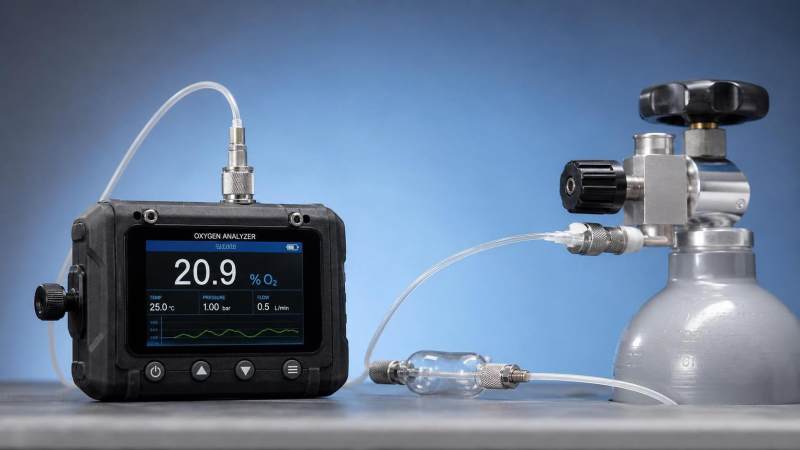 This matters more now because diving systems are becoming more specialized. Rebreathers, enriched air nitrox, trimix workflows, and offshore support operations demand tighter gas control than casual use. The analyzer has become a decision tool, not just a handheld accessory.
From a broader instrumentation perspective, diving analyzers sit in the same family of critical composition analysis devices used across energy, marine, laboratory, and industrial environments. GIH often frames these products through one simple lens: reliable data quality must survive real operating conditions, not only clean bench testing.
What an oxygen analyzer for diving applications must actually do
At the basic level, the analyzer measures oxygen concentration in a gas sample. Most diving units use electrochemical sensors because they are compact, practical, and cost-effective for field use.
In real evaluation, that basic function is not enough. The more relevant question is whether the analyzer delivers stable, repeatable readings across the full use cycle. That includes warm-up, calibration, sampling, storage, transport, and exposure to salt, humidity, and temperature shifts.
A reliable oxygen analyzer for diving applications should support three goals at once: gas verification, operator confidence, and operational consistency. If it performs only in one area, it is not a strong choice.
The selection criteria that matter most
Sensor stability comes before headline accuracy
Quoted accuracy figures can look similar across many products. Stability is usually the better differentiator. A sensor that drifts quickly creates repeated recalibration demands and weakens trust in the reading.
Look for documented sensor life, expected output decline, and drift behavior after storage. A stable analyzer reduces uncertainty during repeated tank checks or field blending sessions.
Calibration should be simple, traceable, and realistic
An oxygen analyzer for diving applications is only as good as its calibration routine. If calibration is awkward, users tend to shorten the process or skip checks under time pressure.
A good design supports straightforward zeroing or span adjustment, clear prompts, and stable calibration hold. Better units also make it easier to document calibration intervals and reference gas conditions.
Response time affects workflow and confidence
Slow response is more than an inconvenience. It increases the chance of reading too early, especially during repetitive checks. Fast stabilization helps confirm whether the value is real or still moving.
For blending stations and deck operations, response time directly affects throughput. In those settings, a faster analyzer improves both pace and consistency.
Marine durability is not optional
Salt spray, moisture ingress, vibration, and rough handling can degrade performance long before a sensor reaches its nominal end of life. Housing quality, seal integrity, connector protection, and display readability deserve close review.
A diving analyzer should also be usable with gloves, in bright sunlight, and in cramped equipment areas. Lab-grade sensitivity means little if the device is awkward on a dive boat or offshore platform.
How application type changes the buying decision
Not every oxygen analyzer for diving applications is being selected for the same duty cycle. The evaluation standard should reflect the actual use case, not a generic equipment list.
This is where many evaluations become more useful. Instead of asking which analyzer is best in general, ask which one remains dependable in the exact workflow where it will be used.
Signals that separate a robust analyzer from a risky one
A strong oxygen analyzer for diving applications usually shows quality in small details. Those details often predict lifecycle performance better than sales literature.
- Clear specification of measurement range and operating conditions
- Published sensor replacement intervals or expected service life
- Consistent sampling method with controlled gas flow
- Calibration instructions that can be repeated without ambiguity
- Replaceable parts and accessible after-sales support
- Traceable quality documentation and stable supply continuity
Risk signs are equally important. Vague accuracy claims, no drift information, unclear sensor source, and limited documentation often point to higher long-term uncertainty.
GIH’s supply-chain research model is useful here. In instrumentation procurement, supplier credibility, component traceability, and technical documentation often matter as much as the analyzer body itself.
Questions worth asking before shortlisting suppliers
A practical assessment should move from product specs to operational proof. That shift usually reveals whether the analyzer is built for dependable field use or only for catalog comparison.
Performance questions
- How does the unit behave after repeated calibration cycles?
- What is the typical warm-up and stabilization time?
- How sensitive is the reading to sample flow variation?
- What happens to accuracy near the upper oxygen range?
Lifecycle questions
- How available are replacement sensors in the target region?
- Is field replacement straightforward or workshop-dependent?
- What level of technical documentation is supplied?
- Is there evidence of stable production quality over time?
These questions align with a broader trend in industrial buying. Decision quality improves when evaluation includes total operating reliability, not only unit price and nominal specification.
A practical framework for the final decision
A disciplined selection process usually starts with the environment, then moves to the gas workflow, then to the supplier. That order prevents overvaluing attractive but secondary features.
Begin by defining the expected gases, frequency of measurement, calibration routine, and exposure conditions. Then compare candidate analyzers against drift behavior, response consistency, mechanical protection, and replacement logistics.
An oxygen analyzer for diving applications should finally be judged by how well it protects measurement confidence over time. In diving, reliable oxygen analysis is not only a technical parameter. It is a control point for safety, accountability, and operational discipline.
The next step is to build a short evaluation matrix using real use conditions, not brochure claims. That makes it easier to compare options, question weak assumptions, and identify the analyzer that will remain trustworthy after repeated field use.
Recommended for You
 How to verify accuracy claims for industrial quality analyzersVerify accuracy claims for industrial quality analyzers with calibration checks, independent testing, and clear acceptance criteria. Learn how to reduce risk and buy with confidence.
 How to calculate cooling loads for an industrial analyzer shelterSize industrial analyzer shelter cooling with confidence. Learn to calculate equipment heat, solar gains, and ventilation loads, then select HVAC capacity for reliable analyzer performance.
 How Do You Handle Analyzer Failure During an Environmental Audit?Learn how to handle analyzer failure during environmental compliance audit procedures. Protect evidence, verify data, and restore monitoring with this practical response guide.
 Do VOC Monitors Require Explosion-Proof Certification?Does VOC monitoring require explosion-proof certification? Learn when approval is needed, compare ATEX and IECEx, and choose the right monitor for your site.
 How sample conditioning affects accuracy in petrochemical analyzersImprove accuracy in petrochemical analyzers with smarter sample conditioning. Discover how phase control, filtration, and transport design prevent bias and deliver reliable process data.
 How to troubleshoot sensor drift in industrial gas detectorsIndustrial gas detectors showing sensor drift? Learn how to verify calibration gas, identify root causes, and determine when sensor replacement is needed for reliable monitoring.
 How to judge whether a competitive price reflects real valueCompetitive Price: learn how to compare scope, compliance, performance, and lifecycle costs to identify real value, reduce risk, and make smarter purchasing decisions.
 When custom gas analysis is the right fit for complex process streamsCustom gas analysis for complex process streams: learn when tailored sampling, interference control, and reliable measurement design deliver confident decisions.
 When does a laser gas analyzer meet stack emissions monitoring needs?Laser gas analyzer for stack emissions: learn when it delivers fast, reliable data, how to assess installation risks, and what to verify for CEMS compliance.
 How to select a hazardous gas analyzer for confined spacesHazardous gas analyzer selection for confined spaces: compare sensors, sampling, certifications, alarms, and maintenance to protect workers and choose with confidence.
 When is a single gas analyzer sufficient for workplace safety monitoring?Discover when a single gas analyzer delivers reliable workplace safety monitoring, and learn the key limits, calibration needs, and risks that require broader detection.
 How to choose an ambient gas analyzer for low-level leak detectionAmbient gas analyzer selection for low-level leak detection: compare sensitivity, cross-sensitivity, sampling design, alarms, and calibration for reliable site performance.
 How to tell when an oxygen sensor needs replacementOxygen sensor replacement signs explained: learn how live data, fault codes, wiring checks, and exhaust inspections pinpoint the real issue before you buy.
 How laser gas analyzers improve combustion control in steel furnacesLaser gas analyzer for steel industry applications delivers fast in-situ O₂ and CO data to optimize furnace combustion, cut fuel waste, and improve steel heating stability.
 How to verify whether explosion proof equipment meets site requirementsExplosion proof equipment verification made practical: match zones, gas or dust groups, temperature classes, certificates, and installation conditions for confident compliance.
 How industrial gas analysis helps detect contamination before releaseIndustrial Gas Analysis helps detect moisture, oil, oxygen, and toxic contaminants before release—protecting processes, ensuring compliance, and reducing costly risks.
 When is electrochemistry detection the right choice for water analysis?Electrochemistry detection for water analysis: learn when fast, reliable monitoring of ions, chlorine, pH, and more delivers actionable results.
 How industrial standards reduce quality risks in supplier selectionIndustrial Standard guidance helps quality and safety managers reduce supplier risks, verify compliance, strengthen traceability, and build resilient instrumentation supply chains.
 When does a multi-component system reduce installation complexity?Multi component systems reduce installation complexity when they eliminate field interfaces, streamline commissioning, and provide proven compatibility. Learn how to assess total cost and supplier accountability.
 How to size an industrial control shelter for outdoor equipmentIndustrial control shelter sizing guide: optimize layout, HVAC, access, safety, and expansion space for reliable outdoor equipment operations.
 How flue analysis helps verify combustion efficiencyFlue analysis verifies combustion efficiency by assessing O2, CO, CO2, and stack temperature to identify excess air, incomplete combustion, and heat losses.
 How to select industrial gas detectors for confined spacesIndustrial gas detectors for confined spaces: learn how to match sensors, sampling methods, alarms, and certifications to real atmospheric hazards.
 When does a laser oxygen analyzer outperform zirconia sensors?Laser oxygen analyzer vs. zirconia sensors: compare speed, selectivity, maintenance, gas chemistry, and installation needs to choose the right oxygen measurement solution.
 How to select a percent range analyzer for process measurementsPercent range analyzer selection made practical: compare accuracy, sample systems, calibration, gas matrix, integration, and lifecycle cost for reliable process measurements.
 How explosion proof analysis verifies safe equipment for hazardous areasExplosion proof analysis verifies hazardous-area equipment by matching certifications, temperature ratings, installation details, and inspection controls for safer compliance.
 When does fixed gas detection need point sensors instead of open-path monitoring?Fixed gas detection: discover when point sensors outperform open-path monitoring for predictable leaks, enclosed zones, local alarms, and safer design decisions.
 How to choose industrial metrology systems for tight-tolerance partsIndustrial metrology guide for tight-tolerance parts: compare CMMs, optical scanners, gauges, uncertainty, workflow, and traceable inspection strategies.
 How process metrology reduces measurement variation in productionProcess metrology reduces production measurement variation by improving traceability, uncertainty control, calibration, and reliable quality decisions.
 How to select an industrial monitoring analyzer for harsh environmentsIndustrial monitoring analyzer selection for harsh environments: evaluate sampling, durability, hazardous-area compliance, accuracy, maintenance, and data reliability.
 How calibration intervals affect test and measurement equipment accuracyTest and measurement equipment calibration intervals directly affect accuracy, risk, compliance, and uptime. Learn how to set evidence-based schedules that protect critical decisions.
 When does process gas monitoring need continuous measurement?Process gas monitoring needs continuous measurement when rapid changes threaten safety, quality, compliance, or uptime. Learn how to specify reliable, actionable monitoring systems.
 How to prevent false alarms in power plant instrumentationPower plant instrumentation guide: prevent false alarms with reliable signal checks, smarter alarm settings, mode-based control, and actionable operator responses.
Search Categories
Search Categories
- Smart Meters & Power Quality
- Transformer Gas Analyzers
- BESS Thermal Runaway Detectors
- Energy, Power & Smart Grid Monitoring
- Optical Profilers & CMM
- Ultrasonic & X-Ray NDT
- Calibration Standards
- Precision Metrology & NDT
- Water Quality Analyzers
- CEMS & VOCs Monitors
- Price Trends
- Import & Export Updates
- Market Trends
- Industry News
- Industry Insights
Latest Article
- How to verify accuracy claims for industrial quality analyzersVerify accuracy claims for industrial quality analyzers with calibration checks, independent testing, and clear acceptance criteria. Learn how to reduce risk and buy with confidence.Posted by:
- How to calculate cooling loads for an industrial analyzer shelterSize industrial analyzer shelter cooling with confidence. Learn to calculate equipment heat, solar gains, and ventilation loads, then select HVAC capacity for reliable analyzer performance.Posted by:
- How Do You Handle Analyzer Failure During an Environmental Audit?Learn how to handle analyzer failure during environmental compliance audit procedures. Protect evidence, verify data, and restore monitoring with this practical response guide.Posted by:
Please give us a message
