
Explosion Proof Analysis: How Hazardous Area Classification Affects Equipment Selection


Explosion proof analysis begins with one critical question: how hazardous area classification defines the real risks surrounding your process environment. For technical evaluation teams, choosing compliant instruments is not only about certification labels, but about matching equipment design, gas groups, temperature classes, and zone requirements with operational reality. This article explains how accurate classification directly shapes safer, more reliable, and more cost-effective equipment selection.
Why hazardous area classification is the real starting point
In many projects, equipment selection still starts with a datasheet filter: “ATEX approved,” “IECEx certified,” or “Class I Div 1 rated.” That approach is convenient, but technically incomplete. Explosion protection does not begin with the device. It begins with the atmosphere the device will enter.
Hazardous area classification is the method used to assess where flammable gases, vapors, mists, or combustible dusts may be present, how often they are present, and for how long. That classification is what determines the minimum protection concept required for electrical and instrumentation equipment.
For technical evaluators, this matters because certification alone does not prove suitability. A transmitter certified for one zone, gas group, or temperature class may still be wrong for the actual installation. A compliant label can create false confidence when the classification basis is outdated, too generic, or copied from a previous project without revalidation.
The practical question is not whether a device is “explosion proof” in a general sense. The practical question is whether its protection method matches the ignition risk profile of that exact location.
Classification systems are similar in purpose, but not interchangeable in use
The two most common frameworks technical teams encounter are the IEC/ATEX Zone system and the North American Class/Division system. Both aim to control ignition risk, but they organize the hazard differently.
Under IEC 60079-based practice and ATEX-related implementation, gas hazards are typically classified as Zone 0, Zone 1, or Zone 2. Dust hazards are Zone 20, Zone 21, or Zone 22. The higher the probability or duration of the hazardous atmosphere, the more stringent the equipment requirements. In simple terms:
- Zone 0 / 20: hazardous atmosphere present continuously, for long periods, or frequently
- Zone 1 / 21: likely to occur in normal operation
- Zone 2 / 22: not likely in normal operation, and if it occurs, it exists only briefly
In North America, NEC and CEC practice commonly uses Class and Division, such as Class I Division 1 or Division 2 for gases and vapors. The Division approach is not identical to Zones, even if there are broad mappings used in engineering discussion. Technical assessment should avoid assuming automatic equivalence without checking the governing code, authority having jurisdiction, and certification basis.
This is where many cross-border projects run into trouble. A supplier may offer a product certified for IECEx/ATEX Zone 1, while the project specification is written around NEC Class I Division 2. Sometimes the device is acceptable through dual certification. Sometimes it is not. Sometimes the device is technically safe but not legally accepted in the installation jurisdiction.
For global sourcing teams, explosion proof analysis is therefore both a technical and regulatory review, not just a procurement exercise.
Zone alone is not enough: gas group and temperature class often decide the outcome
Technical teams often focus on zone designation because it is the most visible part of area classification. In practice, zone is only one layer of the selection logic. Gas group and temperature class are just as important, and in certain cases more restrictive.
Gas grouping reflects the ignition characteristics of the hazardous substance. Under IEC practice for gases, typical groups include IIA, IIB, and IIC, with IIC generally representing the most severe ignition sensitivity among these groups. Hydrogen and acetylene applications, for example, frequently push selection toward IIC-rated equipment. A device suitable for IIA service cannot simply be assumed acceptable in an IIC environment.
Temperature class addresses the maximum surface temperature the equipment may reach. Common classes range from T1 to T6 under gas applications, with T6 imposing a lower allowable surface temperature than T1. The selected equipment must remain below the auto-ignition temperature of the surrounding hazardous atmosphere, with appropriate margin as required by the applicable standard and site engineering practice.
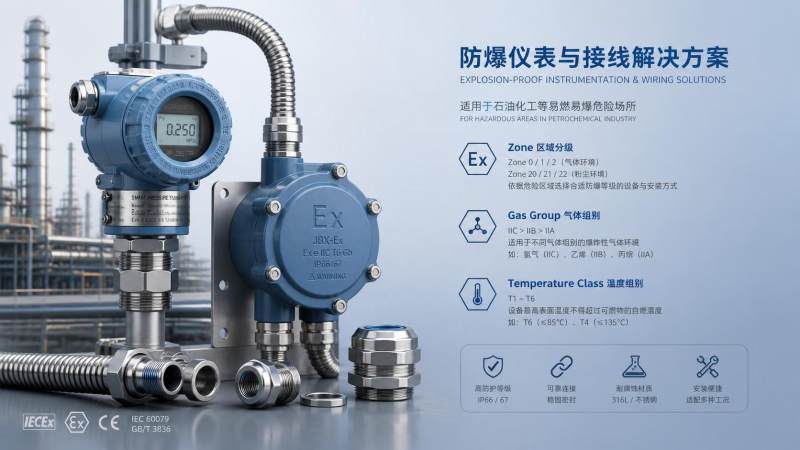
This is a common decision failure in brownfield upgrades. The replacement instrument may fit mechanically, communicate correctly with the control system, and carry an Ex marking. But if its temperature class is weaker than required by the classified area, the installation is noncompliant regardless of functional performance.
Dust adds another layer. Dust ignition behavior is influenced not only by cloud presence but also by dust layer accumulation, enclosure ingress protection, and thermal behavior on surfaces. In dusty plants, the “approved for hazardous area” shortcut is especially risky because dust protection concepts and marking conventions differ from gas-based assumptions.
Protection concept must align with the operating philosophy
Once classification is established, the next question is not merely which device is certified, but which protection concept best fits the application and maintenance reality.
Common protection methods under IEC 60079 series include flameproof enclosure Ex d, intrinsic safety Ex i, increased safety Ex e, purge/pressurization Ex p, and non-sparking Ex n for certain applications, among others. Each has different implications for installation, wiring, maintenance, inspection, and lifecycle cost.
For instrumentation, intrinsic safety is often preferred in low-power signal circuits because it limits available energy to below ignition-capable levels. That can simplify maintenance and permit work practices that are more flexible than flameproof systems, depending on site procedures. But intrinsic safety requires careful loop design, barrier or isolator selection, entity parameter matching, and control of cable characteristics. It is not a plug-and-play label.
Flameproof Ex d equipment, by contrast, contains an internal explosion and prevents flame propagation to the external atmosphere. It is robust and common in field devices, but heavier, more installation-sensitive in terms of cable entries and flame paths, and often less forgiving if maintenance practices are poor.
Technical evaluators should resist generic statements such as “Ex d is safer” or “Ex i is easier.” The right conclusion depends on power level, signal architecture, maintenance model, enclosure access frequency, and the competence of the installation team.
What area classification changes in actual equipment selection
The influence of hazardous area classification is visible across almost every evaluation parameter, not just safety certification.
1. Device type and architecture.
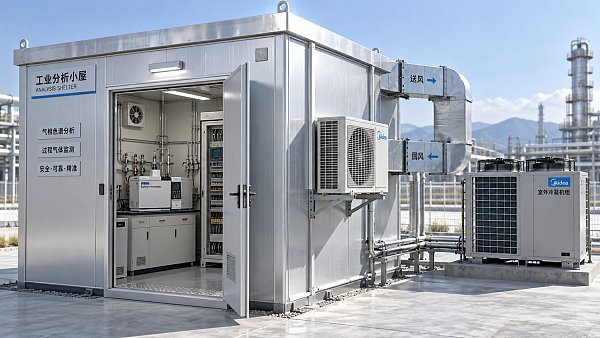
A pressure transmitter in Zone 1 may be selectable in either Ex d or Ex i versions, while a continuous gas analyzer shelter may require purge/pressurization or a safe-area design with sample conditioning extending into the hazardous area. Classification can determine whether the sensing element, electronics, junction box, or entire assembly must be protected.
2. Cable glands, conduit, and accessories.
Teams sometimes validate the instrument and overlook the accessories. Cable entries, stopping plugs, conduit seals, and local enclosures must carry compatible certification and be suitable for the same protection method. One mismatched gland can invalidate the installation.
3. Ambient temperature range.
A certificate may be valid only within a specific ambient range. In hot process units, desert installations, or cold outdoor terminals, the ambient condition can change the certified temperature class or operating limitations. The mark on the nameplate is not enough without reading the certificate schedule and installation instructions.
4. Maintainability and uptime.
A theoretically compliant solution may be impractical if it increases calibration time, requires hot work restrictions, or complicates enclosure opening procedures. Technical evaluation should include the maintenance regime, not just initial installation.
5. Spare parts and global interchangeability.
Multinational operators often prefer standardized protection concepts across regions, but this is not always feasible. Hazard classification method, national approval rules, and local installation codes may constrain standardization. Early review prevents sourcing complexity later.
Where classification errors usually come from
The most costly mistakes are rarely caused by misunderstanding the existence of a hazardous area. They come from oversimplification.
One common issue is using P&ID-level assumptions without revisiting ventilation, release grade, or process changes in the field. A skid originally designed for one solvent may later handle another with different flash point and ignition properties. The area drawing remains unchanged, but the actual risk profile does not.
Another issue is relying on old area classification dossiers during modernization projects. Plant modifications, enclosure additions, altered drainage, reduced ventilation, or changed operating cycles can materially affect zone boundaries.
There is also a recurring documentation gap in packaged equipment procurement. OEMs may certify their own assembly but leave ambiguous the interface conditions for installation into the end user’s classified area. Technical teams should verify not only the equipment certificate, but also the conditions of safe use, special marking such as “X” where applicable, and the exact installation assumptions behind the approval.
ATEX, IECEx, and “explosion proof” are not the same decision layer
In international trade, the term “explosion proof” is often used loosely to describe any equipment intended for hazardous locations. That creates confusion.
Strictly speaking, “explosion proof” has a specific meaning in some regulatory contexts, especially in North American practice, and does not cover all protection concepts used globally. ATEX is a European regulatory framework covering equipment and protective systems intended for use in potentially explosive atmospheres. IECEx is an international certification scheme based on IEC standards, widely used as a technical trust framework but adopted differently by each market.
For technical evaluation teams, the key point is this: certification scheme, protection concept, and legal market acceptance are related but separate questions. A supplier claiming “IECEx certified” may still need additional national approvals. A product marked for ATEX may still require careful review of EPL, group, temperature class, and installation conditions before it fits the target project.
That is why document review should include the certificate itself, not just catalog marking. Nameplate shorthand is useful, but it is not the full compliance record.
A practical evaluation sequence for technical teams
When teams want to avoid both overdesign and compliance gaps, a disciplined sequence works better than certification-first screening.
- Confirm the latest hazardous area classification drawings and basis documents.
- Identify whether the hazard is gas, vapor, mist, or dust, and verify the relevant substance properties.
- Check the required zone or division, group, and temperature class at the exact installation point.
- Determine which protection concepts are acceptable under the site standard and maintenance philosophy.
- Review equipment certificate details, not only marketing datasheets.
- Validate accessories, cable entries, barriers, isolators, and enclosure interfaces as part of the same protection system.
- Check ambient limits, special conditions of use, and serviceability constraints.
- Confirm local regulatory acceptance in the destination market.
This sequence often reveals that the technically optimal solution is not the most heavily certified device, but the one that best fits the actual classified area and operational model. Over-specification can raise cost, weight, installation burden, and lead time without improving risk control. Under-specification, of course, creates a direct safety and compliance exposure.
What good explosion proof analysis looks like in practice
Good explosion proof analysis is less about memorizing Ex markings and more about preserving the logic chain from hazard identification to equipment installation. The strongest technical teams do not treat area classification as a static drawing package sitting in the project archive. They treat it as a live engineering input that shapes instrument architecture, maintenance access, procurement qualification, and compliance documentation.
That mindset matters even more as plants become more connected. Remote I/O, smart field devices, wireless architectures, analyzer shelters, battery-backed monitoring, and retrofit automation all introduce new interfaces between energy sources and hazardous atmospheres. As systems become more digital, the risk of assuming that “low power” automatically means “low hazard” also increases. In classified areas, design intent still has to be proven through standards-based assessment.
For technical evaluation personnel, the takeaway is straightforward. If the hazardous area classification is weak, incomplete, or outdated, equipment selection will also be weak, no matter how reputable the manufacturer or how familiar the certification mark looks. Reliable selection starts when the classified area is understood in enough detail to support a defensible match between risk, protection method, and operating conditions.
That is the real value of explosion proof analysis: not broader certification claims, but tighter alignment between process reality and equipment choice.
Recommended for You
 How does cross-interference affect multi-component gas analyzers?How does cross-interference affect multi component gas analyzers? Explore measurement errors, compensation limits, and validation tips to choose the right system for your process.
 How does temperature affect high-accuracy sensor performance?Explore how temperature affects high accuracy sensor performance. Learn to reduce thermal drift, evaluate compensation, and select the right sensor for reliable measurements.
 Can a C4H8O concentration analyzer distinguish between isomers?Can a C4H8O concentration analyzer distinguish isomers? Compare GC, FTIR and MS methods, uncover selectivity limits, and learn what to validate before choosing your instrument.
 How to identify a reliable supplier using on-time delivery recordsIdentify a Reliable Supplier by verifying on-time delivery records, original commitments, and complete shipments. Learn practical checks to reduce purchasing risk and protect your project schedule.
 How sensitive should a portable hydrogen analyzer be for lab use?Choose a portable hydrogen analyzer for laboratory use with the right quantification limit, accuracy, and range. Learn how to verify performance and avoid costly buying mistakes.
 How to set industrial calibration intervals based on equipment riskSet industrial calibration intervals based on equipment risk, drift, and as-found data. Learn when to shorten or extend schedules to improve reliability and avoid unnecessary costs.
 How to choose electrochemical analyzers for low-current measurementsCompare electrochemical analyzers for precise low-current measurements. Learn how noise, leakage, bandwidth, and real-cell testing help you choose the right instrument.
 What tolerance does a custom gas mixture need for calibration?Choose the right custom gas tolerance for calibration. Learn how blending tolerance, certified uncertainty, and stability affect accuracy—and avoid paying for precision you don’t need.
 How condensation affects stack detector readings in wet flue gasStack detector readings can drift when wet flue gas condenses. Learn how to identify moisture interference, prevent sample losses, and improve emissions monitoring reliability.
 How to prevent condensation in a CO2 analyzer sampling systemPrevent condensation in your CO2 analyzer sampling system. Learn how to control dew point, eliminate cold spots, and manage moisture for reliable readings and fewer costly disruptions.
 How to verify accuracy claims for industrial quality analyzersVerify accuracy claims for industrial quality analyzers with calibration checks, independent testing, and clear acceptance criteria. Learn how to reduce risk and buy with confidence.
 How to calculate cooling loads for an industrial analyzer shelterSize industrial analyzer shelter cooling with confidence. Learn to calculate equipment heat, solar gains, and ventilation loads, then select HVAC capacity for reliable analyzer performance.
 Hydrogen Analyzers for Energy Storage: Purity Monitoring vs. Leak DetectionChoosing a hydrogen analyzer for energy storage systems? Compare purity monitoring and leak detection to select the right sensors, improve safety, and protect fuel cell performance.
 NH3 Monitoring in Fertilizer Plants: Where Should Leak Analyzers Be Installed?NH3 analyzer for fertilizer production: discover where to place leak detectors around storage, compressors, and loading areas to reduce blind spots and improve early warning.
 Diesel Engine NOx Analyzers: Response Time and NO2 Conversion ExplainedChoosing a NOX analyzer for diesel engines? Learn how response time, NO2 conversion, and sampling design affect accuracy—and make a smarter, evidence-based purchase.
 SO2 Analyzers for Smelter Emissions: Sampling Hot, Dust-Laden Flue GasSelect an SO2 analyzer for smelting industry applications. Discover how to handle hot, dust-laden flue gas, prevent sample losses, and achieve reliable emissions monitoring.
 Unstable CH4 Readings in Biogas Monitoring? Check Moisture and Sample FlowCH4 analyzer for biogas monitoring giving unstable readings? Discover how moisture, sample flow, and pressure checks help pinpoint faults and restore reliable methane measurements.
 Buying a CO2 Analyzer for Brewery Gas Recovery: Costs Beyond the Purchase PriceBuying a CO2 analyzer for brewery applications? Compare sampling, installation, calibration, and downtime costs to uncover hidden expenses and make a smarter gas recovery investment.
 Where to Place CO Analyzers for Effective Parking Garage VentilationOptimize your CO analyzer for parking garage ventilation with practical placement tips. Learn how sensor height, airflow, and zone coverage support timely detection and effective fan control.
 NDIR vs. FTIR Gas Analyzers: Which Fits Your Environmental Research?Find the right infrared gas analyzer for environmental research. Compare NDIR vs. FTIR on sensitivity, gas coverage, sampling needs, and cost to choose confidently for your study.
 Oxygen Analyzers for Diving: Calibration Checks Before Nitrox BlendingUsing an oxygen analyzer for diving applications? Discover essential calibration, sensor, and sampling checks before nitrox blending to support reliable readings.
 How Paramagnetic Oxygen Analyzers Work and Why Sample Pressure MattersLearn how a paramagnetic oxygen analyzer works, why sample pressure affects accuracy, and what to check in compensation and calibration before choosing your system.
 How Much Does a Complete CEMS Integration Project Typically Cost?How much does a complete CEMS integration project typically cost? Explore budget ranges, hidden installation costs, and compliance needs to compare quotes and plan confidently.
 What Is the Typical Response Time for Industrial Air Monitors?What is the typical response time for industrial air monitors? Explore T90, sampling delays, and alarm settings to compare performance and choose the right monitor with confidence.
 Do Regulatory Monitoring Systems Need Third-Party Certification?Do regulatory monitoring systems need third-party certification? Learn when it is required, what certificates prove, and how to verify compliance before buying.
 How Do You Choose Wired or Wireless for Stack Monitoring?Learn how to choose between wired and wireless for stack monitoring. Compare reliability, lifecycle costs, and data recovery to find the right CEMS setup for your site.
 What Happens When Combustible Gas Sensor Calibration Is Overdue?What happens if combustible gas sensor is not recalibrated on time? Discover the risks of inaccurate readings and missed alarms, plus steps to restore reliable protection.
 Can One Multi-Gas Detector Replace Four Separate Analyzers?Find out: can a single multi-gas detector replace four separate analyzers? Compare accuracy, safety, compliance, and lifetime costs to make a confident buying decision.
 Industrial Safety vs. Emission Monitoring: What Are the Differences?What are the main differences between industrial safety and emission monitoring? Compare goals, sensors, response times, and compliance needs to choose the right systems for your facility.
 Is Remote Monitoring Worth the Cost for Small Emission Sources?Is it worth investing in remote monitoring for small emission sources? Compare costs, compliance needs, and potential savings to choose the right solution for your operation.
 How Do You Handle Analyzer Failure During an Environmental Audit?Learn how to handle analyzer failure during environmental compliance audit procedures. Protect evidence, verify data, and restore monitoring with this practical response guide.
 Do VOC Monitors Require Explosion-Proof Certification?Does VOC monitoring require explosion-proof certification? Learn when approval is needed, compare ATEX and IECEx, and choose the right monitor for your site.
Search Categories
Search Categories
- Smart Meters & Power Quality
- Transformer Gas Analyzers
- BESS Thermal Runaway Detectors
- Energy, Power & Smart Grid Monitoring
- Optical Profilers & CMM
- Ultrasonic & X-Ray NDT
- Calibration Standards
- Precision Metrology & NDT
- Water Quality Analyzers
- CEMS & VOCs Monitors
- Price Trends
- Import & Export Updates
- Market Trends
- Industry News
- Industry Insights
Latest Article
- How does cross-interference affect multi-component gas analyzers?How does cross-interference affect multi component gas analyzers? Explore measurement errors, compensation limits, and validation tips to choose the right system for your process.Posted by:
- How does temperature affect high-accuracy sensor performance?Explore how temperature affects high accuracy sensor performance. Learn to reduce thermal drift, evaluate compensation, and select the right sensor for reliable measurements.Posted by:
- Can a C4H8O concentration analyzer distinguish between isomers?Can a C4H8O concentration analyzer distinguish isomers? Compare GC, FTIR and MS methods, uncover selectivity limits, and learn what to validate before choosing your instrument.Posted by:
Please give us a message
