How does water vapor affect infrared gas analyzers?


Water vapor can affect infrared gas analyzers by absorbing infrared radiation, altering measured gas concentrations, and creating cross-interference in certain measurement bands. Condensation may also damage components or change the sample reaching the detector. For technical evaluators, understanding these effects is essential when comparing analyzer performance under real operating conditions. The most reliable approach is to assess the optical measurement, sample handling, compensation, and calibration as one system rather than as separate specifications.
How water vapor changes the infrared signal
Infrared analyzers estimate gas concentration from the absorption of radiation at selected wavelengths. In a nondispersive infrared (NDIR) instrument, optical filters and detector arrangements isolate a region associated with the target gas. Fourier-transform infrared (FTIR) instruments instead collect a broader spectrum and use analysis algorithms to resolve contributions from multiple gases.
Water vapor has its own infrared absorption features. If those features overlap the wavelengths used for the target gas, a change in humidity can alter the signal even when the target concentration is unchanged. The resulting error is called spectral cross-interference. Its magnitude and direction depend on the optical design, measurement band, gas matrix, and compensation method; water does not produce the same bias in every analyzer.
There is also a practical distinction between a stable and a variable interference. An instrument calibrated under one humidity condition may perform acceptably while moisture remains constant, yet show a shifting zero or concentration reading as humidity changes. A dry calibration alone cannot demonstrate that this behavior is controlled.
In FTIR systems, a broader spectrum can help distinguish water from other gases, but resolution is not automatic. Spectral overlap, instrument resolution, reference spectra, and the range covered by the analysis model all matter. If water absorption is strong enough to leave little usable signal in a region, applying a correction cannot necessarily recover the lost information.
Wet-basis and dry-basis readings are not interchangeable
Water vapor can change the reported concentration even without optical interference. A wet-basis result includes water vapor in the total gas volume; a dry-basis result excludes it. Removing water therefore increases the numerical concentration of a target gas when expressed on a dry basis, provided the target itself is not lost in the conditioning process.
For example, a gas containing 100 ppm of a target on a wet basis and 10% water vapor corresponds to approximately 111 ppm on a dry basis. This is a basis conversion, not proof of analyzer error. The relationship is:
Dry-basis concentration = wet-basis concentration ÷ (1 − water vapor fraction).
The water fraction must be expressed on the same molar or volumetric basis as the gas concentration, and the calculation assumes no loss or chemical change of the target gas. If moisture is measured separately, uncertainty in that measurement carries into the corrected result. Evaluators comparing two instruments should establish whether each result is wet, dry, or calculated to a reference condition before attributing a difference to analyzer performance.
Condensation can change the sample before it is measured
The most consequential moisture problem may occur upstream of the optical cell. When a sample cools below its water dew point at the relevant pressure, liquid can form in the probe, tubing, filters, or analyzer. Droplets and deposits can contaminate windows, obstruct flow, cause corrosion, or produce unstable readings. A low-flow alarm may reveal a restriction, but it will not necessarily reveal a change in sample composition.
Some target gases dissolve in condensate or react with liquid water. In those applications, the gas reaching the analyzer may no longer represent the process, even if the analyzer itself is functioning correctly. Sulfur dioxide is a relevant example: removing moisture by cooling requires attention to possible losses in the condensate and wetted surfaces. The extent of loss depends on the complete sample matrix and conditioning design.
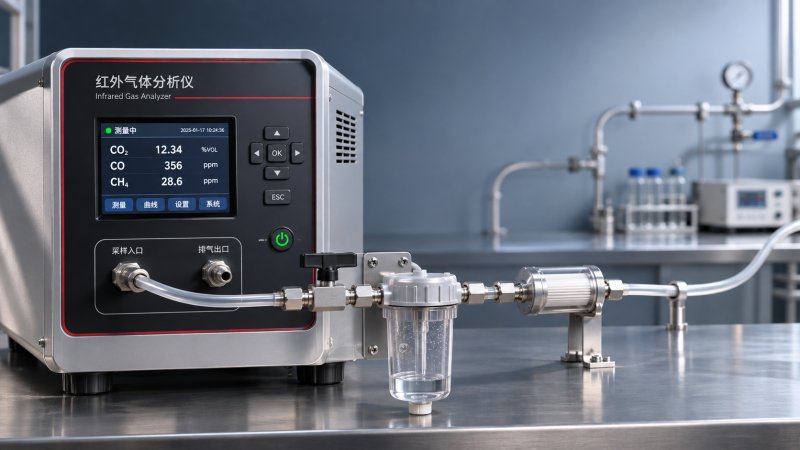
Temperature should be assessed along the entire sample path, not only at the heated line controller. Cold fittings, filter housings, valves, and transitions into a cabinet can become condensation points. Pressure changes also affect dew point, so the operating pressure at each part of the system matters. For gases susceptible to loss or reaction, the relevant condensation risk may include acid dew point as well as water dew point.
Choosing between drying and a heated wet path
There is no universal moisture-control arrangement. The choice depends on the target gases, the required reporting basis, the expected water content, and whether sample conditioning changes the analytes of interest.
Cooling and condensate removal
A cooler reduces the water vapor carried forward by lowering the sample temperature and separating condensate. This can protect an analyzer designed for a conditioned sample and reduce the burden on humidity compensation. It does not produce perfectly dry gas: the remaining moisture depends on the cooler outlet conditions and subsequent pressure and temperature.
The trade-off is sample integrity. A cooler, drain, and associated tubing can remove soluble compounds, introduce leaks, or create carryover between changing process conditions. Ask for evidence of recovery for the gases of interest under representative humidity and concentration conditions, rather than assuming that a cooler suitable for one measurement is suitable for all measurements in the same stream.
Heated extraction and wet measurement
A heated probe, line, and measurement path can keep water and susceptible analytes in the vapor phase until analysis. This approach avoids deliberate condensation, but it places more demands on temperature control, materials, maintenance, and the analyzer’s ability to handle a wet sample.
A heated path is not automatically representative simply because the line is warm. The design must account for the highest expected dew point, pressure changes, cold spots, and the temperature limits of seals, filters, and analyzer components. If a dry-basis result is required, the system also needs a defensible moisture measurement or another accepted means of conversion.
Other drying methods
Permeation dryers and desiccants may be useful in selected applications, but their effects on target gases, response time, and maintenance intervals must be checked. A dryer that removes water effectively can also retain or transmit other compounds differently. The supplier’s compatibility information should cover the actual matrix, not just the carrier gas.
What moisture compensation can—and cannot—correct
Depending on the analyzer, compensation may use a dedicated water measurement, a reference channel, spectral fitting, or an empirical correction model. These techniques can reduce humidity-related bias within a validated operating range. They cannot repair damaged optics, restore an analyte lost in a condensate trap, or make an unrepresentative sample representative.
A useful specification states more than “water compensated.” It identifies the tested moisture range, target gas range, sample temperature and pressure, other gases present, and the residual error after correction. Check whether the stated limit applies across the full range or only at a particular concentration. Also ask what happens when the water reading falls outside the model range: a flagged result is more useful than a plausible number with an unknown error.
For multicomponent samples, interference tests should reflect realistic combinations where feasible. A correction established with water alone may not fully describe behavior when other absorbing gases are present, particularly if their concentrations vary together.
Calibration should test the measurement system, not just the analyzer
Zero and span checks establish whether the instrument responds appropriately to known reference gases under the conditions of the check. They do not, by themselves, verify the response to a humid process sample. Calibration gases introduced directly at the analyzer may also bypass the probe, heated line, cooler, and filters where losses or leaks occur.
A stronger verification plan distinguishes between analyzer checks and full-system checks. Where the method and equipment allow, introduce a suitable test gas upstream and assess recovery through the sample path. A separate humidity-interference test can compare readings at controlled moisture levels while holding the target concentration and other relevant conditions as constant as practical. The test arrangement needs its own safeguards against condensation and unintended dilution.
Document the reference gas composition and uncertainty, injection point, sample flow, pressure, temperatures, moisture condition, stabilization time, and acceptance criteria. For routine operation, trend zero and span results alongside cooler temperatures, line temperatures, flow, and maintenance events. A recurring measurement shift after a drain blockage or filter change may be a sample-system issue rather than detector drift.
Which standards and evidence should be reviewed?
The applicable requirements depend on the measurement purpose and jurisdiction. For emissions monitoring, the governing permit, reference method, and local rules determine the required reporting basis, performance tests, and quality-assurance procedures. An analyzer’s general specification is not a substitute for checking those project-specific obligations.
EN 15267-3 addresses performance criteria and test procedures for automated measuring systems used to monitor emissions from stationary sources. ISO 12039 covers determination of carbon monoxide, carbon dioxide, and oxygen in stationary-source emissions using automated methods. Their applicability depends on the instrument, measurand, and regulatory context; the current edition and relevant provisions should be verified for the project.
ISO/IEC 17025 concerns the competence of testing and calibration laboratories. A calibration certificate from an accredited laboratory can support traceability when the work is within its accredited scope, but accreditation does not establish that an installed analyzer meets every application requirement. Review the certificate’s scope, uncertainty, reference conditions, and whether the tested configuration matches the intended use.
Questions that separate a usable specification from a reassuring one
Before comparing quotations or test reports, define the expected gas composition, moisture extremes, operating pressure, temperature, and required response time. Then ask suppliers to explain how their proposed arrangement handles these conditions:
- What is the maximum permissible water content at the analyzer inlet, and is that limit continuous or conditional?
- Is the stated humidity interference measured before or after compensation, and under which target-gas and water concentrations?
- Where can condensation occur during startup, shutdown, loss of heating, or changes in flow?
- Which target gases may be lost in the cooler, dryer, filters, or sample lines, and what recovery evidence is available?
- Are results reported on a wet or dry basis, and how is moisture measured for any conversion?
- Which checks cover the full sampling system, and which test only the analyzer?
These questions are especially useful when comparing systems across process control, environmental monitoring, and laboratory applications, where the same analyzer technology may be paired with very different sample-handling arrangements. Global Instrument Hub’s instrumentation research perspective is useful here: supplier claims become more comparable when the measurement conditions and supporting evidence are made explicit.
The deciding factor is not whether an analyzer can tolerate water in principle. It is whether the complete system can deliver a representative sample and a defensible result across the humidity conditions the installation will actually encounter. Confirm that point in the test plan before treating a dry-gas accuracy figure as a field-performance guarantee.
Recommended for You
 How does water vapor affect infrared gas analyzers?Infrared gas analyzers can be affected by humidity, condensation and spectral interference. Learn how to protect sample integrity and achieve reliable results.
 How to reduce customer support response timesReduce Customer Support response times with actionable tips for reporting equipment faults, choosing the right channel, and getting expert help faster.
 How to choose a low range analyzer for trace-level measurementsChoose the right low range analyzer for trace-level measurements. Compare detection limits, sampling, calibration and support to make a confident decision.
 How to choose combustible gas detectors for a specific gasChoose combustible gas detectors with confidence. Compare sensor technologies, gas response, calibration, placement, and certification for your application.
 How to choose an air quality analyzer for the pollutants you need to measureChoose an air quality analyzer with confidence. Compare pollutant measurement methods, sampling, accuracy and calibration to find the right fit for your needs.
 How to choose industrial metrology tools for tight tolerancesChoose industrial metrology tools for tight tolerances with confidence. Compare uncertainty, calibration, tool types, and costs to reduce inspection risk.
 How moisture affects fixed analyzer accuracy in stack gas monitoringImprove fixed analyzer accuracy in stack gas monitoring. Discover how moisture causes dilution, interference, and sample loss—and learn practical ways to protect emissions data.
 How does production line speed affect in-line measurement accuracy?Discover how production line speed affects in-line measurement accuracy. Explore sensor response, sampling, and timing to boost throughput without compromising quality.
 How condensation affects HCl concentration analyzer accuracyHCl concentration analyzer accuracy can suffer when condensation traps HCl. Learn how to spot sampling losses, prevent low readings, and improve measurement reliability.
 How does cross-interference affect multi-component gas analyzers?How does cross-interference affect multi component gas analyzers? Explore measurement errors, compensation limits, and validation tips to choose the right system for your process.
 How does temperature affect high-accuracy sensor performance?Explore how temperature affects high accuracy sensor performance. Learn to reduce thermal drift, evaluate compensation, and select the right sensor for reliable measurements.
 Can a C4H8O concentration analyzer distinguish between isomers?Can a C4H8O concentration analyzer distinguish isomers? Compare GC, FTIR and MS methods, uncover selectivity limits, and learn what to validate before choosing your instrument.
 How to identify a reliable supplier using on-time delivery recordsIdentify a Reliable Supplier by verifying on-time delivery records, original commitments, and complete shipments. Learn practical checks to reduce purchasing risk and protect your project schedule.
 How sensitive should a portable hydrogen analyzer be for lab use?Choose a portable hydrogen analyzer for laboratory use with the right quantification limit, accuracy, and range. Learn how to verify performance and avoid costly buying mistakes.
 How to set industrial calibration intervals based on equipment riskSet industrial calibration intervals based on equipment risk, drift, and as-found data. Learn when to shorten or extend schedules to improve reliability and avoid unnecessary costs.
 How to choose electrochemical analyzers for low-current measurementsCompare electrochemical analyzers for precise low-current measurements. Learn how noise, leakage, bandwidth, and real-cell testing help you choose the right instrument.
 What tolerance does a custom gas mixture need for calibration?Choose the right custom gas tolerance for calibration. Learn how blending tolerance, certified uncertainty, and stability affect accuracy—and avoid paying for precision you don’t need.
 How condensation affects stack detector readings in wet flue gasStack detector readings can drift when wet flue gas condenses. Learn how to identify moisture interference, prevent sample losses, and improve emissions monitoring reliability.
 How to prevent condensation in a CO2 analyzer sampling systemPrevent condensation in your CO2 analyzer sampling system. Learn how to control dew point, eliminate cold spots, and manage moisture for reliable readings and fewer costly disruptions.
 How to verify accuracy claims for industrial quality analyzersVerify accuracy claims for industrial quality analyzers with calibration checks, independent testing, and clear acceptance criteria. Learn how to reduce risk and buy with confidence.
 How to calculate cooling loads for an industrial analyzer shelterSize industrial analyzer shelter cooling with confidence. Learn to calculate equipment heat, solar gains, and ventilation loads, then select HVAC capacity for reliable analyzer performance.
 Hydrogen Analyzers for Energy Storage: Purity Monitoring vs. Leak DetectionChoosing a hydrogen analyzer for energy storage systems? Compare purity monitoring and leak detection to select the right sensors, improve safety, and protect fuel cell performance.
 NH3 Monitoring in Fertilizer Plants: Where Should Leak Analyzers Be Installed?NH3 analyzer for fertilizer production: discover where to place leak detectors around storage, compressors, and loading areas to reduce blind spots and improve early warning.
 Diesel Engine NOx Analyzers: Response Time and NO2 Conversion ExplainedChoosing a NOX analyzer for diesel engines? Learn how response time, NO2 conversion, and sampling design affect accuracy—and make a smarter, evidence-based purchase.
 SO2 Analyzers for Smelter Emissions: Sampling Hot, Dust-Laden Flue GasSelect an SO2 analyzer for smelting industry applications. Discover how to handle hot, dust-laden flue gas, prevent sample losses, and achieve reliable emissions monitoring.
 Unstable CH4 Readings in Biogas Monitoring? Check Moisture and Sample FlowCH4 analyzer for biogas monitoring giving unstable readings? Discover how moisture, sample flow, and pressure checks help pinpoint faults and restore reliable methane measurements.
 Buying a CO2 Analyzer for Brewery Gas Recovery: Costs Beyond the Purchase PriceBuying a CO2 analyzer for brewery applications? Compare sampling, installation, calibration, and downtime costs to uncover hidden expenses and make a smarter gas recovery investment.
 Where to Place CO Analyzers for Effective Parking Garage VentilationOptimize your CO analyzer for parking garage ventilation with practical placement tips. Learn how sensor height, airflow, and zone coverage support timely detection and effective fan control.
 NDIR vs. FTIR Gas Analyzers: Which Fits Your Environmental Research?Find the right infrared gas analyzer for environmental research. Compare NDIR vs. FTIR on sensitivity, gas coverage, sampling needs, and cost to choose confidently for your study.
 Oxygen Analyzers for Diving: Calibration Checks Before Nitrox BlendingUsing an oxygen analyzer for diving applications? Discover essential calibration, sensor, and sampling checks before nitrox blending to support reliable readings.
 How Paramagnetic Oxygen Analyzers Work and Why Sample Pressure MattersLearn how a paramagnetic oxygen analyzer works, why sample pressure affects accuracy, and what to check in compensation and calibration before choosing your system.
 How Much Does a Complete CEMS Integration Project Typically Cost?How much does a complete CEMS integration project typically cost? Explore budget ranges, hidden installation costs, and compliance needs to compare quotes and plan confidently.


Search Categories
Search Categories
- Smart Meters & Power Quality
- Transformer Gas Analyzers
- BESS Thermal Runaway Detectors
- Energy, Power & Smart Grid Monitoring
- Optical Profilers & CMM
- Ultrasonic & X-Ray NDT
- Calibration Standards
- Precision Metrology & NDT
- Water Quality Analyzers
- CEMS & VOCs Monitors
- Price Trends
- Import & Export Updates
- Market Trends
- Industry News
- Industry Insights
Latest Article
- How does water vapor affect infrared gas analyzers?Infrared gas analyzers can be affected by humidity, condensation and spectral interference. Learn how to protect sample integrity and achieve reliable results.Posted by:
- How to reduce customer support response timesReduce Customer Support response times with actionable tips for reporting equipment faults, choosing the right channel, and getting expert help faster.Posted by:
- How to choose a low range analyzer for trace-level measurementsChoose the right low range analyzer for trace-level measurements. Compare detection limits, sampling, calibration and support to make a confident decision.Posted by:
Please give us a message