
How does sampling affect gas composition analysis accuracy?


Gas Composition Analysis is only as accurate as the sample reaching the analyzer. Sampling errors can alter concentrations before measurement begins, even when the instrument is well calibrated.
For technical evaluators, the central question is whether the complete sampling system delivers a representative, stable sample at the required measurement point and time.
Probe placement, leaks, condensation, adsorption, reactions, and transport delays can each distort results. Their importance depends on the analyte, process conditions, and intended use.
Where can sampling errors enter gas composition analysis?
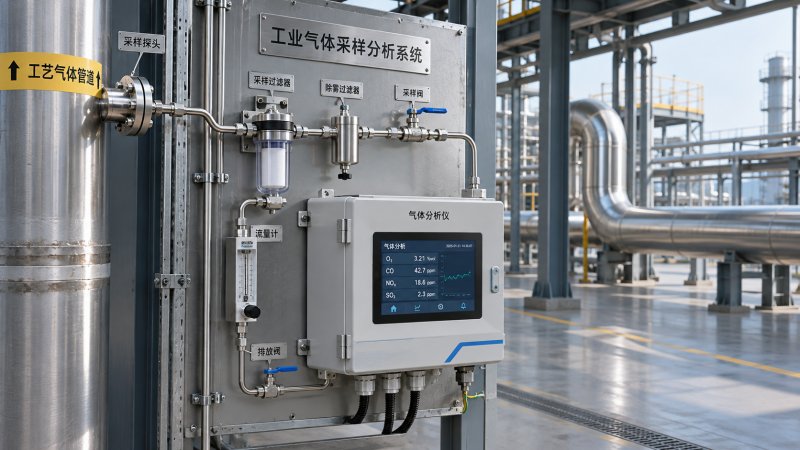
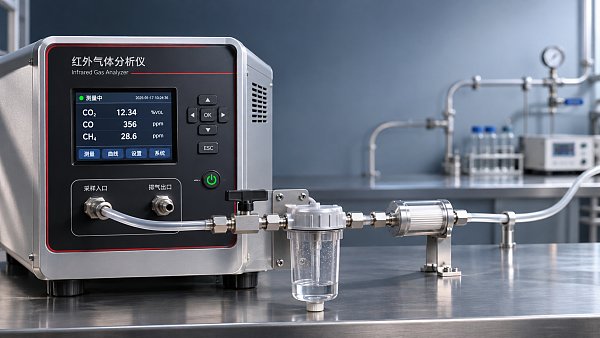
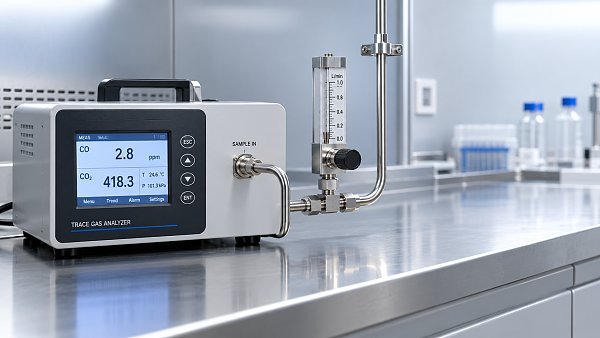
A sampling system connects the process to the analyzer through a probe, tubing, conditioning components, flow controls, and sometimes a pump or collection container.
Every component can change the sample or its timing. A reliable evaluation therefore follows the gas from its source to the measurement cell.
Errors generally fall into three groups: the sample is unrepresentative, its composition changes during handling, or it arrives too late to reflect current conditions.
These problems can produce a persistent bias, increased variability, or a misleading trend. They are especially consequential when decisions depend on trace concentrations.
Consider a process stream containing a water-soluble contaminant. If moisture condenses upstream, some contaminant may dissolve in the liquid, reducing its measured gas concentration.
A calibration performed at the analyzer inlet may confirm instrument performance while missing that upstream loss. Calibration location matters as much as calibration quality.
Begin by defining the measurement objective: which components matter, their expected concentrations, the required uncertainty, and how quickly the result must respond.
Does the probe collect a representative sample?
A precise analyzer cannot correct for a probe positioned where gas composition differs from the location or volume the measurement is intended to represent.
In ducts, stacks, and large vessels, concentration can vary across the flow because of incomplete mixing, temperature gradients, stratification, or nearby injection points.
Evaluate whether the proposed extraction point reflects the process under normal operation and during transitions. Review flow patterns, upstream disturbances, and access constraints.
For some applications, a single fixed probe is adequate. Others require a traverse, multiple sampling points, or a documented assessment of spatial variation.
Probe depth and orientation also matter. A probe too close to a wall may encounter a boundary layer, deposits, or temperatures unlike the bulk stream.
In particulate-laden gas, extraction conditions can affect the amount of entrained material and associated contaminants. Follow the applicable sampling method when representative particle collection matters.
Ask suppliers to explain their placement assumptions and identify the process data needed to verify them. A convenient nozzle is not automatically a representative location.
How do leaks, materials, and reactions change the result?
Leaks can admit ambient air into a sample line operating below atmospheric pressure. Oxygen and nitrogen readings may rise while process-gas components appear diluted.
Small leaks can be significant in trace analysis, particularly when the background concentration of the target compound differs greatly from the process concentration.
Positive-pressure leaks can also change flow or create hazards. Use a leak-check method suitable for the sample, operating pressure, and installation materials.
Sample-contact surfaces can adsorb reactive or low-concentration compounds. Tubing, seals, filters, regulators, and valves should be selected for the specific chemical mixture.
Adsorption may initially produce low readings, then release retained compounds after the process concentration falls. This memory effect can make changes appear slower.
Some gases react with oxygen, moisture, or other sample components during transport. Other compounds can decompose under unsuitable temperature, light, or surface conditions.
Material compatibility charts are useful starting points, but they do not prove recovery at the required concentration. Request application-specific evidence or conduct a representative test.
Minimize unnecessary fittings and dead volumes, and ensure components can be cleaned or replaced. Both design choices reduce opportunities for contamination and carryover.
Should the sample be heated, cooled, filtered, or dried?
Conditioning protects the analyzer and establishes acceptable inlet conditions, but each treatment can also remove or alter the components being measured.
Cooling a wet sample can condense water and dissolve soluble analytes. A downstream measurement may therefore underestimate the original concentration of those compounds.
Where preserving the wet sample is necessary, a heated probe, line, and compatible analyzer may keep the gas above its water and hydrocarbon dew points.
The required temperature depends on pressure and composition throughout the system. Check cold spots at fittings, filters, and transitions, not just the line’s setpoint.
Cooling and drying can be appropriate when the method specifies a dry basis and target gases remain adequately preserved. Verify recovery under expected operating conditions.
Wet-basis and dry-basis results are not interchangeable. If water is the only removed component, dry concentration equals wet concentration divided by one minus water mole fraction.
For example, 100 ppm wet at 10% water corresponds to approximately 111 ppm dry, assuming the analyte is not lost during water removal.
Filters remove particles that could block components or damage the analyzer. However, filter media and collected deposits can adsorb analytes or promote reactions.
Specify filter material, temperature, maintenance interval, and acceptable pressure drop. Assess whether the filter must be upstream or downstream of other conditioning equipment.
For every conditioning step, ask what it removes, what it preserves, and whether the reported result must be corrected or labeled on a particular basis.
How do sample-line length and flow affect response time?
A long line can deliver an accurate composition too late for process control or event detection. Transport delay must be assessed alongside analytical accuracy.
As a first approximation, transport time is the internal gas volume divided by volumetric flow at the same line pressure and temperature.
For instance, a one-liter line carrying gas at one liter per minute under matching conditions has an approximate one-minute transport delay.
This estimate excludes mixing, adsorption, analyzer cell response, and other effects. Use an end-to-end step-response test when timing is operationally important.
Increasing flow or reducing internal volume can shorten delay, but changes must remain compatible with pressure limits, analyzer requirements, and sample conditioning.
A fast-loop arrangement can move gas rapidly to a location near the analyzer while a smaller branch supplies the measurement cell.
Evaluate the complete response time, including probe, line, conditioning, analyzer, and data processing. Ask suppliers to state the conditions behind any response-time claim.
What changes when samples are collected in bags or cylinders?
Grab samples are useful for laboratory analysis and intermittent checks, but collection and storage add opportunities for leakage, contamination, and composition changes.
Select a container and preparation procedure compatible with the target gases and expected concentration. Prior use, cleaning residues, and surface condition can matter.
Confirm that the sample remains stable for the planned holding time and transport conditions. Stability evidence should cover the actual matrix where practical.
Document collection time, location, pressure, temperature, container identification, and any conditioning. These details help the laboratory interpret results and investigate discrepancies.
For cylinders, assess pressure changes and the risk of condensation as the sample cools. Follow the applicable method and safe handling procedures.
A delayed laboratory result can be analytically sound yet unrepresentative of a rapidly changing process. Match the collection period to the decision being made.
How can evaluators verify sampling accuracy before procurement?
Start with an analyte-by-analyte specification. Include concentration ranges, matrix composition, pressure, temperature, humidity, particulates, required response time, and acceptable uncertainty.
Request a sample-system schematic showing all wetted materials, temperatures, pressures, flow rates, filters, drains, valves, and the proposed calibration-gas introduction points.
Ask for an uncertainty budget that includes relevant sampling contributions as well as analyzer performance. Identify assumptions and whether errors are estimated or measured.
Distinguish calibration from recovery testing. Introducing a known gas upstream of critical components can reveal losses or delays that inlet-only calibration may miss.
Choose a challenge gas and conditions representative of the application. A dry standard alone may not reveal losses caused by moisture or condensation.
Where feasible, compare results with a validated reference method or an independently collected sample. Explain expected differences in timing, location, and wet or dry basis.
Define acceptance criteria before testing: allowable bias, repeatability, recovery, response time, and leak tightness should reflect the measurement’s intended use.
Also review maintenance access, replacement intervals, diagnostic alarms, and calibration procedures. A system that performs initially must remain practical to operate over time.
For regulated measurements, identify the applicable method and jurisdiction early. Specific rules may govern probe location, conditioning, validation, and reporting.
Conclusion: evaluate the measurement chain, not just the analyzer
Sampling affects gas composition analysis by determining which gas reaches the analyzer, whether its composition is preserved, and when the result becomes available.
The strongest technical assessment connects probe placement, materials, conditioning, transport, and verification to the target analytes and the decisions supported by the measurement.
Before selecting a system, require evidence of representative sampling and acceptable end-to-end performance under realistic conditions. That evidence makes analyzer specifications meaningful.
Recommended for You
 How does sampling affect gas composition analysis accuracy?Gas Composition Analysis depends on representative sampling. Discover how probe placement, conditioning and transport affect accuracy, and what to verify before choosing a system.
 How does a CO analyzer control parking garage ventilation?Discover how a CO analyzer for parking garage ventilation controls fans, supports efficient airflow, and helps maintain a safer garage environment.
 How to choose a gas quality analyzer for natural gas pipelinesChoose the right gas quality analyzer for natural gas pipelines. Compare technologies, sampling systems and performance to support reliable decisions.
 How does pressure affect laser oxygen analyzer readings?Laser oxygen analyzer readings can shift with pressure. Learn how compensation, sample conditions and calibration affect accuracy—and how to troubleshoot changes.
 How to identify regulatory compliance requirements for your businessRegulatory Compliance starts with knowing which rules apply. Learn how to assess obligations, document decisions, and build effective controls for your business.
 How to choose industrial air monitors for workplace VOCsChoose industrial air monitors for workplace VOCs with confidence. Compare sensor technologies, placement, calibration, and safety requirements.
 Laser vs infrared gas analyzers for stack monitoring: Which handles water vapor interference better?Laser vs infrared gas analyzer stack monitoring: Discover which technology better handles water vapor interference and how to choose for your application.
 Can an air detector identify carbon monoxide indoors?Can an air detector identify carbon monoxide indoors? Learn which sensors detect CO, how to check device specifications, and why a certified alarm matters.
 How does a paramagnetic gas analyzer measure oxygen?Discover how a paramagnetic gas analyzer measures oxygen, what affects accuracy, and how to choose the right solution for your application.
 How to choose a reliable gas analyzer for low concentrationsChoose a reliable gas analyzer for low concentrations. Compare technologies, sampling, calibration and supplier evidence to make a confident purchase.
 How does cross-sensitivity affect multi gas analysis accuracy?Discover how cross-sensitivity affects multi gas analysis accuracy, and learn how to identify interference, validate compensation, and improve measurement reliability.
 How to choose metrics for sustainable monitoringSustainable Monitoring starts with metrics that drive action. Learn how to define boundaries, assess data quality, and track meaningful improvements.
 How to verify a trusted manufacturer's production capacityTrusted Manufacturer capacity claims need proof. Learn how to verify production plans, bottlenecks, quality records and supply risks before you place an order.
 How to choose an emission controller for an industrial boilerChoose the right emission controller for your industrial boiler. Compare technologies, operating conditions, compliance needs, and costs.
 How to choose composition analyzers for low-concentration measurementsChoose composition analyzers with confidence. Discover how quantification limits, sample handling and matrix effects shape reliable low-concentration measurements.
 How does online analysis compare with laboratory testing for water quality monitoring?Online analysis vs. laboratory testing: compare speed, accuracy, costs, and compliance to find the right water quality monitoring strategy.
 How to choose the right detection range for a custom gas analyzerChoose the right custom gas analyzer detection range with practical guidance on accuracy, exposure limits, calibration, and supplier evaluation.
 How does multi component monitoring detect gases in stack emissions?Discover how multi component monitoring detects stack gases, manages interference and supports reliable emissions reporting. Explore key CEMS selection factors.
 How bright should an industrial monitor be for outdoor use?Choosing an outdoor industrial monitor? Learn why 1,000 nits is a starting point and how glare, contrast, and heat affect sunlight readability.
 How does water vapor affect infrared gas analyzers?Infrared gas analyzers can be affected by humidity, condensation and spectral interference. Learn how to protect sample integrity and achieve reliable results.
 How to reduce customer support response timesReduce Customer Support response times with actionable tips for reporting equipment faults, choosing the right channel, and getting expert help faster.
 How to choose a low range analyzer for trace-level measurementsChoose the right low range analyzer for trace-level measurements. Compare detection limits, sampling, calibration and support to make a confident decision.
 How to choose combustible gas detectors for a specific gasChoose combustible gas detectors with confidence. Compare sensor technologies, gas response, calibration, placement, and certification for your application.
 How to choose an air quality analyzer for the pollutants you need to measureChoose an air quality analyzer with confidence. Compare pollutant measurement methods, sampling, accuracy and calibration to find the right fit for your needs.
 How to choose industrial metrology tools for tight tolerancesChoose industrial metrology tools for tight tolerances with confidence. Compare uncertainty, calibration, tool types, and costs to reduce inspection risk.
 How moisture affects fixed analyzer accuracy in stack gas monitoringImprove fixed analyzer accuracy in stack gas monitoring. Discover how moisture causes dilution, interference, and sample loss—and learn practical ways to protect emissions data.
 How does production line speed affect in-line measurement accuracy?Discover how production line speed affects in-line measurement accuracy. Explore sensor response, sampling, and timing to boost throughput without compromising quality.
 How condensation affects HCl concentration analyzer accuracyHCl concentration analyzer accuracy can suffer when condensation traps HCl. Learn how to spot sampling losses, prevent low readings, and improve measurement reliability.
 How does cross-interference affect multi-component gas analyzers?How does cross-interference affect multi component gas analyzers? Explore measurement errors, compensation limits, and validation tips to choose the right system for your process.
 How does temperature affect high-accuracy sensor performance?Explore how temperature affects high accuracy sensor performance. Learn to reduce thermal drift, evaluate compensation, and select the right sensor for reliable measurements.
 Can a C4H8O concentration analyzer distinguish between isomers?Can a C4H8O concentration analyzer distinguish isomers? Compare GC, FTIR and MS methods, uncover selectivity limits, and learn what to validate before choosing your instrument.
 How to identify a reliable supplier using on-time delivery recordsIdentify a Reliable Supplier by verifying on-time delivery records, original commitments, and complete shipments. Learn practical checks to reduce purchasing risk and protect your project schedule.
Search Categories
Search Categories
- Smart Meters & Power Quality
- Transformer Gas Analyzers
- BESS Thermal Runaway Detectors
- Energy, Power & Smart Grid Monitoring
- Optical Profilers & CMM
- Ultrasonic & X-Ray NDT
- Calibration Standards
- Precision Metrology & NDT
- Water Quality Analyzers
- CEMS & VOCs Monitors
- Price Trends
- Import & Export Updates
- Market Trends
- Industry News
- Industry Insights
Latest Article
- How does sampling affect gas composition analysis accuracy?Gas Composition Analysis depends on representative sampling. Discover how probe placement, conditioning and transport affect accuracy, and what to verify before choosing a system.Posted by:
- How does a CO analyzer control parking garage ventilation?Discover how a CO analyzer for parking garage ventilation controls fans, supports efficient airflow, and helps maintain a safer garage environment.Posted by:
- How to choose a gas quality analyzer for natural gas pipelinesChoose the right gas quality analyzer for natural gas pipelines. Compare technologies, sampling systems and performance to support reliable decisions.Posted by:
Please give us a message
