How to choose a gas quality analyzer for natural gas pipelines


Choose a gas quality analyzer by working backward from the decision its results must support. A pipeline operator calculating energy for custody transfer may need a compositional analysis system with an approved calculation method. A blending station protecting downstream equipment may place greater value on fast detection of a specific contaminant or an unacceptable change in gas properties.
Start with the required measurements and their contractual limits, then test whether the analyzer and its sampling system can deliver usable results under actual pipeline conditions. A strong instrument specification has limited value if the sample changes before it reaches the detector, the analysis arrives too late, or the installed system cannot be maintained.
Define what the measurement must support
Write down the decisions that depend on each result. These may include accepting gas at an interconnection, calculating delivered energy, managing a blending operation, protecting equipment or demonstrating compliance with a pipeline specification. Each decision can require different measurements, update rates and levels of confidence.
For energy determination, the required outputs may include gross or net calorific value, relative density and Wobbe index. The agreement governing the measurement should establish which quantities are needed, their reference conditions and the accepted calculation method. A compositional analyzer can provide inputs for these calculations, but the usefulness of the result depends on whether it measures the components required by that method over the expected gas range.
Pipeline quality specifications may also set limits for water, hydrogen sulfide, total sulfur, carbon dioxide, oxygen or hydrocarbon dew point. These are separate measurement problems. An analyzer that reports heating value does not necessarily detect a trace contaminant at its contractual limit, and a moisture measurement alone does not establish the hydrocarbon dew point.
Build a measurement list before approaching suppliers. For each output, record the normal and extreme concentrations, the limit that triggers action, the required reporting interval and what happens if the reading is unavailable. If gas may contain biomethane, hydrogen or other blended streams, include their expected components and ranges. Ask whether the proposed measurement and calculation methods remain valid for those compositions.
Match the technology to the required outputs
No single analyzer technology automatically covers every pipeline quality requirement. The following comparison is a starting point for narrowing the options; individual instrument configurations and performance still need evaluation against the gas composition and measurement limits.
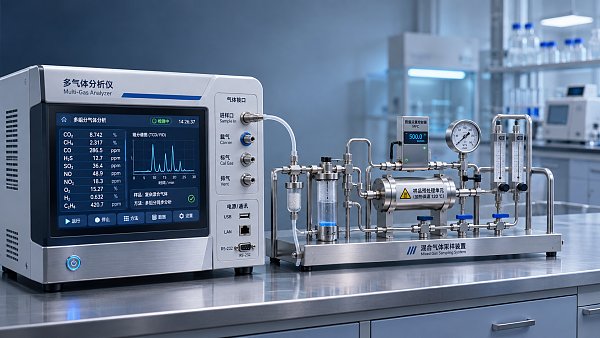
A process gas chromatograph is often a candidate when the required result depends on several components and a prescribed calculation. Its analysis is periodic, however, so the evaluator should establish whether the time between valid results is compatible with the process decision. Faster targeted measurement can be useful for a contaminant alarm, but an instrument designed around one component cannot be assumed to provide a complete energy calculation.
Some sites will need more than one measurement. For example, a composition analyzer can support energy reporting while a separate moisture analyzer monitors a water limit. That arrangement adds equipment and maintenance, but it can also avoid forcing one instrument to perform a task for which its detection capability is insufficient.
Evaluate the sampling system as part of the measurement
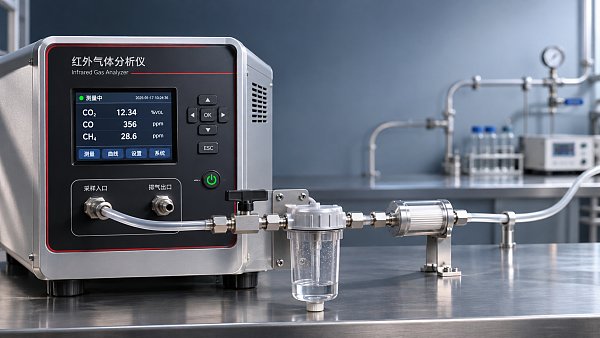
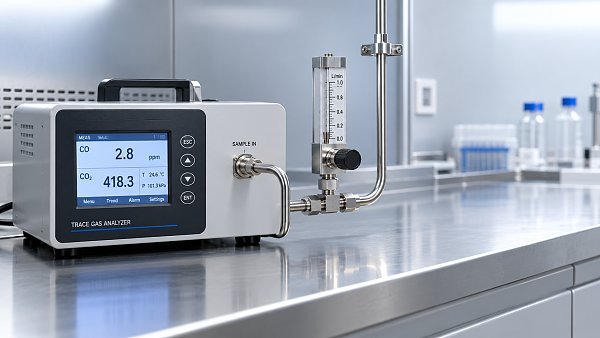
The sample path deserves the same scrutiny as the analyzer. Define where the sample enters the system, how pressure and temperature change along the path, where conditioning occurs, and how the sample is returned or disposed of. The design must deliver gas representative of the pipeline while staying within the analyzer’s inlet requirements.
Pressure reduction and cooling can cause heavier hydrocarbons or water to condense. The resulting vapor may no longer represent the original pipeline gas, affecting calculated energy properties or contaminant readings. Heated lines, regulators or enclosures may be appropriate, but their design must account for the expected composition, pressure and ambient conditions. Simply heating every component is not a substitute for a sample-system review.
Filters and separators also involve trade-offs. They can protect equipment from liquid and particles, yet may remove material relevant to the measurement or introduce delays and contamination. For trace measurements, tubing materials, dead volumes and previous exposure can affect how quickly the sample path reflects a concentration change. Ask the supplier to explain these effects for the specific target and concentration range.
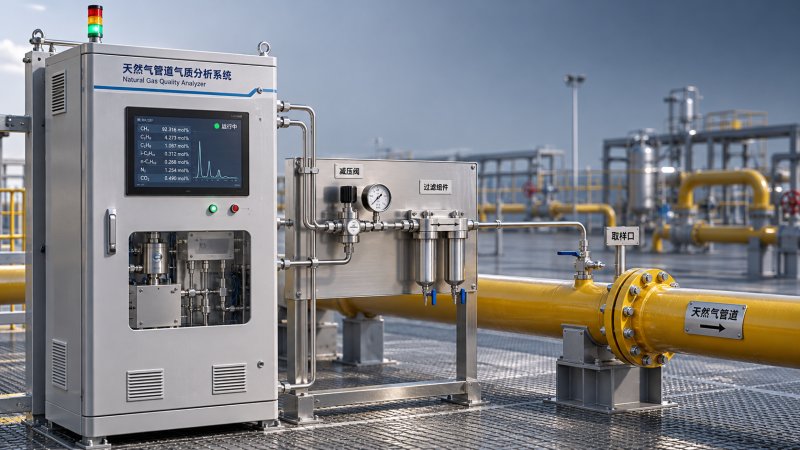
Response time should be assessed from the pipeline takeoff to the usable output. It includes transport through the sample line, conditioning, the analyzer’s measurement cycle and communication to the control system. A fast detector at the end of a long, low-flow sample line may still report a change too late for the intended action. Request an estimate for the proposed installation, including the assumptions behind sample flow and line length.
Compare performance at the decision limit
Do not rank bids using a single accuracy figure. Review the stated performance for each required component or calculated property at the concentrations that matter. Detection limit, repeatability, measurement uncertainty and range describe different aspects of performance; a low detection limit alone does not establish whether readings close to a contractual threshold are reliable enough to support acceptance or rejection.
For calculated properties, ask how component measurement uncertainty, calibration and the calculation method affect the reported result. An analyzer may meet its individual component specifications while the combined uncertainty is unsuitable for the commercial decision. The required uncertainty and treatment of disputed results should follow the applicable contract and metering arrangements.
Also consider what happens near a limit. If gas quality varies around an alarm or acceptance threshold, measurement uncertainty and update delay can affect how often operators intervene. Agree on the alarm logic, validation rules and operational response with the relevant engineering and commercial teams; an analyzer specification cannot make those decisions on its own.
Calibration is part of that assessment. Establish which reference gases are required, whether they cover the expected composition and concentration range, how they are introduced, and how often checks or adjustments are expected. For trace contaminants, consider reference gas stability and compatibility with the sample path. Ask how the system identifies an expired calibration, failed validation or suspect result, and whether it continues to transmit a value with an appropriate quality flag.
Check installation and operating obligations before selecting a bid
The proposed system must fit the site’s electrical classification and the jurisdiction in which it will operate. Where applicable, review hazardous-area certification for the actual equipment configuration, including the enclosure, heaters and associated electrical components. ATEX or IECEx documentation may be relevant depending on the location and project requirements. Certification of an individual instrument does not automatically establish suitability of a complete assembled system.
Review the practical interfaces at the same time: available utilities, environmental limits, sample and vent connections, communications, time stamps and the way invalid results are presented to the control or metering system. If results support custody transfer, determine which approvals, standards and audit records the governing agreement and local rules require. A technically capable analyzer may still be unsuitable if its configuration or data handling cannot satisfy those obligations.
Maintenance requirements can change the cost and availability of the measurement. Compare calibration gases, consumables, planned service, technician access, diagnostics and expected downtime. Ask what happens when a detector, sample pump or communications link fails: whether the system alarms, how long recovery takes, and what value the receiving system uses while valid data is absent. Where continuity is essential, assess whether an alternative measurement or operating procedure is needed.
Before making the final comparison, give each supplier the same gas composition envelope, measurement limits, site conditions and response requirements. Request a complete sample-system design, a component-by-component performance statement, calibration and maintenance requirements, and a description of exceptions to the specification. The preferred offer is the one that can support the required pipeline decision across the expected operating range, with assumptions and responsibilities clear enough to be tested during commissioning.
Recommended for You
 How to choose a gas quality analyzer for natural gas pipelinesChoose the right gas quality analyzer for natural gas pipelines. Compare technologies, sampling systems and performance to support reliable decisions.
 How does pressure affect laser oxygen analyzer readings?Laser oxygen analyzer readings can shift with pressure. Learn how compensation, sample conditions and calibration affect accuracy—and how to troubleshoot changes.
 How to identify regulatory compliance requirements for your businessRegulatory Compliance starts with knowing which rules apply. Learn how to assess obligations, document decisions, and build effective controls for your business.
 How to choose industrial air monitors for workplace VOCsChoose industrial air monitors for workplace VOCs with confidence. Compare sensor technologies, placement, calibration, and safety requirements.
 Laser vs infrared gas analyzers for stack monitoring: Which handles water vapor interference better?Laser vs infrared gas analyzer stack monitoring: Discover which technology better handles water vapor interference and how to choose for your application.
 Can an air detector identify carbon monoxide indoors?Can an air detector identify carbon monoxide indoors? Learn which sensors detect CO, how to check device specifications, and why a certified alarm matters.
 How does a paramagnetic gas analyzer measure oxygen?Discover how a paramagnetic gas analyzer measures oxygen, what affects accuracy, and how to choose the right solution for your application.
 How to choose a reliable gas analyzer for low concentrationsChoose a reliable gas analyzer for low concentrations. Compare technologies, sampling, calibration and supplier evidence to make a confident purchase.
 How does cross-sensitivity affect multi gas analysis accuracy?Discover how cross-sensitivity affects multi gas analysis accuracy, and learn how to identify interference, validate compensation, and improve measurement reliability.
 How to choose metrics for sustainable monitoringSustainable Monitoring starts with metrics that drive action. Learn how to define boundaries, assess data quality, and track meaningful improvements.
 How to verify a trusted manufacturer's production capacityTrusted Manufacturer capacity claims need proof. Learn how to verify production plans, bottlenecks, quality records and supply risks before you place an order.
 How to choose an emission controller for an industrial boilerChoose the right emission controller for your industrial boiler. Compare technologies, operating conditions, compliance needs, and costs.
 How to choose composition analyzers for low-concentration measurementsChoose composition analyzers with confidence. Discover how quantification limits, sample handling and matrix effects shape reliable low-concentration measurements.
 How does online analysis compare with laboratory testing for water quality monitoring?Online analysis vs. laboratory testing: compare speed, accuracy, costs, and compliance to find the right water quality monitoring strategy.
 How to choose the right detection range for a custom gas analyzerChoose the right custom gas analyzer detection range with practical guidance on accuracy, exposure limits, calibration, and supplier evaluation.
 How does multi component monitoring detect gases in stack emissions?Discover how multi component monitoring detects stack gases, manages interference and supports reliable emissions reporting. Explore key CEMS selection factors.
 How bright should an industrial monitor be for outdoor use?Choosing an outdoor industrial monitor? Learn why 1,000 nits is a starting point and how glare, contrast, and heat affect sunlight readability.
 How does water vapor affect infrared gas analyzers?Infrared gas analyzers can be affected by humidity, condensation and spectral interference. Learn how to protect sample integrity and achieve reliable results.
 How to reduce customer support response timesReduce Customer Support response times with actionable tips for reporting equipment faults, choosing the right channel, and getting expert help faster.
 How to choose a low range analyzer for trace-level measurementsChoose the right low range analyzer for trace-level measurements. Compare detection limits, sampling, calibration and support to make a confident decision.
 How to choose combustible gas detectors for a specific gasChoose combustible gas detectors with confidence. Compare sensor technologies, gas response, calibration, placement, and certification for your application.
 How to choose an air quality analyzer for the pollutants you need to measureChoose an air quality analyzer with confidence. Compare pollutant measurement methods, sampling, accuracy and calibration to find the right fit for your needs.
 How to choose industrial metrology tools for tight tolerancesChoose industrial metrology tools for tight tolerances with confidence. Compare uncertainty, calibration, tool types, and costs to reduce inspection risk.
 How moisture affects fixed analyzer accuracy in stack gas monitoringImprove fixed analyzer accuracy in stack gas monitoring. Discover how moisture causes dilution, interference, and sample loss—and learn practical ways to protect emissions data.
 How does production line speed affect in-line measurement accuracy?Discover how production line speed affects in-line measurement accuracy. Explore sensor response, sampling, and timing to boost throughput without compromising quality.
 How condensation affects HCl concentration analyzer accuracyHCl concentration analyzer accuracy can suffer when condensation traps HCl. Learn how to spot sampling losses, prevent low readings, and improve measurement reliability.
 How does cross-interference affect multi-component gas analyzers?How does cross-interference affect multi component gas analyzers? Explore measurement errors, compensation limits, and validation tips to choose the right system for your process.
 How does temperature affect high-accuracy sensor performance?Explore how temperature affects high accuracy sensor performance. Learn to reduce thermal drift, evaluate compensation, and select the right sensor for reliable measurements.
 Can a C4H8O concentration analyzer distinguish between isomers?Can a C4H8O concentration analyzer distinguish isomers? Compare GC, FTIR and MS methods, uncover selectivity limits, and learn what to validate before choosing your instrument.
 How to identify a reliable supplier using on-time delivery recordsIdentify a Reliable Supplier by verifying on-time delivery records, original commitments, and complete shipments. Learn practical checks to reduce purchasing risk and protect your project schedule.
 How sensitive should a portable hydrogen analyzer be for lab use?Choose a portable hydrogen analyzer for laboratory use with the right quantification limit, accuracy, and range. Learn how to verify performance and avoid costly buying mistakes.
 How to set industrial calibration intervals based on equipment riskSet industrial calibration intervals based on equipment risk, drift, and as-found data. Learn when to shorten or extend schedules to improve reliability and avoid unnecessary costs.


Search Categories
Search Categories
- Smart Meters & Power Quality
- Transformer Gas Analyzers
- BESS Thermal Runaway Detectors
- Energy, Power & Smart Grid Monitoring
- Optical Profilers & CMM
- Ultrasonic & X-Ray NDT
- Calibration Standards
- Precision Metrology & NDT
- Water Quality Analyzers
- CEMS & VOCs Monitors
- Price Trends
- Import & Export Updates
- Market Trends
- Industry News
- Industry Insights
Latest Article
- How to choose a gas quality analyzer for natural gas pipelinesChoose the right gas quality analyzer for natural gas pipelines. Compare technologies, sampling systems and performance to support reliable decisions.Posted by:
- How does pressure affect laser oxygen analyzer readings?Laser oxygen analyzer readings can shift with pressure. Learn how compensation, sample conditions and calibration affect accuracy—and how to troubleshoot changes.Posted by:
- How to identify regulatory compliance requirements for your businessRegulatory Compliance starts with knowing which rules apply. Learn how to assess obligations, document decisions, and build effective controls for your business.Posted by:
Please give us a message