
How does pressure affect laser oxygen analyzer readings?


Pressure can change a laser oxygen analyzer reading even when the oxygen mole fraction remains constant. Higher absolute pressure increases oxygen number density and changes the shape of its absorption line; lower pressure has the opposite effects. A well-designed analyzer accounts for these changes, but compensation is only valid within its specified pressure, temperature and gas-composition ranges.
Consider an analyzer monitoring a process during a pressure ramp: an apparent oxygen shift may reflect a real composition change, an uncompensated optical effect, or a change in the sample reaching the instrument. The first task is to identify the pressure at the optical measurement path and establish whether the reported value is oxygen concentration, partial pressure or another quantity.
Pressure changes both the signal and the line shape
Most industrial laser oxygen instruments use tunable diode laser absorption spectroscopy (TDLAS). A laser scans an oxygen absorption feature, and the instrument derives oxygen content from the absorption signature over a known optical path. The exact signal processing differs: some systems fit the spectral line, while others use wavelength modulation or related techniques. Consequently, pressure sensitivity cannot be inferred from a single generic correction factor.
For an ideal gas, oxygen partial pressure is the oxygen mole fraction multiplied by the absolute total pressure: pO2 = xO2 × P. At fixed temperature, increasing total pressure at constant mole fraction also increases the number of oxygen molecules per unit volume. In an idealized, optically thin measurement using integrated absorbance, total absorption over the line is proportional to oxygen number density and path length. An analyzer reporting mole fraction must therefore account for pressure and temperature, directly or through a validated calibration model.
Pressure also affects collisions between gas molecules. These collisions broaden the absorption line: the feature generally becomes wider as pressure increases. Its peak height does not necessarily rise in proportion to pressure, even though the integrated absorption may increase. A system that measures a line peak or a modulation signal can therefore respond differently from one that fits the complete line. Pressure broadening can also increase overlap with nearby absorption features, depending on the selected wavelength and gas mixture.
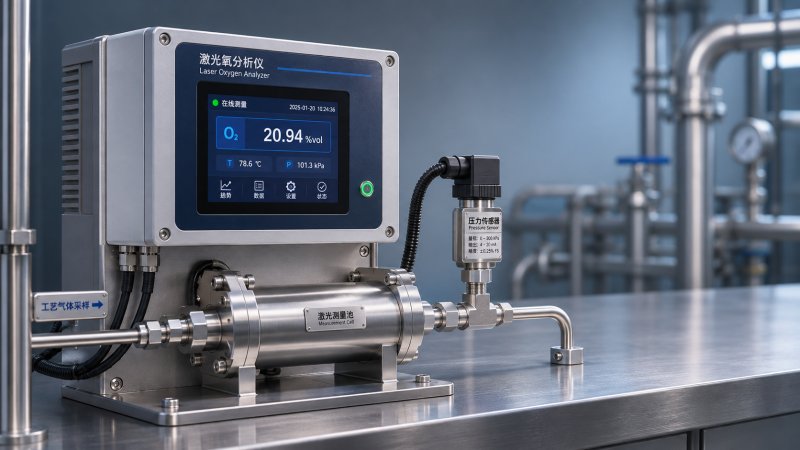
The distinction matters when reviewing a specification. “Pressure compensated” does not by itself explain which physical effects are corrected, which pressure is measured, or how residual error changes at the ends of the operating range. Ask for the applicable performance limits under the actual gas and pressure conditions.
Start with the reported quantity
A reading can change for a valid physical reason rather than because the analyzer is drifting. For example, if the oxygen mole fraction stays constant while absolute pressure rises, oxygen partial pressure rises proportionally. A display configured to report partial pressure should reflect that change; a correctly compensated mole-fraction display should ideally remain stable, assuming temperature, composition and other relevant conditions are unchanged.
Use absolute pressure in the partial-pressure relationship. Gauge pressure is relative to local atmospheric pressure, so it cannot be substituted without conversion. This is especially consequential near atmospheric pressure or under vacuum. Also verify the scaling of ppm and percent, the displayed units, and whether a control system applies a separate conversion after receiving the analyzer signal.
The pressure that matters is at the optical path
For an in-situ installation, the relevant pressure is normally the gas pressure across the optical measurement path. A transmitter mounted elsewhere on a vessel or duct may not represent that pressure during rapid changes, significant flow or a restriction. The pressure signal must also reach the analyzer in the units, range and update format expected by its compensation algorithm.
In an extractive system, process pressure and cell pressure can be substantially different. A regulator, pump, flow restriction, filter or blocked line may change the pressure at the measurement cell. A stable process-pressure indication therefore does not prove that the analyzer is operating at a stable cell pressure. Conversely, a process pressure change may have little direct optical effect if the sample system maintains cell pressure within its validated range.
Review pressure together with sample flow. A restriction can alter residence time or introduce pressure fluctuations, making a reading appear to lag or oscillate. A leak on the low-pressure side can admit ambient air; a leak elsewhere can lose sample or affect flow. Either can change the oxygen concentration reaching the cell, which is a different problem from incorrect pressure compensation. Follow the site’s approved leak-check procedure and account for the hazards of the sample gas.
Dynamic pressure is a separate test condition
A pressure-compensation function that works at steady state may leave a transient error during a fast ramp. Pressure measurement, gas transport, spectral acquisition and signal filtering do not necessarily have the same response time. If the pressure value used for correction represents an earlier state than the optical measurement, a temporary mismatch can appear even when both sensors are individually accurate.
Ask the supplier to define the allowable pressure rate of change, if specified, and the response time and filtering applied to the pressure input. Where rapid pressure changes matter to process decisions, evaluate synchronized trends rather than comparing isolated display values.
Calibration must match the measurement conditions
A calibration performed at one pressure does not automatically establish accuracy across the full operating envelope. The analyzer may apply a pressure-dependent spectral model, use a pressure sensor and temperature input, or rely on calibration and validation at specified conditions. Determine which approach is used and whether the stated accuracy includes residual pressure-compensation error.
When planning a comparison or calibration, record the oxygen reference value, gas matrix, temperature, absolute pressure at the optical cell and the analyzer’s wet- or dry-basis setting. A reference gas certified for mole fraction is not a fixed partial-pressure reference when total pressure changes. Equally, comparing an analyzer on a wet basis with a dry reference can create an apparent discrepancy unrelated to the optical pressure correction.
Water vapor deserves particular attention. Adding or removing water changes the dry-gas mole fractions relative to the wet mixture, while condensation can alter the sample and damage or obstruct components. Pressure reduction can also influence the sample’s condensation behavior. Keep the sample within the conditioning system’s specified operating conditions and document where drying, if any, occurs.
The balance gas matters as well. Oxygen lines can broaden differently in different gas matrices, so a correction validated in air may not have the same uncertainty in a process gas with a substantially different composition. Interfering absorbers near the chosen oxygen line may create additional fitting errors. Request matrix-specific validation or an uncertainty statement where the process mixture differs materially from the calibration mixture.
Separate compensation error from a real sample change
When an oxygen trend tracks pressure, do not immediately adjust the span. An adjustment may hide the symptom at one pressure while worsening the result elsewhere. Use a controlled investigation that preserves the original configuration and records the conditions behind each reading:
- Confirm the measurement basis. Check whether the output is mole fraction or partial pressure, the pressure units and reference, and the wet/dry setting. Compare the analyzer display with the value received by the control system.
- Locate the actual pressure measurement. Identify the optical cell or path pressure, the sensor used for compensation, and any regulator or restriction between that point and the process. Check sensor range, calibration status and signal scaling.
- Review simultaneous trends. Compare oxygen, cell pressure, temperature, sample flow and analyzer diagnostics. A shift occurring only during pressure transitions suggests a different investigation from a stable offset at each pressure.
- Check the sample system. Look for pressure-control instability, filter loading, leaks, condensation and changes in flow or transport delay. Use approved procedures appropriate to the process gas.
- Test at representative stable pressures. Where safe and permitted, introduce a suitable reference mixture at the measurement path and compare the indicated result at multiple pressures within the specified range. Allow readings to stabilize and record temperature and gas composition.
- Compare with the stated specification. Assess the observed change against the applicable uncertainty and operating limits, not only against a single calibration point. Escalate unexplained deviations or invalid diagnostics before changing calibration parameters.
A reference-gas pressure test is most informative when it changes cell pressure without unintentionally changing the reference mixture reaching the cell. The arrangement must also avoid exceeding cell, regulator or tubing ratings. For an in-situ instrument, an equivalent check may require a manufacturer-approved verification method rather than introducing test gas into the process.
Specify evidence before accepting an analyzer for a variable-pressure duty
The operating-pressure range alone is not an accuracy claim. A cell may be mechanically rated for a pressure at which the instrument’s stated measurement performance does not apply. Obtain separate limits for mechanical design, optical measurement, pressure compensation and any sample-conditioning components.
A useful technical evaluation should establish:
- The specified accuracy or uncertainty across the required oxygen range, absolute pressure range and temperature range, including any exclusions or reference conditions.
- Whether pressure is measured internally or supplied externally, and whether transmitter error, calibration and response time are included in the stated performance.
- The validated gas matrices, water-vapor limits and known spectral interferences, particularly when calibration gas and process gas differ.
- The location and operating range of the measurement cell for an extractive system, including the effect of regulator failure, flow changes and pressure loss.
- The treatment of invalid, out-of-range or missing pressure inputs: for example, whether the analyzer alarms, flags the result or continues using a substitute value.
- The evidence available for steady-state and, where relevant, transient performance over the intended pressure envelope.
For a control or protective application, agree on how an invalid compensation input is communicated to the receiving system and how the installation responds. A plausible oxygen number is not sufficient evidence of a valid measurement when the pressure used to calculate it is unavailable, incorrectly scaled or outside the analyzer’s validated range.
Recommended for You
 How does pressure affect laser oxygen analyzer readings?Laser oxygen analyzer readings can shift with pressure. Learn how compensation, sample conditions and calibration affect accuracy—and how to troubleshoot changes.
 How to identify regulatory compliance requirements for your businessRegulatory Compliance starts with knowing which rules apply. Learn how to assess obligations, document decisions, and build effective controls for your business.
 How to choose industrial air monitors for workplace VOCsChoose industrial air monitors for workplace VOCs with confidence. Compare sensor technologies, placement, calibration, and safety requirements.
 Laser vs infrared gas analyzers for stack monitoring: Which handles water vapor interference better?Laser vs infrared gas analyzer stack monitoring: Discover which technology better handles water vapor interference and how to choose for your application.
 Can an air detector identify carbon monoxide indoors?Can an air detector identify carbon monoxide indoors? Learn which sensors detect CO, how to check device specifications, and why a certified alarm matters.
 How does a paramagnetic gas analyzer measure oxygen?Discover how a paramagnetic gas analyzer measures oxygen, what affects accuracy, and how to choose the right solution for your application.
 How to choose a reliable gas analyzer for low concentrationsChoose a reliable gas analyzer for low concentrations. Compare technologies, sampling, calibration and supplier evidence to make a confident purchase.
 How does cross-sensitivity affect multi gas analysis accuracy?Discover how cross-sensitivity affects multi gas analysis accuracy, and learn how to identify interference, validate compensation, and improve measurement reliability.
 How to choose metrics for sustainable monitoringSustainable Monitoring starts with metrics that drive action. Learn how to define boundaries, assess data quality, and track meaningful improvements.
 How to verify a trusted manufacturer's production capacityTrusted Manufacturer capacity claims need proof. Learn how to verify production plans, bottlenecks, quality records and supply risks before you place an order.
 How to choose an emission controller for an industrial boilerChoose the right emission controller for your industrial boiler. Compare technologies, operating conditions, compliance needs, and costs.
 How to choose composition analyzers for low-concentration measurementsChoose composition analyzers with confidence. Discover how quantification limits, sample handling and matrix effects shape reliable low-concentration measurements.
 How does online analysis compare with laboratory testing for water quality monitoring?Online analysis vs. laboratory testing: compare speed, accuracy, costs, and compliance to find the right water quality monitoring strategy.
 How to choose the right detection range for a custom gas analyzerChoose the right custom gas analyzer detection range with practical guidance on accuracy, exposure limits, calibration, and supplier evaluation.
 How does multi component monitoring detect gases in stack emissions?Discover how multi component monitoring detects stack gases, manages interference and supports reliable emissions reporting. Explore key CEMS selection factors.
 How bright should an industrial monitor be for outdoor use?Choosing an outdoor industrial monitor? Learn why 1,000 nits is a starting point and how glare, contrast, and heat affect sunlight readability.
 How does water vapor affect infrared gas analyzers?Infrared gas analyzers can be affected by humidity, condensation and spectral interference. Learn how to protect sample integrity and achieve reliable results.
 How to reduce customer support response timesReduce Customer Support response times with actionable tips for reporting equipment faults, choosing the right channel, and getting expert help faster.
 How to choose a low range analyzer for trace-level measurementsChoose the right low range analyzer for trace-level measurements. Compare detection limits, sampling, calibration and support to make a confident decision.
 How to choose combustible gas detectors for a specific gasChoose combustible gas detectors with confidence. Compare sensor technologies, gas response, calibration, placement, and certification for your application.
 How to choose an air quality analyzer for the pollutants you need to measureChoose an air quality analyzer with confidence. Compare pollutant measurement methods, sampling, accuracy and calibration to find the right fit for your needs.
 How to choose industrial metrology tools for tight tolerancesChoose industrial metrology tools for tight tolerances with confidence. Compare uncertainty, calibration, tool types, and costs to reduce inspection risk.
 How moisture affects fixed analyzer accuracy in stack gas monitoringImprove fixed analyzer accuracy in stack gas monitoring. Discover how moisture causes dilution, interference, and sample loss—and learn practical ways to protect emissions data.
 How does production line speed affect in-line measurement accuracy?Discover how production line speed affects in-line measurement accuracy. Explore sensor response, sampling, and timing to boost throughput without compromising quality.
 How condensation affects HCl concentration analyzer accuracyHCl concentration analyzer accuracy can suffer when condensation traps HCl. Learn how to spot sampling losses, prevent low readings, and improve measurement reliability.
 How does cross-interference affect multi-component gas analyzers?How does cross-interference affect multi component gas analyzers? Explore measurement errors, compensation limits, and validation tips to choose the right system for your process.
 How does temperature affect high-accuracy sensor performance?Explore how temperature affects high accuracy sensor performance. Learn to reduce thermal drift, evaluate compensation, and select the right sensor for reliable measurements.
 Can a C4H8O concentration analyzer distinguish between isomers?Can a C4H8O concentration analyzer distinguish isomers? Compare GC, FTIR and MS methods, uncover selectivity limits, and learn what to validate before choosing your instrument.
 How to identify a reliable supplier using on-time delivery recordsIdentify a Reliable Supplier by verifying on-time delivery records, original commitments, and complete shipments. Learn practical checks to reduce purchasing risk and protect your project schedule.
 How sensitive should a portable hydrogen analyzer be for lab use?Choose a portable hydrogen analyzer for laboratory use with the right quantification limit, accuracy, and range. Learn how to verify performance and avoid costly buying mistakes.
 How to set industrial calibration intervals based on equipment riskSet industrial calibration intervals based on equipment risk, drift, and as-found data. Learn when to shorten or extend schedules to improve reliability and avoid unnecessary costs.
 How to choose electrochemical analyzers for low-current measurementsCompare electrochemical analyzers for precise low-current measurements. Learn how noise, leakage, bandwidth, and real-cell testing help you choose the right instrument.

Search Categories
Search Categories
- Smart Meters & Power Quality
- Transformer Gas Analyzers
- BESS Thermal Runaway Detectors
- Energy, Power & Smart Grid Monitoring
- Optical Profilers & CMM
- Ultrasonic & X-Ray NDT
- Calibration Standards
- Precision Metrology & NDT
- Water Quality Analyzers
- CEMS & VOCs Monitors
- Price Trends
- Import & Export Updates
- Market Trends
- Industry News
- Industry Insights
Latest Article
- How does pressure affect laser oxygen analyzer readings?Laser oxygen analyzer readings can shift with pressure. Learn how compensation, sample conditions and calibration affect accuracy—and how to troubleshoot changes.Posted by:
- How to identify regulatory compliance requirements for your businessRegulatory Compliance starts with knowing which rules apply. Learn how to assess obligations, document decisions, and build effective controls for your business.Posted by:
- How to choose industrial air monitors for workplace VOCsChoose industrial air monitors for workplace VOCs with confidence. Compare sensor technologies, placement, calibration, and safety requirements.Posted by:
Please give us a message
