How does cross-sensitivity affect multi gas analysis accuracy?


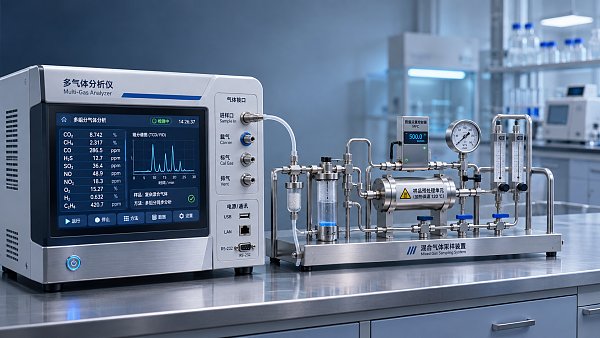
Cross-sensitivity affects multi gas analysis accuracy when a substance in the sample produces a response that the analyzer attributes, wholly or partly, to another gas. The reported concentration can be too high or too low, and the size of the error may change as the mixture changes. A sensor that performs well with a clean calibration gas can therefore give a misleading result in a process stream containing several reactive or optically active compounds.
Whether the effect matters depends on the interfering gas, its concentration relative to the target, the measurement principle and the decision based on the reading. A modest bias may be tolerable for a broad process trend but unacceptable near an alarm threshold or an emissions limit. For technical evaluators, the central question is how the complete analyzer performs across the mixtures and conditions it is expected to encounter.
How interference changes the reported concentration
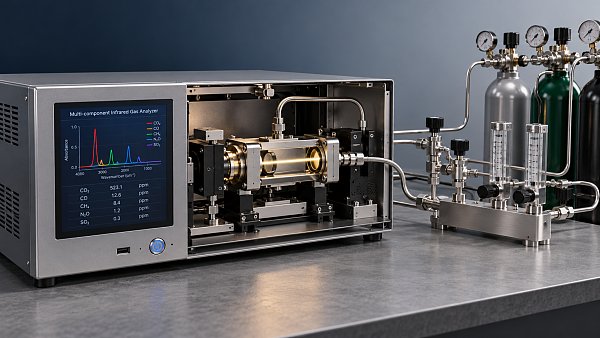
Gas analyzers infer concentration from a physical or chemical response. Electrochemical sensors generate a signal through reactions at electrodes; infrared instruments measure absorption at selected wavelengths; other systems use different responses or separate components before detection. Each method has a range of substances and conditions that can influence its signal.
For an electrochemical sensor, an interfering gas may participate in an electrode reaction and produce a signal resembling that of the target. Depending on the sensor design and the interfering species, the response may add to or subtract from the target response. In infrared analysis, absorption features of different gases can overlap within the wavelengths used by the instrument. Optical design, spectral resolution and the analysis algorithm determine how well the system can distinguish them.
Consider a carbon monoxide channel exposed to a mixture that also contains hydrogen. Some carbon monoxide electrochemical sensors respond to hydrogen, so a reported carbon monoxide value may include a hydrogen contribution. The direction and magnitude depend on the particular sensor and its compensation design; they cannot be inferred reliably from the gas names alone. A manufacturer’s interference table is a useful starting point, provided it applies to the installed sensor, firmware and operating conditions.
For a simplified illustration, suppose a sensor’s documented response to a particular interferent is equivalent to 10 units of target gas for every 100 units of interferent, at the stated test conditions. If the sample contains 200 units of that interferent, the approximate contribution would be 20 units of target-equivalent signal, assuming a linear response in that range. An indicated value of 50 units could then include a substantial interference component. This arithmetic is illustrative: real responses can be nonlinear, mixture-dependent or affected by environmental conditions.

Interference is especially consequential when the target concentration is small compared with the interferent concentration. Even a low relative response to a major component can be large compared with a trace target. The reverse can also matter: a negative interference can conceal an increase in the target gas, making an apparently stable reading less reassuring than it looks.
Why multi-gas readings do not automatically resolve the problem
An instrument with several gas channels can use one measurement to help correct another, but the presence of several channels does not itself guarantee accurate separation. Each channel may respond to more than one component. The instrument must have enough independent information, and a suitable model of those responses, to estimate the concentrations of interest.
In a simplified linear model, each channel’s output is the sum of contributions from the gases to which it responds. If two gases produce nearly indistinguishable response patterns across the available channels, the calculation becomes sensitive to small errors. Noise, drift or an imperfect interference coefficient can then cause a large error in the estimated concentrations. Adding a sensor helps only if its response provides useful independent information under the relevant conditions.
Compensation also relies on knowing what is present. An algorithm may correct for a measured interferent while leaving an unmeasured solvent vapor or process byproduct unaccounted for. If that unmeasured compound varies with production, the residual error can look like a change in the target gas.
Optical analyzers face a related problem when spectral features overlap. A wider spectral measurement and a suitable reference library can improve component discrimination, but the result still depends on spectral resolution, the model and the actual composition. For a complex mixture, a separation-based technique such as gas chromatography may be appropriate when it provides adequate separation and a suitable detection limit. It introduces its own considerations, including cycle time, sample handling and separation performance.
Conditions that make cross-sensitivity harder to predict
Published interference values are often measured for a specified gas concentration, temperature, humidity and sensor configuration. They should not automatically be treated as fixed correction factors for every installation. An evaluator should look for the test conditions and the range over which the manufacturer supports a correction.
Several conditions deserve attention when comparing a specification with the intended sample:
- Composition and concentration: Interference may change outside the tested range, and a mixture can behave differently from a series of single-gas tests. Upsets, startup and cleaning cycles can introduce compounds absent during normal operation.
- Humidity and temperature: These can alter sensor response or optical measurements directly and can also affect the response to an interfering gas. A correction established in a dry test may not represent a wet sample.
- Oxygen and background gas: Some sensing reactions depend on oxygen availability, while the balance gas can affect physical properties relevant to other measurement methods. The calibration matrix should be considered alongside the target concentration.
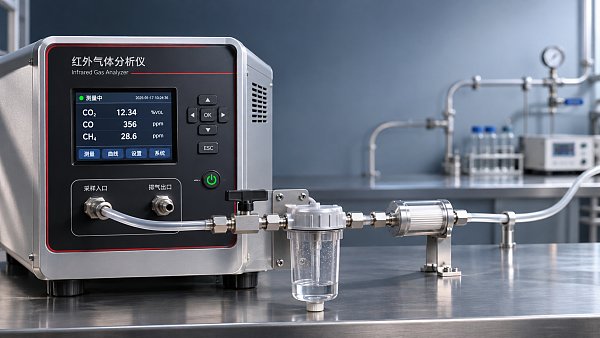
- Sample conditioning: Filters, dryers, heated lines and condensate handling can remove, delay or alter target gases and interferents. A sensor may receive a different mixture from the one at the sample point.
- Sensor condition: Aging, contamination or exposure to reactive compounds can change sensitivity over time. A correction that worked for a new sensor may become less accurate as its responses change.
These effects can be difficult to distinguish from cross-sensitivity in a field reading. For example, condensation that removes a soluble target gas can produce a low result, while an interfering gas may push the sensor signal high. The combined reading could appear plausible even though both effects are present. Evaluating the sensor alone will not reveal errors introduced upstream in the sample system.
What a defensible interference test should show
A useful evaluation starts with the intended measurement decision: the target gases, expected ranges, reporting units, response time and concentration at which a result changes an operational action. From there, define the sample envelope, including routine composition and credible excursions. This gives the test a practical purpose: determining whether interference can move the result far enough to affect that decision.
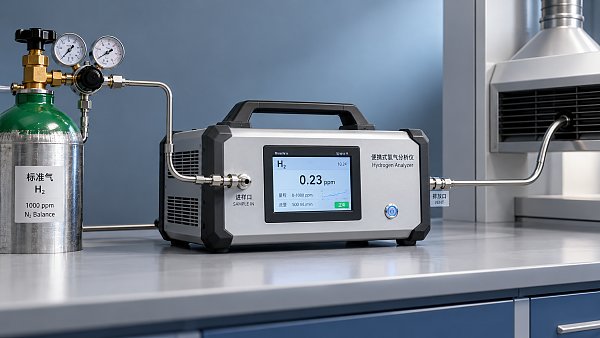
Start with a baseline measurement using a suitable target-gas standard in a known matrix. Then introduce individual suspected interferents at relevant concentrations, both without the target and with the target present. The first condition helps reveal an apparent target signal caused by the interferent; the second shows whether the target response changes in its presence. Include concentrations near the low end of the target range and near any decision threshold, where the same absolute bias may have different consequences.
Individual-gas tests are not enough when several interferents can occur together. Test representative mixtures through the complete sampling and conditioning system, allowing for the analyzer’s specified response and stabilization time. Where composition varies over a cycle, examine transitions as well as steady readings: channels and sample-system components may respond at different speeds, producing temporary errors that a steady-state correction does not address.
Compare the analyzer with a reference measurement whose uncertainty and selectivity are suitable for the decision. Record the composition, environmental conditions, flow, conditioning configuration, analyzer settings and sensor age or operating history. Repeat measurements over a relevant range to distinguish a consistent bias from variability. A single favorable point cannot establish performance across the operating envelope.
The result should be expressed in terms the user can apply: the observed bias and variability for the tested mixtures, the conditions under which compensation was enabled, and any mixtures or ranges where performance was inadequate. If the intended use is subject to a specific regulatory method or performance standard, the test plan and acceptance criteria must also match that applicable requirement. A general product accuracy figure or a laboratory calibration certificate alone does not establish fitness for every mixture.
Assessing compensation and managing residual error
Ask how each reported concentration is calculated. A clear technical response should identify which interferents are measured, which are assumed to be absent or constant, and whether compensation coefficients depend on temperature, humidity or concentration. It should also explain what happens when an input channel is out of range, unavailable or due for calibration. An apparently precise compensated value is less useful if the instrument gives no indication that an input used in the correction is unreliable.
Calibration addresses part of this problem but has limits. Zero and span checks can reveal drift and establish response to the calibration gas; they do not necessarily test the effect of an interferent absent from that gas. Where interference is material, include a representative mixture or a separate interference challenge in the verification program. The frequency should reflect sensor stability, exposure and the consequences of an incorrect result.
There are several ways to reduce the remaining error: choose a more selective sensing principle, remove an interferent with validated conditioning, add an independent measurement, or use a method that separates components before detection. Each option has a trade-off. A filter can also remove target gas or become exhausted; a second channel adds calibration and maintenance requirements; a separation method may be too slow for a fast alarm. Confirm that the chosen approach works at the required concentration and response time.
For safety-related applications, treat cross-sensitivity as part of the instrument and system assessment, including the direction of possible error and the consequences at the alarm setpoint. Follow the applicable site procedures, manufacturer instructions and relevant requirements for the intended use. A high false reading can disrupt operations, but a low reading can prevent an alarm from representing the hazard; both need to be considered when setting acceptance criteria.
The most informative specification is therefore one tied to a defined mixture and operating range. If the expected interferents cannot be identified or controlled, the uncertainty of the reported target concentration should remain part of the decision. Where that uncertainty is too large at the point of action, the measurement method or the sampling arrangement needs to change before the reading can be relied upon.
Recommended for You
 How does cross-sensitivity affect multi gas analysis accuracy?Discover how cross-sensitivity affects multi gas analysis accuracy, and learn how to identify interference, validate compensation, and improve measurement reliability.
 How to choose metrics for sustainable monitoringSustainable Monitoring starts with metrics that drive action. Learn how to define boundaries, assess data quality, and track meaningful improvements.
 How to verify a trusted manufacturer's production capacityTrusted Manufacturer capacity claims need proof. Learn how to verify production plans, bottlenecks, quality records and supply risks before you place an order.
 How to choose an emission controller for an industrial boilerChoose the right emission controller for your industrial boiler. Compare technologies, operating conditions, compliance needs, and costs.
 How to choose composition analyzers for low-concentration measurementsChoose composition analyzers with confidence. Discover how quantification limits, sample handling and matrix effects shape reliable low-concentration measurements.
 How does online analysis compare with laboratory testing for water quality monitoring?Online analysis vs. laboratory testing: compare speed, accuracy, costs, and compliance to find the right water quality monitoring strategy.
 How to choose the right detection range for a custom gas analyzerChoose the right custom gas analyzer detection range with practical guidance on accuracy, exposure limits, calibration, and supplier evaluation.
 How does multi component monitoring detect gases in stack emissions?Discover how multi component monitoring detects stack gases, manages interference and supports reliable emissions reporting. Explore key CEMS selection factors.
 How bright should an industrial monitor be for outdoor use?Choosing an outdoor industrial monitor? Learn why 1,000 nits is a starting point and how glare, contrast, and heat affect sunlight readability.
 How does water vapor affect infrared gas analyzers?Infrared gas analyzers can be affected by humidity, condensation and spectral interference. Learn how to protect sample integrity and achieve reliable results.
 How to reduce customer support response timesReduce Customer Support response times with actionable tips for reporting equipment faults, choosing the right channel, and getting expert help faster.
 How to choose a low range analyzer for trace-level measurementsChoose the right low range analyzer for trace-level measurements. Compare detection limits, sampling, calibration and support to make a confident decision.
 How to choose combustible gas detectors for a specific gasChoose combustible gas detectors with confidence. Compare sensor technologies, gas response, calibration, placement, and certification for your application.
 How to choose an air quality analyzer for the pollutants you need to measureChoose an air quality analyzer with confidence. Compare pollutant measurement methods, sampling, accuracy and calibration to find the right fit for your needs.
 How to choose industrial metrology tools for tight tolerancesChoose industrial metrology tools for tight tolerances with confidence. Compare uncertainty, calibration, tool types, and costs to reduce inspection risk.
 How moisture affects fixed analyzer accuracy in stack gas monitoringImprove fixed analyzer accuracy in stack gas monitoring. Discover how moisture causes dilution, interference, and sample loss—and learn practical ways to protect emissions data.
 How does production line speed affect in-line measurement accuracy?Discover how production line speed affects in-line measurement accuracy. Explore sensor response, sampling, and timing to boost throughput without compromising quality.
 How condensation affects HCl concentration analyzer accuracyHCl concentration analyzer accuracy can suffer when condensation traps HCl. Learn how to spot sampling losses, prevent low readings, and improve measurement reliability.
 How does cross-interference affect multi-component gas analyzers?How does cross-interference affect multi component gas analyzers? Explore measurement errors, compensation limits, and validation tips to choose the right system for your process.
 How does temperature affect high-accuracy sensor performance?Explore how temperature affects high accuracy sensor performance. Learn to reduce thermal drift, evaluate compensation, and select the right sensor for reliable measurements.
 Can a C4H8O concentration analyzer distinguish between isomers?Can a C4H8O concentration analyzer distinguish isomers? Compare GC, FTIR and MS methods, uncover selectivity limits, and learn what to validate before choosing your instrument.
 How to identify a reliable supplier using on-time delivery recordsIdentify a Reliable Supplier by verifying on-time delivery records, original commitments, and complete shipments. Learn practical checks to reduce purchasing risk and protect your project schedule.
 How sensitive should a portable hydrogen analyzer be for lab use?Choose a portable hydrogen analyzer for laboratory use with the right quantification limit, accuracy, and range. Learn how to verify performance and avoid costly buying mistakes.
 How to set industrial calibration intervals based on equipment riskSet industrial calibration intervals based on equipment risk, drift, and as-found data. Learn when to shorten or extend schedules to improve reliability and avoid unnecessary costs.
 How to choose electrochemical analyzers for low-current measurementsCompare electrochemical analyzers for precise low-current measurements. Learn how noise, leakage, bandwidth, and real-cell testing help you choose the right instrument.
 What tolerance does a custom gas mixture need for calibration?Choose the right custom gas tolerance for calibration. Learn how blending tolerance, certified uncertainty, and stability affect accuracy—and avoid paying for precision you don’t need.
 How condensation affects stack detector readings in wet flue gasStack detector readings can drift when wet flue gas condenses. Learn how to identify moisture interference, prevent sample losses, and improve emissions monitoring reliability.
 How to prevent condensation in a CO2 analyzer sampling systemPrevent condensation in your CO2 analyzer sampling system. Learn how to control dew point, eliminate cold spots, and manage moisture for reliable readings and fewer costly disruptions.
 How to verify accuracy claims for industrial quality analyzersVerify accuracy claims for industrial quality analyzers with calibration checks, independent testing, and clear acceptance criteria. Learn how to reduce risk and buy with confidence.
 How to calculate cooling loads for an industrial analyzer shelterSize industrial analyzer shelter cooling with confidence. Learn to calculate equipment heat, solar gains, and ventilation loads, then select HVAC capacity for reliable analyzer performance.
 Hydrogen Analyzers for Energy Storage: Purity Monitoring vs. Leak DetectionChoosing a hydrogen analyzer for energy storage systems? Compare purity monitoring and leak detection to select the right sensors, improve safety, and protect fuel cell performance.
 NH3 Monitoring in Fertilizer Plants: Where Should Leak Analyzers Be Installed?NH3 analyzer for fertilizer production: discover where to place leak detectors around storage, compressors, and loading areas to reduce blind spots and improve early warning.




Search Categories
Search Categories
- Smart Meters & Power Quality
- Transformer Gas Analyzers
- BESS Thermal Runaway Detectors
- Energy, Power & Smart Grid Monitoring
- Optical Profilers & CMM
- Ultrasonic & X-Ray NDT
- Calibration Standards
- Precision Metrology & NDT
- Water Quality Analyzers
- CEMS & VOCs Monitors
- Price Trends
- Import & Export Updates
- Market Trends
- Industry News
- Industry Insights
Latest Article
- How does cross-sensitivity affect multi gas analysis accuracy?Discover how cross-sensitivity affects multi gas analysis accuracy, and learn how to identify interference, validate compensation, and improve measurement reliability.Posted by:
- How to choose metrics for sustainable monitoringSustainable Monitoring starts with metrics that drive action. Learn how to define boundaries, assess data quality, and track meaningful improvements.Posted by:
- How to verify a trusted manufacturer's production capacityTrusted Manufacturer capacity claims need proof. Learn how to verify production plans, bottlenecks, quality records and supply risks before you place an order.Posted by:
Please give us a message