
Explosion Proof Monitor Checklist for Safer Site Deployment


Explosion Proof Monitor choices start with real site conditions
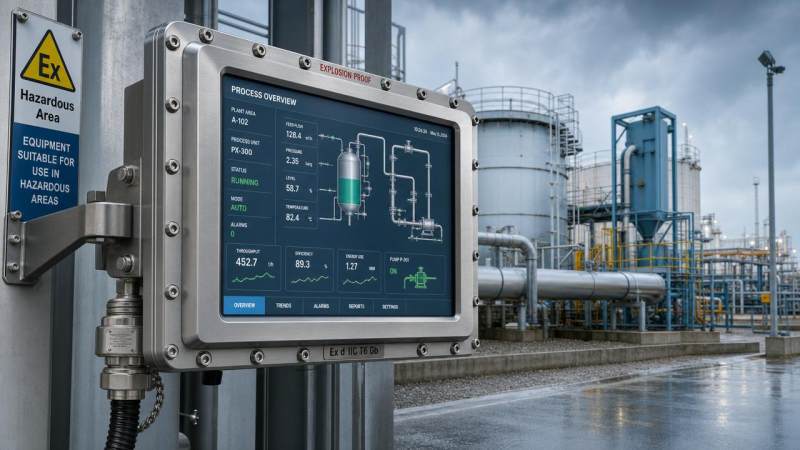
Selecting an explosion proof monitor is rarely a simple screen decision. In hazardous operations, the display becomes part of the safety chain, the inspection workflow, and the data visibility layer.
That is why a useful checklist must begin with deployment reality. A monitor installed near solvent tanks faces different pressures than one mounted in a dust-prone grain terminal.
The same explosion proof monitor may look acceptable on paper, yet fail the site once ingress risk, operator distance, glove use, heat load, or certification scope are reviewed.
Across industrial manufacturing, energy, environmental monitoring, laboratories, and construction interfaces, visibility matters because bad interpretation can become a process deviation, a delayed alarm, or an unsafe manual workaround.
This is also where GIH’s instrumentation perspective becomes relevant. In complex automation environments, display equipment should be judged as part of measurement integrity, compliance traceability, and long-term operating confidence.
Why one hazardous area does not behave like another
A common mistake is treating all hazardous sites as the same because they share ATEX or IECEx language. In practice, the hazard label is only the starting point.
Process plants with vapor exposure often care about enclosure integrity, thermal management, and readable process graphics under continuous operation. Dust-heavy facilities may worry more about sealing, cleaning frequency, and surface temperature control.
Outdoor utility yards introduce another layer. Sunlight glare, winter condensation, cable routing, and remote diagnostics can decide whether an explosion proof monitor remains useful after the first season.
More sensitive environments, including pilot laboratories or pharmaceutical support areas, usually focus on controlled cleaning, image clarity, documentation access, and compatibility with validated operating procedures.
The better judgment method is to map the monitor to the process risk, human interaction pattern, and maintenance exposure instead of relying on certification marks alone.
In process plants, visibility and heat management often matter more than expected
In chemical, petrochemical, and oil and gas settings, the explosion proof monitor often supports local HMI viewing, camera feeds, batch confirmation, or alarm interpretation.
Here, screen brightness is not a comfort feature. If operators must lean in to read process values, response time slows and unsafe proximity may increase.
Another overlooked point is internal heat behavior. A larger display with poor thermal design may comply in a catalog condition but struggle inside a hot process zone enclosure.
When reviewing an explosion proof monitor for these sites, it helps to confirm temperature class, mounting orientation limits, ventilation assumptions, and whether the unit remains readable during alarm-heavy screens.
A practical site test is better than a brochure comparison. Check the screen while wearing PPE, standing at normal working distance, and viewing the exact control graphics used in daily shifts.
Dust, bulk handling, and materials sites need a different checklist
Dust-classified areas often expose weak assumptions in monitor selection. Fine particles affect seals, cleaning intervals, cable glands, and even touchscreen usability over time.
In grain, mining, cement, and powder processing operations, the right explosion proof monitor should be judged for enclosure resistance, surface contamination tolerance, and maintenance access without frequent dismantling.
It is also worth checking whether the display will be used mainly for quick status checks or extended troubleshooting. Those two patterns can justify very different screen size and interface choices.
A monitor that performs well in a gas-classified skid may become inconvenient in dusty handling lines where wiping, vibration, and repeated starts are normal operating conditions.
Where demand shifts across site types
The differences are easier to manage when key site conditions are compared side by side before approval.
Outdoor energy and utility projects reward more careful planning
In smart grid stations, fuel terminals, renewable storage compounds, and remote pumping assets, an explosion proof monitor often serves as an operational checkpoint rather than a continuously attended screen.
That changes the review logic. Instead of focusing only on display specification, the better question is how quickly the unit can be diagnosed, serviced, and restored after exposure events.
For these projects, cable entry, corrosion resistance, spare part continuity, and network integration deserve early attention. A compliant unit with poor field support can become a weak link in critical infrastructure visibility.
GIH’s broader coverage of smart energy instrumentation points to the same lesson seen in sensor and analyzer deployments: environmental resilience only counts when it remains maintainable across long asset cycles.
Before installation, use a checklist that filters real risks
A high-quality explosion proof monitor checklist should narrow uncertainty, not just confirm specifications already printed on a datasheet.
- Confirm hazardous area classification, certification scope, and any local code interpretation affecting placement.
- Review display use case, including HMI viewing, camera monitoring, maintenance diagnostics, or document access.
- Check viewing distance, ambient light, PPE limitations, and whether touch interaction is realistic on site.
- Evaluate enclosure sealing, temperature rise, and cleaning method against actual contaminants.
- Inspect power, signal, mounting, and grounding compatibility with existing instrumentation architecture.
- Verify spare support, service intervals, and replacement path for the expected operating life.
This approach aligns well with how GIH evaluates instrumentation across process control and monitoring categories: operating context must be tested together with compliance evidence and lifecycle practicality.
Misjudgments that often appear late in deployment
One repeated error is choosing an explosion proof monitor by certification and screen size alone. That may satisfy paperwork while ignoring line-of-sight, glare, maintenance reach, or actual interface complexity.
Another issue is assuming similar hazardous areas share identical needs. A loading rack, an analyzer shelter, and a blending room may sit under related standards, yet demand very different mounting and interaction decisions.
Lifecycle cost is also easy to underestimate. If front glass replacement, seal inspection, or field recalibration forces repeated shutdown coordination, the monitor becomes more expensive than its initial price suggested.
Some sites overvalue high feature counts. In practice, a simpler explosion proof monitor with stable readability and easier maintenance may outperform a more advanced model that complicates service or user training.
Turn the checklist into a site-specific decision standard
The most effective next step is to convert the checklist into a repeatable review standard for each hazardous environment under consideration.
Start by separating sites by exposure type, operator behavior, and maintenance difficulty. Then compare each explosion proof monitor option against those conditions, not against generic benchmark claims.
Where uncertainty remains, ask for evidence that matches the application: thermal data, certification details, cleaning limits, network compatibility, and field service history.
That disciplined review usually leads to better deployment decisions, fewer installation surprises, and stronger confidence that visibility equipment supports both safety and process truth where it matters most.
For organizations following the kind of intelligence-led instrumentation practice promoted by GIH, the goal is not just to install an explosion proof monitor. It is to place the right monitor in the right hazardous context with clear evidence behind the choice.
Recommended for You
 How to judge whether a competitive price reflects real valueCompetitive Price: learn how to compare scope, compliance, performance, and lifecycle costs to identify real value, reduce risk, and make smarter purchasing decisions.
 When custom gas analysis is the right fit for complex process streamsCustom gas analysis for complex process streams: learn when tailored sampling, interference control, and reliable measurement design deliver confident decisions.
 When does a laser gas analyzer meet stack emissions monitoring needs?Laser gas analyzer for stack emissions: learn when it delivers fast, reliable data, how to assess installation risks, and what to verify for CEMS compliance.
 How to select a hazardous gas analyzer for confined spacesHazardous gas analyzer selection for confined spaces: compare sensors, sampling, certifications, alarms, and maintenance to protect workers and choose with confidence.
 When is a single gas analyzer sufficient for workplace safety monitoring?Discover when a single gas analyzer delivers reliable workplace safety monitoring, and learn the key limits, calibration needs, and risks that require broader detection.
 How to choose an ambient gas analyzer for low-level leak detectionAmbient gas analyzer selection for low-level leak detection: compare sensitivity, cross-sensitivity, sampling design, alarms, and calibration for reliable site performance.
 How to tell when an oxygen sensor needs replacementOxygen sensor replacement signs explained: learn how live data, fault codes, wiring checks, and exhaust inspections pinpoint the real issue before you buy.
 How laser gas analyzers improve combustion control in steel furnacesLaser gas analyzer for steel industry applications delivers fast in-situ O₂ and CO data to optimize furnace combustion, cut fuel waste, and improve steel heating stability.
 How to verify whether explosion proof equipment meets site requirementsExplosion proof equipment verification made practical: match zones, gas or dust groups, temperature classes, certificates, and installation conditions for confident compliance.
 How industrial gas analysis helps detect contamination before releaseIndustrial Gas Analysis helps detect moisture, oil, oxygen, and toxic contaminants before release—protecting processes, ensuring compliance, and reducing costly risks.
 When is electrochemistry detection the right choice for water analysis?Electrochemistry detection for water analysis: learn when fast, reliable monitoring of ions, chlorine, pH, and more delivers actionable results.
 How industrial standards reduce quality risks in supplier selectionIndustrial Standard guidance helps quality and safety managers reduce supplier risks, verify compliance, strengthen traceability, and build resilient instrumentation supply chains.
 When does a multi-component system reduce installation complexity?Multi component systems reduce installation complexity when they eliminate field interfaces, streamline commissioning, and provide proven compatibility. Learn how to assess total cost and supplier accountability.
 How to size an industrial control shelter for outdoor equipmentIndustrial control shelter sizing guide: optimize layout, HVAC, access, safety, and expansion space for reliable outdoor equipment operations.
 How flue analysis helps verify combustion efficiencyFlue analysis verifies combustion efficiency by assessing O2, CO, CO2, and stack temperature to identify excess air, incomplete combustion, and heat losses.
 How to select industrial gas detectors for confined spacesIndustrial gas detectors for confined spaces: learn how to match sensors, sampling methods, alarms, and certifications to real atmospheric hazards.
 When does a laser oxygen analyzer outperform zirconia sensors?Laser oxygen analyzer vs. zirconia sensors: compare speed, selectivity, maintenance, gas chemistry, and installation needs to choose the right oxygen measurement solution.
 How to select a percent range analyzer for process measurementsPercent range analyzer selection made practical: compare accuracy, sample systems, calibration, gas matrix, integration, and lifecycle cost for reliable process measurements.
 How explosion proof analysis verifies safe equipment for hazardous areasExplosion proof analysis verifies hazardous-area equipment by matching certifications, temperature ratings, installation details, and inspection controls for safer compliance.
 When does fixed gas detection need point sensors instead of open-path monitoring?Fixed gas detection: discover when point sensors outperform open-path monitoring for predictable leaks, enclosed zones, local alarms, and safer design decisions.
 How to choose industrial metrology systems for tight-tolerance partsIndustrial metrology guide for tight-tolerance parts: compare CMMs, optical scanners, gauges, uncertainty, workflow, and traceable inspection strategies.
 How process metrology reduces measurement variation in productionProcess metrology reduces production measurement variation by improving traceability, uncertainty control, calibration, and reliable quality decisions.
 How to select an industrial monitoring analyzer for harsh environmentsIndustrial monitoring analyzer selection for harsh environments: evaluate sampling, durability, hazardous-area compliance, accuracy, maintenance, and data reliability.
 How calibration intervals affect test and measurement equipment accuracyTest and measurement equipment calibration intervals directly affect accuracy, risk, compliance, and uptime. Learn how to set evidence-based schedules that protect critical decisions.
 When does process gas monitoring need continuous measurement?Process gas monitoring needs continuous measurement when rapid changes threaten safety, quality, compliance, or uptime. Learn how to specify reliable, actionable monitoring systems.
 How to prevent false alarms in power plant instrumentationPower plant instrumentation guide: prevent false alarms with reliable signal checks, smarter alarm settings, mode-based control, and actionable operator responses.
 How fixed gas detectors help prevent leaks in enclosed workspacesFixed gas detectors provide continuous leak monitoring in enclosed workspaces, enabling faster alarms, safer responses, and stronger protection for people and processes.
 How industrial gas analysis helps detect process contamination earlyIndustrial Gas Analysis helps detect oxygen, moisture, and hydrocarbon contamination early, enabling faster fault isolation, safer operations, and stronger process control.
 What drives environmental compliance continuous monitoring setup cost?Environmental compliance continuous monitoring setup cost: uncover hidden expenses, compare bids accurately, and build a reliable, audit-ready system.
 How to select gas analysis equipment for continuous emissions monitoringGas analysis equipment selection guide for reliable continuous emissions monitoring—compare technologies, sampling, calibration, compliance, and maintenance needs.
 What detection limit is needed for NH3 environmental monitoring?High accuracy NH3 analyzer for environmental monitoring: learn how to set the right detection limit, improve sampling reliability, and make defensible decisions.
 How to select a NOX analyzer for power plant emissions complianceNOX analyzer for power plant emissions: learn how to select a compliant, reliable CEMS solution with the right range, sample handling, calibration, and data integrity.



Search Categories
Search Categories
- Smart Meters & Power Quality
- Transformer Gas Analyzers
- BESS Thermal Runaway Detectors
- Energy, Power & Smart Grid Monitoring
- Optical Profilers & CMM
- Ultrasonic & X-Ray NDT
- Calibration Standards
- Precision Metrology & NDT
- Water Quality Analyzers
- CEMS & VOCs Monitors
- Price Trends
- Import & Export Updates
- Market Trends
- Industry News
- Industry Insights
Latest Article
- How to judge whether a competitive price reflects real valueCompetitive Price: learn how to compare scope, compliance, performance, and lifecycle costs to identify real value, reduce risk, and make smarter purchasing decisions.Posted by:
- When custom gas analysis is the right fit for complex process streamsCustom gas analysis for complex process streams: learn when tailored sampling, interference control, and reliable measurement design deliver confident decisions.Posted by:
- When does a laser gas analyzer meet stack emissions monitoring needs?Laser gas analyzer for stack emissions: learn when it delivers fast, reliable data, how to assess installation risks, and what to verify for CEMS compliance.Posted by:
Please give us a message
