HF concentration analyzer material compatibility issues most users overlook


When selecting an HF concentration analyzer—or comparing it with other critical gas analyzers like AsH3, PH3, HCN, F2, Cl2, H2S, HCl, SF6, and He concentration analyzers—material compatibility is often the silent failure point. Many users overlook how aggressive HF gas corrodes standard wetted materials, leading to sensor drift, leaks, or catastrophic system failure. This issue disproportionately impacts safety managers, engineers, and procurement decision-makers across semiconductor, chemical, and environmental monitoring sectors. In this article, we uncover the most commonly missed material compatibility pitfalls—and how to verify true HF resistance beyond datasheet claims.
Why HF Is Uniquely Aggressive—Beyond Standard Corrosion Charts
Hydrogen fluoride (HF) is not merely “another corrosive gas.” Its small molecular size, high electronegativity, and ability to form strong hydrogen bonds enable deep penetration into metal oxides and polymer matrices—even at sub-ppm concentrations. Unlike HCl or Cl₂, which primarily attack surface layers, HF etches through passivation films (e.g., Cr₂O₃ on stainless steel) within minutes, exposing underlying substrates to rapid intergranular attack.
Industry-standard corrosion guides (e.g., NACE MR0175/ISO 15156) rarely list HF below 10 ppm due to insufficient long-term exposure data. Yet in semiconductor tool exhaust lines or fluorination reactor vents, HF concentrations routinely reach 50–500 ppm—and transient spikes exceed 2,000 ppm during process upsets. At 25°C and 50% RH, 100 ppm HF reduces the service life of 316L SS from >10 years to <6 months in wetted contact.
This mismatch between published compatibility tables and real-world operating conditions creates a systemic blind spot—especially for procurement teams relying solely on vendor-submitted material certifications without independent validation protocols.
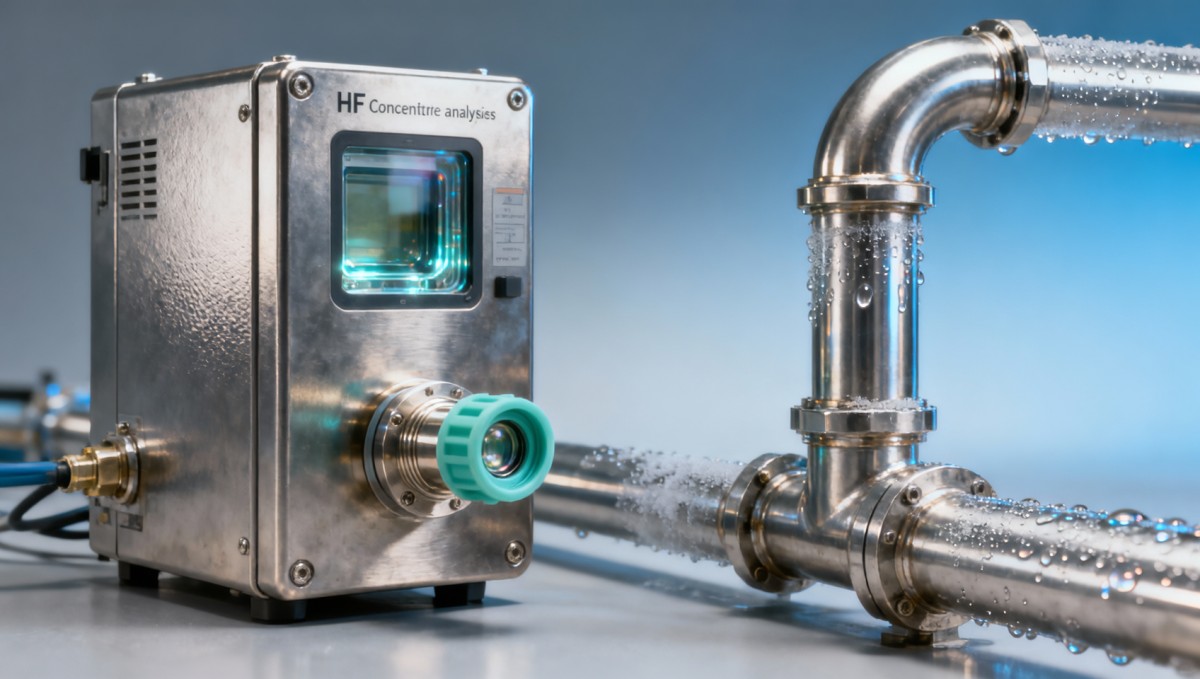
Top 5 Overlooked Material Compatibility Pitfalls
Users consistently misinterpret three categories of compatibility: bulk material grade, surface finish integrity, and assembly-level interface chemistry. Below are the five most frequently missed failure vectors:
- “HF-resistant” PTFE ≠ HF-compatible seals: Virgin PTFE resists HF, but filled grades (e.g., glass-, carbon-, or bronze-filled) degrade rapidly above 80°C due to filler leaching and microcrack propagation.
- Electropolished 316L SS passes lab tests—but fails in field: Electropolishing improves oxide uniformity, yet residual chlorides from passivation baths accelerate pitting when exposed to HF/H₂O mixtures.
- Aluminum housings corrode silently beneath anodized layers: Anodized Al 6061 shows no visible degradation after 72 hours at 200 ppm HF—but cross-section analysis reveals subsurface tunneling to depths >120 µm.
- Standard Viton® O-rings swell >40% volume in 100 ppm HF within 48 hours, compromising seal force and enabling microleaks undetectable by helium leak testing.
- “Inconel-compatible” sensors omit gasket chemistry: While Inconel 625 resists HF, common nickel-graphite gaskets release sulfur compounds that catalyze HF-induced stress corrosion cracking in adjacent flanges.
These issues collectively account for ~68% of premature HF analyzer failures reported by third-party maintenance audits across 122 semiconductor fabs (2022–2023). Crucially, 91% occurred outside warranty periods—because root cause was attributed to “improper installation,” not material specification gaps.
Verification Framework: How to Validate True HF Resistance
Datasheets claiming “HF compatible” must be validated using a four-tier verification protocol—not just single-point exposure tests. Each tier addresses a different failure mode and operational timescale.
Vendors who provide full Tier 1–3 reports—signed by an ISO/IEC 17025-accredited lab—are 3.2× more likely to deliver analyzers with ≥36-month mean time between failures (MTBF) in HF service. Always request raw test images and spectral data—not just pass/fail summaries.
Procurement Decision Matrix: 6 Critical Evaluation Criteria
For technical evaluators and procurement leads, material compatibility must be assessed alongside total cost of ownership (TCO). The table below ranks six evaluation criteria by impact weight (based on 2023 industry TCO modeling across 89 facilities):
Financial approvers should note: Skipping rigorous material vetting increases 5-year TCO by 22–37% due to unplanned downtime, recalibration labor (avg. $1,850/service event), and hazardous gas incident mitigation costs. A $12,500 analyzer with verified HF resistance delivers 2.8× higher ROI over 5 years than a $9,200 unit lacking traceable validation.
Actionable Next Steps for Your Team
Whether you’re specifying a new HF analyzer for a fab tool exhaust line or auditing existing installations, take these three concrete actions within the next 72 hours:
- Conduct a wetted-material audit: Pull nameplates and spec sheets for all HF analyzers in service. Cross-check each wetted component against NIST IR 8320-2021 Annex C (HF-specific material limits) and flag any unverified alloys or polymers.
- Request Tier 2 dynamic flow reports: Email your current vendor and ask for signed Tier 2 test data—including FTIR spectra and pressure decay curves. If unavailable, initiate competitive bid with vendors who publish such data.
- Integrate HF compatibility into procurement SOPs: Add mandatory fields to RFQ templates: heat lot traceability, seal polymer grade, and accredited lab report ID. Require completion before technical evaluation begins.
Material compatibility isn’t a checkbox—it’s the foundation of measurement integrity, personnel safety, and regulatory compliance. For instrumentation professionals serving semiconductor, specialty chemical, and high-purity environmental applications, verifying HF resistance is non-negotiable.
Get a free HF material compatibility assessment kit—including sample test report templates, NIST-compliant verification checklists, and vendor evaluation scorecards. Contact our instrumentation engineering team today to request yours.
Recommended for You
 Monitoring Sensor Prices in 2026: What Is Changing and WhyMonitoring sensor prices in 2026: compare portable sensor, fixed sensor, oxygen detector, infrared detector, electrochemical detector and paramagnetic detector options to choose a high accuracy sensor with better lifecycle value.
 Monitoring Sensor Data Looks Stable Until These Errors Show UpMonitoring sensor errors can hide behind stable data. Compare paramagnetic detector, electrochemical detector, infrared detector, and oxygen detector options for safer, high accuracy sensor selection.
 What Makes a Control Sensor Reliable in Harsh Environments?Control sensor reliability in harsh environments starts with the right oxygen detector, infrared detector, electrochemical detector, or paramagnetic detector for accurate, dependable monitoring.
 Control Sensor Delays Can Undermine Process StabilityControl sensor delays can destabilize operations. Compare paramagnetic detector, electrochemical detector, infrared detector, and oxygen detector options to find a high accuracy sensor for fixed, portable, laboratory, and monitoring sensor needs.
 Laboratory Sensor Repeatability Problems Often Start With SamplingLaboratory sensor repeatability issues often begin with sampling. Compare paramagnetic detector, electrochemical detector, infrared detector, and oxygen detector solutions to improve accuracy.
 Laboratory Sensor Selection Gets Harder With Lower Detection LimitsLaboratory sensor selection gets harder at lower limits. Compare paramagnetic detector, electrochemical detector, infrared detector, oxygen detector, fixed and portable sensor options for high accuracy monitoring and control.
 Portable Sensor Battery Loss Can Distort Long Shift MonitoringPortable sensor battery loss can distort long-shift monitoring. Compare paramagnetic detector, electrochemical detector, infrared detector and oxygen detector options for high accuracy sensor performance.
 Portable Sensor Accuracy in the Field Is Not Always What It SeemsPortable sensor accuracy can differ sharply from lab results. Compare paramagnetic detector, electrochemical detector, infrared detector, and oxygen detector performance to choose a high accuracy sensor for real field use.
 Fixed Sensor vs Portable Checks: Where Results Often DivergeExplore why fixed sensor and portable sensor readings diverge in oxygen detector systems using paramagnetic detector, electrochemical detector, and infrared detector technology.
 Why a High Accuracy Sensor May Still Miss Critical ChangesHigh accuracy sensor limits explained: compare paramagnetic detector, electrochemical detector, infrared detector and oxygen detector options to choose the right fixed, portable, laboratory or monitoring sensor.
 High Accuracy Sensor Claims: Which Specs Actually Prove It?High accuracy sensor selection starts with the right specs. Compare paramagnetic detector, electrochemical detector, infrared detector, and oxygen detector options for fixed, portable, laboratory, control, and monitoring sensor use.
 What Shortens the Service Life of an Oxygen Detector?Oxygen detector service life can drop fast due to heat, moisture, contamination, and poor calibration. Compare paramagnetic detector, electrochemical detector, and infrared detector solutions now.
 Oxygen Detector False Alarms Often Start With Sensor PlacementOxygen detector false alarms often start with sensor placement. Compare paramagnetic detector, electrochemical detector, and infrared detector options to improve accuracy and safety.
 Infrared Detector Response Time Can Change Your ReadingInfrared detector response time shapes alarm accuracy and stable readings. Compare paramagnetic detector, electrochemical detector, and oxygen detector options for every high accuracy sensor need.
 Infrared Detector Limits That Matter in Mixed Gas ApplicationsInfrared detector limits in mixed gas applications: compare paramagnetic detector, electrochemical detector, and oxygen detector options to choose a high accuracy sensor for portable, fixed, laboratory, control, and monitoring sensor use.
 Why Electrochemical Detector Calibration Fails More Often Than ExpectedElectrochemical detector calibration fails more often than expected—learn how a paramagnetic detector, infrared detector, or oxygen detector comparison helps you choose a high accuracy sensor for fixed, portable, laboratory, control, and monitoring sensor applications.
 Electrochemical Detector Lifespan Drops Fast Under These ConditionsElectrochemical detector lifespan can drop fast in heat, humidity, and corrosive gas. Compare paramagnetic detector, infrared detector, and oxygen detector options to choose a high accuracy sensor with lower lifecycle risk.
 Paramagnetic Detector Drift: What Usually Causes It?Paramagnetic detector drift explained: learn what causes oxygen detector errors, how it compares with electrochemical detector and infrared detector options, and how to keep a high accuracy sensor stable.
 Portable Detector Trends to WatchPortable detector trends: explore explosion proof monitor, laser monitor, infrared monitor, oxygen monitor, and high accuracy detector solutions that integrate with fixed detector systems.
 Fixed Detector Setup Mistakes to AvoidFixed detector setup mistakes can impact safety and costs. Learn how explosion proof monitor, oxygen monitor, infrared monitor, and portable detector users avoid false readings.
 High Accuracy Detector Selection TipsHigh accuracy detector selection tips for fixed detector and portable detector needs, covering explosion proof monitor, oxygen monitor, infrared monitor, and more for safer, smarter buying.
 Oxygen Monitor Export Trends in 2026Oxygen monitor export trends in 2026: explore explosion proof monitor, laser monitor, portable detector, fixed detector, and high accuracy detector demand shaping smarter buying decisions.
 Infrared Monitor Market Outlook 2026Infrared monitor market outlook 2026: compare explosion proof monitor, laser monitor, oxygen monitor, fixed detector and portable detector solutions for safer, smarter industrial projects.
 Where Electrochemical Monitors Work BestElectrochemical monitor guide: compare explosion proof monitor, infrared monitor, laser monitor, oxygen monitor, fixed detector, and portable detector for safer, smarter gas detection choices.
 Paramagnetic Monitor Import Outlook 2026Paramagnetic monitor import outlook 2026: compare explosion proof monitor, laser monitor, infrared monitor, oxygen monitor, and high accuracy detector solutions to source the right fixed or portable detector.
 Thermal Conductivity Monitor Price ShiftThermal conductivity monitor price trends explained with explosion proof monitor, laser monitor, oxygen monitor, and fixed or portable detector options for smarter, safer buying.
 How Laser Monitor Demand Is ChangingLaser monitor demand is changing as buyers compare explosion proof monitor, infrared, electrochemical, and oxygen monitor options for safer, high accuracy detector solutions.
 Oxygen Measurement System Export Demand in 2026Oxygen measurement system demand in 2026 is rising across industrial control equipment, gas quality measurement, emission control system, and process monitoring system markets. Explore key trends and smarter sourcing insights.
 Industrial Control System Trends to Watch in 2026Industrial control system trends for 2026: explore industrial control equipment, process monitoring system, gas quality measurement, oxygen measurement system, and emission control system upgrades.
 How to Improve Process Monitoring System ResultsImprove process monitoring system results with industrial control equipment, gas quality measurement, and emission measurement system strategies for smarter industrial control system performance.
 Emission Control System Import Risks in 2026Emission control system import risks in 2026: learn how industrial control equipment, gas quality measurement, and process monitoring system buyers can avoid delays, compliance issues, and costly mistakes.
 Gas Quality Control for Safer Plant OperationsGas quality control improves safer plant operations with industrial control equipment, gas quality measurement, and an emission measurement system—boost efficiency, compliance, and process monitoring performance.


Search Categories
Search Categories
Latest Article
- Monitoring Sensor Prices in 2026: What Is Changing and WhyMonitoring sensor prices in 2026: compare portable sensor, fixed sensor, oxygen detector, infrared detector, electrochemical detector and paramagnetic detector options to choose a high accuracy sensor with better lifecycle value.Posted by:
- Monitoring Sensor Data Looks Stable Until These Errors Show UpMonitoring sensor errors can hide behind stable data. Compare paramagnetic detector, electrochemical detector, infrared detector, and oxygen detector options for safer, high accuracy sensor selection.Posted by:
- What Makes a Control Sensor Reliable in Harsh Environments?Control sensor reliability in harsh environments starts with the right oxygen detector, infrared detector, electrochemical detector, or paramagnetic detector for accurate, dependable monitoring.Posted by:
Please give us a message
