
Do Regulatory Monitoring Systems Need Third-Party Certification?


Regulatory monitoring systems need third-party certification when the applicable law, permit, or approval scheme requires it. There is no universal rule covering every emissions monitor, water quality analyzer, or industrial measurement system. Some applications require independently certified equipment; others require installation-specific performance tests, approved measurement methods, calibration records, or a combination of these.
For procurement teams, the first question is whether the proposed system can produce evidence accepted for the intended compliance obligation. A product certificate may be essential, but it rarely establishes that an entire installation is ready for regulatory reporting. Conversely, a system without a general third-party product certificate may still be acceptable under a framework built around demonstrated performance and continuing quality assurance.
When does third-party certification become mandatory?
The requirement comes from the rules governing the measurement and its use. Start with the facility’s permit, applicable monitoring regulations, and any technical standards incorporated into those requirements. These documents determine whether an independent body must certify the equipment, assess the installed system, test its performance, or verify particular measurements.
Three situations deserve separate attention:
- A specified equipment approval scheme: The applicable framework requires a monitor certified or approved under a named scheme. A manufacturer’s declaration alone will not satisfy that requirement.
- Mandatory performance demonstration: The framework requires initial and continuing tests of the installed monitoring system. Independent testing may be required, but the resulting evidence is different from a product certificate.
- A contractual requirement: An owner, engineering contractor, or customer requires third-party certification even where the regulation permits another compliance route. This affects purchasing acceptance without necessarily being a legal requirement.
A tender stating only “all instruments must be certified” leaves too much unresolved. It should identify the scheme, the equipment covered, the required scope, and the party responsible for obtaining acceptance. Otherwise, suppliers can submit technically valid documents that address different questions.
The intended use of the data also matters. An analyzer used for process adjustment may face different requirements from one whose readings demonstrate compliance with a discharge limit. If a project plans to use the same instrument for both purposes, the specification should address the compliance function from the outset.
Are certification, accreditation, calibration, and validation interchangeable?
No. Each provides evidence about a different part of the measurement chain. Confusing them can leave a project with substantial documentation but no proof that its compliance requirements have been met.
Product certification
Product certification assesses a defined product against specified requirements under a certification scheme. Its scope may cover measurement performance, environmental suitability, electrical safety, or another characteristic. The certificate applies within its stated boundaries: model, configuration, measurement range, operating conditions, and any exclusions.
A safety certificate does not establish that the equipment measures a regulated pollutant accurately. Similarly, certification of an analyzer does not automatically cover the sampling system, data processing software, or complete monitoring installation.
Laboratory accreditation
Accreditation under ISO/IEC 17025 concerns a laboratory’s competence to perform specified testing or calibration activities. It is not a general product approval and does not certify every instrument the laboratory tests.
The laboratory’s accreditation scope must cover the relevant activity. A laboratory accredited for one measurement discipline does not automatically have accredited capability for every pollutant, matrix, or calibration range. Buyers should review the scope alongside the report.
Calibration
Calibration establishes the relationship between an instrument’s indications and reference values under stated conditions, with associated measurement uncertainty. It supports confidence in measurements and can provide metrological traceability.
Calibration alone does not establish suitability for a regulatory application. An instrument can be calibrated correctly yet perform poorly when exposed to interfering gases, contaminated sample lines, changing temperatures, or a sample matrix outside its intended use.
Installed-system validation and acceptance
Installation-specific testing evaluates the assembled measurement chain under its operating conditions. Depending on the framework, this can include comparison with reference measurements, response checks, assessment of data handling, and formal acceptance procedures.
This evidence addresses a gap that product certification cannot close by itself: whether the equipment, sampling arrangement, installation, and reporting process work together at the facility.
How do requirements differ between emissions and water monitoring?
Continuous emissions monitoring illustrates why “certified” needs a precise meaning. In the United States, requirements under 40 CFR Part 75 include certification procedures for monitoring systems used in covered applications. These procedures involve prescribed demonstrations of system performance; they should not be confused with purchasing an analyzer carrying a universal third-party approval mark.
Requirements under 40 CFR Part 60 depend on the applicable source rule and monitoring provisions. Relevant performance specifications and quality assurance requirements can govern initial acceptance and ongoing operation. Procurement teams therefore need to identify the actual regulatory pathway before deciding which certificates or test reports to request.
In European stationary-source monitoring, EN 14181 provides a quality assurance framework for automated measuring systems. Equipment suitability, installed-system calibration and validation, and continuing quality assurance have distinct roles. Product certification schemes can support equipment selection, while site-specific work remains necessary where the applicable framework requires it. The standard’s legal relevance depends on how it is incorporated into national requirements or permits.
The UK’s MCERTS arrangements provide another example of scheme-specific assessment. Where applicable requirements call for MCERTS-certified equipment, buyers must check the relevant certificate and its scope. Certification for one instrument category or application does not establish acceptance for every monitoring task.
Water monitoring requires the same discipline, but the acceptance route may differ. A permit or drinking-water framework may specify an approved analytical method, sampling procedure, laboratory qualification, or particular monitoring equipment. An online analyzer suitable for operational control may not be accepted as the sole basis for compliance reporting.
For example, continuous measurements can help detect a process upset while compliance remains tied to samples analyzed using a prescribed method. Before replacing that sampling arrangement with an online system, establish whether the governing framework permits the substitution and what evidence it requires.
Does a certified analyzer make the whole system compliant?
No. A regulatory monitoring system extends from the point where the sample or signal is obtained to the record submitted for compliance. Failures anywhere along that chain can undermine otherwise capable equipment.
For an extractive emissions system, the chain may include a probe, heated sample line, conditioning equipment, analyzer, calibration arrangement, and data acquisition system. Moisture removal, leaks, condensation, or sample transport can affect the result. The certificate for the analyzer needs to be read alongside the conditions under which it was assessed.
For a water quality installation, sample representativeness, fouling, flow conditions, reagent handling, and maintenance can influence the reading. A certified measurement principle does not establish that a particular sampling location represents the discharge being regulated.
Data processing adds another boundary. Even accurate measurements can produce unacceptable reports if averaging periods, units, correction calculations, time stamps, or invalid-data rules are configured incorrectly. Where software is included in a certified configuration, its version and permitted settings should be checked. Where it is outside that scope, separate verification may be necessary.
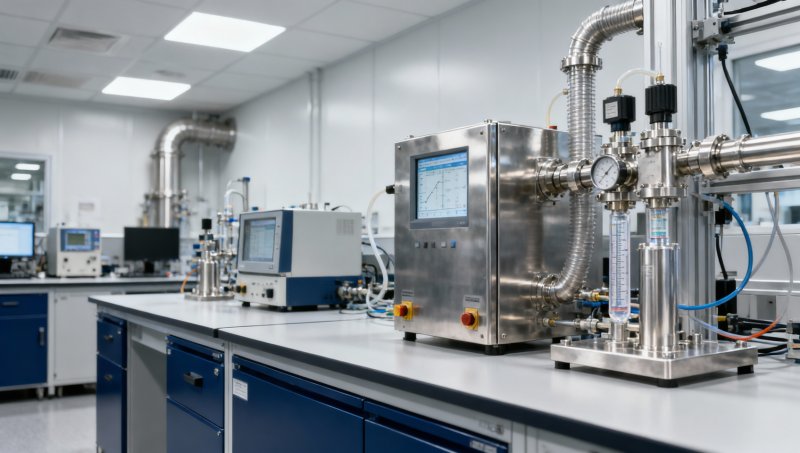
A useful acceptance review follows the measurement chain from sampling through reporting and assigns evidence to each stage. This reveals whether the project has proof of equipment performance, installation suitability, and reporting accuracy, or only a certificate for one component.
What should buyers check in a supplier’s documentation?
Ask the supplier to connect each compliance claim to a specific document and requirement. “Internationally certified,” “regulatory compliant,” and “tested to industry standards” are too broad to support a purchasing decision.
The review should answer six questions:
- Who issued the document? Distinguish an independent certification body, an accredited laboratory, a regulator, and the manufacturer.
- What was assessed? Identify the exact model, components, measurement principle, software version where relevant, and system boundaries.
- Against which requirements? Check the named scheme, standard, test method, and applicable edition.
- For which application? Confirm the pollutant or parameter, sample matrix, measurement range, and operating conditions.
- What limitations apply? Read annexes, exclusions, installation conditions, and maintenance requirements.
- What is its status? Check validity, suspension or withdrawal information, and whether the supplied configuration remains covered.
Where the issuing scheme provides a public register, compare the supplier’s document with that record. A brochure logo offers much less assurance than a verifiable certificate with a defined scope.
Measurement range deserves particular care. A certificate covering a broad range does not automatically establish acceptable performance near a low regulatory limit. Review the performance evidence against the concentrations expected at the facility and the applicable acceptance criteria.
Also distinguish certificates from test reports. A report may document strong results for a particular sample or configuration without providing the continuing oversight associated with a certification scheme. Both can be useful, but their evidential roles differ.
Can equipment certified in one country be used in another?
It may be technically suitable, but acceptance should not be assumed. The destination jurisdiction may use different performance criteria, reference methods, approval procedures, or reporting rules. A recognized certificate can support the assessment without replacing a locally required approval or site test.
International accreditation arrangements can help establish confidence in laboratory competence. They do not compel every regulator to accept every report for every compliance purpose. Product safety markings and hazardous-area approvals also address their own requirements; they do not establish acceptance of environmental monitoring data.
For cross-border purchases, specify the destination application and compliance route before comparing quotations. The relevant question is whether the documentation satisfies that route, including any additional installation testing, rather than whether the supplier holds the largest number of certificates.
What if the rules do not explicitly require third-party certification?
Independent evidence can still be valuable, particularly where poor measurement would expose the operator to significant compliance risk. Its value depends on what uncertainty it resolves.
An independent performance evaluation may help assess interference effects or operation near a permit limit. Accredited calibration may support traceability. Installation testing may reveal sampling losses or incorrect reporting calculations. Buying a general certificate that addresses none of these issues adds little to the decision.
The procurement specification should therefore separate mandatory evidence from additional assurance. This gives suppliers a clear basis for pricing and prevents a voluntary preference from being presented as a statutory obligation. It also allows buyers to compare different technical solutions against the same acceptance criteria.
What should be settled before placing an order?
Settle the acceptance route while the equipment configuration and contract terms can still be changed. Identify the governing requirement, the evidence needed before delivery, the tests needed after installation, and responsibility for correcting a failed acceptance result.
Include the continuing obligations. Regulatory acceptance may depend on periodic checks, calibration, maintenance, reference testing, and retained records. Replacement components or software changes can affect the assessed configuration and may trigger additional review or testing under the applicable framework.
A practical purchase specification can state the required certification scope, installed-system acceptance criteria, documentation deliverables, and division of responsibility in a few precise clauses. That gives the buyer a defensible answer to the original question: whether third-party certification is required for this system, what it proves, and what evidence must still be obtained before its data can support compliance.
Recommended for You
 How condensation affects stack detector readings in wet flue gasStack detector readings can drift when wet flue gas condenses. Learn how to identify moisture interference, prevent sample losses, and improve emissions monitoring reliability.
 How to prevent condensation in a CO2 analyzer sampling systemPrevent condensation in your CO2 analyzer sampling system. Learn how to control dew point, eliminate cold spots, and manage moisture for reliable readings and fewer costly disruptions.
 How to verify accuracy claims for industrial quality analyzersVerify accuracy claims for industrial quality analyzers with calibration checks, independent testing, and clear acceptance criteria. Learn how to reduce risk and buy with confidence.
 How to calculate cooling loads for an industrial analyzer shelterSize industrial analyzer shelter cooling with confidence. Learn to calculate equipment heat, solar gains, and ventilation loads, then select HVAC capacity for reliable analyzer performance.
 Do Regulatory Monitoring Systems Need Third-Party Certification?Do regulatory monitoring systems need third-party certification? Learn when it is required, what certificates prove, and how to verify compliance before buying.
 How Do You Choose Wired or Wireless for Stack Monitoring?Learn how to choose between wired and wireless for stack monitoring. Compare reliability, lifecycle costs, and data recovery to find the right CEMS setup for your site.
 What Happens When Combustible Gas Sensor Calibration Is Overdue?What happens if combustible gas sensor is not recalibrated on time? Discover the risks of inaccurate readings and missed alarms, plus steps to restore reliable protection.
 Can One Multi-Gas Detector Replace Four Separate Analyzers?Find out: can a single multi-gas detector replace four separate analyzers? Compare accuracy, safety, compliance, and lifetime costs to make a confident buying decision.
 Industrial Safety vs. Emission Monitoring: What Are the Differences?What are the main differences between industrial safety and emission monitoring? Compare goals, sensors, response times, and compliance needs to choose the right systems for your facility.
 Is Remote Monitoring Worth the Cost for Small Emission Sources?Is it worth investing in remote monitoring for small emission sources? Compare costs, compliance needs, and potential savings to choose the right solution for your operation.
 How Do You Handle Analyzer Failure During an Environmental Audit?Learn how to handle analyzer failure during environmental compliance audit procedures. Protect evidence, verify data, and restore monitoring with this practical response guide.
 Do VOC Monitors Require Explosion-Proof Certification?Does VOC monitoring require explosion-proof certification? Learn when approval is needed, compare ATEX and IECEx, and choose the right monitor for your site.
 How sample conditioning affects accuracy in petrochemical analyzersImprove accuracy in petrochemical analyzers with smarter sample conditioning. Discover how phase control, filtration, and transport design prevent bias and deliver reliable process data.
 How to troubleshoot sensor drift in industrial gas detectorsIndustrial gas detectors showing sensor drift? Learn how to verify calibration gas, identify root causes, and determine when sensor replacement is needed for reliable monitoring.
 How to judge whether a competitive price reflects real valueCompetitive Price: learn how to compare scope, compliance, performance, and lifecycle costs to identify real value, reduce risk, and make smarter purchasing decisions.
 When custom gas analysis is the right fit for complex process streamsCustom gas analysis for complex process streams: learn when tailored sampling, interference control, and reliable measurement design deliver confident decisions.
 When does a laser gas analyzer meet stack emissions monitoring needs?Laser gas analyzer for stack emissions: learn when it delivers fast, reliable data, how to assess installation risks, and what to verify for CEMS compliance.
 How to select a hazardous gas analyzer for confined spacesHazardous gas analyzer selection for confined spaces: compare sensors, sampling, certifications, alarms, and maintenance to protect workers and choose with confidence.
 When is a single gas analyzer sufficient for workplace safety monitoring?Discover when a single gas analyzer delivers reliable workplace safety monitoring, and learn the key limits, calibration needs, and risks that require broader detection.
 How to choose an ambient gas analyzer for low-level leak detectionAmbient gas analyzer selection for low-level leak detection: compare sensitivity, cross-sensitivity, sampling design, alarms, and calibration for reliable site performance.
 How to tell when an oxygen sensor needs replacementOxygen sensor replacement signs explained: learn how live data, fault codes, wiring checks, and exhaust inspections pinpoint the real issue before you buy.
 How laser gas analyzers improve combustion control in steel furnacesLaser gas analyzer for steel industry applications delivers fast in-situ O₂ and CO data to optimize furnace combustion, cut fuel waste, and improve steel heating stability.
 How to verify whether explosion proof equipment meets site requirementsExplosion proof equipment verification made practical: match zones, gas or dust groups, temperature classes, certificates, and installation conditions for confident compliance.
 How industrial gas analysis helps detect contamination before releaseIndustrial Gas Analysis helps detect moisture, oil, oxygen, and toxic contaminants before release—protecting processes, ensuring compliance, and reducing costly risks.
 When is electrochemistry detection the right choice for water analysis?Electrochemistry detection for water analysis: learn when fast, reliable monitoring of ions, chlorine, pH, and more delivers actionable results.
 How industrial standards reduce quality risks in supplier selectionIndustrial Standard guidance helps quality and safety managers reduce supplier risks, verify compliance, strengthen traceability, and build resilient instrumentation supply chains.
 When does a multi-component system reduce installation complexity?Multi component systems reduce installation complexity when they eliminate field interfaces, streamline commissioning, and provide proven compatibility. Learn how to assess total cost and supplier accountability.
 How to size an industrial control shelter for outdoor equipmentIndustrial control shelter sizing guide: optimize layout, HVAC, access, safety, and expansion space for reliable outdoor equipment operations.
 How flue analysis helps verify combustion efficiencyFlue analysis verifies combustion efficiency by assessing O2, CO, CO2, and stack temperature to identify excess air, incomplete combustion, and heat losses.
 How to select industrial gas detectors for confined spacesIndustrial gas detectors for confined spaces: learn how to match sensors, sampling methods, alarms, and certifications to real atmospheric hazards.
 When does a laser oxygen analyzer outperform zirconia sensors?Laser oxygen analyzer vs. zirconia sensors: compare speed, selectivity, maintenance, gas chemistry, and installation needs to choose the right oxygen measurement solution.
 How to select a percent range analyzer for process measurementsPercent range analyzer selection made practical: compare accuracy, sample systems, calibration, gas matrix, integration, and lifecycle cost for reliable process measurements.

Search Categories
Search Categories
- Smart Meters & Power Quality
- Transformer Gas Analyzers
- BESS Thermal Runaway Detectors
- Energy, Power & Smart Grid Monitoring
- Optical Profilers & CMM
- Ultrasonic & X-Ray NDT
- Calibration Standards
- Precision Metrology & NDT
- Water Quality Analyzers
- CEMS & VOCs Monitors
- Price Trends
- Import & Export Updates
- Market Trends
- Industry News
- Industry Insights
Latest Article
- How condensation affects stack detector readings in wet flue gasStack detector readings can drift when wet flue gas condenses. Learn how to identify moisture interference, prevent sample losses, and improve emissions monitoring reliability.Posted by:
- How to prevent condensation in a CO2 analyzer sampling systemPrevent condensation in your CO2 analyzer sampling system. Learn how to control dew point, eliminate cold spots, and manage moisture for reliable readings and fewer costly disruptions.Posted by:
- How to verify accuracy claims for industrial quality analyzersVerify accuracy claims for industrial quality analyzers with calibration checks, independent testing, and clear acceptance criteria. Learn how to reduce risk and buy with confidence.Posted by:
Please give us a message
