
How Paramagnetic Oxygen Analyzers Work and Why Sample Pressure Matters


A paramagnetic oxygen analyzer can report a changing oxygen concentration even when the gas composition remains constant. If pressure rises inside the measuring cell, the number of oxygen molecules per unit volume increases, changing the magnetic response. An instrument calibrated at one pressure can therefore give a biased result at another unless it controls or compensates for that change.
For technical evaluators, pressure handling deserves the same attention as measuring range, response time, and repeatability. A stable process pressure does not guarantee stable cell pressure, and an atmospheric vent does not guarantee a constant absolute pressure. The useful question is whether the complete measurement system can maintain its specified accuracy across the pressure conditions it will actually encounter.
How oxygen produces a measurable magnetic signal
Oxygen is paramagnetic: it is attracted into a magnetic field because of its molecular electronic structure. Many common background gases, including nitrogen and carbon dioxide, are diamagnetic and respond much more weakly in the opposite direction. This difference allows an analyzer to extract an oxygen-sensitive signal from a gas mixture without consuming oxygen in an electrochemical reaction.
A widely used implementation employs a small suspended dumbbell with two gas-filled spheres positioned in a nonuniform magnetic field. When oxygen enters the cell, its attraction toward the stronger field produces a force that displaces the dumbbell. An optical system detects that displacement. In a feedback design, an electromagnetic restoring force holds the dumbbell near its reference position, and the current needed to maintain that position provides the measurement signal.
The instrument converts this signal into oxygen concentration using its calibration and internal corrections. That conversion assumes defined operating conditions. Magnetic response depends on the amount of oxygen occupying the cell and on temperature, while background-gas effects and mechanical disturbances can also influence the reading.
Other paramagnetic designs use different ways to detect oxygen’s magnetic behavior. Some measure a pressure difference generated by a magnetic field, with a reference gas involved in the measurement. Thermomagnetic designs detect effects associated with magnetic susceptibility changing as oxygen is heated. These architectures have different dependencies on flow, reference-gas conditions, and gas composition. A pressure specification for one design should not automatically be applied to another.
For evaluation purposes, the sensing principle establishes why oxygen can be measured selectively. The analyzer’s architecture and sample system establish how reliably that signal becomes a concentration reading.
Why absolute cell pressure changes the result
Oxygen concentration expressed as volume percent is approximately its mole fraction for an ideal gas mixture. At constant composition, compressing the mixture does not change that fraction. It does, however, increase oxygen number density—the number of oxygen molecules occupying a given volume.
The relationship can be expressed as oxygen number density = xO₂ × P / (kB × T), where xO₂ is oxygen mole fraction, P is absolute pressure, T is absolute temperature, and kB is Boltzmann’s constant. Oxygen partial pressure is correspondingly xO₂ × P. A density-sensitive magnetic measurement therefore needs pressure and temperature conditions to be accounted for before it can reliably report mole fraction.
For an idealized, uncompensated analyzer at constant temperature, with a linear response and negligible background effects, the indicated concentration can be approximated by indicated O₂ ≈ actual O₂ × Pmeasurement / Pcalibration. This is a useful explanation of pressure sensitivity, rather than a universal correction formula for every instrument. The actual response depends on the sensing design, signal processing, and compensation already applied.
Consider a calculated example: a gas containing 10.0% oxygen is measured after calibration at an absolute cell pressure of 1.00 bar. If measurement pressure rises to 1.05 bar, the simplified relationship predicts an indication of about 10.5% oxygen. The error is 0.5 percentage points, or 5% of the original reading. Those two descriptions are different and should remain distinct when comparing accuracy claims.
Absolute pressure is the relevant quantity. A gauge-pressure reading describes pressure relative to the surrounding atmosphere. Zero gauge pressure can therefore correspond to different absolute pressures as weather or site elevation changes. Likewise, a regulator that holds a constant gauge pressure does not necessarily hold a constant absolute cell pressure.
Temperature also affects the magnetic response beyond its effect on gas density. Cell temperature control and temperature compensation should be assessed alongside pressure compensation. A simple pressure-ratio calculation is insufficient when temperature varies substantially or when the instrument’s measurement architecture introduces additional dependencies.
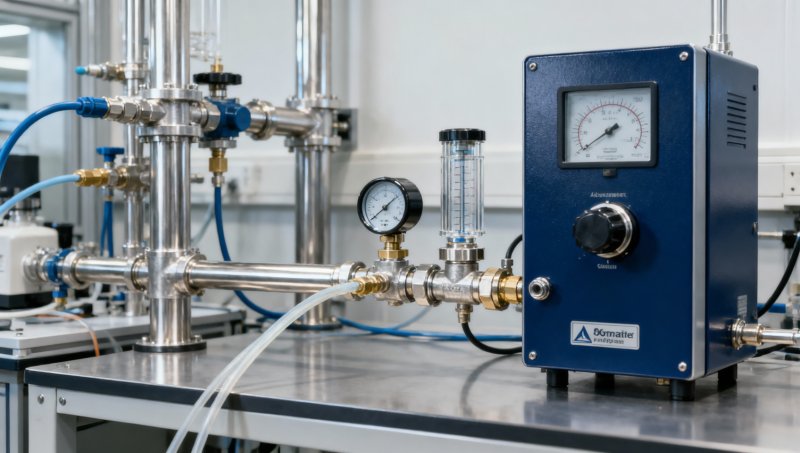
Where pressure errors enter the sample system
The pressure that matters is the pressure in the measuring cell. Process-line pressure, pressure at a cylinder regulator, and pressure at the analyzer inlet can all differ from it. Tubing, valves, filters, flow restrictions, pumps, and the outlet connection create pressure losses or backpressure between those locations.
An analyzer exhausting through a short, unrestricted vent may operate close to atmospheric pressure. Connecting that outlet to a long tube, a shared exhaust header, or a gas recovery system changes the conditions. Pressure fluctuations downstream can propagate into the cell. A restriction after the cell can also raise its pressure even while the inlet regulator and flow indicator appear stable.
Filter loading creates another dependency. With a pump pulling sample through the analyzer, a growing restriction upstream can reduce cell pressure. With a different pump position or control arrangement, the effects may differ. The pressure behavior must be traced through the actual flow path; a component list alone does not establish it.
Flow and pressure are related, but they are separate evaluation variables. Increasing flow can increase pressure drop through the cell and its connections. It can also introduce flow-related disturbances in sensitive measuring arrangements. Constant indicated flow does not prove constant absolute cell pressure, particularly if the flow measurement itself depends on pressure and temperature.
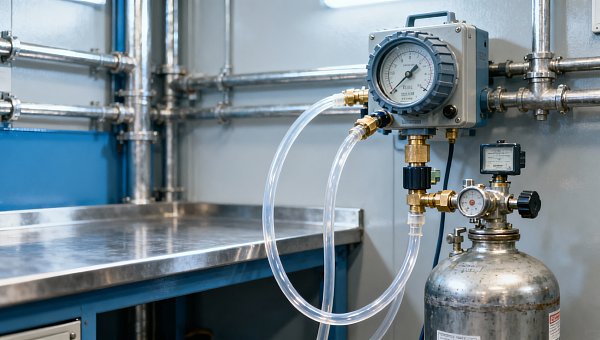
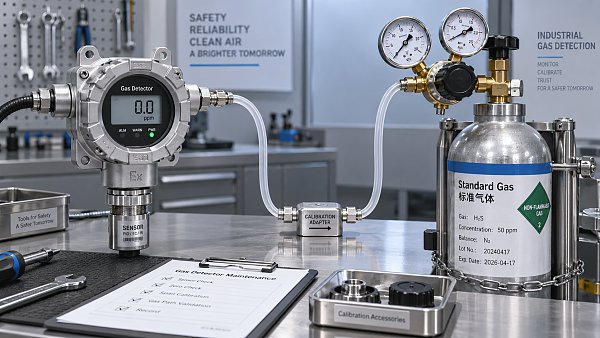
Calibration plumbing can create an error that becomes visible only after the instrument returns to process gas. A cylinder regulator may supply calibration gas at a higher pressure or through a different restriction than the sample stream. The analyzer can display the correct span value during adjustment while its subsequent process readings remain biased.
Calibration gas should therefore pass through a representative flow path, at suitable flow and comparable cell pressure. Where the paths necessarily differ, compensation must cover that difference. The useful diagnostic record includes the pressure during both calibration and measurement, rather than only the regulator setting.
In extractive emissions monitoring, oxygen may be used to normalize reported pollutant concentrations. An oxygen error can consequently affect the corrected emissions result as well as the oxygen display. In process control, a similar bias can prompt an unnecessary operating adjustment. Pressure sensitivity becomes particularly consequential when the reading approaches an alarm threshold or drives another calculation.
What pressure control and compensation must accomplish
Pressure stabilization limits the size of the disturbance. Electronic compensation corrects for the remaining disturbance using a pressure measurement and an instrument-specific relationship. Either approach can be effective within its stated conditions, and some systems use both. The evaluation should establish the operating envelope and residual error of the complete arrangement.
A pressure sensor must measure a pressure representative of the cell. A sensor at the inlet may provide an adequate estimate under defined flow conditions, but changing restrictions can weaken that relationship. An atmospheric-pressure sensor accounts for ambient changes; it cannot independently identify backpressure from an obstructed outlet. Sensor location is therefore part of the accuracy assessment.
Compensation also has limits. A specified correction range does not necessarily equal the maximum pressure the cell can safely withstand. Static correction may perform differently during rapid pressure changes if the pressure sensor, gas path, and oxygen signal respond at different speeds. An analyzer that gives accurate readings after settling can still generate temporary errors during valve switching or pump cycling.
Useful questions for a technical evaluation include:
- What absolute cell-pressure range supports the stated oxygen accuracy, and what residual pressure error remains within that range?
- Where is pressure measured, and how does that measurement represent cell pressure as flow or restrictions change?
- Does compensation cover outlet backpressure as well as atmospheric-pressure changes?
- Are the accuracy figures stated as percentage of reading, percentage of full scale, or oxygen percentage points?
- What happens if pressure leaves the compensation range or the pressure sensor fails?
The last question matters for control applications. A plausible oxygen number can continue to appear even when its correction is invalid. Where the analyzer supports them, pressure diagnostics and measurement-validity flags should be available to the control or monitoring system, with a defined response to an invalid measurement.
Pressure compensation does not correct every cause of an oxygen shift. Air entering a sample line under suction changes the composition itself. Condensation can remove water and change the wet-versus-dry reporting basis. Magnetic background effects can also vary with gas composition; nitric oxide is an example of another paramagnetic gas. These effects require separate assessment, especially when process-gas composition changes between operating modes.
A claim of “pressure compensated” should therefore be read as a bounded performance claim. It should identify the pressure range, relevant flow and temperature conditions, and remaining uncertainty. It does not establish immunity to leaks, condensation, changing background gases, or operation beyond the cell’s mechanical limits.
Testing the pressure claim under relevant conditions
A useful acceptance test holds gas composition constant while varying pressure within the permitted operating range. Use a suitable reference mixture, record pressure representative of the cell, and observe both raw and corrected signals where available. Flow should be controlled or documented so that a pressure effect can be distinguished from a simultaneous flow effect.
The test should include the likely sources of disturbance: changes in sample supply, outlet backpressure, pump operation, and transitions between calibration and process sampling. Allow readings to settle for static checks, then examine transient behavior separately where switching events matter to the application. The objective is to measure residual error under relevant conditions, not merely to demonstrate that a correction function is enabled.
Acceptance criteria should follow the measurement’s intended use. A laboratory comparison, a combustion-control loop, and an emissions calculation may require different uncertainty budgets and response behavior. Calibration-gas uncertainty, repeatability, drift, pressure sensitivity, and sample conditioning all contribute to the result. Repeatability at one fixed pressure cannot establish accuracy across the operating envelope.
Where a regulatory or contractual monitoring method applies, its requirements for calibration, reporting basis, and system performance should guide acceptance. Explosion-protection certification addresses a separate question from analytical accuracy. Similarly, a calibration certificate establishes performance under its documented conditions; it does not demonstrate that the installed sample system reproduces those conditions.
A paramagnetic oxygen analyzer is a sound technical choice when its sensing architecture suits the gas mixture and its sample system keeps cell conditions within a verified envelope. Before selection, establish three things: the absolute pressure the cell will actually experience, the residual error after control or compensation, and the behavior during the transitions that matter to the process. Those answers make the accuracy specification usable for an engineering decision.
Recommended for You
 How to choose electrochemical analyzers for low-current measurementsCompare electrochemical analyzers for precise low-current measurements. Learn how noise, leakage, bandwidth, and real-cell testing help you choose the right instrument.
 What tolerance does a custom gas mixture need for calibration?Choose the right custom gas tolerance for calibration. Learn how blending tolerance, certified uncertainty, and stability affect accuracy—and avoid paying for precision you don’t need.
 How condensation affects stack detector readings in wet flue gasStack detector readings can drift when wet flue gas condenses. Learn how to identify moisture interference, prevent sample losses, and improve emissions monitoring reliability.
 How to prevent condensation in a CO2 analyzer sampling systemPrevent condensation in your CO2 analyzer sampling system. Learn how to control dew point, eliminate cold spots, and manage moisture for reliable readings and fewer costly disruptions.
 How to verify accuracy claims for industrial quality analyzersVerify accuracy claims for industrial quality analyzers with calibration checks, independent testing, and clear acceptance criteria. Learn how to reduce risk and buy with confidence.
 How to calculate cooling loads for an industrial analyzer shelterSize industrial analyzer shelter cooling with confidence. Learn to calculate equipment heat, solar gains, and ventilation loads, then select HVAC capacity for reliable analyzer performance.
 Oxygen Analyzers for Diving: Calibration Checks Before Nitrox BlendingUsing an oxygen analyzer for diving applications? Discover essential calibration, sensor, and sampling checks before nitrox blending to support reliable readings.
 How Paramagnetic Oxygen Analyzers Work and Why Sample Pressure MattersLearn how a paramagnetic oxygen analyzer works, why sample pressure affects accuracy, and what to check in compensation and calibration before choosing your system.
 How Much Does a Complete CEMS Integration Project Typically Cost?How much does a complete CEMS integration project typically cost? Explore budget ranges, hidden installation costs, and compliance needs to compare quotes and plan confidently.
 What Is the Typical Response Time for Industrial Air Monitors?What is the typical response time for industrial air monitors? Explore T90, sampling delays, and alarm settings to compare performance and choose the right monitor with confidence.
 Do Regulatory Monitoring Systems Need Third-Party Certification?Do regulatory monitoring systems need third-party certification? Learn when it is required, what certificates prove, and how to verify compliance before buying.
 How Do You Choose Wired or Wireless for Stack Monitoring?Learn how to choose between wired and wireless for stack monitoring. Compare reliability, lifecycle costs, and data recovery to find the right CEMS setup for your site.
 What Happens When Combustible Gas Sensor Calibration Is Overdue?What happens if combustible gas sensor is not recalibrated on time? Discover the risks of inaccurate readings and missed alarms, plus steps to restore reliable protection.
 Can One Multi-Gas Detector Replace Four Separate Analyzers?Find out: can a single multi-gas detector replace four separate analyzers? Compare accuracy, safety, compliance, and lifetime costs to make a confident buying decision.
 Industrial Safety vs. Emission Monitoring: What Are the Differences?What are the main differences between industrial safety and emission monitoring? Compare goals, sensors, response times, and compliance needs to choose the right systems for your facility.
 Is Remote Monitoring Worth the Cost for Small Emission Sources?Is it worth investing in remote monitoring for small emission sources? Compare costs, compliance needs, and potential savings to choose the right solution for your operation.
 How Do You Handle Analyzer Failure During an Environmental Audit?Learn how to handle analyzer failure during environmental compliance audit procedures. Protect evidence, verify data, and restore monitoring with this practical response guide.
 Do VOC Monitors Require Explosion-Proof Certification?Does VOC monitoring require explosion-proof certification? Learn when approval is needed, compare ATEX and IECEx, and choose the right monitor for your site.
 How sample conditioning affects accuracy in petrochemical analyzersImprove accuracy in petrochemical analyzers with smarter sample conditioning. Discover how phase control, filtration, and transport design prevent bias and deliver reliable process data.
 How to troubleshoot sensor drift in industrial gas detectorsIndustrial gas detectors showing sensor drift? Learn how to verify calibration gas, identify root causes, and determine when sensor replacement is needed for reliable monitoring.
 How to judge whether a competitive price reflects real valueCompetitive Price: learn how to compare scope, compliance, performance, and lifecycle costs to identify real value, reduce risk, and make smarter purchasing decisions.
 When custom gas analysis is the right fit for complex process streamsCustom gas analysis for complex process streams: learn when tailored sampling, interference control, and reliable measurement design deliver confident decisions.
 When does a laser gas analyzer meet stack emissions monitoring needs?Laser gas analyzer for stack emissions: learn when it delivers fast, reliable data, how to assess installation risks, and what to verify for CEMS compliance.
 How to select a hazardous gas analyzer for confined spacesHazardous gas analyzer selection for confined spaces: compare sensors, sampling, certifications, alarms, and maintenance to protect workers and choose with confidence.
 When is a single gas analyzer sufficient for workplace safety monitoring?Discover when a single gas analyzer delivers reliable workplace safety monitoring, and learn the key limits, calibration needs, and risks that require broader detection.
 How to choose an ambient gas analyzer for low-level leak detectionAmbient gas analyzer selection for low-level leak detection: compare sensitivity, cross-sensitivity, sampling design, alarms, and calibration for reliable site performance.
 How to tell when an oxygen sensor needs replacementOxygen sensor replacement signs explained: learn how live data, fault codes, wiring checks, and exhaust inspections pinpoint the real issue before you buy.
 How laser gas analyzers improve combustion control in steel furnacesLaser gas analyzer for steel industry applications delivers fast in-situ O₂ and CO data to optimize furnace combustion, cut fuel waste, and improve steel heating stability.
 How to verify whether explosion proof equipment meets site requirementsExplosion proof equipment verification made practical: match zones, gas or dust groups, temperature classes, certificates, and installation conditions for confident compliance.
 How industrial gas analysis helps detect contamination before releaseIndustrial Gas Analysis helps detect moisture, oil, oxygen, and toxic contaminants before release—protecting processes, ensuring compliance, and reducing costly risks.
 When is electrochemistry detection the right choice for water analysis?Electrochemistry detection for water analysis: learn when fast, reliable monitoring of ions, chlorine, pH, and more delivers actionable results.
 How industrial standards reduce quality risks in supplier selectionIndustrial Standard guidance helps quality and safety managers reduce supplier risks, verify compliance, strengthen traceability, and build resilient instrumentation supply chains.
Search Categories
Search Categories
- Smart Meters & Power Quality
- Transformer Gas Analyzers
- BESS Thermal Runaway Detectors
- Energy, Power & Smart Grid Monitoring
- Optical Profilers & CMM
- Ultrasonic & X-Ray NDT
- Calibration Standards
- Precision Metrology & NDT
- Water Quality Analyzers
- CEMS & VOCs Monitors
- Price Trends
- Import & Export Updates
- Market Trends
- Industry News
- Industry Insights
Latest Article
- How to choose electrochemical analyzers for low-current measurementsCompare electrochemical analyzers for precise low-current measurements. Learn how noise, leakage, bandwidth, and real-cell testing help you choose the right instrument.Posted by:
- What tolerance does a custom gas mixture need for calibration?Choose the right custom gas tolerance for calibration. Learn how blending tolerance, certified uncertainty, and stability affect accuracy—and avoid paying for precision you don’t need.Posted by:
- How condensation affects stack detector readings in wet flue gasStack detector readings can drift when wet flue gas condenses. Learn how to identify moisture interference, prevent sample losses, and improve emissions monitoring reliability.Posted by:
Please give us a message
