
How to verify whether explosion proof equipment meets site requirements


How to Verify Whether Explosion Proof Equipment Meets Site Requirements
Verifying whether explosion proof equipment meets site requirements is essential for protecting personnel, assets, and operational continuity in hazardous locations.
Quality and safety managers must evaluate area classification, gas or dust groups, temperature classes, installation conditions, and certification validity, rather than relying on a product label.
This guide provides a practical approval framework for confirming compliance with ATEX, IECEx, and site-specific safety requirements before equipment enters service.
The central rule is simple: explosion proof equipment is acceptable only when its complete approved configuration matches the documented hazards at its installed location.
Start With the Site Hazard Assessment
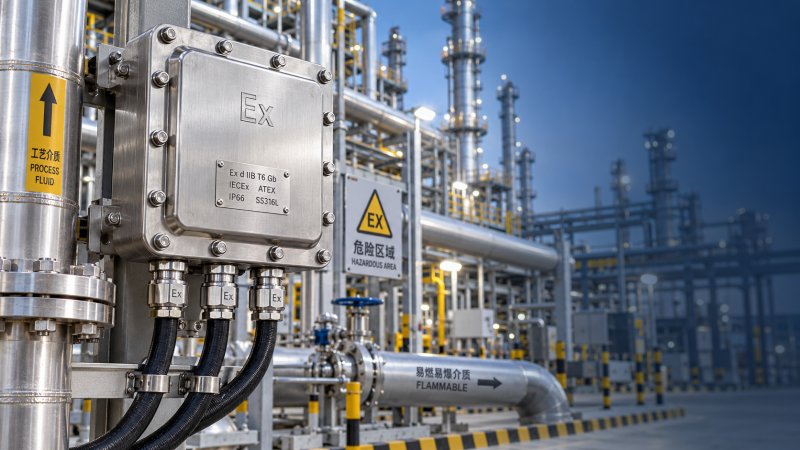
Do not begin with a supplier datasheet. Begin with the hazardous-area classification drawing, risk assessment, process information, and equipment location plan.
An explosion proof enclosure may be technically robust but still unsuitable if the site contains a different gas group, dust type, ignition risk, or ambient condition.
Safety managers should obtain the latest classified-area dossier from engineering, operations, or the responsible hazardous-area assessor before approving any equipment.
The dossier should identify whether the location is classified for flammable gas, vapour, mist, combustible dust, or more than one hazard.
It should also define the zone or division, the hazardous material present, expected release frequency, ventilation assumptions, and temperature limits.
For ATEX and IECEx sites, gas hazards are generally classified as Zone 0, Zone 1, or Zone 2.
Dust hazards are generally classified as Zone 20, Zone 21, or Zone 22, depending on how often combustible dust clouds occur.
Zone 0 and Zone 20 represent the most demanding environments because explosive atmospheres may be present continuously, frequently, or for long periods.
Zone 1 and Zone 21 cover areas where explosive atmospheres are likely during normal operation, while Zone 2 and Zone 22 cover abnormal conditions.
A correct equipment decision therefore requires matching the equipment protection level to the actual zone, not selecting the strongest-looking product available.
Where local regulations use the North American system, the assessment may instead refer to Class, Division, Group, and temperature code requirements.
Mixed facilities need particular care because ATEX, IECEx, NEC, CEC, and local rules use related concepts but are not interchangeable approvals.
Match Equipment Protection to the Required Zone
After confirming the area classification, compare it directly with the equipment’s permitted zone marking and equipment protection level, commonly called EPL.
For gas atmospheres, equipment marked Ga is suitable for Zone 0, Gb for Zone 1, and Gc for Zone 2.
Equipment suitable for a more severe zone can generally be used in a less severe zone, provided all other conditions remain compatible.
For combustible dust, Da corresponds to Zone 20, Db to Zone 21, and Dc to Zone 22 applications.
The letter after the protection level matters. A gas-certified device is not automatically approved for a dust atmosphere, even when installed nearby.
Many process facilities contain both hazards. For example, a solvent handling room may have vapours, while adjacent transfer points may accumulate combustible powder.
In those cases, the marking must explicitly cover every relevant atmosphere, such as gas and dust protection in the required zones.
Quality personnel should record the exact installation location, approved zone, equipment tag, certificate number, and full marking in the acceptance file.
A generic statement such as “ATEX approved” does not demonstrate that a transmitter, junction box, motor, or sensor suits the assigned zone.
Approval should be withheld when the area classification is missing, outdated, ambiguous, or based on process conditions that have materially changed.
Check Gas Group, Dust Group, and Temperature Class
Zone suitability is only one part of the decision. The equipment must also be suitable for the specific flammable gas, vapour, or combustible dust.
For gases, equipment is commonly marked IIA, IIB, or IIC, with IIC representing the most demanding group.
Hydrogen and acetylene are typical IIC examples because they can ignite through smaller gaps and require more stringent protection construction.
Equipment marked IIA cannot be assumed suitable for IIB or IIC service, even when its enclosure is labelled explosion proof.
For dust, material groups include IIIA for combustible flyings, IIIB for non-conductive dust, and IIIC for conductive dust.
Conductive dust can create additional electrical risks, so equipment suitable only for IIIB must not be accepted for IIIC locations.
Temperature class verification is equally important because external equipment surfaces can become ignition sources without a visible electrical fault.
Gas temperature classes range from T1 through T6. Lower numerical classes allow higher maximum surface temperatures.
For example, T4 equipment has a maximum surface temperature of 135 degrees Celsius, while T6 is limited to 85 degrees Celsius.
The approved equipment temperature class must be cooler than the ignition temperature of the hazardous substance, considering the actual operating environment.
Dust assessments require additional attention because dust layers can insulate surfaces and raise temperatures beyond normal clean-condition performance.
Check the marked maximum surface temperature, the permitted dust-layer assumptions, and the site’s minimum ignition temperature for dust clouds and layers.
Read the Complete Explosion Proof Marking
Explosion proof compliance cannot be verified from one label element. Review the full marking exactly as shown on the nameplate and certificate.
A typical IECEx or ATEX marking may include protection type, group, temperature class, EPL, ambient range, IP rating, certificate reference, and special conditions.
Protection concepts may include Ex d flameproof, Ex e increased safety, Ex i intrinsic safety, Ex p pressurization, Ex m encapsulation, or Ex t dust protection.
Each method has installation constraints. An Ex d enclosure may require certified cable glands, controlled flamepaths, and specific fastening arrangements.
Ex i circuits depend on system-level verification, including barriers, cable parameters, field device values, grounding arrangements, and entity calculations.
An intrinsically safe instrument can become non-compliant when paired with an incorrect isolator, excessive cable capacitance, or an undocumented field modification.
Equipment marked with a “U” certificate may represent a component rather than complete standalone equipment suitable for direct installation.
Equipment marked with an “X” certificate has special conditions of use that must be reviewed before approval, not filed without action.
These conditions may restrict ambient temperatures, require specific cable entries, prohibit electrostatic charging, or mandate protection from ultraviolet exposure.
Quality teams should attach the certificate schedule and special-condition pages to the inspection record, because the nameplate alone may omit critical limitations.
Validate Certificates and Regulatory Acceptance
Certification is meaningful only when it is authentic, current, applicable to the exact product version, and accepted by the jurisdiction where equipment will operate.
Request the complete certificate, not merely a supplier declaration, marketing brochure, or photograph of a label from an unspecified production unit.
Verify the certificate number in the relevant official database, including IECEx Certificate of Conformity records or the appropriate ATEX notified-body documentation.
Confirm that the manufacturer name, model number, suffixes, electrical ratings, protection marking, and issue status match the delivered equipment exactly.
Small model suffixes may change enclosure material, sensor type, cable entry arrangement, operating temperature range, or permitted hazardous-area use.
Check whether the certificate has been withdrawn, replaced, corrected, or limited by later conditions that the procurement package does not mention.
ATEX equipment normally requires appropriate conformity documentation and CE marking for the European market, but this does not automatically satisfy every national requirement.
IECEx certification supports international confidence, yet local authorities, insurers, customers, or project specifications may require additional approvals or documentation.
For North American projects, verify the required listing body, installation code, Class and Division or Zone marking, and field-labeling obligations.
Approved vendor status should never replace certificate review. Supplier qualification supports procurement control but does not prove site-specific technical suitability.
Inspect Installation Conditions, Not Only the Product
Even correctly certified explosion proof equipment can fail compliance after installation if cables, glands, earthing, mounting, maintenance, or environmental conditions are wrong.
Conduct a pre-energization inspection that compares the approved design package with the equipment actually installed in the hazardous area.
Check that every cable gland is certified for the protection concept, cable type, thread form, temperature range, and hazardous-area category involved.
Unused cable entries must be closed with certified stopping plugs. Improvised plugs, tape, or ordinary threaded caps can invalidate enclosure protection.
For Ex d equipment, inspect flamepaths for corrosion, paint contamination, mechanical damage, missing bolts, incorrect fasteners, and unauthorized machining.
For Ex e equipment, verify terminal tightness, conductor preparation, creepage distances, enclosure integrity, and compliance with the manufacturer’s torque requirements.
For Ex t dust protection, ensure that the enclosure rating, seals, glands, and maintenance practices prevent dust ingress under actual plant conditions.
Check the ambient temperature around the installed item, including solar loading, nearby hot pipework, equipment self-heating, and restricted airflow.
A device certified for minus 20 to plus 40 degrees Celsius may not remain compliant inside a hot outdoor cabinet or enclosed process skid.
Also confirm ingress protection, corrosion resistance, vibration capability, chemical compatibility, and mechanical protection against the site’s operating environment.
Use a Controlled Acceptance and Change Process
A reliable verification program treats hazardous-area approval as a controlled workflow, not a one-time purchasing check completed before delivery.
Before purchase, engineering should define the required zone, group, temperature class, protection type, ambient range, electrical characteristics, and required certification route.
During supplier evaluation, procurement should request full certificates, drawings, instructions, declaration documents, and evidence that supplied configuration matches the approved model.
At receiving inspection, quality personnel should compare nameplates, serial numbers, certificates, accessories, cable entries, and documentation against the purchase specification.
Before commissioning, competent inspectors should confirm installation workmanship and document deviations, corrective actions, and final acceptance status for each equipment tag.
After commissioning, maintenance must preserve the certified condition through inspections, approved spare parts, controlled repairs, and formal management of change procedures.
Any modification involving cable entries, enclosure drilling, firmware-related operating limits, electrical supply, sensor replacement, or mounting location should trigger reassessment.
Maintain a hazardous-area equipment register containing area classification, tag details, full marking, certificate references, inspection frequency, repair history, and outstanding actions.
This register makes audits faster and helps safety managers identify when process changes have made previously accepted explosion proof equipment unsuitable.
Common Approval Errors That Create Unnecessary Risk
The most common error is accepting equipment because the supplier uses the phrase “explosion proof” without confirming the governing standard and exact protection marking.
Another frequent error is checking only the gas zone while overlooking gas group, temperature class, ambient limit, and special conditions of certification.
Teams also sometimes approve a certified enclosure but ignore uncertified glands, adapters, blanking plugs, cable types, or modifications made during installation.
Using old classification drawings is another serious weakness, especially after changes to solvents, process temperatures, ventilation systems, dust handling, or production capacity.
Do not assume that a similar installation proves suitability. Different material properties, release scenarios, electrical loads, and ambient temperatures can alter the decision.
When evidence conflicts, stop approval and involve a competent hazardous-area engineer. The cost of clarification is small compared with incident, shutdown, and liability exposure.
Conclusion: Confirm the Whole Compliance Chain
Explosion proof equipment meets site requirements only when the site hazard, equipment marking, certificate scope, installation method, and maintenance controls align completely.
For quality and safety managers, the practical priority is traceability: document why the location is classified, why the equipment is suitable, and how compliance remains preserved.
Use zone, group, temperature, certification, installation, and change-control checks as one connected approval process rather than separate administrative tasks.
That approach reduces avoidable procurement errors, supports defensible audits, and ensures explosion proof protection performs as intended when hazardous conditions occur.
Recommended for You
 How sensitive should a portable hydrogen analyzer be for lab use?Choose a portable hydrogen analyzer for laboratory use with the right quantification limit, accuracy, and range. Learn how to verify performance and avoid costly buying mistakes.
 How to set industrial calibration intervals based on equipment riskSet industrial calibration intervals based on equipment risk, drift, and as-found data. Learn when to shorten or extend schedules to improve reliability and avoid unnecessary costs.
 How to choose electrochemical analyzers for low-current measurementsCompare electrochemical analyzers for precise low-current measurements. Learn how noise, leakage, bandwidth, and real-cell testing help you choose the right instrument.
 What tolerance does a custom gas mixture need for calibration?Choose the right custom gas tolerance for calibration. Learn how blending tolerance, certified uncertainty, and stability affect accuracy—and avoid paying for precision you don’t need.
 How condensation affects stack detector readings in wet flue gasStack detector readings can drift when wet flue gas condenses. Learn how to identify moisture interference, prevent sample losses, and improve emissions monitoring reliability.
 How to prevent condensation in a CO2 analyzer sampling systemPrevent condensation in your CO2 analyzer sampling system. Learn how to control dew point, eliminate cold spots, and manage moisture for reliable readings and fewer costly disruptions.
 How to verify accuracy claims for industrial quality analyzersVerify accuracy claims for industrial quality analyzers with calibration checks, independent testing, and clear acceptance criteria. Learn how to reduce risk and buy with confidence.
 How to calculate cooling loads for an industrial analyzer shelterSize industrial analyzer shelter cooling with confidence. Learn to calculate equipment heat, solar gains, and ventilation loads, then select HVAC capacity for reliable analyzer performance.
 Where to Place CO Analyzers for Effective Parking Garage VentilationOptimize your CO analyzer for parking garage ventilation with practical placement tips. Learn how sensor height, airflow, and zone coverage support timely detection and effective fan control.
 NDIR vs. FTIR Gas Analyzers: Which Fits Your Environmental Research?Find the right infrared gas analyzer for environmental research. Compare NDIR vs. FTIR on sensitivity, gas coverage, sampling needs, and cost to choose confidently for your study.
 Oxygen Analyzers for Diving: Calibration Checks Before Nitrox BlendingUsing an oxygen analyzer for diving applications? Discover essential calibration, sensor, and sampling checks before nitrox blending to support reliable readings.
 How Paramagnetic Oxygen Analyzers Work and Why Sample Pressure MattersLearn how a paramagnetic oxygen analyzer works, why sample pressure affects accuracy, and what to check in compensation and calibration before choosing your system.
 How Much Does a Complete CEMS Integration Project Typically Cost?How much does a complete CEMS integration project typically cost? Explore budget ranges, hidden installation costs, and compliance needs to compare quotes and plan confidently.
 What Is the Typical Response Time for Industrial Air Monitors?What is the typical response time for industrial air monitors? Explore T90, sampling delays, and alarm settings to compare performance and choose the right monitor with confidence.
 Do Regulatory Monitoring Systems Need Third-Party Certification?Do regulatory monitoring systems need third-party certification? Learn when it is required, what certificates prove, and how to verify compliance before buying.
 How Do You Choose Wired or Wireless for Stack Monitoring?Learn how to choose between wired and wireless for stack monitoring. Compare reliability, lifecycle costs, and data recovery to find the right CEMS setup for your site.
 What Happens When Combustible Gas Sensor Calibration Is Overdue?What happens if combustible gas sensor is not recalibrated on time? Discover the risks of inaccurate readings and missed alarms, plus steps to restore reliable protection.
 Can One Multi-Gas Detector Replace Four Separate Analyzers?Find out: can a single multi-gas detector replace four separate analyzers? Compare accuracy, safety, compliance, and lifetime costs to make a confident buying decision.
 Industrial Safety vs. Emission Monitoring: What Are the Differences?What are the main differences between industrial safety and emission monitoring? Compare goals, sensors, response times, and compliance needs to choose the right systems for your facility.
 Is Remote Monitoring Worth the Cost for Small Emission Sources?Is it worth investing in remote monitoring for small emission sources? Compare costs, compliance needs, and potential savings to choose the right solution for your operation.
 How Do You Handle Analyzer Failure During an Environmental Audit?Learn how to handle analyzer failure during environmental compliance audit procedures. Protect evidence, verify data, and restore monitoring with this practical response guide.
 Do VOC Monitors Require Explosion-Proof Certification?Does VOC monitoring require explosion-proof certification? Learn when approval is needed, compare ATEX and IECEx, and choose the right monitor for your site.
 How sample conditioning affects accuracy in petrochemical analyzersImprove accuracy in petrochemical analyzers with smarter sample conditioning. Discover how phase control, filtration, and transport design prevent bias and deliver reliable process data.
 How to troubleshoot sensor drift in industrial gas detectorsIndustrial gas detectors showing sensor drift? Learn how to verify calibration gas, identify root causes, and determine when sensor replacement is needed for reliable monitoring.
 How to judge whether a competitive price reflects real valueCompetitive Price: learn how to compare scope, compliance, performance, and lifecycle costs to identify real value, reduce risk, and make smarter purchasing decisions.
 When custom gas analysis is the right fit for complex process streamsCustom gas analysis for complex process streams: learn when tailored sampling, interference control, and reliable measurement design deliver confident decisions.
 When does a laser gas analyzer meet stack emissions monitoring needs?Laser gas analyzer for stack emissions: learn when it delivers fast, reliable data, how to assess installation risks, and what to verify for CEMS compliance.
 How to select a hazardous gas analyzer for confined spacesHazardous gas analyzer selection for confined spaces: compare sensors, sampling, certifications, alarms, and maintenance to protect workers and choose with confidence.
 When is a single gas analyzer sufficient for workplace safety monitoring?Discover when a single gas analyzer delivers reliable workplace safety monitoring, and learn the key limits, calibration needs, and risks that require broader detection.
 How to choose an ambient gas analyzer for low-level leak detectionAmbient gas analyzer selection for low-level leak detection: compare sensitivity, cross-sensitivity, sampling design, alarms, and calibration for reliable site performance.
 How to tell when an oxygen sensor needs replacementOxygen sensor replacement signs explained: learn how live data, fault codes, wiring checks, and exhaust inspections pinpoint the real issue before you buy.
 How laser gas analyzers improve combustion control in steel furnacesLaser gas analyzer for steel industry applications delivers fast in-situ O₂ and CO data to optimize furnace combustion, cut fuel waste, and improve steel heating stability.


Search Categories
Search Categories
- Smart Meters & Power Quality
- Transformer Gas Analyzers
- BESS Thermal Runaway Detectors
- Energy, Power & Smart Grid Monitoring
- Optical Profilers & CMM
- Ultrasonic & X-Ray NDT
- Calibration Standards
- Precision Metrology & NDT
- Water Quality Analyzers
- CEMS & VOCs Monitors
- Price Trends
- Import & Export Updates
- Market Trends
- Industry News
- Industry Insights
Latest Article
- How sensitive should a portable hydrogen analyzer be for lab use?Choose a portable hydrogen analyzer for laboratory use with the right quantification limit, accuracy, and range. Learn how to verify performance and avoid costly buying mistakes.Posted by:
- How to set industrial calibration intervals based on equipment riskSet industrial calibration intervals based on equipment risk, drift, and as-found data. Learn when to shorten or extend schedules to improve reliability and avoid unnecessary costs.Posted by:
- How to choose electrochemical analyzers for low-current measurementsCompare electrochemical analyzers for precise low-current measurements. Learn how noise, leakage, bandwidth, and real-cell testing help you choose the right instrument.Posted by:
Please give us a message
