
What makes equipment suitable for a hazardous environment?


Equipment is suitable for a hazardous environment when its design, certification, materials, installation method, and operating limits all match the hazards present at the point of use. A stainless-steel enclosure, a sealed cable gland, or a high ingress-protection rating may improve durability, yet none of these features alone proves that a transmitter, motor, sensor, light, or control device can be safely used where flammable gas, combustible dust, corrosive chemicals, high pressure, extreme temperature, or low oxygen conditions exist.
The central question is whether the equipment can avoid becoming an ignition source, fail predictably without creating a secondary hazard, and continue performing its intended function under the actual environmental load. That assessment must include the surrounding atmosphere as well as the process medium, mounting location, wiring, maintenance access, and credible fault conditions.
Start with the hazard, not the equipment label
Hazardous areas are often discussed as though they were a single category. They are not. A pump room with vapor from a volatile solvent, a grain handling area with suspended organic dust, an offshore enclosure exposed to salt spray, and a battery room where hydrogen can accumulate present very different threats. Equipment selected for one may be unsuitable for another even when both locations are described as hazardous.
Flammable gas and vapor hazards depend on whether an ignitable mixture could be present and how frequently it may occur. Combustible dust introduces different concerns: dust can enter joints, settle on surfaces, insulate heat-producing components, and create an explosive cloud when disturbed. Fibers and flyings behave differently again, especially around rotating machinery and ventilation openings.
Environmental severity also changes the answer. An instrument may be protected against ignition in a gas atmosphere but still fail because process vapors attack its diaphragm, ultraviolet exposure embrittles a cable jacket, washdown water enters an incorrectly fitted conduit, or ambient heat drives its surface temperature beyond an acceptable limit. Suitability is therefore a match between a defined product configuration and a defined installation condition.
Control of ignition sources
Electrical equipment can ignite a hazardous atmosphere through sparks, arcs, hot surfaces, static discharge, or electrical faults. Mechanical devices can generate heat through bearing failure, friction, impact, misalignment, or blocked cooling. A safe selection considers both normal operation and the faults that the protection concept is designed to address.
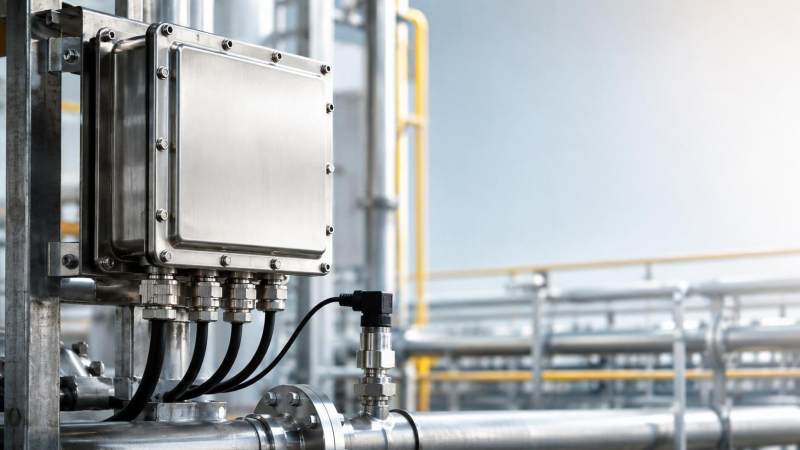
Common explosion-protection methods deal with this problem in different ways. A flameproof or explosion-proof enclosure is designed to contain an internal ignition and cool escaping gases through engineered flame paths. Increased-safety construction reduces the chance of arcs, excessive temperature, and loose connections during normal service. Intrinsic safety limits the electrical and thermal energy available in a circuit so that ignition should not occur under specified fault conditions. Pressurization keeps a protective gas inside an enclosure to prevent hazardous atmosphere from entering. Encapsulation, oil immersion, powder filling, and non-sparking concepts are used in other suitable applications.
These methods are not interchangeable. An intrinsically safe pressure transmitter, for example, depends on the complete loop: field device, associated apparatus or barrier, cable parameters, grounding arrangement where required, and documented control drawing. Replacing a barrier with a visually similar unit or extending cable length beyond the evaluated limits can invalidate the installation basis. A flameproof enclosure may tolerate an internal explosion, but opening it while energized in a hazardous location defeats the protection concept. Its threaded joints, bolts, seals, and flame paths must remain in the condition assumed by its approval.
Certification must match the marked conditions
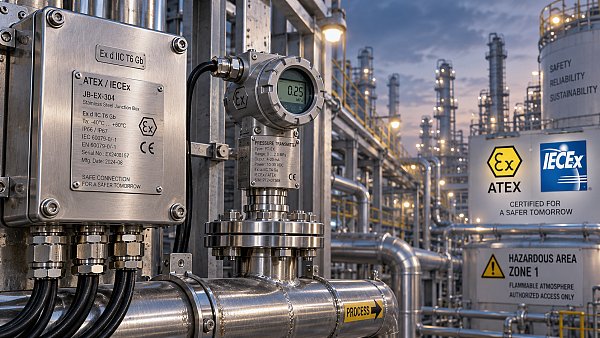
ATEX and IECEx markings are frequently used as evidence that electrical equipment has been assessed for explosive atmospheres. Their value lies in the details carried by the marking and supporting documentation, not in the presence of a logo alone. The certification must correspond to the location classification system, the type of explosive atmosphere, the protection technique, and the permitted operating conditions.
For gas and vapor locations, the equipment group and gas subgroup matter because gases differ in how easily they can be ignited and how an internal flame may propagate. Hydrogen and acetylene create more demanding conditions than many common hydrocarbon vapors. A device approved for a less demanding group cannot automatically be transferred to a location containing a more easily ignited gas.
Temperature classification deserves the same scrutiny. The maximum surface temperature of equipment must remain below the ignition temperature of the surrounding atmosphere with an appropriate margin as established by the applicable scheme and site requirements. The process temperature is not the only heat source. Solar radiation, poor ventilation, nearby hot piping, electrical loading, a blocked fan, or thick dust deposits may raise the external surface temperature. A unit that appears acceptable on a cool indoor datasheet can become unsuitable when mounted on an exposed vessel or inside a congested cabinet.
Dust approvals require attention to enclosure protection against dust ingress and to the maximum surface temperature under dust-covered conditions. A dust layer is not merely contamination. It can trap heat and alter the thermal behavior used during product evaluation. Housekeeping and mounting orientation therefore influence the continuing validity of the selection.
Material compatibility is a safety issue
A hazardous environment is often chemically aggressive as well as potentially explosive. Material selection must consider direct contact, splashing, fumes, cleaning agents, salt exposure, and the temperature at which the chemicals are encountered. Stainless steel is widely used, but it is not universally resistant. Chlorides can promote localized corrosion in certain conditions; strong acids, alkalis, solvents, or oxidizing agents may require different alloys, linings, polymers, elastomers, or ceramic components.
For process instrumentation, the wetted diaphragm, sensor body, impulse tubing, valve manifold, seal fill fluid, and O-rings may each have a different compatibility limit. A pressure transmitter can retain an intact external enclosure while its diaphragm gradually deteriorates. Similarly, an analyzer sample line can be explosion-protected electrically but still become unsafe if a chemically incompatible tube cracks and releases flammable material into an enclosed area.
Elastomers deserve careful attention because their behavior is often less obvious than metal corrosion. A seal may swell, harden, soften, lose compression, or permit permeation without an immediate visible leak. Temperature cycling accelerates many of these effects. Compatibility should be assessed against the full mixture and cleaning regime rather than the nominal primary chemical alone.
Process containment and mechanical limits
Hazardous-area suitability does not replace mechanical engineering requirements. A level switch mounted on a pressurized vessel must have adequate pressure containment, correct process connection, suitable gasket arrangement, and a design compatible with vibration and thermal expansion. Explosion protection addresses the surrounding atmosphere; it does not prove that the device can withstand the process pressure or prevent loss of containment.
Pressure ratings should be read in context. A stated maximum working pressure may apply at a specified temperature, with a particular connection type, under static rather than pulsating load. Pressure spikes, water hammer, pump pulsation, blocked outlets, and thermal expansion can produce transient loads beyond normal operating values. In a hazardous location, a leak from an overstressed instrument connection can create the very flammable release that the electrical protection was intended to manage.
Vibration and mechanical shock are also easy to underestimate. Repeated vibration can loosen terminal screws, fatigue tubing, damage cable terminations, disturb sensor calibration, and compromise sealing faces. Remote mounting, vibration-rated fittings, properly supported impulse lines, or a different measuring principle may be more appropriate than simply choosing a heavier enclosure.
Ingress protection and explosion protection answer different questions
Ingress protection ratings describe resistance to entry of solids and water under defined test conditions. They are useful when evaluating rain, washdown, dust exposure, or temporary immersion, but they do not establish protection against ignition. Conversely, an enclosure with a recognized explosion-protection concept may still have installation restrictions for water exposure, corrosion, cable orientation, or drain and breather arrangements.
A frequent error is to treat a high ingress-protection rating as a universal environmental rating. It does not indicate resistance to solvents, salt fog, ultraviolet radiation, steam, pressure washing at close range, or prolonged condensation inside an enclosure. Cable glands and blanking plugs must match the enclosure and the approved installation method. A correctly rated housing fitted with an unsuitable gland becomes a weak point for both water ingress and hazardous-area integrity.
Condensation can be especially troublesome in outdoor process units. Daily temperature swings draw moist air through imperfect seals, and water may collect on terminals or electronics. A sealed enclosure is not automatically immune, because pressure changes and cable pathways can create moisture routes. The design may need approved breathing or drainage provisions, environmental barriers, correctly specified glands, and placement that avoids direct water pooling.
Installation is part of the certified system
Equipment markings are meaningful only when the installed assembly follows the applicable instructions. Cable type, termination torque, conductor range, earthing point, conduit arrangement, gland type, stopping plugs, shielding method, and separation from non-intrinsically safe circuits all matter. Small deviations are common sources of nonconformance because they look minor compared with the device itself.
For intrinsically safe systems, loop documentation should identify the device parameters and the associated apparatus parameters, including voltage, current, power, capacitance, and inductance limits where applicable. The cable is not simply a connection: its capacitance and inductance contribute to the evaluated circuit. Field modifications should be reviewed against the approved system documentation before energization.
For enclosures using flameproof protection, damaged threads, altered joints, missing fasteners, non-original windows, and unauthorized machining can affect flame transmission performance. Applying paint to critical mating surfaces, inserting an unapproved gasket, or replacing a cable entry without maintaining the approved arrangement may change the construction in ways that are not visible during routine operation.
Reliability includes measurement performance
A device that remains electrically safe but produces unstable or inaccurate readings may still create a hazardous process condition. Temperature sensors exposed to thermal cycling can drift. Differential-pressure instruments can develop plugged impulse lines. Optical sensors may lose signal through coating, and conductivity probes can be affected by deposits or polarization. Alarm and shutdown functions need consideration of sensor failure modes, signal behavior on loss of power, and the response required by the process.
Environmental influences should be separated from process changes. A fluctuating flow signal might reflect a real process disturbance, but it may also result from vibration, poor grounding, moisture in a junction box, electromagnetic interference, or an unsuitable sensor location near a pump discharge. Treating every unstable reading as a process issue can delay the discovery of an installation problem.
Calibration also needs to reflect the installed condition. Bench calibration may confirm the electronics while missing errors caused by mounting stress, hydrostatic head, ambient temperature, impulse-line configuration, or sensor orientation. Where measurement supports a safety-related action, functional verification should confirm the entire sensing path rather than only the instrument display.
Maintenance preserves the original protection level
Hazardous-area equipment should be maintained with attention to the details that maintain its approved construction. Inspections commonly focus on physical damage, corrosion, loose fasteners, cracked windows, cable condition, gland tightness, unused entries, enclosure seals, grounding connections, and legibility of markings. The required inspection depth and interval depend on the installation, exposure, equipment type, and governing site procedures.
Replacement parts require particular discipline. A terminal block, gasket, fuse, display cover, battery, cable gland, or fastener that appears equivalent may have different temperature, mechanical, or certification characteristics. Repairs to flameproof joints, encapsulated assemblies, or intrinsically safe circuits should not be improvised. Restoring operation is different from restoring the equipment's original safety basis.
Suitability is best treated as a continuing condition rather than a one-time purchasing attribute. The correct equipment remains suitable when the hazardous-area classification, process medium, ambient limits, certified configuration, installation details, and maintenance condition continue to agree. When any of those conditions changes, the original selection should be reconsidered before the change becomes part of normal operation.
Recommended for You
 How to calculate cooling loads for an industrial analyzer shelterSize industrial analyzer shelter cooling with confidence. Learn to calculate equipment heat, solar gains, and ventilation loads, then select HVAC capacity for reliable analyzer performance.
 How Do You Handle Analyzer Failure During an Environmental Audit?Learn how to handle analyzer failure during environmental compliance audit procedures. Protect evidence, verify data, and restore monitoring with this practical response guide.
 Do VOC Monitors Require Explosion-Proof Certification?Does VOC monitoring require explosion-proof certification? Learn when approval is needed, compare ATEX and IECEx, and choose the right monitor for your site.
 How sample conditioning affects accuracy in petrochemical analyzersImprove accuracy in petrochemical analyzers with smarter sample conditioning. Discover how phase control, filtration, and transport design prevent bias and deliver reliable process data.
 How to troubleshoot sensor drift in industrial gas detectorsIndustrial gas detectors showing sensor drift? Learn how to verify calibration gas, identify root causes, and determine when sensor replacement is needed for reliable monitoring.
 How to judge whether a competitive price reflects real valueCompetitive Price: learn how to compare scope, compliance, performance, and lifecycle costs to identify real value, reduce risk, and make smarter purchasing decisions.
 When custom gas analysis is the right fit for complex process streamsCustom gas analysis for complex process streams: learn when tailored sampling, interference control, and reliable measurement design deliver confident decisions.
 When does a laser gas analyzer meet stack emissions monitoring needs?Laser gas analyzer for stack emissions: learn when it delivers fast, reliable data, how to assess installation risks, and what to verify for CEMS compliance.
 How to select a hazardous gas analyzer for confined spacesHazardous gas analyzer selection for confined spaces: compare sensors, sampling, certifications, alarms, and maintenance to protect workers and choose with confidence.
 When is a single gas analyzer sufficient for workplace safety monitoring?Discover when a single gas analyzer delivers reliable workplace safety monitoring, and learn the key limits, calibration needs, and risks that require broader detection.
 How to choose an ambient gas analyzer for low-level leak detectionAmbient gas analyzer selection for low-level leak detection: compare sensitivity, cross-sensitivity, sampling design, alarms, and calibration for reliable site performance.
 How to tell when an oxygen sensor needs replacementOxygen sensor replacement signs explained: learn how live data, fault codes, wiring checks, and exhaust inspections pinpoint the real issue before you buy.
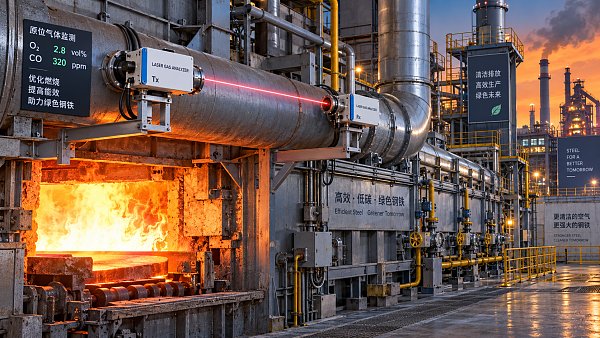
 How laser gas analyzers improve combustion control in steel furnacesLaser gas analyzer for steel industry applications delivers fast in-situ O₂ and CO data to optimize furnace combustion, cut fuel waste, and improve steel heating stability.
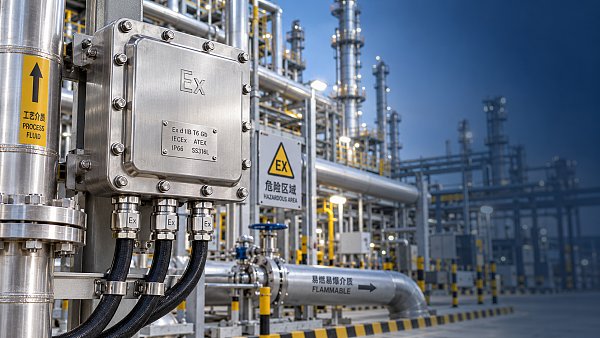
 How to verify whether explosion proof equipment meets site requirementsExplosion proof equipment verification made practical: match zones, gas or dust groups, temperature classes, certificates, and installation conditions for confident compliance.
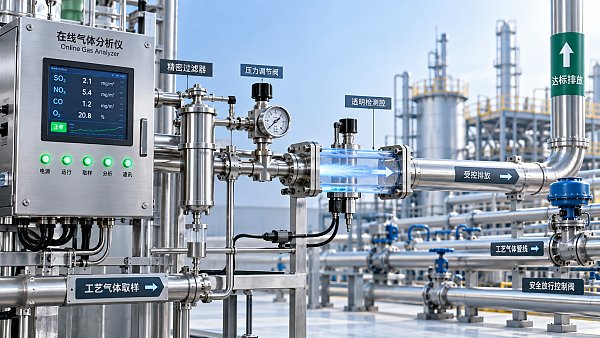
 How industrial gas analysis helps detect contamination before releaseIndustrial Gas Analysis helps detect moisture, oil, oxygen, and toxic contaminants before release—protecting processes, ensuring compliance, and reducing costly risks.
 When is electrochemistry detection the right choice for water analysis?Electrochemistry detection for water analysis: learn when fast, reliable monitoring of ions, chlorine, pH, and more delivers actionable results.
 How industrial standards reduce quality risks in supplier selectionIndustrial Standard guidance helps quality and safety managers reduce supplier risks, verify compliance, strengthen traceability, and build resilient instrumentation supply chains.
 When does a multi-component system reduce installation complexity?Multi component systems reduce installation complexity when they eliminate field interfaces, streamline commissioning, and provide proven compatibility. Learn how to assess total cost and supplier accountability.
 How to size an industrial control shelter for outdoor equipmentIndustrial control shelter sizing guide: optimize layout, HVAC, access, safety, and expansion space for reliable outdoor equipment operations.
 How flue analysis helps verify combustion efficiencyFlue analysis verifies combustion efficiency by assessing O2, CO, CO2, and stack temperature to identify excess air, incomplete combustion, and heat losses.
 How to select industrial gas detectors for confined spacesIndustrial gas detectors for confined spaces: learn how to match sensors, sampling methods, alarms, and certifications to real atmospheric hazards.
 When does a laser oxygen analyzer outperform zirconia sensors?Laser oxygen analyzer vs. zirconia sensors: compare speed, selectivity, maintenance, gas chemistry, and installation needs to choose the right oxygen measurement solution.
 How to select a percent range analyzer for process measurementsPercent range analyzer selection made practical: compare accuracy, sample systems, calibration, gas matrix, integration, and lifecycle cost for reliable process measurements.
 How explosion proof analysis verifies safe equipment for hazardous areasExplosion proof analysis verifies hazardous-area equipment by matching certifications, temperature ratings, installation details, and inspection controls for safer compliance.
 When does fixed gas detection need point sensors instead of open-path monitoring?Fixed gas detection: discover when point sensors outperform open-path monitoring for predictable leaks, enclosed zones, local alarms, and safer design decisions.
 How to choose industrial metrology systems for tight-tolerance partsIndustrial metrology guide for tight-tolerance parts: compare CMMs, optical scanners, gauges, uncertainty, workflow, and traceable inspection strategies.
 How process metrology reduces measurement variation in productionProcess metrology reduces production measurement variation by improving traceability, uncertainty control, calibration, and reliable quality decisions.
 How to select an industrial monitoring analyzer for harsh environmentsIndustrial monitoring analyzer selection for harsh environments: evaluate sampling, durability, hazardous-area compliance, accuracy, maintenance, and data reliability.
 How calibration intervals affect test and measurement equipment accuracyTest and measurement equipment calibration intervals directly affect accuracy, risk, compliance, and uptime. Learn how to set evidence-based schedules that protect critical decisions.
 When does process gas monitoring need continuous measurement?Process gas monitoring needs continuous measurement when rapid changes threaten safety, quality, compliance, or uptime. Learn how to specify reliable, actionable monitoring systems.
 How to prevent false alarms in power plant instrumentationPower plant instrumentation guide: prevent false alarms with reliable signal checks, smarter alarm settings, mode-based control, and actionable operator responses.
 How fixed gas detectors help prevent leaks in enclosed workspacesFixed gas detectors provide continuous leak monitoring in enclosed workspaces, enabling faster alarms, safer responses, and stronger protection for people and processes.
Search Categories
Search Categories
- Smart Meters & Power Quality
- Transformer Gas Analyzers
- BESS Thermal Runaway Detectors
- Energy, Power & Smart Grid Monitoring
- Optical Profilers & CMM
- Ultrasonic & X-Ray NDT
- Calibration Standards
- Precision Metrology & NDT
- Water Quality Analyzers
- CEMS & VOCs Monitors
- Price Trends
- Import & Export Updates
- Market Trends
- Industry News
- Industry Insights
Latest Article
- How to calculate cooling loads for an industrial analyzer shelterSize industrial analyzer shelter cooling with confidence. Learn to calculate equipment heat, solar gains, and ventilation loads, then select HVAC capacity for reliable analyzer performance.Posted by:
- How Do You Handle Analyzer Failure During an Environmental Audit?Learn how to handle analyzer failure during environmental compliance audit procedures. Protect evidence, verify data, and restore monitoring with this practical response guide.Posted by:
- Do VOC Monitors Require Explosion-Proof Certification?Does VOC monitoring require explosion-proof certification? Learn when approval is needed, compare ATEX and IECEx, and choose the right monitor for your site.Posted by:
Please give us a message
