
How flue analysis helps verify combustion efficiency


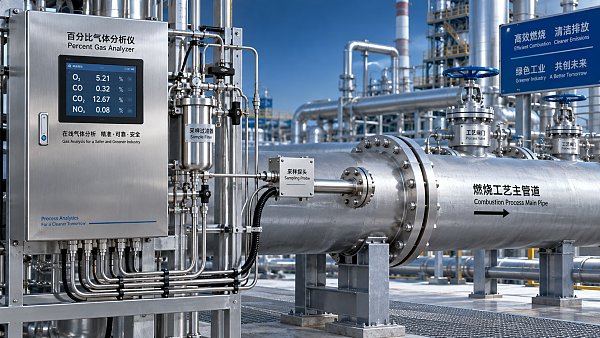
Flue analysis verifies combustion efficiency by testing whether the chemical evidence in the exhaust agrees with what a correctly tuned burner should produce. It does not measure fuel use directly, nor does it prove heat-transfer performance on its own. Its value lies in revealing the combustion conditions behind fuel consumption: excess air, oxygen starvation, incomplete oxidation, dilution, stack heat loss, and, in some cases, air leakage or unstable firing.
The most useful measurements are oxygen (O2), carbon monoxide (CO), carbon dioxide (CO2), and flue-gas temperature. Interpreted together, these readings indicate whether combustion air is close to the practical optimum for the fuel and appliance. A low O2 value is not automatically efficient; if CO rises at the same time, the burner may be short of air or mixing poorly. Conversely, zero or very low CO with excessively high O2 often means the burner is carrying unnecessary excess air, which increases the volume of hot gas leaving through the stack.
Combustion efficiency is a balance, not a single analyzer reading
Complete combustion requires enough oxygen to oxidize the combustible elements in the fuel. For a hydrocarbon fuel, the idealized reaction produces carbon dioxide and water:
CxHy + O2 → CO2 + H2O
In actual equipment, exactly stoichiometric operation is rarely a stable or safe target. Fuel and air do not mix perfectly; burner geometry, atomization quality, furnace pressure, load changes, and ambient conditions all create local zones with too little or too much oxygen. A controlled amount of excess air is therefore maintained to limit CO, unburned hydrocarbons, soot, and flame instability.
The engineering question is whether that excess air is necessary. Every additional unit of air entering the burner must be heated and discharged with the flue gas. If the air rate is too high, the system loses sensible heat through the stack. If it is too low, incomplete combustion produces CO and may create soot, deposits, flame safety issues, or unacceptable emissions. Flue analysis provides the evidence needed to locate the acceptable operating window between these two losses.
Combustion efficiency reported by a portable analyzer is generally a calculated figure rather than a direct calorimetric measurement. The calculation commonly estimates stack losses from flue-gas temperature, combustion-air temperature, O2 or CO2, and fuel-specific constants. It should therefore be described as combustion efficiency or flue-gas efficiency, not as total boiler, furnace, or process efficiency. Heat-transfer fouling, radiation loss, steam leakage, cycling loss, and downstream process losses can materially affect overall system performance even when the combustion result is good.
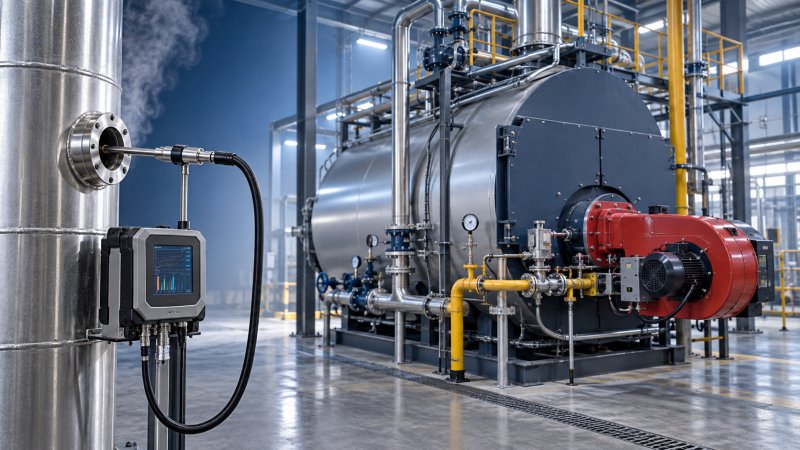
What each flue-gas variable actually proves
Oxygen is the primary excess-air indicator. Atmospheric air contains approximately 20.9% oxygen by volume. After combustion, residual O2 in the dry flue gas indicates that more air was supplied than the theoretical minimum, assuming the sample has not been diluted by leakage. Higher residual oxygen generally corresponds to higher excess air. The relationship is nonlinear and depends on the fuel and measurement basis, but the directional meaning is clear: rising O2 normally means more air is passing through the system.
O2 must never be interpreted in isolation. A high O2 reading can result from an over-open air damper, but it can also arise when ambient air leaks into a negative-pressure flue, when a sampling probe draws false air, or when the sample point is downstream of dilution air. In those cases, reducing combustion air based solely on the analyzer reading can push the burner toward unsafe low-air operation.
Carbon monoxide is the critical incomplete-combustion warning. CO forms when carbon-containing fuel is not fully oxidized to CO2. Elevated CO may indicate insufficient air, weak fuel-air mixing, poor atomization of liquid fuel, burner damage, unstable draft, flame impingement, recirculation, or an inappropriate burner setting for the firing rate. CO is often normalized to a reference oxygen concentration when used for emissions comparison, because measured concentration changes as flue gas is diluted by excess air.
A low CO reading is necessary but not sufficient evidence of good combustion. It is possible to suppress CO with very high excess air while still wasting energy. The meaningful result is a stable low CO level at the lowest practical excess-air setting allowed by burner design, operating load, safety requirements, and applicable emissions limits.
Carbon dioxide confirms the combustion-air relationship. As excess air falls, dry CO2 normally rises toward the theoretical maximum for the fuel. Natural gas, fuel oil, coal, biomass, and mixed fuels have different maximum CO2 values because their elemental compositions differ. For this reason, CO2 is useful only when the selected fuel in the analyzer calculation matches the actual fuel. A default setting for “natural gas” is unsuitable for biogas, refinery fuel gas, hydrogen blends, or fuels with variable composition unless the relevant properties are configured or the interpretation is adjusted.
Flue-gas temperature reveals stack heat loss, but only relative to inlet-air temperature. A stack at 180°C and a stack at 140°C cannot be compared meaningfully without knowing the combustion-air temperature, appliance duty, and whether dilution or heat recovery is present. The important value in a combustion calculation is usually the temperature rise between combustion air and flue gas. A high differential can indicate excessive stack loss, heat-exchanger fouling, damaged refractory, bypassing, inadequate heat transfer, or an operating condition for which the equipment was not designed. It does not automatically mean the burner is poorly adjusted.
The combined reading matters more than the individual number
A practical flue analysis assessment begins by looking for patterns rather than searching for a universal “good” oxygen percentage. Burner manuals, fuel specifications, appliance design, and local emissions conditions define the correct acceptance range.
The third condition is especially important in technical evaluation. Total excess air can appear adequate at the flue outlet while poor burner mixing creates oxygen-poor zones inside the flame. Those zones generate CO before secondary air can complete oxidation. Simply adding more air may lower CO, but it can also raise stack loss and obscure the root cause. Burner hardware condition and flame geometry should be assessed before treating excess air as the only control variable.
Sampling quality determines whether the calculation is credible
A precise analyzer cannot correct for an unrepresentative sample. The probe should be positioned in a location where flue gas is sufficiently mixed and where the sample is not affected by ambient-air ingress, stratification, or downstream dilution. In small appliance testing, the appropriate test port is often defined by the equipment design. In larger ducts and stacks, traverse requirements and sampling locations may be governed by the applicable emissions-testing method or site procedure.
The probe must reach the gas stream, not merely the wall boundary layer. Sampling at a cold wall can distort temperature and encourage condensation. If water condenses in the sample path, soluble gas components can be lost or altered; nitrogen dioxide and sulfur dioxide measurements are particularly sensitive to sampling-system design. For basic combustion tuning focused on O2, CO, and temperature, a clean probe, intact hose, functioning particulate filter, and properly maintained condensate trap remain essential.
Stabilization is equally important. Readings taken immediately after inserting the probe may reflect air in the line or a transient caused by opening a test port. Measurements should be recorded only after the analyzer response has stabilized and the appliance has reached a representative load condition. Modulating equipment should be assessed across its relevant firing range. A burner that performs acceptably at high fire can show elevated CO or excessive O2 at low fire if linkage, variable-speed control, fuel pressure, or draft changes are not correctly matched.
Dry basis, wet basis, and oxygen correction are not interchangeable
Flue-gas results are frequently miscompared because they are reported on different bases. Dry-basis measurements exclude water vapor, while wet-basis measurements include it. Since water vapor dilutes the other gas constituents, dry-basis O2, CO2, and pollutant concentrations differ from wet-basis values. Analyzer displays and emissions permits may use different conventions; the reporting basis must be stated before comparing results.
Similarly, a measured CO concentration is not necessarily comparable across operating conditions with different excess-air levels. Oxygen correction converts a measured concentration to a specified reference O2 condition. The general dry-gas relationship is:
Cref = Cmeas × (20.9 − O2,ref) / (20.9 − O2,meas)
where concentrations and oxygen values use consistent dry-volume units. The reference oxygen level is set by the relevant permit, regulation, or test method; it must not be selected merely to make results appear more favorable. Correction is useful for compliance comparison, but it does not replace diagnosing the actual combustion condition.
Instrument specifications and standards need to match the task
For portable combustion analyzers used on boilers, furnaces, and water heaters, EN 50379 is widely recognized in relevant markets as a standard series covering requirements and test methods for portable electrical equipment used to measure combustion flue-gas parameters. The appropriate part and performance class depend on the intended use, including whether the instrument supports commissioning, maintenance, or statutory inspection activity. Where a jurisdiction requires a specific analyzer approval, installer certification, or documented calibration practice, that local requirement takes precedence.
Technical evaluation should examine more than the headline gas ranges. Useful questions include sensor type and expected cross-sensitivities; CO measurement range and overload protection; stated accuracy under field conditions; pump flow and leak-test capability; temperature-probe rating; condensate management; data logging; and the ability to document zeroing, calibration status, and maintenance. Electrochemical sensors have finite service lives and can be affected by exposure history. An analyzer with a recent calibration certificate is valuable, but calibration does not eliminate the need for pre-use checks, clean sampling components, correct zeroing in fresh air where specified, and periodic verification with traceable test gases where the quality system requires it.
For continuous emissions monitoring or regulated source testing, portable flue analysis is not automatically equivalent to compliance-grade measurement. Applicable permit conditions, national methods, and quality-assurance requirements determine the measurement system, calibration protocol, data availability, and reporting basis. Portable analysis remains highly useful for tuning, troubleshooting, maintenance verification, and screening, but its intended decision must be defined before treating its output as compliance evidence.
Using flue analysis to verify an adjustment
A defensible tuning record compares stable before-and-after conditions rather than relying on a single “best” display value. It identifies the fuel, firing rate or load, combustion-air temperature, flue-gas temperature, O2, CO, calculated combustion efficiency, analyzer identification, calibration status, and sampling location. If draft, fuel pressure, ambient conditions, or process demand changed materially between readings, that should be recorded because the comparison may no longer represent the adjustment alone.
The strongest verification is not the highest calculated efficiency. It is a repeatable operating condition in which CO remains controlled, flame behavior is stable, oxygen remains within the burner manufacturer’s acceptable range, and the stack-loss calculation is consistent with equipment condition. When O2 and CO indicate satisfactory combustion but calculated efficiency remains weak, the next investigation should shift from burner adjustment to heat-transfer surfaces, flue-path integrity, insulation, refractory, economizer performance, and operating cycle.
Flue analysis turns combustion from a visual judgment into a traceable technical assessment. Used with correct sampling, fuel settings, reporting basis, and equipment-specific limits, it distinguishes excessive air from incomplete combustion and burner problems from downstream thermal losses. That distinction is what makes the measurement useful: it prevents an apparently simple damper adjustment from becoming a safety, emissions, or reliability problem.
Recommended for You
 How to verify accuracy claims for industrial quality analyzersVerify accuracy claims for industrial quality analyzers with calibration checks, independent testing, and clear acceptance criteria. Learn how to reduce risk and buy with confidence.
 How to calculate cooling loads for an industrial analyzer shelterSize industrial analyzer shelter cooling with confidence. Learn to calculate equipment heat, solar gains, and ventilation loads, then select HVAC capacity for reliable analyzer performance.
 How Do You Handle Analyzer Failure During an Environmental Audit?Learn how to handle analyzer failure during environmental compliance audit procedures. Protect evidence, verify data, and restore monitoring with this practical response guide.
 Do VOC Monitors Require Explosion-Proof Certification?Does VOC monitoring require explosion-proof certification? Learn when approval is needed, compare ATEX and IECEx, and choose the right monitor for your site.
 How sample conditioning affects accuracy in petrochemical analyzersImprove accuracy in petrochemical analyzers with smarter sample conditioning. Discover how phase control, filtration, and transport design prevent bias and deliver reliable process data.
 How to troubleshoot sensor drift in industrial gas detectorsIndustrial gas detectors showing sensor drift? Learn how to verify calibration gas, identify root causes, and determine when sensor replacement is needed for reliable monitoring.
 How to judge whether a competitive price reflects real valueCompetitive Price: learn how to compare scope, compliance, performance, and lifecycle costs to identify real value, reduce risk, and make smarter purchasing decisions.
 When custom gas analysis is the right fit for complex process streamsCustom gas analysis for complex process streams: learn when tailored sampling, interference control, and reliable measurement design deliver confident decisions.
 When does a laser gas analyzer meet stack emissions monitoring needs?Laser gas analyzer for stack emissions: learn when it delivers fast, reliable data, how to assess installation risks, and what to verify for CEMS compliance.
 How to select a hazardous gas analyzer for confined spacesHazardous gas analyzer selection for confined spaces: compare sensors, sampling, certifications, alarms, and maintenance to protect workers and choose with confidence.
 When is a single gas analyzer sufficient for workplace safety monitoring?Discover when a single gas analyzer delivers reliable workplace safety monitoring, and learn the key limits, calibration needs, and risks that require broader detection.
 How to choose an ambient gas analyzer for low-level leak detectionAmbient gas analyzer selection for low-level leak detection: compare sensitivity, cross-sensitivity, sampling design, alarms, and calibration for reliable site performance.
 How to tell when an oxygen sensor needs replacementOxygen sensor replacement signs explained: learn how live data, fault codes, wiring checks, and exhaust inspections pinpoint the real issue before you buy.
 How laser gas analyzers improve combustion control in steel furnacesLaser gas analyzer for steel industry applications delivers fast in-situ O₂ and CO data to optimize furnace combustion, cut fuel waste, and improve steel heating stability.
 How to verify whether explosion proof equipment meets site requirementsExplosion proof equipment verification made practical: match zones, gas or dust groups, temperature classes, certificates, and installation conditions for confident compliance.
 How industrial gas analysis helps detect contamination before releaseIndustrial Gas Analysis helps detect moisture, oil, oxygen, and toxic contaminants before release—protecting processes, ensuring compliance, and reducing costly risks.
 When is electrochemistry detection the right choice for water analysis?Electrochemistry detection for water analysis: learn when fast, reliable monitoring of ions, chlorine, pH, and more delivers actionable results.
 How industrial standards reduce quality risks in supplier selectionIndustrial Standard guidance helps quality and safety managers reduce supplier risks, verify compliance, strengthen traceability, and build resilient instrumentation supply chains.
 When does a multi-component system reduce installation complexity?Multi component systems reduce installation complexity when they eliminate field interfaces, streamline commissioning, and provide proven compatibility. Learn how to assess total cost and supplier accountability.
 How to size an industrial control shelter for outdoor equipmentIndustrial control shelter sizing guide: optimize layout, HVAC, access, safety, and expansion space for reliable outdoor equipment operations.
 How flue analysis helps verify combustion efficiencyFlue analysis verifies combustion efficiency by assessing O2, CO, CO2, and stack temperature to identify excess air, incomplete combustion, and heat losses.
 How to select industrial gas detectors for confined spacesIndustrial gas detectors for confined spaces: learn how to match sensors, sampling methods, alarms, and certifications to real atmospheric hazards.
 When does a laser oxygen analyzer outperform zirconia sensors?Laser oxygen analyzer vs. zirconia sensors: compare speed, selectivity, maintenance, gas chemistry, and installation needs to choose the right oxygen measurement solution.
 How to select a percent range analyzer for process measurementsPercent range analyzer selection made practical: compare accuracy, sample systems, calibration, gas matrix, integration, and lifecycle cost for reliable process measurements.
 How explosion proof analysis verifies safe equipment for hazardous areasExplosion proof analysis verifies hazardous-area equipment by matching certifications, temperature ratings, installation details, and inspection controls for safer compliance.
 When does fixed gas detection need point sensors instead of open-path monitoring?Fixed gas detection: discover when point sensors outperform open-path monitoring for predictable leaks, enclosed zones, local alarms, and safer design decisions.
 How to choose industrial metrology systems for tight-tolerance partsIndustrial metrology guide for tight-tolerance parts: compare CMMs, optical scanners, gauges, uncertainty, workflow, and traceable inspection strategies.
 How process metrology reduces measurement variation in productionProcess metrology reduces production measurement variation by improving traceability, uncertainty control, calibration, and reliable quality decisions.
 How to select an industrial monitoring analyzer for harsh environmentsIndustrial monitoring analyzer selection for harsh environments: evaluate sampling, durability, hazardous-area compliance, accuracy, maintenance, and data reliability.
 How calibration intervals affect test and measurement equipment accuracyTest and measurement equipment calibration intervals directly affect accuracy, risk, compliance, and uptime. Learn how to set evidence-based schedules that protect critical decisions.
 When does process gas monitoring need continuous measurement?Process gas monitoring needs continuous measurement when rapid changes threaten safety, quality, compliance, or uptime. Learn how to specify reliable, actionable monitoring systems.
 How to prevent false alarms in power plant instrumentationPower plant instrumentation guide: prevent false alarms with reliable signal checks, smarter alarm settings, mode-based control, and actionable operator responses.




Search Categories
Search Categories
- Smart Meters & Power Quality
- Transformer Gas Analyzers
- BESS Thermal Runaway Detectors
- Energy, Power & Smart Grid Monitoring
- Optical Profilers & CMM
- Ultrasonic & X-Ray NDT
- Calibration Standards
- Precision Metrology & NDT
- Water Quality Analyzers
- CEMS & VOCs Monitors
- Price Trends
- Import & Export Updates
- Market Trends
- Industry News
- Industry Insights
Latest Article
- How to verify accuracy claims for industrial quality analyzersVerify accuracy claims for industrial quality analyzers with calibration checks, independent testing, and clear acceptance criteria. Learn how to reduce risk and buy with confidence.Posted by:
- How to calculate cooling loads for an industrial analyzer shelterSize industrial analyzer shelter cooling with confidence. Learn to calculate equipment heat, solar gains, and ventilation loads, then select HVAC capacity for reliable analyzer performance.Posted by:
- How Do You Handle Analyzer Failure During an Environmental Audit?Learn how to handle analyzer failure during environmental compliance audit procedures. Protect evidence, verify data, and restore monitoring with this practical response guide.Posted by:
Please give us a message
