
What certification should you verify before buying an IECEx analyzer?


An IECEx analyzer should be accepted only after its IECEx Certificate of Conformity (CoC) has been verified against the exact equipment configuration, hazardous-area classification, protection concept, and installation conditions. A logo on a datasheet, an “Ex-proof” statement, or a certificate belonging to a related product family is not enough.
The most important document is the equipment CoC issued through the IECEx Certification System by an approved IECEx Certification Body (ExCB). It establishes that a defined product has been assessed to specified IEC standards for explosive atmospheres. Yet the certificate is only the starting point: its marking, conditions of certification, referenced standards, manufacturer details, and scope must all match the analyzer that will actually be installed.
The document that matters most: IECEx Certificate of Conformity
Before buying an IECEx analyzer, request the full IECEx CoC number and verify it in the official IECEx online certificate database. A legitimate certificate normally identifies the manufacturer, product type, model or series, applicable standards, protection marking, ambient-temperature limits, and any special conditions for safe use.
The critical question is not whether a supplier can show an IECEx certificate. It is whether the certificate covers the exact analyzer being offered, including its enclosure, power arrangement, display, communication ports, probe or sample interface, battery pack where applicable, and optional modules.
Analyzers are frequently supplied as configurable systems rather than as a single sealed instrument. A gas analyzer may include a field enclosure, sample probe, heated line, conditioning cabinet, pump, calibration-gas connection, display unit, remote I/O, and communication gateway. Certification coverage can differ across those items. An IECEx certificate for the main analyzer electronics does not automatically certify the complete skid, shelter, sampling assembly, or external accessories.
A valid verification should therefore compare the purchase specification with the certificate’s stated type designation. Differences that deserve immediate clarification include:
- Different suffixes, hardware revisions, enclosure sizes, or display options;
- Alternative power supplies or voltage ranges;
- Wireless, Ethernet, serial, fiber, USB, or service-port additions;
- Battery-operated versus externally powered versions;
- Separate sample-conditioning or purge systems;
- Field-installed sensors, probes, junction boxes, and cable glands;
- Third-party components assembled into a supplier’s package.
A broad-looking product name is not proof of broad certification scope. The certificate’s model designation and description control the scope, not a sales quotation or catalogue illustration.
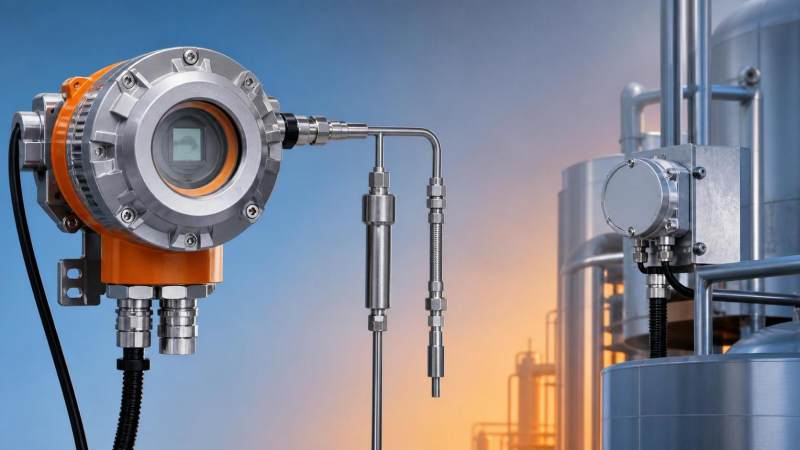
Read the Ex marking as an application boundary
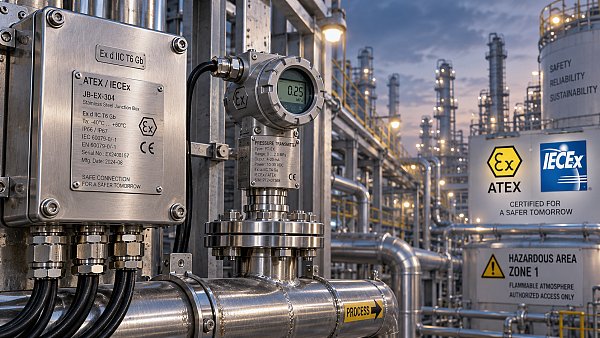
The Ex marking on the certificate and equipment label is the operational boundary of the certification. It shows what type of explosive atmosphere the analyzer is designed to address and under what constraints. A technical review should not treat the marking as a generic safety badge.
A common marking might include elements such as Ex db IIC T4 Gb or Ex ia IIC T4 Ga. Each part carries a decision-relevant meaning.
For example, an analyzer marked for Gb is generally intended for Zone 1 or Zone 2 gas hazardous areas, while an analyzer marked Gc is intended for Zone 2 only. A product acceptable in a Zone 2 cabinet should not be assumed suitable for a Zone 1 process area. The same discipline applies to dust zones: Da, Db, and Dc correspond to different levels of protection for Zones 20, 21, and 22.
Temperature classification requires particular care with analyzers because internal heat sources can be substantial. Heated sample lines, ovens, optical benches, pumps, laser modules, power converters, and environmental heaters can affect the protection concept. The relevant certificate may specify a temperature class only within a stated ambient-temperature range. If the installation site exceeds that range, the marking cannot simply be carried over unchanged.
Check the standards named on the certificate, not only the word “IECEx”
IECEx certification is built around applicable IEC 60079 series standards and, for dust-related protection, often IEC 60079-31 or other relevant parts of the series. IEC 60079-0 provides general requirements; the additional standard depends on the protection method used.
Typical examples include IEC 60079-1 for flameproof enclosures, IEC 60079-7 for increased safety, IEC 60079-11 for intrinsic safety, IEC 60079-18 for encapsulation, IEC 60079-2 for pressurization, and IEC 60079-31 for protection by enclosure for dust. The certificate should identify the editions used for assessment.
This is not a purely administrative detail. The protection method determines whether the site must manage purge gas, verify enclosure pressure, preserve flamepath integrity, control cable-gland selection, or maintain intrinsic-safety separation. An analyzer with Ex p protection, for instance, depends on a pressurization system operating as specified; certification does not remove the need to engineer and maintain that system correctly.
Where a project specification calls for a particular edition of IEC 60079 or has been written around a national adoption of the standard, the certificate should be reviewed against that requirement. A certificate to earlier standards is not necessarily unacceptable, but the project owner, authority having jurisdiction, or local regulation may impose additional conditions.
Special conditions for safe use are part of the certification
The most consequential text on an IECEx CoC is often found in the certificate schedule or in “Conditions of Certification,” sometimes reflected by an X suffix in the certificate number. An X indicates that special conditions for safe use apply. It does not mean the equipment is defective or unsuitable. It means the analyzer can be used safely only when those stated conditions are fulfilled.
Such conditions may require a particular cable type, a restricted ambient range, UV protection for a non-metallic enclosure, limitations on external cleaning, specific fastener grades, controlled electrostatic charging, shielding from impact, or restrictions on gland types. For an analyzer system, they may also define how remote sensor heads, purge systems, optical windows, or external terminals must be installed.
These conditions need to become procurement and installation requirements, not remain as unread certificate text. A purchase order should preserve the certified configuration, and the installation package should include the relevant conditions alongside drawings, wiring schedules, and maintenance instructions.
A U suffix requires a different response. It indicates an Ex component certificate rather than a complete item of equipment. An Ex component may be suitable for incorporation into certified equipment, but it is not by itself evidence that the finished analyzer assembly is certified for installation in a hazardous area. This distinction is especially important when suppliers integrate certified enclosures, terminals, glands, or modules into a custom analyzer cabinet.
Intrinsic safety requires a system-level check
Portable analyzers, remote probes, detector heads, and low-power field interfaces are often based on intrinsic safety. In these arrangements, the certification of the analyzer alone does not complete the safety assessment. The connected circuit must remain within the electrical parameters permitted by the certified apparatus.
Review the certificate and instructions for the relevant entity parameters: maximum input voltage, current, power, and allowable external capacitance and inductance. The associated apparatus—such as an isolator, barrier, power supply, or safe-area interface—must be compatible. Cable length and cable characteristics can affect the calculation. A replacement battery, probe, charger, or communication adapter may also fall outside the certified arrangement if it is not specifically approved.
“Intrinsically safe” should therefore not be used as a blanket description for every connected part of an analyzer package. The protection applies to defined circuits under defined installation conditions. A technically capable instrument can lose compliance when an uncertified accessory is substituted or when field wiring exceeds the documented limits.
Do not confuse IECEx with ATEX, CE marking, or laboratory accreditation
IECEx and ATEX both address equipment for explosive atmospheres, and their technical foundations often overlap. They are not interchangeable legal labels. ATEX is a European Union regulatory framework, while IECEx is an international certification system. An IECEx CoC may support an assessment route in some commercial or regulatory contexts, but it does not automatically satisfy every jurisdiction’s market-access rules.
Where equipment will be placed on the EU market, the required ATEX conformity documentation and marking must be assessed separately. Conversely, an ATEX certificate does not automatically demonstrate that the product holds an IECEx CoC. Countries may also have local approval, registration, inspection, or installation requirements beyond either scheme.
ISO/IEC 17025 accreditation is another separate issue. It concerns the competence of testing and calibration laboratories; it is not an explosion-protection certificate for an analyzer. Likewise, CE marking can cover several EU directives or regulations but is not, by itself, proof that an analyzer is certified for a specified hazardous zone.
Verify the certification chain behind the product
The IECEx CoC is supported by an IECEx Test Report (ExTR) and a Quality Assessment Report (QAR). The ExTR records the technical assessment and testing supporting the certification. It is not usually a public procurement document, but a supplier should be able to explain the certified protection concept and provide appropriate supporting documentation where contractual review requires it.
The QAR addresses the manufacturer’s quality system for producing Ex equipment, commonly in relation to ISO/IEC 80079-34 requirements. Its importance is practical: explosion protection depends not only on an approved design but on controlled production of that design. The manufacturer named on the CoC and the manufacturing arrangement should be consistent with the product being supplied.
Questions arise when a trading company offers an analyzer under a private label, when manufacturing has moved, or when a product is assembled in a different facility from the certificate holder’s stated arrangement. These situations do not automatically invalidate certification, but they require traceability. The supplied nameplate, serial number, manufacturer identity, certificate reference, and technical file should form a coherent chain.
Certificate validity is not the same as product equivalence
A certificate found in the IECEx database should be checked for its current status, issue date, and revision history. A replacement certificate or variation may supersede an earlier version. The product delivered should correspond to the current certified design, not merely to an archived catalogue entry.
At goods receipt, retain photographs of the Ex nameplate, serial number, certificate number, marking, and ambient-temperature rating. Compare these details with the approved submittal and certificate. This is useful because hazardous-area compliance is frequently weakened by apparently minor substitutions: a different gland, enclosure window, battery, cable entry, connector, or field-replaceable sensor.
Maintenance deserves the same discipline. Explosion-protected equipment must be repaired and modified in ways that preserve its certified design. Re-machining a flameproof joint, drilling an additional cable entry, replacing a window with a non-approved material, or altering a pressurized enclosure can invalidate the basis on which the analyzer was certified.
A defensible approval decision
An IECEx analyzer is ready for technical approval when the official CoC covers the exact offered configuration; the Ex marking matches the hazardous-area zone, material group, and temperature requirement; all X conditions can be implemented; connected circuits and accessories remain within certified limits; and the project’s local legal requirements are separately satisfied.
The certificate is not merely a document to attach to a vendor file. It defines the analyzer’s permissible safety envelope. Reading that envelope with the same care applied to measurement range, response time, detection limit, or sample compatibility is what prevents a certified instrument from becoming an uncertified installation.
Recommended for You
 How to judge whether a competitive price reflects real valueCompetitive Price: learn how to compare scope, compliance, performance, and lifecycle costs to identify real value, reduce risk, and make smarter purchasing decisions.
 When custom gas analysis is the right fit for complex process streamsCustom gas analysis for complex process streams: learn when tailored sampling, interference control, and reliable measurement design deliver confident decisions.
 When does a laser gas analyzer meet stack emissions monitoring needs?Laser gas analyzer for stack emissions: learn when it delivers fast, reliable data, how to assess installation risks, and what to verify for CEMS compliance.
 How to select a hazardous gas analyzer for confined spacesHazardous gas analyzer selection for confined spaces: compare sensors, sampling, certifications, alarms, and maintenance to protect workers and choose with confidence.
 When is a single gas analyzer sufficient for workplace safety monitoring?Discover when a single gas analyzer delivers reliable workplace safety monitoring, and learn the key limits, calibration needs, and risks that require broader detection.
 How to choose an ambient gas analyzer for low-level leak detectionAmbient gas analyzer selection for low-level leak detection: compare sensitivity, cross-sensitivity, sampling design, alarms, and calibration for reliable site performance.
 How to tell when an oxygen sensor needs replacementOxygen sensor replacement signs explained: learn how live data, fault codes, wiring checks, and exhaust inspections pinpoint the real issue before you buy.
 How laser gas analyzers improve combustion control in steel furnacesLaser gas analyzer for steel industry applications delivers fast in-situ O₂ and CO data to optimize furnace combustion, cut fuel waste, and improve steel heating stability.
 How to verify whether explosion proof equipment meets site requirementsExplosion proof equipment verification made practical: match zones, gas or dust groups, temperature classes, certificates, and installation conditions for confident compliance.
 How industrial gas analysis helps detect contamination before releaseIndustrial Gas Analysis helps detect moisture, oil, oxygen, and toxic contaminants before release—protecting processes, ensuring compliance, and reducing costly risks.
 When is electrochemistry detection the right choice for water analysis?Electrochemistry detection for water analysis: learn when fast, reliable monitoring of ions, chlorine, pH, and more delivers actionable results.
 How industrial standards reduce quality risks in supplier selectionIndustrial Standard guidance helps quality and safety managers reduce supplier risks, verify compliance, strengthen traceability, and build resilient instrumentation supply chains.
 When does a multi-component system reduce installation complexity?Multi component systems reduce installation complexity when they eliminate field interfaces, streamline commissioning, and provide proven compatibility. Learn how to assess total cost and supplier accountability.
 How to size an industrial control shelter for outdoor equipmentIndustrial control shelter sizing guide: optimize layout, HVAC, access, safety, and expansion space for reliable outdoor equipment operations.
 How flue analysis helps verify combustion efficiencyFlue analysis verifies combustion efficiency by assessing O2, CO, CO2, and stack temperature to identify excess air, incomplete combustion, and heat losses.
 How to select industrial gas detectors for confined spacesIndustrial gas detectors for confined spaces: learn how to match sensors, sampling methods, alarms, and certifications to real atmospheric hazards.
 When does a laser oxygen analyzer outperform zirconia sensors?Laser oxygen analyzer vs. zirconia sensors: compare speed, selectivity, maintenance, gas chemistry, and installation needs to choose the right oxygen measurement solution.
 How to select a percent range analyzer for process measurementsPercent range analyzer selection made practical: compare accuracy, sample systems, calibration, gas matrix, integration, and lifecycle cost for reliable process measurements.
 How explosion proof analysis verifies safe equipment for hazardous areasExplosion proof analysis verifies hazardous-area equipment by matching certifications, temperature ratings, installation details, and inspection controls for safer compliance.
 When does fixed gas detection need point sensors instead of open-path monitoring?Fixed gas detection: discover when point sensors outperform open-path monitoring for predictable leaks, enclosed zones, local alarms, and safer design decisions.
 How to choose industrial metrology systems for tight-tolerance partsIndustrial metrology guide for tight-tolerance parts: compare CMMs, optical scanners, gauges, uncertainty, workflow, and traceable inspection strategies.
 How process metrology reduces measurement variation in productionProcess metrology reduces production measurement variation by improving traceability, uncertainty control, calibration, and reliable quality decisions.
 How to select an industrial monitoring analyzer for harsh environmentsIndustrial monitoring analyzer selection for harsh environments: evaluate sampling, durability, hazardous-area compliance, accuracy, maintenance, and data reliability.
 How calibration intervals affect test and measurement equipment accuracyTest and measurement equipment calibration intervals directly affect accuracy, risk, compliance, and uptime. Learn how to set evidence-based schedules that protect critical decisions.
 When does process gas monitoring need continuous measurement?Process gas monitoring needs continuous measurement when rapid changes threaten safety, quality, compliance, or uptime. Learn how to specify reliable, actionable monitoring systems.
 How to prevent false alarms in power plant instrumentationPower plant instrumentation guide: prevent false alarms with reliable signal checks, smarter alarm settings, mode-based control, and actionable operator responses.
 How fixed gas detectors help prevent leaks in enclosed workspacesFixed gas detectors provide continuous leak monitoring in enclosed workspaces, enabling faster alarms, safer responses, and stronger protection for people and processes.
 How industrial gas analysis helps detect process contamination earlyIndustrial Gas Analysis helps detect oxygen, moisture, and hydrocarbon contamination early, enabling faster fault isolation, safer operations, and stronger process control.
 What drives environmental compliance continuous monitoring setup cost?Environmental compliance continuous monitoring setup cost: uncover hidden expenses, compare bids accurately, and build a reliable, audit-ready system.
 How to select gas analysis equipment for continuous emissions monitoringGas analysis equipment selection guide for reliable continuous emissions monitoring—compare technologies, sampling, calibration, compliance, and maintenance needs.
 What detection limit is needed for NH3 environmental monitoring?High accuracy NH3 analyzer for environmental monitoring: learn how to set the right detection limit, improve sampling reliability, and make defensible decisions.
 How to select a NOX analyzer for power plant emissions complianceNOX analyzer for power plant emissions: learn how to select a compliant, reliable CEMS solution with the right range, sample handling, calibration, and data integrity.







Search Categories
Search Categories
- Smart Meters & Power Quality
- Transformer Gas Analyzers
- BESS Thermal Runaway Detectors
- Energy, Power & Smart Grid Monitoring
- Optical Profilers & CMM
- Ultrasonic & X-Ray NDT
- Calibration Standards
- Precision Metrology & NDT
- Water Quality Analyzers
- CEMS & VOCs Monitors
- Price Trends
- Import & Export Updates
- Market Trends
- Industry News
- Industry Insights
Latest Article
- How to judge whether a competitive price reflects real valueCompetitive Price: learn how to compare scope, compliance, performance, and lifecycle costs to identify real value, reduce risk, and make smarter purchasing decisions.Posted by:
- When custom gas analysis is the right fit for complex process streamsCustom gas analysis for complex process streams: learn when tailored sampling, interference control, and reliable measurement design deliver confident decisions.Posted by:
- When does a laser gas analyzer meet stack emissions monitoring needs?Laser gas analyzer for stack emissions: learn when it delivers fast, reliable data, how to assess installation risks, and what to verify for CEMS compliance.Posted by:
Please give us a message
